The life and legacy of the College’s beloved goose, Jorge

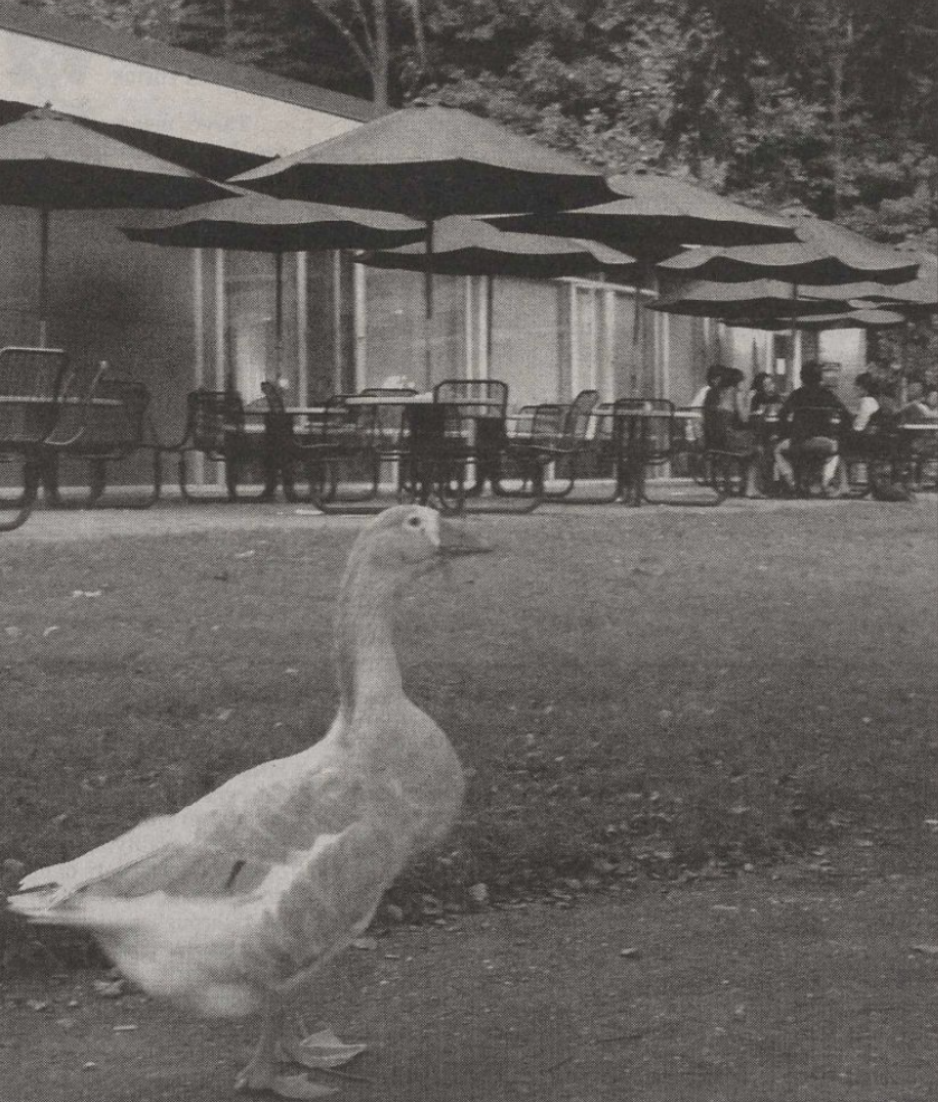
Photo by Caitlin Healey ’09

This is the first known photograph of Jorge the goose to have been printed in Mount Holyoke News.

By Madeleine Diesl ’28

Science & Environment Editor

On Dec. 9, 2024, tragedy struck Mount Holyoke College: Jorge, the campus goose, flew into a Blanchard Hall window and died. Jorge was a feral Pilgrim goose who frequented Lower Lake, but his legacy was much more than that: He was the unofficial mascot of LITS and a large part of the student culture at Mount Holyoke for several decades. Now, a year after this dreadful event, we can remember Jorge by his many appearances in the College’s digital archives, particularly in past Mount Holyoke News articles.

In the Nov. 11, 2004 issue of MHN, Rachael Robins ’07 claimed that they liked to “feed the goose granola from [their] own mouth,” perhaps referring to Jorge. A year later, in the Sept. 29, 2005 issue, Katie Adler ’08 wrote an article detailing a day in the life of the “Mangled Goose,” which is described as having a “strong and thick orange beak” and “[lurking] along the shoreline near Prospect [Hall], stalking its next victim.” Though he remains unnamed, it can only be assumed that Adler is describing Jorge. 

One of the first references to Jorge by his name, “Jorge,” appears to be in the 2007 April Fool's issue, in a joke article by “Anonymous Samanta ’10” about him relocating from Lower Lake to Wilder Hall. However, the writer also refers to him as “Hubert,” a name that never shows up elsewhere in the digital archives. In fact, over the course of the past 20 years, Jorge has been called “Hubert,” the “Mangled Goose,” the “Prospect Goose,” the “Lower Lake Goose,” and even the “Big White Ugly” in a photo caption in the Sept. 18, 2008 issue. This photo, which depicts Jorge walking next to an outdoor dining area, is actually the earliest known photograph of Jorge in an MHN article. 

Current students have a lot to say about Jorge, as well. When asked about his death, Yan Hernandez ’28 said, “Jorge has left an intersex grey pilgrim goose shaped hole in my heart. I miss seeing him lord over Lower Lake and eating bugs in the grass. He was truly the best of us. #Latinopride.” 

Amy Gingras ’28 referenced the fictional character Eggman from one of SnapCube’s Sonic the Hedgehog fan dubs on YouTube:  “I miss my goose. I miss him a lot. I’ll be back.” 

Missing Jorge’s presence has been a common theme amongst students, as Nicole Lasko ’28 commented: “He was well loved and he is universally missed … there's never going to be another like him.”

If you’re interested in learning more about Jorge and Mount Holyoke News’s history in general, pay a visit to the Five College digital archives website or Mount Holyoke’s Archives and Special Collections and search for the Mount Holyoke College student newspaper collection – the yearly April 1st articles are particularly entertaining!

Quill Nishi-Leonard ’27 contributed fact-checking.

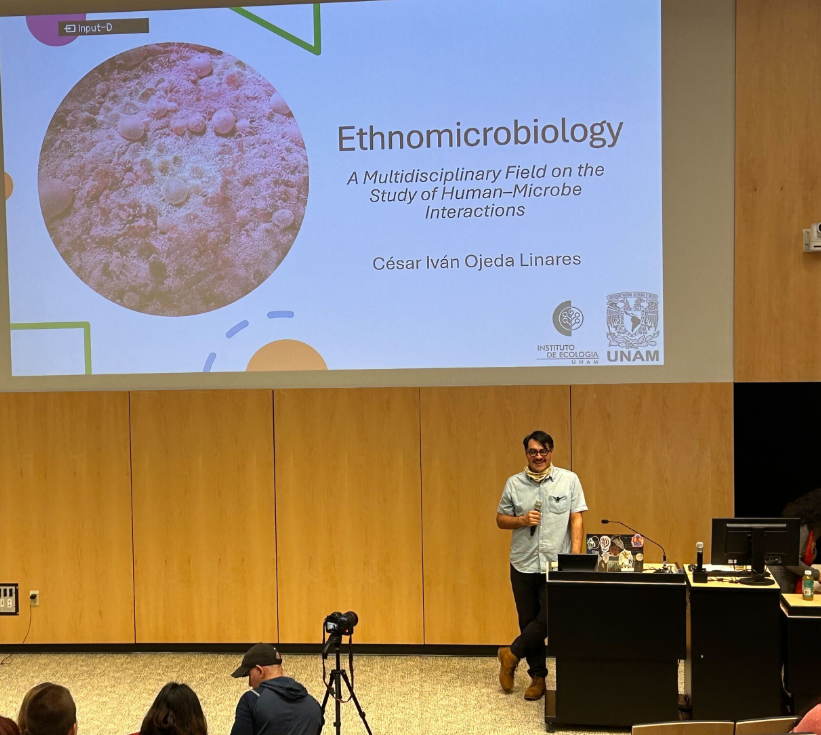
Dr. Ojeda Linares discusses ethnomicrobiology in Nov. 11 lecture

Photo by Angelina Godinez ‘28

Dr. Ojeda Linares traveled to Mount Holyoke College to deliver a guest lecture on ethnomicrobiology in Gamble Auditorium.

BY ANGELINA GODINEZ ‘28

MANAGING EDITOR OF SOCIAL MEDIA

On Nov. 11, Mount Holyoke College’s Department of Critical Race and Political Economy hosted ethnographic microbiologist Dr. César Iván Ojeda Linares to deliver a unique lecture on ethnomicrobiology and cultural preservation of traditional and indigenous fermentation practices. Ojeda Linares is a recent Ph.D. graduate from the National Autonomous University of Mexico who promotes traditional fermentation techniques throughout Mexico through a mix of ethnography and microbiology. 

The lecture began with Visiting Professor of Critical Race and Political Economy, Pilar Egüez Guevara, introducing Ojeda Linares and discussing how this lecture connects to her course, Latinx Foodways, where students are encouraged to think of cultural food production and consumption. Through Ojeda Linares’ ethnographic work and effort to preserve cultural practices from big pharmaceutical companies, students get to learn the cultural consequences of micropiracy and the capitalization of traditional fermented drinks such as kombucha and colonche. 

Fermentation is a natural process which uses microorganisms to produce a variety of foods and beverages. Microorganisms are organisms often composed of just one cell, typically too small to be seen under a microscope; these seemingly invisible organisms shape the planet's atmosphere and are a companion to all human evolution. They exist everywhere — in water, soil, air, on our skins, in the food we eat and can either have a positive or negative effect on the human body. Ethnomicrobiology aims to understand and reflect on the historical and dynamic human knowledge systems about microorganisms. Like most scientific research, research on microbes — and therefore fermentation — often remains completely disconnected from traditional ecological practices in Indigenous traditions. 

Ojeda Linares sought to correct this lack of traditional scientific knowledge, starting with learning about the fermentation process of colonche, a fermented drink made from the prickly pears found on cacti. Colonche has historical origins in Zacatecas and Guanajuato, Mexico and is well known for its vibrant color and similarities to tapeche and pulque. In Ojeda Linares’ study, he discovered the importance of using traditional clay pots during the fermentation process in order to best maintain microbial communities, further emphasizing the importance of traditional fermentation practices as opposed to modern techniques involving stainless steel and fabricated starter cultures. 

To underline the  significance and importance of traditional fermentation practices, Ojeda Linares shared results from an experiment where selected participants consumed a liter of colonche a month and experienced changes such as increased sleep, libido and overall health. When the same participants were offered a pill form of healthy microbes found in colonche, the results were not as significant. Ojeda Linares hopes to continue to bring information about microbes to young children and aid them in seeing their cultural practices in a positive light, motivating future generations to study ethnomicrobiology. 

Eden Copeland ’27 contributed fact checking. 

A profile of 100-level STEM courses on offer this spring

By Madeleine Diesl ’28

Science & Environment Editor

Whether you’re a prospective STEM major, interested in the sciences but unsure where to start, or just looking for a fun course to fulfill your distribution requirements, there is an introductory-level STEM class for you! In spring 2026, Mount Holyoke College will be offering 15 different 100-level STEM courses without prerequisites. This means that absolutely anyone — regardless of background — can take these courses, with the exception of a few limited to first years and sophomores.

One unique aspect of some science courses is that they have a lab section. Lab sections at Mount Holyoke College typically run one day of the week from 1:30 to 4:20 p.m and offer students an opportunity to do some hands-on learning and gain low-stakes research experience. Depending on the subject, lab students might get to use specialized equipment, collect data outside in nature, or even go on off-campus field trips.

In a statement to Mount Holyoke News, Assistant Professor of Biological Sciences Chloe Pak Drummond described the benefits of taking a lab course at Mount Holyoke College: “Because labs allow students to engage course material hands-on, they are very helpful for strengthening understanding and gaining an appreciation for the larger context of the course material.” This spring, there are five different introductory level STEM lab courses on offer.

If you’re interested in computers and coding, you should consider either COMSC-151: Introduction to Computational Problem Solving or COMSC-100: Foundations of Computer Science. While both courses provide an overview of the study of computer science, it is important to note that COMSC-151 includes programming, while COMSC-100 does not.

If you’d rather study the human brain, you should take NEURO-100: Introduction to Neuroscience and Behavior. This course, which has elements of psychology, biology, and anatomy, gives students a preliminary understanding of all things neuroscience. NEURO-100 is limited to first years and sophomores.

More into mixing chemicals? You should consider CHEM-150, also known as General Chemistry: Foundations. One benefit to taking CHEM-150 is that it meets the requirements for many other majors, including geology, biology, and neuroscience.

Finally, if you want a lab course that explores the natural world, you should take BIOL-145EX: Introductory Biology: ‘Exploring Biodiversity with Laboratory.’ Like many courses in the biology department, BIOL-145EX lab includes experimental design and scientific writing which gives students many opportunities for independent research.

Drummond, who teaches BIOL-145EX, expanded upon some of the lab activities in her course: “The labs include working with microscopes, conducting experiments around plant pigments and photosynthesis, reconstructing evolutionary history using DNA, and studying the foraging behavior of squirrels.”

In addition, there are plenty of introductory STEM courses for students who don’t have time in their schedule for a three-hour lab.

For the mathematically-minded student, the College will be offering STAT-140: Introduction to the Ideas and Applications of Statistics, MATH-101: Calculus I, and DATA-113: Introduction to Data Science. If you’re also interested in programming, DATA-113 includes writing code in Python.

Math is the basis of many science subjects, so taking a math or statistics class can be beneficial for all potential STEM majors. As Visiting Assistant Professor Ishfaaq Mohammed Imtiyas — who will be teaching one of the sections of STAT-140 — explained in an email to Mount Holyoke News, “The goal of [STAT-140] is to set a good foundation for students with a wide variety of future aspirations. … It’s a fun class.”

The physics department will be offering two interdisciplinary 100-level science courses next semester: PHYS-107: Dancing with Gravity: Physics and Dance, and PHYS-109: Science on Screen. Both of these courses tie together science and the arts in unique ways; PHYS-107 includes in-class dance performance, while PHYS-109 features a weekly film screening. Either of these classes could be a good fit for students interested in the intersection between STEM and humanities.

If you want to learn more about our planet — or others — you should consider a course in the geology or astronomy departments. The Department of Geology will be offering two courses under the GEOL-104: Introduction to Geology and Physical Geography title. There’s GEOL-104DN: Dinosaurs, and GEOL-104EG: Environmental Geology.

Visiting Assistant Professor Kinuyo Kanamaru, who will be teaching environmental geology in the spring, described her upcoming course to Mount Holyoke News: “How is it possible to navigate with a compass when the magnetic North Pole moves away from true north at a speed of 60 kilometers per year? [GEOL-104] is the discovery of answers to abstract questions such as this!”

The astronomy department leads in number of introductory-level classes, with three courses being offered this spring without prerequisites: ASTR-100: Stars and Galaxies, ASTR-104: Planet Earth, and ASTR-105: The Sky. ASTR-105 meets in the evening, and students who take it learn to use the telescopes at the Williston Observatory.

Further information about all of these courses and more can be found in the Mount Holyoke College course catalog.

Sam McKay ’29 contributed fact-checking.

Fascinating fall phenomena: Your questions, answered

By Quill Nishi-Leonard ’27

Editor-in-Chief

Why are the squirrels burying nuts?

As winter begins to descend upon the Northern Hemisphere, squirrels begin engaging in a practice known as caching — where they bury nuts in the ground — to prepare for the coming scarcity. 

Some squirrels limit their caching to one or two locations, while others spread out their burying across multiple places. These practices are known respectively as larder and scatter hoarding. The squirrels most commonly spotted around the College’s campus are eastern gray squirrels, and according to the Scientific American, they “tend to favor scatter hoarding.” The squirrels you see hoarding nuts on campus likely have many different caches in many different spots.


Can squirrels remember where they’ve cached their nuts?

While it’s sometimes thought that the squirrels are unable to keep track of the nuts they bury, “a growing body of research suggests that they do remember,” per the Scientific American. Scatter hoarding can make it more difficult for the squirrels to remember where they’ve buried everything, but the practice is still overall beneficial to the squirrels. “Each cache’s smaller size eliminates the risk that the squirrels will lose their entire stash in one go,” the Scientific American explains.

To increase their chances of successfully locating their caches in the winter, eastern gray squirrels will also lick the nuts they bury. As reported by the Society for the Protection of New Hampshire Forests, the squirrels “can smell the spit through the snow and frost.”


Why are the leaves changing color?

The College’s campus is surrounded by deciduous trees, or trees that have leaves that change color from green to yellow, orange or red as winter approaches. The green hue is caused by chlorophyll, which trees use “to absorb energy from sunlight during photosynthesis,” according to an article by the Smithsonian. As temperatures drop and the days grow shorter, deciduous trees gradually stop producing chlorophyll. 

In an email interview with Mount Holyoke News, Biology Club Secretary Johanna Schwachter ’28 explained the process: “The reds, oranges and yellows of fall foliage are actually present within leaves all year long! Deciduous trees' leaves usually appear green because the pigment chlorophyll … masks the presence of these other colors. But once trees sense the change in seasons, they stop producing chlorophyll to prepare for dormancy. As chlorophyll breaks down, the underlying colors are revealed. Carotenoids are responsible for the yellows and oranges.”

Red leaves are the result of a chemical change, according to the Smithsonian: “Sugars that can get trapped in the leaves produce new pigments … called anthocyanins … that weren’t part of the leaf in the growing season.”

“Even though we can only see them for a few months, these pigments have important roles in the leaves year-round: Carotenoids are antioxidants … they protect cell structure … and anthocyanins act as ‘sunscreen,’ preventing damage from excess sunlight,” Schwachter said.


It’s getting colder, so why are the geese still here?

The Canada geese in Massachusetts can actually be divided into two different groups, according to the Massachusetts Division of Fisheries and Wildlife. “The first is the migratory population which passes through in the spring and fall,” the Division’s website states. “The second is the resident population.”

The geese that can be found around campus year-round are resident geese. While resident geese may move within the state — they prefer to live near water that hasn’t frozen over — they rarely completely migrate because they’re the descendants of captive geese. In the early 20th century, hunters sometimes owned captive geese, often using them as decoys. These decoys helped hunters lure migratory geese in as they moved through the state. The Boston Globe states that by the 1930s, “using live geese as decoys was outlawed,” in Massachusetts and as a result, many captive geese were released into the wild.

These formerly captive geese had no migratory instincts, a trait that can be still found in their descendents, today’s resident geese.

Karishma Ramkarrran ’27 contributed fact-checking. 

United in curiosity: An overview of the College’s science clubs

Graphic by Mari Al Tayb ’26

Quill Nishi-Leonard ’27

Editor-in-Chief

With over a hundred student organizations at Mount Holyoke College, it’s easy to get overwhelmed when deciding which clubs to join. For those interested in joining a science or environment-focused club, Mount Holyoke News interviewed the leaders of four student organizations to learn more about their histories, what they do, and how to join.

Biology Club

Biology Club provides a community for students interested in the biological sciences, from biology majors to those who are just curious about biology. According to President Natalija Radosavljevic ’28, the club is “open to anyone.”

“[Biology] is one of the biggest majors here at Mount Holyoke, and there are so many different interests, from like plant biology, to human biology,” she said. “We just kind of want to connect people more … We're big on collaboration, bringing together … the science network in Mount Holyoke.”

While Biology Club doesn’t have regular general meetings, Radosavljevic stated they “usually just do two events a month.”

“Last semester, we did a scrapbooking collaboration with Students for Health Humanities,” Radosavljevic explained. “We had a lot of berries and snacks that everyone liked. And it was just really good to be in community and make art and talk about our classes and just be around people with similar interests.”

On Sept. 27, Biology Club hosted a nature walk along Upper Lake. “It was just kind of a scavenger hunt for all the local nature around here,” Radosavljevic said. “We're looking forward to [hosting] a picnic with the greenhouse, because people [liked] the outside walk so much.”

Later this October, Biology Club will also be holding a pumpkin painting event. Students can learn about Biology Club’s upcoming activities on their Instagram, @mhc.bioclub, or by joining their mailing list on Embark.

MHC GEO Club

MHC GEO Club offers a space for students to form friendships and explore geology and geography.

“It's not a particularly academic club, we just kind of like to do fun things and get people involved in geoscience as much as we can,” Treasurer Juliet Poppele-Green ’27 said. “We organize themed movie nights and field trips, and last semester we had [a] museum collections workshop, with like how to display rocks and minerals for a museum, which was really cool.”

GEO hosts events and activities regularly, both on and off campus. “We try to do an event every two weeks,” Poppele-Green said. Most of GEO’s events are held on Wednesdays at 7 p.m.

This semester, GEO has held two events. “We had a fire pit at the beginning of the year and then we had a movie night last week,” Poppele-Green explained. “Our fire pit was a really big success. We had maybe 50 people that came throughout the evening. And some of them were interested in talking about geology and some of them were just there to enjoy s'mores, which is totally cool.”

GEO plans to host another movie night and an event for Halloween. Students can stay up-to-date with GEO by checking their Instagram, @mhcgeoclub, or by joining their mailing list on Embark.

“As long as you're interested in learning and having fun, you're totally welcome,” Poppele-Green said. “I’ve never not had a good time at a GEO Club meeting.”

Mount Holyoke Honeybees

Mount Holyoke Honeybees — also known as MHH — is all about “sustainability and … loving bees,” according to Founder and Co-Chair, Yeslee Neris ’26.

Neris created the club because she wanted to “[spread] awareness about how [bees are] vital ethological pollinators.” Currently, MHH is working to “get bees on campus to help with … the decline in bees in the area.” They hope to have bees of their own on campus by the end of the Spring 2026 semester.

Despite its newness — the club was founded last year — MHH has already had tangible impacts on campus. Last semester, MHH began growing a pollinator garden behind Creighton Hall. “One of our board members who's abroad right now was working on it. Their name is Liv,” Neris said. “They set up the flowers and they did a lot of weeding stuff and if you go back there, there are bumblebees, honeybees … It’s like the perfect spot for them.”

MHH hosted a variety of activities last semester, such as lip balm making and honey tasting. This month, the club will be traveling to UMass Amherst to get firsthand experience in beekeeping. Later this semester, they also plan to host a spelling bee to raise money. Students can compete after paying a small entrance fee.

“It's gonna be really cute. Everyone can pick out their own team,” Neris explained. “You can have your own name and you can dress up, and it's just a little fun spelling bee.”

Interested students can follow MHH’s Instagram, @mtholyokehoneybees, or join the club’s mailing list on Embark. Membership is open to everyone.

“People that have never beekeeped before come to our meetings and they're in awe about what we want to do and what we've done in the past,” Neris said. “They love it and that's all you need.”

ASTRO

President Upasana Bista ’27 describes ASTRO as a space for everyone to “[look] at the stars and … [share] their love of astronomy.” The club, founded in 2023, hopes to break the stereotype that astronomy and astronomers are “super scientific and boring.”

ASTRO meets every week in Kendade’s Physics and Astro Lounge at around 6:45 p.m. Outside of regular meetings, the club also occasionally hosts events and activities.

“I think one of our most memorable events was the solar eclipse in the 2024 spring,” said Bista. “We went to Vermont and saw the 100% eclipse … That would probably be the most historic activity we've ever done.”

This semester, ASTRO will be hosting a Friendsgiving event in mid-November. “We make bracelets, we maybe do some artsy stuff, and then it's just a nice time in the lounge,” Bista explained. The club also plans to host more open houses in the Williston Observatory in collaboration with the astronomy department.

During open houses, ASTRO opens “up the observatory and [looks] at the stars in the sky,” Bista explained. “It has a … 120-ish-year old telescope and other new telescope … [and] there's a kitchenette … [where] you can have hot chocolate … if it's cold and you can definitely hang around.”

“There's beautiful paintings and drawings and decorations and I think Tom is working on turning the basement into some sort of a gallery or a museum,” Bista said. “It's definitely a very cool place.”

Students can stay up-to-date with ASTRO by following their Instagram, @astro_mhc, or by emailing Visiting Assistant Professor in Astronomy Thomas Burbine to join their mailing list.

According to Bista, membership is open to “anyone who loves to look at the sky … who's curious about the stars and just [wants to] have a fun time.”

Past science clubs

Some of the earliest evidence of a biology club at the College actually dates back to the 1920s. A 1926 constitution from the Archives and Special Collections’ Biology Club file reads, “The purpose of this club shall be to promote a wider interest in biology.” Club membership was open to those who had “completed six hours of work in the departments of Zoology, Physiology, or Botany” and paid the club’s annual $0.50 fee. The club met monthly, and their November, January, March and May meetings were open to all students.

According to Radosavljevic, Biology Club “has a long history of dying out, starting back up, dying out, starting back up.” A 1964 constitution from the same file lays the groundwork for a similar club, and a paper from a 2001 Biology Club advertises: “A new weekly program open to all students interested in science. Every Sunday at 8’o-clock come join us for an hour of interesting television programming.” Club members watched a variety of channels, from Animal Planet to National Geographic.

In the 1950s, the College also had a Physiology Club. Its 1951 constitution read, “The purpose of this club shall be to promote interest in physiology through lectures by people in this field; and to bring physiology students and faculty advisors together.” The club met every two months, “except when otherwise determined,” and membership was open to physiology students and faculty.

A 1947 letter from the Archives’ Physics Club file discusses the existence of such a community on campus. The club was informal, with Chairman Mildred Allen writing, “There are no officers, but I usually see that a notice is posted a few days ahead and that there are tea and cookies with which to begin the meeting.”

The 1965 iteration of the club was more official, with a written statement of purpose: “Newton Never Knew Physics Club [will] promote interest in … the study of physics through sponsoring outside speakers, arranging displays, [and] rejuvenating the attic lab.”

While some of the College’s past science clubs required members to have certain majors or pay dues, all of the current student organizations interviewed by Mount Holyoke News are much more open. As Neris put it, “If you care, you can join.”

Karishma Ramkarran ’27 contributed fact-checking.

Caring for first-year plants: Advice from the Greenhouse

Graphic by Mari Al Tayb ’26

By Angel Fox FP’26

S&E Section Editor

Mount Holyoke College welcomed the class of 2029 during this past orientation, where they were able to receive their first-year plants from Talcott Greenhouse. Plants for incoming first-years carry on a tradition started in 1971 by then-greenhouse manager Johnny Walker, who wanted to connect students with the greenhouse and botanic garden from the moment they entered Mount Holyoke College.

Tom Clark, director of the Botanic Garden, explained, “The goal of the new-student plant project is to showcase the richness of the greenhouse as a resource for students. We also want to bring a little green into their lives during this period of intense transition.”

Caring for these plants may come as a challenge for first-time plant parents and busy college students, but solutions are available. Any students wondering how to care for plants can ask employees at the Talcott Greenhouse during open hours. There is also a plant table available, where students can re-pot plants that need new homes with the aid of greenhouse staff.

Potted plants need a few basics to survive: Appropriate temperatures, a certain amount of light and water (each depending on their type).

Step one of caring for a new plant is to identify the plant. Once the plant name is known, many different resources are available online and at the College’s greenhouse.

According to Alison Costello, Mount Holyoke’s horticulturist and botanic gardens expert, the first year plants included “The spider plant, Chlorophytum comosum, which may be solid green or variegated [multiple colors on its leaves] with lengthwise stripes of white or yellow; Swedish ivy, Plectranthus australis, with glossy green leaves, reddish stems and scalloped edges; variegated Swedish ivy, Plectranthus coleoides, [which has] lime green foliage with bright cream and a fuzzy leaf; and the inch plant, Tradescantia zebrina, purple and silver green creeping plants that are fast-growing and have trailing stems.”

Proper placement in dorms can be challenging, as many plants require a certain amount of light per day. As Mount Holyoke College sits in the Northern Hemisphere, south-facing windows get the most sun due to the earth's axial tilt. According to Costello, all the plants given out by the greenhouse are chosen for success, and they appreciate bright indirect light. For dorms that face busy walkways, window privacy film may assist in keeping curtains open so that plants can get sun.

Plants should not be placed too close to heaters or drafty cold areas. Most indoor plants should be in environments kept above 60 degrees. 55 degrees is too cold for the plants given out by the greenhouse. If plants need to be moved between buildings in winter, it is important to protect them from freezing temperatures with paper or plastic coverings. Indoor plants should not be stored in vehicles or other outdoor areas during the winter.

Watering new plants can be made easier by tracking time between waterings in a calendar or with reminders on phones. Time between waterings will vary depending on pot size and material. To check if your plant needs water, insert your finger about two inches into the soil near the edge of the pot. If your fingertip is dry, it needs water.

Every plant is different, but most potted plants do not want soggy or dried out roots. Always check soil before watering to prevent overwatering. Costello recommends avoiding killing the plant with kindness. Frequently, new plant owners will think a distressed or yellowing plant needs water; in fact, a plant with yellowing leaves has often already been overwatered. Overwatering a plant can lead to root rot. This causes the plant to become unable to take up water or nutrients, leaf-wilt, and eventual death.

Alternatively, when plants have been dry for too long, it is important to give them plenty of water. This can be tricky, as completely dry soil often separates from the edges of pot walls and prevents water from being fully absorbed by the soil and roots. Plants can be stressed during this period, so try to avoid creating soggy soil. Putting the plant in the sink under a gentle stream of water for a few minutes helps to ensure the soil has absorbed the water. Drainage holes in pots are necessary, as they allow the plant to release excess water. After the soil has sat under the tap for a few minutes be sure to check the soil to see if it is wet, not soggy, by scratching away a small section about an inch deep. If it is still dry, continue the gentle watering under the tap and check again in a few minutes.

If there are questions, or if any student’s plants are in distress, they can contact the Botanic Garden and greenhouse staff. Costello explains, “Use the Botanic Garden staff as a resource. We are here to help. The best way is to set up an appointment with us. Inside the greenhouse's main entrance is a poster with a QR code. You can use that code to schedule an appointment. We can help you with any questions you have, troubleshooting plant problems or transplanting your plant. If it's too cold for your plant to travel outside, take a picture — we will try to give you tips from there. Soil and pots are also provided for students if they want to do it themselves. [These are] available anytime we are open: Monday-Friday 9-4, or Saturday and Sunday 1-4.”

There are many unique plants on display both in the greenhouse and Botanic Garden. Costello also urges students to take advantage of the garden’s many benches to destress or get some work done. Accessing the gardens and greenhouse is easiest from the Upper Lake entrance or from the stairs near Clapp Laboratory due to the ongoing geothermal project. Additionally, there will be many events in the Botanic Garden and greenhouse this fall.

Costello states, “Coming up this fall, the Botanic Garden will be hosting tours during Family and Friends Weekend. One tour available will be on that Sunday, focusing on the outdoor plants within the botanic garden, and the pollinators and animal habitats it supports. Check out the schedule when it becomes available and sign up to join us!”

Karishma Ramkarran ’27 and Madeleine Diesl ’28 provided fact-checking.

Updates on the College's Geothermal Project in summer 2025

Photo by Paige Comeau ’26
A view of the geothermal project work near the Ciruti Language Center and the Mail Center.

By Paige Comeau ’26

Managing Editor of Content

Over the summer break, students may have noticed various construction sites springing up across campus as Mount Holyoke College entered phase three of its ambitious geothermal energy project. As work on this project continues into the new academic year, it may be beneficial to review the progress made over the summer term.

Phase three began on March 17, 2025, with work along Lower Lake Road to install distribution piping. Construction occurred in segments, with the first starting at the end of Park Street and ending along the north end of Talcott Greenhouse. This work was completed in early May, before graduation, and continued throughout the rest of the summer in three other areas between the greenhouse and the Community Center. Construction along other areas of Lower Lake Road, between Torrey Hall and the Betty Shabazz Cultural Center, is scheduled to continue through early January.

Site preparation for work on the club rugby field began mid-May, with drilling beginning in June. The bores drilled into the field will eventually be turned into the thermal energy storage system that the geothermal project relies upon. The drilling is expected to last into October, during which access to the rugby field will be restricted. While a general restoration of the field is planned for late 2025 or early 2026, a full restoration is expected to take place in 2027. As of right now, the club rugby team is practicing on the Mosier Elementary School pitch on Mondays, Tuesdays, and Thursdays and on the field behind Creighton Hall on Wednesdays and Fridays. Rugby player Isabella Borrego ’27 encourages students interested in the sport to join the email list in case of any sudden changes.

Additional valve replacement work was spread throughout the summer months, with construction around Kendade Hall, Porter Hall, and Safford Hall being completed in August. Construction is scheduled to continue throughout the remainder of the fall semester, starting in mid-September near Skinner Green, to replace leaking gaskets on the hot water distribution lines of which will be finished by the end of October, but will remain restricted until mid-November. Similar work is also being done near Mary Wooley Circle during the same time frame.

Alongside this exterior work, four residence halls went under construction this summer: Mead Hall, Mandelle Hall, and both North and South Rockefeller Hall. Work on these four residences began in late May with updates to accessibility and infrastructure alongside conversions in the heating and cooling systems to allow for use of the geothermal energy. Some of the planned updates include a revamped Golden Pear, lounge space, and sprinkler system in Mead, window replacements in the Delles, as well as improvements to create more accessible dorm rooms, an accessible ramp, doors and patios in Rockefeller Hall.

While students are on campus, work in the basement and on the accessible ramp of Rockefeller Hall continues. Temporary laundry and trunk rooms are available on the first floor to accommodate the residents while certain areas remain inaccessible.

In Mead, construction is planned to restart during winter break, when the first floor commercial kitchen will be made into a new student lounge and the existing Golden Pear will be updated.

Students looking for more information on the geothermal project or ongoing construction can visit the Mount Holyoke College website, or go to an in-person “Thermal Thursdays” meeting on Sept. 25, held in room 118 of the Kohler Building from 9-10:30 p.m.

Karishma Ramkarran ’27 and Madeleine Diesl ’28 provided fact-checking.

Prof. Darby Dyar celebrates retirement from Mount Holyoke

Photo by Angel Fox FP ’26

Attendees gather in Dwight Hall to listen to Prof. Darby Dyar speak at her retirement conference.

Angel Fox FP ’26

Staff Writer

Darby Dyar, Mount Holyoke College’s Kennedy-Schelkunoff Professor of Astronomy, celebrated her retirement from the College with a full-day symposium on April 12, 2025. Titled “Contributions of Five College Alums to Planetary Science & Beyond: A Conference in Honor of the Retirement of Darby Dyar,” also colloquially referred to as “DarbyFest,” the symposium gathered Dyar’s former advisees, students and colleagues to share their science, stories and admiration for Dyar in a celebratory environment.

In addition to Dyar herself, DarbyFest invited 23 speakers, many of whom shared personal stories of Dyar’s impacts on their confidence in conducting scientific research, making career choices and building personal trajectories, as well as Dyar’s impact on the larger scientific community. At the end of the symposium, Dyar delivered a deeply moving account of her story, leaving many attendees in tears.

Like many college students, it took time for Dyar to find her path forward. As an undergraduate at Wellesley College, she took a variety of classes until geology peaked her interest. She explained in a recent interview with Mount Holyoke News, “I went to Wellesley wanting to be an English major, and then I decided that I liked art history better. And I was happily studying art history until I found out that … you had to take a science class. So I asked around to find out what the easiest science class was, and it was geology. So I took geology, and I kind of got hooked, so I ended up double majoring.”

Following her graduation from Wellesley, Dyar continued her studies as a geochemistry Ph.D. student at the Massachusetts Institute of Technology , where at the time she was one of the only women in the department. She spoke about the surreal experience of not seeing any other women for weeks during her talk at DarbyFest, and later expressed her appreciation for historically women’s colleges, comparing them to a “womb” of learning.

When asked about how to handle imposter syndrome to help students feel more confident, Dyar said in an interview with Mount Holyoke News, “You don't get over imposter syndrome, you just get better at dealing with it … I will say that one of the things that I learned at Wellesley was to believe in myself and to be persistent, and, you know, to fail and try again, and that … that is the secret to my success.” Dyar also expressed the importance of asking for help as a student.

According to the Planetary Science Institute website, where Dyar is listed as a senior scientist, her list of contributions to astronomy and science include receiving the 2016 G.K. Gilbert Award for outstanding contributions to planetary science from the Geological Society of America and the 2018 Eugene Shoemaker Distinguished Scientist Medal from NASA. She also participated in the Mars Science Laboratory Science Team from 2012 to 2014.

Dyar also became a fellow of the Mineralogical Society of America in 1995, as well as of the GSA in 2017, the Helmholtz International group in 2018 and the Geochemical Society in 2019. She later received the Wellesley College Alumnae Achievement Award in 2020. She was also recently honored with the Roebling Medal in 2025 –– the MSA’s highest award –– for “scientific eminence primarily by scientific publication of outstanding original research in mineralogy,” according to the University of Chicago’s GSECARS website.

Professor Tom Burbine shared at DarbyFest that Dyar likely taught thousands of students through courses in upper level seminars. Burbine estimates that Dyar has worked with at least 40 undergraduate and graduate theses students, published over 800 papers and has been awarded millions of dollars in grants for student research within the Five Colleges.

Dyar’s lab at Mount Holyoke College contained a special vacuum chamber, capable of creating conditions similar to Mars. This allowed her to conduct measurements on a vast library of rock samples that she amassed throughout her career, eventually developing a reference set for utilization as a scientist on the Mars Rover mission with NASA. She also assisted in the development of the first-ever laser instrument sent to a planetary surface, called ChemCam, which was able to identify rock composition on Mars, 124.2 million miles from Earth.

Dyar once required a base for her large spectrometer, which she brought to the College with her from previous institutions, including the University of Oregon. Once at Mount Holyoke, it was no longer needed and was repurposed by facilities into a bench. Dyar also notes her favorite place on campus is that bench, which is located between Mary Lyon’s grave and the library..

While Dyar may be retiring from Mount Holyoke College, her science career and contributions to astronomy are far from over. She will continue as the Deputy Principal Investigator and co-lead for the Venus Emissivity Mapper instrument for the VERITAS mission with NASA.

Dyar commented that working with students was her favorite part of conducting research at the College, and uses a quote from the musical Wicked to describe their impact on her. “‘Because I knew you, I have been changed for good,’ … that's exactly how I feel about the students. The students have made me a better person in a lot of different ways,” Dyar said.

Her tenure at the Collegehas not only been impactful for past students, but has established a legacy of support for future undergraduates. With the help of Eva Paus and Katya King, Dyar spearheaded the Lynk funding project after noticing inefficiencies in how prior funding was being alloted to students. After Lynk funding became a success, Wellesley College followed suit with their own version of the program.

At the end of each semester, Dyar held an astronomy party for the department, with the goal of creating a stronger sense of community through crafting activities: A tradition that the department plans to continue. “It gets people out of their math brain for, you know, half an hour and into their creative brain, which is really important,” Dyar said.

Dyar was also committed to making science classes less stressful for students. She experimented with novel pedagogy, which proved a successful pursuit through her teaching style. Instead of offering a midterm and final with multiple questions in one period, she alternatively offered a weekly quiz, distributing the same amount of questions over multiple periods, increasing accessibility and reducing stress for students, particularly for non-STEM majors.

Her approach to structuring weekly lecture and lab course work was also novel. Mount Holyoke STEM classes have traditionally been taught with three lectures and one separate lab component per week. Dyar explained how she changed her approach to lab classes to be much more hands-on by prioritizing class meetings for laboratory activities and meeting for lecture when she felt it was a more appropriate use of time.

Dyar’s impactful career has not only contributed to greater knowledge about Mars, but has forever changed the hearts and minds of her students. When describing those she has taught throughout the years, she expressed the importance of all students having an understanding of science, whether they major in STEM or not.

“I feel very strongly that you can't turn your back on science, that you have to have some of the vocabulary in order to survive in society and to serve society, which is what I want my Mount Holyoke students to do. So I'd like to think that my legacy is in both the non-scientists and the scientists that I've had the pleasure of interacting with,” Dyar said.

Madeleine Diesl ’28 contributed fact-checking.