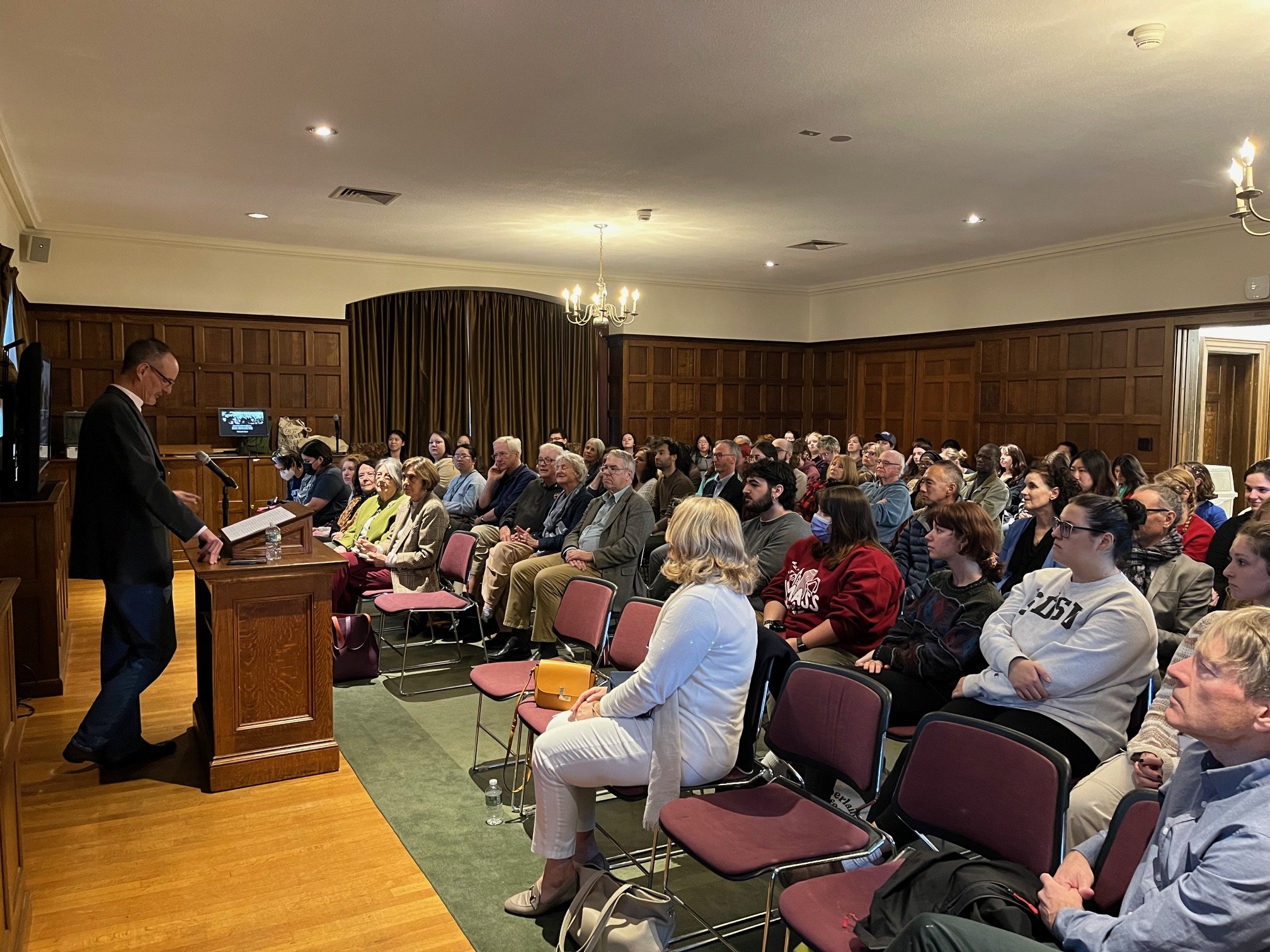
Dr. Jessica DiCarlo presents Annual Geography Lecture on Global China

BY OLIVIA RUSSO ’25

STAFF WRITER

On Thursday, Feb. 13, the Mount Holyoke College community welcomed University of Utah Professor Jessica DiCarlo in presenting the College’s Annual Geography Lecture.

Motivated by several years of work in the non-governmental organization and education sectors of Tibet and China, DiCarlo’s research is focused on infrastructure, China’s global integration and socio-environmental issues, according to her website. As a human geographer, she has situated her research at the intersection of development studies, political ecology and Global China studies, with an emphasis on connecting ground-level cases observed from local communities to overarching global processes through ethnographic fieldwork. 

At the beginning of her lecture, entitled “From the Ground to the Global: Conceptualizing Global China and How it is Transforming Development,” DiCarlo introduced a critical approach to thinking about the concept of Global China. Global China often encompasses different connotations and perceptions, which are sometimes contradictory but seemingly always dynamic and in flux. She emphasized the importance of analyzing the term’s historical roots: while the mention and usage of the term “Global China” sharply increased post-2013, the exact phrasing began to circulate in the 1970s. The discussion at that time primarily focused on whether China could become a global power and on Global China as a phenomenon happening to China rather than something China was doing to the rest of the world. However, it gradually transitioned to indicate China’s integration into global markets and its active shaping of global systems. 

Using a genealogical approach, DiCarlo presented “six paths” of Global China: “other,” “integration,” “status,” “bridge,” “threat” and “alternative.” She notes that each path builds on particular lineages and understanding of both “China” and “global,” and while they are interlinked, tensions also exist within and between paths. For example, while “other” treats China as an external or alien force, and traces Western fear and anxiety about a rising China, “bridge” understands China as connections between people, cultures and ideas. While “status” frames China’s global rise as evidence of shifting power hierarchies, “threat” portrays China’s global footprint as a challenge to the existing order. Such conceptions of Global China have important implications for developmental thinking, as well as security measures, policies, development projects and more.

In contrast to the implications of Global China on an international scale, these paths simultaneously unfold in a different manner on a local scale. DiCarlo presented several projects indicative of this dissonance that she studied through fieldwork in Laos: the Laos-China Railway, Laos-China Economic Corridor and the Boten Special Economic Zone. These projects were part of the Belt and Road Initiative, a massive global infrastructure development strategy adopted by China. She described that, on a larger scale, these projects have extravagant launch parties, dominate the land as massive structures, are showcased in headlines and supposedly represent economic development and modernity. However, the fanfare that surrounds these global infrastructure projects often obscures the local, everyday experiences of people actually on the ground.

For example, DiCarlo found that in the Boten Special Economic Zone, workers were tasked with long, tedious labor that was ultimately intended to market a certain vision of prosperity, fanfare and money in the zone. Once the guests left, the whole city shut down. Another example she presented was the Laos-China Railway, which physically dominated the landscape and presented many issues for people on the ground. DiCarlo highlighted that people on the ground often don’t talk about the BRI or understand the project as a Chinese initiative despite being affected by issues such as farmland loss, deforestation or being displaced from their homes. She described that local residents were more concerned with land appropriation and lack of compensation for the displaced. Thus, while the BRI may seem to be everywhere, it’s not always visible to those most affected by it.

In general, DiCarlo argues that such development projects display the need to pay attention to “politics of sight,” pertaining to how the projects themselves as well as people are seen, and “downstream effects and flows,” or how power flows downstream from China and encounters obstacles along the way. Infrastructure projects exist on a spectrum of visibility, and visible projects, such as gleaming highways or giant ports, often hide or distract from less visible issues, like labor disputes and environmental damage.

Karishma Ramkarran ’27 contributed fact-checking.

Letters to MoHome: Trump’s desire for Greenland while living in Denmark

BY EMMA QUIRK ’26

CONTRIBUTING WRITER

Hello from Copenhagen! 

I’ve been living in Denmark for the past month (and a half). There is so much to say about my experience studying abroad so far, but, for now, I just want to share what it’s been like to be here while Donald Trump is claiming he wants to buy Greenland. 

While this has mostly been taken as a joke by Americans, the Danes take this threat quite seriously. It has also brought up larger conversations about the status of Greenland as part of the Danish kingdom. Trump and Greenland are mentioned in news headlines and overheard in bars, coffee shops and bakeries. I’ve had conversations about this situation with my visiting host family and in the majority of my classes. 

In my course, “Postcolonial Europe: Narratives, Nationalism and Race,” we’ve specifically delved into the history of Greenland and Denmark, and the current conversations surrounding their relationship, as well as Trump. 

Denmark’s colonization of Greenland began with Christian missionaries in 1721. The overarching attitude in Denmark was one of superiority, based on racist and imperial beliefs. Like other Indigenous Peoples, the Inuit in Greenland were both scorned as being underdeveloped as well as idealized for their connection to, as the Danes saw it, traditional ways of life. Greenland remained an official colony of Denmark until 1954, when it became recognized as an autonomous state. Greenland was and still is part of the Kingdom of Denmark. 

Trump’s recent offer to buy Greenland wasn’t the first time the United States has shown an interest. There have been discussions within the United States government at various points, including a private offer after World War Ⅱ. Trump himself also talked about buying the island during his first term as president.

The official response from Denmark has been to say that Greenland is not for sale. King Frederik updated the royal coat of arms to have a larger polar bear, representing Greenland, and a larger ram, representing the Faroe Islands, apparently in response to Trump’s comments. Additionally, a satirical petition was started for Denmark to buy California. This petition has amassed over 244,000 signatures as of Feb. 13. 

The official response from Greenland has been to affirm that they are not interested in being purchased. In a statement, Prime Minister Múte Egede said “Greenland is ours. We are not for sale and will never be for sale. We must not lose our long struggle for freedom.” 

Tensions are not only high in Denmark because of Trump but because of the current relationship between Denmark and Greenland. Many Greenlanders want independence, and Egede has been working toward this. With a successful referendum, Greenland can be its own nation. Greenland will be having a parliamentary election in April, and Danes are watching to see what will happen. 

The Inuit of Greenland have been pushing for freedom and trying to rewrite the colonial narrative that Denmark has created. One way that this is being done is through art. With my Postcolonial Europe class, we’ve had the opportunity to explore some of this art. 

We visited Nordatlantens Brygge — which translates to North Atlantic House — which is a cultural center in Copenhagen, to see the exhibit The Arctic Exotic. The exhibit is the work of Ivínguak’ Stork Høegh, a Greenlandic contemporary collage artist. Her collages push back against exoticizing narratives of the Arctic and Greenland. 

Additionally, we had a guest lecture with Emile Hertling Péronard, a Greenlandic film producer, director and writer. He discussed the role of Danish film in curating stereotypical narratives about Greenland. Péronard works on films that represent Greenland and Greenlanders from their perspectives. He is a producer for the Greenlandic production company Ánorâk Film and one of the founders of Polarama Greenland, Greenland’s first production service company. 

Ignoring colonial histories disregards the current material effects of colonialism for both the colonizers and the colonized. Art like Høegh’s collages and Péronard’s films both presents history and presents Greenlandic culture from another perspective. 

Karishma Ramkarran ’27 contributed fact-checking.

Letters to Mohome

Letters to Mohome

Letters to MoHome is a new column started by MHN’s Global editors to spotlight the journeys of Mount Holyoke College students who are currently studying abroad. In submissions styled as diary entries, students can share their experiences, hopes and fears with the Mount Holyoke community back home no matter what continent they’re on. To submit an entry, students currently abroad can use the Google Form at https://forms.gle/ST3Q9PviecxAWCvo6.

From Mahsa Amini to Ahou Daryaei: the women’s protests in Iran

From Mahsa Amini to Ahou Daryaei: the women’s protests in Iran

A woman paces down the streets of Tehran, Iran’s capital, on Nov. 2, 2024, arms crossed, in the footage published by the Guardian. Dressed only in a purple bra and striped white and pink underwear, she’s both a rare spot of color in a sea of black and white, as well as an hourglass rapidly running out. She gazes up at the sky and breathes out: She knows what’s coming, but she doesn’t run. She merely sits down on the wide railing of a nearby staircase, hands folded in her lap, and waits. 

Flyover Zone technology allows users to “travel back in time” and experience ancient Rome

Flyover Zone technology allows users to “travel back in time” and experience ancient Rome

Students, historians and archaeologists alike can now “travel back in time” and experience the city of ancient Rome. Yorescape, a digital platform founded by Flyover Zone, provides curated virtual tours through reconstructions of ancient civilizations. 

The history behind Cuba’s blackout

The history behind Cuba’s blackout

Across the United States last month, people bore witness to the devastating effects of Hurricane Milton, from the flooding of Asheville, North Carolina to the destructive storm that hit Florida in the first few weeks of October. But the place hit the hardest may have been an island almost the size of Florida with almost half as many people just 90 miles from Key West: Cuba.

Canadian government expels six Indian diplomats after investigation

Canadian government expels six Indian diplomats after investigation

Canadian and Indian diplomatic relations are at an impasse. On Oct. 14, 2024, the Canadian government expelled six Indian diplomats, including the high commissioner, according to the Associated Press. This came after an investigation into the June 2023 killing of a Sikh activist that led to the uncovering of evidence of other possible crimes committed by agents of the Indian government. The Indian government has denied the accusations and has expelled six Canadian diplomats, including the high commissioner.

Investigation of fraud and questions surrounding ownership arise at The Jewish Chronicle

Investigation of fraud and questions surrounding ownership arise at The Jewish Chronicle

Columnists​​ Jonathan Freedland, Hadley Freeman and David Aaronovitch have recently broken relations with the United Kingdom’s Jewish Chronicle, the world's oldest Jewish newspaper, after the publication faced accusations of false reporting. According to The Forward, the most prominent Jewish newspaper in the United States, the resignations are due to allegations that some of the paper’s stories about the Israel-Hamas war were fabricated to fall in line with comments made by Israeli Prime Minister, Benjamin Netanyahu. 


Mount Holyoke students return from studying abroad in Japan

Mount Holyoke students return from studying abroad in Japan

On Oct. 1, four Mount Holyoke College students who recently returned from studying abroad gathered in Ciruti 109 to present their experiences at the Japan Study Abroad Information Session. While the experience of studying abroad isn’t an uncommon one at the College — over 40% of students will have studied abroad by the time they cross the stage at Commencement — only seven of the over 150 study abroad programs available to Mount Holyoke College students are located in Japan. Mount Holyoke News interviewed two of the students who presented to understand their experiences, stories and takeaways from studying in Japan.


How Thailand is changing the game for queer rights

How Thailand is changing the game for queer rights


 Thousands of people took to the streets in Bangkok, Thailand, on June 1, 2024, decked out in colorful makeup, brandishing rainbow flags and cheering their support for pride. But something was different this year. The crowd of activists was waiting with bated breath for an announcement over a quarter-century in the making that could change their lives: same-sex marriage would finally be legalized in their country. It would take four more months, until the end of September, when Thailand’s King Maha Vajiralongkorn gave his assent and made it official. 


Study Away Fair shows MHC students their opportunities for travel

Study Away Fair shows MHC students their opportunities for travel

For many students at Mount Holyoke College, fall is the time to think about studying abroad. To that end, the Study Away Fair took place on Tuesday, Sept. 17 from 4-6 p.m. in Chapin Auditorium. The fair is held annually by the McCulloch Center for Global Initiatives on the third Tuesday of September. Organizers from programs all over the world were in attendance to answer questions and give out information to prospective students. A projector at the back of the auditorium was also set up to display general information.

Mount Holyoke screens Baba Hillman’s film, ‘Kitâb al-Isfâr: Book of the Journey

Mount Holyoke screens Baba Hillman’s film, ‘Kitâb al-Isfâr: Book of the Journey

It was movie night in Gamble Auditorium on Sept. 12, where the Religion, French, Art Studio and Film Media Theater departments held a joint screening of Baba Hillman’s film “Kitâb al-Isfâr: Book of the Journey.” Hillman, who is a Five College professor emerita of film and video at Hampshire College, was present for the screening and later had a discussion with Elliot Montague, assistant professor of film production in the FMT department, who is also her former student. The film recounts Hillman’s experience after surviving a car crash in the Andalusian mountains just outside of Malaga, and how her experiences in the immediate aftermath segued into her travels and learning experiences. Professor Montague said on bringing the film to Mt. Holyoke “As a former Five College Professor who taught film production in the consortium for over 20 years, she had taught at every college except Mount Holyoke. She has however taught several Mt. Holyoke students in the past through her Paris filmmaking course, as well as at Hampshire. We thought this would be a great opportunity for her to show her recent work here and connect with our students.”

Lower house of the Mexican legislature passes judicial reform plan

Lower house of the Mexican legislature passes judicial reform plan

In Mexico, judges may soon be chosen by ballot. On Sept. 4, the lower house of Mexico’s Congress passed a proposal that would redesign the entire judiciary of Mexico, according to the New York Times. The plan would allow almost all of the country’s judges — more than 7,000 — to be elected by voters, be they at the federal, state or local level. Currently, the Mexican president appoints judges by virtue of their qualifications and training.

The I word: how immigration policy is impacting elections in 2024

The I word: how immigration policy is impacting elections in 2024

The stars have aligned in 2024: around half of the global population is living in a country going through an election cycle, according to the Carnegie Endowment for International Peace. Immigration and migration policy have been key issues throughout several campaigns across the globe. In this article, Mount Holyoke News will explore how individual countries and their leaders are navigating the topic of immigration politically during their election cycles.

What to know about Masoud Pezeshkian, Iran’s new reformist president

What to know about Masoud Pezeshkian, Iran’s new reformist president

Reformist candidate Masoud Pezeshkian defeated ultraconservative Saeed Jalili in a runoff on July 5, 2024, winning Iran’s presidential election, according to AP News. The win comes at a time when Iran has received significant international attention due to its strict religious domestic policy and anti-Israel foreign policy. This election’s result may signify a shift in politics for Iran.

“The forgotten tragedy:” Sudan’s civil war leads to humanitarian crisis, affecting millions

“The forgotten tragedy:” Sudan’s civil war leads to humanitarian crisis, affecting millions

For over a year, the civil war in Sudan has terrorized civilians and led to an expanding humanitarian crisis affecting the entire nation.

On April 15, 2023, fighting escalated between the Sudanese Armed Forces and the paramilitary group Rapid Support Forces.This has caused more than 8.6 million people in Sudan to be displaced internally and externally as refugees, according to the United Nations Refugee Agency. Essential services are also under attack, leaving communities without healthcare options.