Senate: Residential Life staff discuss new on-campus party policy

Photo by Genevieve Zahner ’26

At the October 9 Senate, Residental Life staff explained the new campus party policy, which allows for some kinds of alcohol at registered parties.

Coco Athas ’26 opened with the Mount Holyoke land acknowledgment, then noted the events of the week, which included “Honoring the Ancestor, Gloria Anzaldúa: Todo Viene del Corazón/All Comes from the Heart” on Wednesday Oct. 8 at 12 p.m. in the Unity Center, the Smith College job and internship fair on Thursday Oct. 9 at 3:30 p.m. Transportation was provided to this event by the College. As well as a public library card sign up on Thursday Oct. 9 at 2 p.m. in the Williston Memorial Library Atrium.

The new party policy instated by Student Engagement in the Division of Student Life requires students to register parties with the area coordinator and on the Event Management System, as well as complete a responsible host training prior to registering. Previous party policies state that alcohol is not permitted, unless working with student involvement to employ trained bartenders, but these new rules attempt to allow students to gather and drink together in a responsible manner, as will be discussed below. Hosts cannot charge for any aspect of the event, and events cannot exceed the 50 person maximum. All guests must have received invitations, and outside guests must be accompanied by a Mount Holyoke Student in accordance with the existing guest policy.

The representatives noted that “unsanctioned, large scale-gatherings happen regularly” in the same locations, impacting specific members of the community. Mandelle Hall was mentioned as being a popular party space. Concerns included alcohol and substance misuse, medical emergencies, fire safety, impact to the community, and inconsistency and inequities in enforcement. Enforcement of the College’s previous policy included shutting down all unsanctioned gatherings that occurring in residence halls and common spaces. To avoid this, they created a new policy that will allow for sanctioned gatherings that “align with expressed students' needs and wants.” The ResLife staff looked at other schools such as Smith College and Amherst College for what policies they are enforcing to create the new Mount Holyoke policy.

Their goals for the new policy are to provide clear expectations and guidelines — especially in regards to alcohol and enforcement — through education to center student autonomy and agency with minimal professional staff intervention. These policies aim to “promote values of accountability, responsibility, and respect for one another and our physical spaces” and additionally ground the expectations in community care and well-being. Creating interstudent dialogue in regards to solving problems and taking care of the resident hall spaces was also an important aspect of this new policy.

Key changes include requiring hosts to undergo safe party host training, implementing a formal registration process through EMS, establishing norms and regulations for hosts regarding cleanup, check-ins from public safety at the beginning of parties, the normalization of calling for help if needed, and the permitting of alcohol in accordance with guidelines.

Hosts will be held accountable if damages or violations to policy occur. Hosts must also be responsive to community concern, including calling for help, upholding capacity, being in communication with residents to manage concerns and ending parties at the start of quiet hours at 1:30 a.m.

Further, according to the alcohol guidelines, “alcohol can be present but cannot exceed certain quantities.” There may not be hard alcohol or mixed drinks, guests under 21 years old cannot possess or consume alcohol, non-alcoholic beverages and snacks must be provided, and there may be no sale of drinks. The representatives noted that what students drink before parties is not part of the policy. Additionally, no open containers are permitted outside of the party space.

Senate was then opened for questions. Attendees voiced concerns about the party policy. These questions allowed for ResLife staff to provide more information, such as the role of party hosts and how communication between residents and party hosts will be possible, which is still being determined by ResLife staff.

Age restrictions will be enforced by the Public Safety and Service department, and if underage students choose to drink before the parties that choice is not to be blamed on the hosts under the new policy. There is a medical amnesty policy in place for those who are underage and need medical attention due to drinking. Different types of violations to the policy will be handled based on circumstance, but the goal is community understanding of why the policy is in place, and emphasizing community safety and wellbeing.

The new policy will go into effect on Monday, Oct. 20, and all events must be registered starting on Oct. 24. All unregistered events after this date will be shut down.

Senate ended with announcements, which were about events held by clubs and student organizations.

Bellatrix is hosting “Get Your Geek On” on Oct. 31 at 10 p.m. and the International Relations club is hosting a “Brown Bag Lunch” on Oct. 16, where Associate Professor of International Relations and Politics Christopher Mitchell will talk about his research with catered lunch from 12-1:30 p.m. in Skinner Hall, room 202.

Asexual Awareness Week is Oct. 19-25. The Coalition for Asexual/Aromantic Awareness is hosting a zine workshop Saturday, Oct. 18 from 4-5 p.m. in the Jeannette Marks House. They will be tabling Thurs. Oct. 23 from 5-7 p.m. about the history of asexual awareness.

Active Minds is hosting a “run club” every Sunday at 10 a.m. Running and walking is welcomed, and those interested should meet outside Kendall Sports and Dance Complex to do an Upper Lake loop. The Student Government Association Springie Committee is seeking springies of all classes who are interested in participating in a Big/Little program for incoming spring admits. The club squash team is hosting a “sugar and screams” fundraiser and will be tabling Monday and Friday evenings.

There was no Senate on Tuesday, 10/14 due to Fall Break.

Quill Nishi-Leonard ’27 contributed fact-checking.

The College introduces Google AI chat feature, Gemini

Graphic by Mari Al Tayb ’26

By Emma Quirk ’26 & Genevieve Zahner ’26

News and Photos Editor | News Editor

On Aug. 20, the College announced the introduction of Gemini AI, Google’s AI chat application in an MHC: This Week email. Gemini, Google’s AI chat application, can be used “to explore ideas, draft or summarize writing, create content and images, and support research or creative projects.” In a follow-up email, this information was reiterated, with a reminder for students to “follow the guidelines set by faculty in their individual courses, and be transparent about the origin and process used for their submitted work.” Additionally, there was a note for all users to follow the Mount Holyoke College Guidelines for the Ethical Use of Generative AI.

These guidelines exist “to ensure the ethical, secure, and responsible use of AI, fostering a culture of critical engagement with technology in line with the College’s mission and strategic vision as we navigate these changes as a community.” They go into detail about various aspects of AI usage, including ethical use, culture of critical engagement, professional integrity and responsibility and data privacy and security. At the bottom of the page, it states that ChatGPT was used to create these guidelines, with “substantial editing” by Mount Holyoke faculty and staff.

LITS has been at the forefront of investigations about AI usage, as well as the integration of Gemini and other generative AI tools on campus. The LITS Advisory Committee, College Compliance Committee, Leadership Council, a faculty forum, and the Student Government Association Senate were all part of the decision to introduce Gemini. However, because of the focus on “the foundational technology environment, privacy, and information security of the College, I, as Chief Information Officer, made the decision,” Alex Wirth-Cauchon told Mount Holyoke News.

Multiple factors influenced this decision, including issues of privacy, equity and educational access. A significant concern was about AI tools mining information. “Sharing non-public information ... with such tools puts the community’s privacy and personal information security at risk,” Wirth-Cauchon said. “Our contract with Google prevents Gemini from using our information to train their model, advertising, or other uses.”

This became more pressing when Google started allowing college students to freely access Gemini for one year. However, this access “is not covered by the College’s contract that provides limits to what Google can do with the data submitted to Gemini,” Wirth-Cauchon said. “Additionally, we were concerned about the inequity created in a year when charges would begin for those accounts.”

There was interest from faculty and staff to have access to generative AI, either for course materials or various work as part of the College. Wirth-Cauchon stated, “Granting access to Gemini addressed this need without additional cost to the College, those departments, or the staff in those departments.”

In an email from President Danielle Holley on Sept. 3, she announced that there would be an AI Working Group sponsored by Provost Lisa Sullivan and Wirth-Cauchon. This committee will be split into sub-groups, including one connected with the Association of American Colleges and Universities — AAC&U — Institute on AI, Pedagogy, and the Curriculum. The AI Working Group will have faculty, staff and student members. Wirth-Cauchon said the purpose of this group is to “help us to broaden and deepen the community’s critical engagement with the impact of generative AI for the mission of the College.”

Vanessa Rosa, co-chair of critical race and political economy and associate professor in Latine studies, is part of Mount Holyoke’s AAC&U Institute on AI team. She attended a conference hosted by AAC&U over the summer, where she learned more about AI and about the Institute. The Institute is essentially a year-long mentorship program. “Each institution puts together a team that will go through this kind of structured program to really think through AI for their campus,” Rosa said in an interview with MHN. “Who is Mount Holyoke? What is our mission? What are our values? And how do we need to be thinking very carefully about AI in relation to those things.”

She spoke about the importance of learning about AI to understand it. “I think it's our responsibility to be educated and understand what AI is, what it does, and to interrogate what we don't know yet,” Rosa said. “My major concerns around AI are intellectual property, equity, [and] the environment.”

Angie Gregory, sustainability program manager for the Miller Worley Center for the Environment, is also focused on the environmental impacts of AI. Gregory recognizes that there are ways for AI to be useful, but encourages people to do their own research to learn about the consequences. Looking at studies from CNBC, University of Massachusetts Amherst and the United Nations can put the impacts into perspective, from “land use acquisition and development for the buildings that need to house these servers, to the amount of water that's used to cool these servers.”

“I think we as consumers of these technologies need to think about what the demand side is saying to those industries,” Gregory said. “So we can reduce our demand side and be intentional with when and how we use it.”

Despite some of the harmful consequences for people and the environment, she is not pessimistic about the future. “It can all feel really overwhelming and outside of our control,” Gregory said. “[But] we are on this campus together in an enclosed, kind of tight community where we have the opportunity to connect with all these individuals in real time ... I think there’s opportunity in that.”

Alex Moskowitz, an assistant professor of English at Mount Holyoke College, spoke in an interview with Mount Holyoke News about his thoughts of where AI fits into an English classroom, stating, “One of the things that distinguishes an English classroom at Mount Holyoke from an English classroom at other institutions like UMass, is that we have really, really small classes.” Most English classes at Mount Holyoke are capped between 16-18 students, creating a more personalized learning environment, as well as being primarily discussion based learning models. “One of the things you can do here is … you read the text, you come up with your ideas, and you speak about them in class, and you speak about them with your classmates, you speak about them with your professors. This is the work that is possible here. AI has no role,” Moskowitz said.

Moskowitz also spoke on how generations of knowledge for English students comes from reading, writing and discussion. He says speaking about literature with classmates offers new perspectives and brings up new ideas one never considered before, and AI prevents students from learning anything new. He additionally spoke about his policy in the classroom surrounding AI, and how he personally considers it to be a form of plagiarism. “I tell students they are not allowed to use it for whatever purpose … I want you to learn this thing, and you can't learn it through the use of AI … So it doesn't serve a pedagogical purpose in my courses, therefore don't use it,” he said.

Moskowitz also commented on the idea of Mount Holyoke trying to become more carbon neutral with efforts such as the geothermal project, but then adopting AI tools which are known to use immense amounts of energy. “Go look up the articles about what those data centers do to the communities that they're in, they're incredibly destructive, like the air quality, the water quality, everything. They destroy the immediate surroundings. And those communities are often Black and brown communities where those data centers are built,” he said.

Moskowitz wrapped up by encapsulating his philosophy on AI by saying, “There's more I could say, but there are these political and ethical and environmental reasons that AI is really, really deeply problematic, and so I'll say to students, don't use it, because pedagogically, it doesn't make sense.”

Mount Holyoke News also reached out to Mara Breen, a cognitive scientist and professor of psychology, to ask about how fields such as hers who use computational models of AI are working around the development of generative models. “So starting from the 1970s we had this term AI, artificial intelligence. Now what did it mean in 1971, [is] probably a little bit different from how we conceptualize it today,” she said, drawing the distinction between newer models such as ChatGPT and models used in labs. “I use various machine learning algorithms, which some people would call AI, but that's very different from these generative AI models like LLMs.”

Breen also spoke to how these models are used as learning tools. “As a cognitive scientist, I'm deeply interested in computational models as a tool of study, where we say, here's what we know humans do. What do computational models do?”

She explained how AI has a place in her classroom as computational models, however her thoughts on generative models in the classroom are slightly different, stating “The value of a scientific paper is not the abstract, right? Usually it's not. We're not reading a paper because of the abstract, we're saying, okay, but how did they operationalize their variables? What is the method that they used? What were their results? How did they interpret it?”

She also emphasized that the “potential benefit is not worth the cost” of using a generative model for simple tasks such as searching for an old email or redesigning a class.

Breen approaches AI in her classroom through education, and explaining to students how AI works and what exactly it is by comparing it to neural networks and models to help students grasp what she means. Additionally, she explains to students how the models they use in her field are helpful for offloading specific mathematical or experimental tasks, such as marking boundaries in research, but also teaching them about the harms of generative AI such as the labor exploitation and energy used in data centers. “We make the joke that [the brain] runs on, you know, coffee and Flaming Hot Cheetos, and GPT runs on all of the electricity in Texas,” she said.

Breen advises that before using AI, people should “make sure it's a reasoned choice,” and not to use it as a replacement for Google, or doing research by yourself, and to get educated on what exactly AI is and the effects.

Madeleine Diesl ’28 contributed fact checking.

Zowie Banteah homecoming: supporting our Indigenous communities

Photo courtesy of Ashley Herrera Mantanico ’27

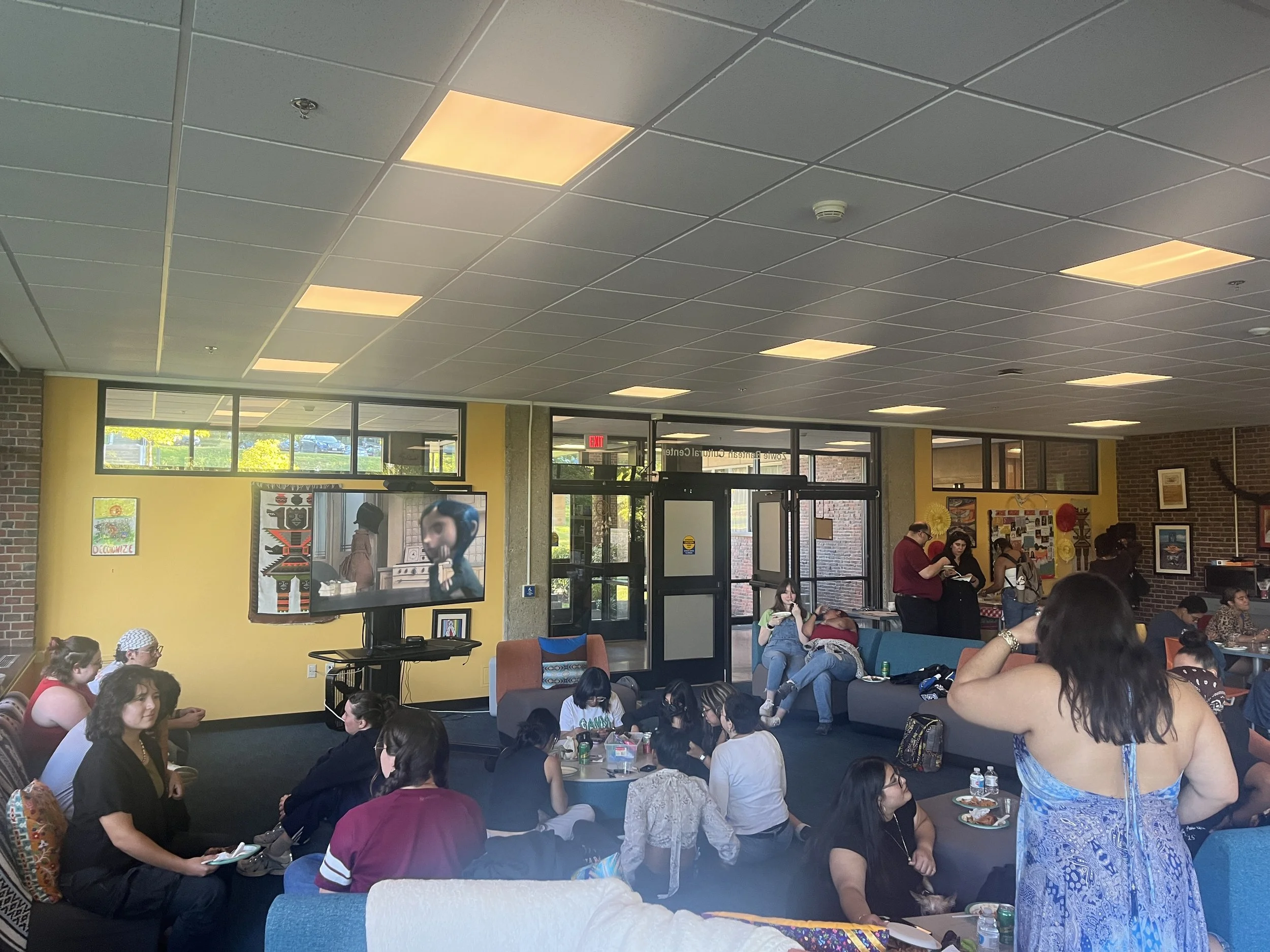
MHC students and staff celebrate the Zowie Homecoming in the Zowie Banteah Cultural Center.

Kannille Washington ’28

Staff Writer

In an open room, a community gathers with food, beading and lively conversation. On Friday, Sept. 12, from 4:30 to 6:30 p.m., the Zowie Banteah Cultural Center hosted its annual Zowie Banteah Homecoming. Thirty years after its original opening on the top floor of the Eliana Ortega Cultural Center, the promise and mission of the center continues—in its new location between Ham and MacGregor Halls—to thrive under the organization of the new Building Manager and Program Coordinator, Ashley Anai Herrera Mantanico ’27.

“It is important to know that a lot of students were part of the reason why this space is here in the first place because they were advocating for their representation in the 90s and 2000s during a time where there was none,” Mantanico ’27 shared in a statement. Zowie Banteah ’96 herself was a student here at Mount Holyoke. She was a psychology and education major with a minor in Native American studies who led the dream and mission to make the center a reality. Now, in 2025, students continue to gather and support indigenous students on campus.

The Mount Holyoke College verbal Land Acknowledgement says, “This land acknowledgement seeks to verbalize Mount Holyoke’s commitment to engage in shared responsibility as part of our collective humanity. We urge everyone to participate in action steps identified by Indigenous community based organizations.” With any mission statement, it is important to consider how verbal promises become reality. While Mantanico notes she is “really appreciative and grateful,” she also highlights an important question: “Are we being taught how to support indigenous and Native American communities?”

Her actions so far prove she is on the right track in supporting these communities herself. With various events such as the Zowie Banteah Homecoming and the recent trip to Harvard’s 27th annual Powwow, she has started the year off strong in engaging the students and community in indigenous events. With the beginning of our Hortense Parker celebrations on campus, we can see there is a strong outlook for future events and much hope in Mantanico’s drive as she continues in her role.

This support is not just the work of one or two students, though. There is a legacy of student initiative. Mantanico highlights Katie Dick ’19, Nezbah Rita Young’25 and Juliette Gagnon Strong Heart ’24 as students who made the space what it is for her and many other community members today.

“They made it feel like a home, and that's what it is, it's a home for us”.

Madeleine Diesl ’28 contributed fact checking.

Dean Marcella Runell welcomes students at the first Senate of the Year

Photo by Sarah Ann Figueroa ’28

Cordelia Athas ’26 sits on stage with Dean Marcella Runnell at this autumn’s first Senate meeting.

By Sarah Ann Figueroa ’28

Staff Writer

On Sept. 23, at the first Mount Holyoke senate meeting of the 2025-2026 academic year, Dr. Marcella Runell, vice president of Student Life and dean of students, came to talk about her work and spark excitement for what is to come this semester at the Division of Student Life.

The meeting began with a welcome from Cordelia “Coco” Athas ’26, the chair of Senate, who gave the new and returning senators an amiable welcome to the first senate of the year. The group went over the standard flow of Senate gatherings, and it was announced that President Danielle Holley will be next week’s guest speaker for the Senate’s Town Hall. Athas also shared that Town Halls will be more condensed going forward, with emphasis on only asking “relevant and respectful questions” to keep time from going over. Then, Runell was introduced to speak in a sort of mini-town hall, where she was asked to share what she does at Mount Holyoke College’s Division of Student Life, and answer questions.

Athas started by asking Runell, “What is your role at Mount Holyoke College?”

Runell brought up the weekly “Dean’s Corner" emails which are sent out to the student body every Friday, as she felt that they “really encapsulates” what her job is.

As a leader in Student Life at Mount Holyoke, Runell plays a key role in facilitating the day to day experience of students, and creating a more positive and inclusive community. The Dean’s Corner Newsletter provides direct links to various resources and upcoming calendar events, along with highlighting moments in the community via photo collages. In her own words, Runell described her role as being about “communicating between and among all the different stakeholders on campus that are responsible for the student experience,” as well as community building with students directly.

Later, Athas asked what Runell feels students should know about the College’s MHC Forward Strategic Plan. Starting by providing context on this plan’s importance, Runell commented, “There are so many things that were in the last strategic plan that have radically changed Mount Holyoke.” She specifically highlighted the expansion of Blanchard Hall’s Community Center and its centralized dining in 2018, saying that, “It’s hard to imagine where we would be if that hadn’t been the vision in that last plan,” and, “There was no space for students to all be together except for the library.”

Runell then listed some of the College’s divisions that will undergo changes with the current strategic plan, adding that many of these decisions came directly from student feedback about what they wanted to see in the future. The three major areas that Runell mentions will be touched upon in the current Strategic Plan are supporting students’ career development, providing better “residential education” for students, and the new Mount Holyoke Commitment to financial affordability.

During the Q&A portion of the Town Hall, one student asked about the decision to move Disability Services from the Office of Academic Deans to the Division of Student Life. Runell first stated that it is standard among most higher-ed institutions to have such services “report into Student Affairs or Student Life, because accommodations are not just academic.”

She further explained, “In an ideal scenario, we would really be thinking about the whole student experience in terms of accommodations … That’s one of the reasons [Disability Services] sit in Student Affairs, because it is meant to be broad and encompassing.”

Runnell also addressed the aspect of the physical space where Disability Services is currently located, asking herself aloud, “Can we find a better space than the third floor of Mary Lyon Hall, which is not one of the most accessible places on campus.” She immediately answered her own question, stating,, “We have Student Life spaces all over campus,” solidifying the advantages of rehoming Disability Services to reside under the Division of Student Life.

To wrap up, Athas asked Runell, “In your opinion, is Bigfoot real?”

Runell’s response was, “I’m gonna say there’s a good chance.” Ending with casual chat amongst the two on stage, and plenty of laughter from the senators in the crowd, the first Senate of the year concluded at just under 40 minutes.

Fact checked by Madeleine Diesl.

College's unions participate in Convocation day strike

Photo courtesy of Sarah Ann Figeuroa ’28
Mount Holyoke College staff and students protested outside the College’s front gates during the SEIU 32BJ and UAW Local 2322 unions’ joint labor strike.

By Karishma Ramkarran ’27

Copy Chief

On Tuesday, Sept. 2 the College celebrated Convocation, an annual tradition that recognizes Mount Holyoke’s students and faculty. Although the theme of sustainability through community marked this year’s Convocation, students did not fail to notice the absence of Mount Holyoke’s essential dining and maintenance workers from the celebration.

As part of a joint demonstration of labor power by the College’s workers’ unions, SEIU 32BJ and UAW Local 2322, Mount Holyoke’s dining hall, facilities staff and housekeepers participated in an unfair labor practice — also known as ULP — strike outside the front gates. In an act of solidarity, the striking workers were joined by students and community members as early as 5 a.m. with picket signs.

The strike followed a series of failed negotiations between the unions and the College that occurred throughout the summer over new contracts, which are agreed upon every three years. It has not been the first time the College’s workers have held rallies in front of the main campus gate; in-between contract meetings, rallies were organized on April 24 and May 13 of this year.

New and returning students on campus began organizing as early as Monday, Sept. 1 to support the strike. The Instagram account Students for Staff Collective Bargaining – @mhcsscb on Instagram – posted a series of action items for students to carry out on Convocation day. These action items included attending a “reverse boycott” wherein students filled up the dining hall before Convocation from 8-10 a.m., boycotting the barbecue on Skinner Green after Convocation, and protesting at the rally at the front gates at 4 p.m. In Blanchard Hall, fliers encouraging student involvement in the strike were posted on community boards and on tables.

At 9:20 a.m. on the day of Convocation, Carl M. Ries, vice president for finance and administration and treasurer, sent the student body an email with the subject line “Update on Campus Operations: Union Strikes.” The email was an official acknowledgement of the strikes from the College. Ries wrote that the College was “committed to minimizing disruptions to [students’] campus experience during the strike” through “developed contingency plans,” which referred to the movement of the Convocation cookout from its original location on Skinner Green to the Dining Commons. The cookout after Convocation was available only to students, many of whom boycotted the event because the College replaced striking dining workers with temporary workers.

Sally Durdan ’81, the Chair of the Board of Trustees, began Convocation by acknowledging Labor Day, which had been celebrated the previous day, Sept. 1. Prior to the College’s official land acknowledgement, Durdan said, “We will open today’s celebration by acknowledging the essential work of our facilities, dining, and housekeeping staff.”

Durdan’s remarks were cut off by the chants of students demanding that the College “pay their workers.” The Board of Trustees, along with President Danielle Holley, stood up for the student protest, with some individuals clapping along. Vic Klapa ’26, who started the Students for Staff Collective Bargaining Instagram account, used a megaphone to amplify their support for the striking staff.

Klapa addressed the Board of Trustees on stage, “Mount Holyoke College, it is shameful that an institution that prides itself on being progressive refuses to do the bare minimum of giving your workers a minimum wage.”

Encouraged by the cheers of fellow students, Klapa continued, “You pride yourself on women’s empowerment, yet you underpay jobs mostly staffed by women. How is that feminist?”

Holley, who had taken the podium, said, “I just wanted to let you know I was just outside with our workers who are striking … and I want to let you know how much the College really does appreciate and care about our workers.”

Holley was met with more shouts from the crowd: “Pay them then,” and “Six months is too long.”

In response, Holley told the students that the College was working assiduously to obtain a fair agreement for the workers’ contracts, especially on the subject of a livable wage. “We will meet all the demands regarding the living wage, that is not a question,” Holley said.

“I am pro-labor myself,” Holley continued, “I have lots of people in my family who are union workers, I’d never imagined it would come to this day.”

“I sincerely want to come to an agreement with all of our unions in a way that respects labor … and I think you will see when we are completed with this process that is exactly what we will do,” Holley said.

At 10 a.m. – the start of Convocation – the SEIU 32BJ and UAW unions held a press conference outside the College’s main gates. Dozens of workers gathered, holding up banners and signs expressing support of the unions. Vehicles passing by the rally honked in solidarity with the workers on strike.

The speakers at the press conference drew attention to the College’s founding values, which include a commitment to social justice and progressivism, in their demands that Mount Holyoke engage in fair negotiations with their workers. The name Frances Perkins — belonging to a Mount Holyoke alum and former U.S. secretary of labor — was evoked in protest of the College’s labor practices.

According to SEIU 32BJ union, over 40% of its workers at the College don’t make a livable wage, which they calculated using the MIT Living Wage Calculator. The living wage calculator calculates a livable wage for an individual using the location in which they live and their family circumstances. It accounts for the individual’s family expenses, which include food, childcare, medical care, housing and transportation.

The union representatives stated that when workers at the College do receive an increase in pay, they receive more responsibilities as a consequence of underhiring. Patrick Burke, president of UAW Local 2322 which represents around 25 of the College’s housekeepers, said, “Mount Holyoke has $1 billion; workers are asking for 1/1000 of that.” The union alleged that the College had been negotiating contracts in bad faith — particularly by threatening to cease negotiations if workers went on strike — which is against the National Labor Relations Act.

Several political representatives in the area attended the press conference to demonstrate their support of the College’s striking workers. State Senator Adam Gómez spoke about the strike as part of a greater fight for justice and democracy. “It is crucial that we stand together to support the heart of the institution: The worker,” Gómez said.

Rhonda Saletnik, a housekeeper for Pearsons Hall, said, “The College wouldn’t be working if we didn’t work.”

At 4 p.m., students flooded through the front gates to join the rally and express their solidarity with the union workers. Ben Grosscup, an American songwriter and activist from western Massachusetts, performed familiar classics with a pro-union twist for the crowd, including “(Strike) Around the Clock,” “We’re Not Gonna Take It!” and “Fight for Justice.”

Students who attended were given picket signs by union organizers, along with music sheets so they could sing along with Grosscup. The rally frequently erupted in cheers for the unions on strike — SEIU 32BJ and UAW — along with slogans like “Solidarity forever,” “Union strong,” and “The people united will never be defeated.”

In an interview with the Mount Holyoke News, student attendee Maeve McCorry ’28 said, “Students need to understand that these workers are valuable, not just because of the labor they provide for us, but because they are human beings … who deserve dignity.”

In a conversation with Klapa about their motivations behind the protest during convocation, they said, “Labor rights in general is something that has such a personal meaning to me. I was raised by a mom and a grandma who were both immigrants. They worked in factories. English wasn’t their first language. And we grew up working class.”

They continued, “They didn’t work at unionized jobs, so, I have metal fillings in my teeth. And there were times in my life where I wasn’t able to access insurance for certain months because that [wasn’t] allowed in my mom’s contract.”

Among the rally attendees were Mount Holyoke faculty pledging support for their fellow workers at the College. Mary Renda, a professor of history, spoke of being “proud of SEIU and UAW for standing up” and continued the general theme of Frances Perkins by stating that “[Perkins] worked to ensure people had the right to unionize.”

According to Kevin Brown, the executive vice president of SEIU 32BJ, all 200 members of the unions at the College participated in the strike. Brown told the crowd that the College had not believed its workers would strike during Convocation, and the loss of labor had led to a couple managers running the dining hall for the entire day.

Brown spoke against the College’s labor representatives, stating that they did “evil, illegal things” during negotiations. The strike was intentionally held on Convocation day, an annual College tradition, to “give the College a lesson.” After the rally students returned to the Dining Commons in the act of another reverse boycott. A speaker declared that resuming regular work the next day was an act of voluntary labor, which would be taken back if certain conditions weren’t met, or if any striker was fired by the College.

Holley, in an email addressed to the student body, shared more resources and information regarding negotiations between the unions and the College. “Mount Holyoke has been in active negotiations with representatives from both SEIU and UAW and has made offers that include significant wage increases, added holidays, enhanced benefits and new opportunities for professional development,” she wrote.

To further discuss these matters, Holley invited concerned students to attend a community forum in Chapin Hall on Sept. 3 at 4:45 pm.

At the forum, Holley prefaced the conversation with an explanation of how labor negotiations work at the College: the College’s representatives meet with union representatives to discuss various issues for new contracts. The College’s representatives include their labor counsel Joe McCullough, Associate Vice President for HR Jay Toomey, and the Assistant Vice President of Employee and Labor Relations Mary Simeoli. Holley clarified that she is not present at these meetings.

After she had spoken about several non-economic offers that the College had offered to the unions, Holley proceeded to address the main point of contention among the student body: the issue of a livable wage.

“The clear compensation structure is that we pay people based on market rates, based on benchmarking,” Holley said.

She continued with an example: “[Kitchen assistants] can be paid in a range of $18 an hour, even though we recently advertised for some at $20 an hour. If you look over at Amherst College, they advertise that same kitchen assistant position for $15-$19 an hour.”

“We pay $18 an hour for those jobs because that is the market rate. We actually believe we pay a little above the market rate for kitchen assistance,” she explained.

Holley continued to detail the wage-related offer the College had made during negotiations, which was an 8.5% raise in contrast to the union’s proposed 11.5% raise, which had been agreed upon during previous negotiations three years ago. She also enumerated the ways in which employees at the College are compensated besides wages, including retirement contributions and healthcare.

Before opening the community forum to a Q&A session, Holley spoke of the college’s deficit of $5 billion, mostly due to employee wages and benefits. “But I also want to be transparent with this community. We are at the end of our fiscal ability,” she said.

Holley continued, “I will take accountability for the fact that we should not be here right now, because I should have insisted that this contract was completed by June 30.”

During the Q&A, Gillian Krugman ’27 addressed the forum, “I refuse to accept the notion that their [the worker’s] rights to a livable wage is not within the economic contours that you posited … The administration negotiated in August with one condition: To not strike. This is a blatant disregard to the law.”

Krugman continued, “Just because conditions are worse under other administrations, doesn’t mean our labor conditions cannot change.”

On Friday, Sept. 5, negotiations between the College and SEIU 32BJ had produced a tentative agreement that includes annual raises that total 11% over the three-year contract for all members, with the lowest paid workers receiving between a 13.5% and 20% increase over the same period. The union also secured access to no-cost legal services for civil matters, such as immigration, and policy improvements for non-economic issues such as sick leave, parental leave and holidays.

The College had negotiated the same day separately with UAW Local 2322. The union has secured their members an increase in wages towards the livable wage calculated by the MIT Living Wage Calculator.

In an email sent to the student body on Tuesday, Sept. 9, Holley wrote, “We anticipate these agreements will be ratified by the respective bargaining units within the next two weeks, at which point they will go into effect as outlined in each contract.”

She continued, “Advocacy has always been a part of Mount Holyoke’s story, and effective advocacy begins with a willingness to listen and learn. We have shown that Mount Holyoke is a place where everyone is valued and heard, and we will continue to uphold these principles as we move forward together.”

Madeleine Diesl ’28 contributed fact-checking.

Students celebrate the start of the academic year at Nightfest

Photo by Emma Quirk ’26
Myat Nandi Kyaw ’28, Hailey Brooks ’27, Manu Ribas ’26, Christine Niu ’27 serving popcorn at Nightfest.

By Emma Quirk ’26

News Editor & Photos Editor

Students celebrated the first weekend back on campus with friends and peers at Nightfest. Hosted by the Office of Student Involvement and the Student Government Association on Sept. 6, the event was advertised as including games, music, and more.

While Nightfest was originally going to be held on Skinner Green, it was moved indoors due to rain and a thunderstorm watch in the area. However, in contrast to the gloomy weather, Blanchard Hall was lively, with students of all class years milling about. The entire first floor was filled with people and tables that offered various foods and activities. On one side of the floor was snacks, with popcorn cones, cotton candy sticks, and a “make your own teabag” station. While the Cochary Pub & Kitchen was open, it remained quiet throughout Nightfest as students enjoyed the goodies provided by the event.

On the other side of the floor, students could get their face painted or take a picture at the photo booth. The line for photos extended across the entire length of the first floor, as students waited to pose with props. Between the tables, groups of students sat and stood in circles, playing games, eating their treats, chatting with one another, and taking in the activity around them.

The Great Room boasted glow-in-the-dark mini golf. Lively music was playing, and the room was dim except for the golf course and glow sticks that students waved and wore as necklaces. All in all, Nightfest was a vibrant celebration to finish out the first week of classes.

Madeleine Diesl ’28 contributed fact-checking.

Negotiations continue for the worker union on campus

On Tuesday, May 13, the Service Employees International Union – also known as SEIU – 32BJ labor union held two back-to-back rallies to bring community awareness to the current negotiations with the College’s administration. This is the second rally held by the union this year, as the first rally was held on April 24. There have been five negotiation sessions as of May 13.

Worker rally draws campus attention as contract negotiations continue

Students and professors joined staff from Dining Services and Residential Life outside the main campus gate of Mount Holyoke College on Thursday, April 24, in support of the Service Employees International Union — also known as SEIU — 32BJ labor union and the group’s current contract negotiations with the College’s administration. 

Students create ethnographic food documentaries

Photo by Angelina Godinez ‘28

Critical Race and Political Economy Professor Pilar Egüez’s class conducted field visits in Holyoke, where they filmed ethnographic documentaries.

Angelina Godinez ’28

Opinion Editor

Amidst federal pressure for universities and corporations to make cuts to diversity, equity and inclusion programs, Mount Holyoke College staff and students recently came together to form a community that goes beyond a traditional class curriculum. The Colleges Community and Belonging Director Maria Cartagena and Visiting Assistant Professor in Critical Race and Political Economy Pilar Egüez Guevara created the class, Ethnographic Food Documentary, together. Guevara and Cartagena collaborated in making a hands-on, immersive approach not only to anthropology but also to community building. Instead of merely reading about varying identities, this class prepares students with the ethnographic skills they need to do research themselves and ultimately complete the course with a short ethnographic documentary.

Beginning on Feb. 18, the class embarked on its first field visit to Holyoke, Massachusetts, a city rich in culture, history and untold stories. According to Guevara, “Holyoke is underrepresented in terms of research conducted about this community from an academic standpoint.”

Guevara believes that, through the class’ research and film projects, the students can “disrupt and transform narratives about Latinx residents in Holyoke and throughout the country.” In addition to shaping narratives through film and emphasizing the value and importance these community members hold, the students use film to move memories and recipes into tangible documents, allowing them to be passed down, valued and remembered for generations to come.

This immersive field visit was just one of many class visits to Holyoke where the students would meet their film participants over a shared meal, followed by individual filming and interviewing processes.

Throughout the class, students are equipped with ethnographic skills to ensure that they professionally and ethically tell the stories of historically silenced voices through their film. With readings, screenings of films and learning from Guevara’s own personal projects, students have spent ample class time fine-tuning their ethnographic skills. Cross-listed as both an anthropology and CRPE course, it will culminate in a debut screening of each student-produced film in Holyoke.

Although this is not Guevara’s first ethnographic project, she told Mount Holyoke News why she believes such projects and research are important.

“I saw the need to teach courses like this in the context of the widespread, decades-long war waged against traditional knowledge systems, and in particular against traditional foods deemed as unhealthy by western science,” Guevara said. “My team at Comidas Que Curan envisioned teaching ethnography and filmmaking as a way to question negative representations of traditional cultural practices, and create dignified portrayals of the bearers of this knowledge, particularly older women.

“The wisdom that is carried and continues to be alive in communities throughout the world is part of their intangible cultural heritage,” Guevara said.

May 1 will mark the official premiere of four short ethnographic films made by students over nearly three months. The College’s Cartagena is one of the class’s film participants, who is featured alongside Holyoke activist Neftalí Duran, where they advocate for the importance of access to healthy, affordable and culturally significant foods and ingredients in a culture-diverse city such as Holyoke. Cartagena plays a vital role in bridging the gap between South Hadley and the city of Holyoke, and is trusted and beloved not only by students, but also residents of Holyoke. Trust is an essential component of their class and ethnographic research; without trust between the participants, staff, and students, the act of delegating and directing a film within only one semester would have been impossible.

Said acts of trust are emphasized through the three remaining films of the class. One film spotlights the stories of both Ada Fernandez Jr. and Ada Fernandez Sr., past owners of Holyoke’s very own Puerto Rican family restaurant formerly known as Fernandez’s Family Restaurant. Following the death of beloved father and husband Rafael Fernandez, the face of Fernandez’s restaurant, the film shows the unbreakable bond of culture and pride through the family’s values in community, cooking and cultural perseverance. Similarly to the Fernandez family film, a film following Migdalia Lavoy, a Holyoke traditional food expert, shows the importance of cooking in Migdallia’s very own house. This film explores the importance of cooking in relation to culture and hope. Despite not having professional culinary experience, the film shows that Lavoy is what a chef ought to be.

Last but not least is Aramis Lopez, a Puerto Rican reflecting on how his cooking is more than just culturally significant. In each spoonful of food, his pride in both Puerto Rico and Holyoke shines, emphasizing that his recipes are not just recipes but an important part of his cultural heritage.

Throughout the course of this class, students got to experience filming, researching, interviewing and editing. Soon both Mount Holyoke College and Holyoke community members will reap the benefits in having a tangible form of media to preserve and represent their hard work, culture and community.

With the help of passionate students and staff, the College’s community can continue to find importance in the seemingly mundane by appreciating not only our cultures, but the ones around us. With classes such as Guevara’s, students are on track to follow her words by “foster[ing] spaces, channels and strategies for cultural appreciation, as opposed to appropriation, exploitation, exclusion, and hate.”

Leah Dutcher ’28 contributed fact-checking.

Editor’s note: Angelina Godinez ’28 assisted with the production of the documentary on the Fernandez’s Family Restaurant mentioned in this piece.

New campus community seeks to alter discourse

Graphic by Echo Chen ’27

CORRECTION 4/29/25: The headline and several statements within this article have been updated to more accurately reflect this HxA chapter’s status as an organization that has not been officially recognized by Mount Holyoke College’s Office of Student Involvement, among other changes. For a full description of these changes, please refer to the complete correction notice at the bottom of the page.

By Karishma Ramkarran ’27

News Editor

Content Warning: This article discusses racism and transphobia.

A new unofficial organization at Mount Holyoke College has emerged amidst renewed discussions about the role of free speech on college campuses.

Elise Schemmel Shapiro ’25 is the co-chair, alongside Professor Cassandra Sever, of Mount Holyoke College’s chapter of Heterodox Academy — abbreviated as HxA — a non-profit organization whose mission statement, according to their website, is to advocate for “policy and culture changes that ensure universities are truth-seeking, knowledge-generating institutions grounded in open inquiry, viewpoint diversity, and constructive disagreement.” As of right now, the College’s chapter of HxA is registered within the national organization itself but is not officially recognized by the College’s Office of Student Involvement.

The national organization was co-founded in 2015 by three academics, including New York University Professor Jonathan Haidt, who advocated that diversity, equity and inclusion initiatives on college campuses had created ideologically intolerant environments. While HxA advocates for institutional neutrality, Schemmel Shapiro described that she believes HxA founder Jonathan Haidt is fundamentally a classical liberal. Haidt has stated that colleges that have espoused DEI missions have cultivated a “hostile climate” to conservative viewpoints. Instead of focusing on racial, sexual, or gender diversity, HxA advocates for viewpoint diversity through institutional neutrality and open inquiry.

In an interview with Mount Holyoke News, Schemmel Shapiro said she sought to create a chapter on campus last semester because of what she sees as a “lack of viewpoint diversity.” She said, “My first semester, I would hear the same [thing] over and over again. I would hear these slogans like ‘cis-white men take up so much space’ ... I was just like, ‘This is really boring.’”

“College is supposed to be a place where you … engage with uncomfortable ideas because that’s what intellectual growth is,” Schemmel Shapiro said. “You’re not going to convince anyone of your position if … all you know about their position is that it’s bad. You need to spend time with them and actually know the psychological mechanisms behind their arguments, and then you can develop your argument to be stronger.”

Members of the national HxA organization have defended controversial statements made by academics and institutions regarding race and political engagement. For example, in an October 2024 post on the organization’s official Substack, HxA Director of Policy Joe Cohn defended statements made by a professor at the University of Pennsylvania Law School in which she said, “America would be better off with fewer Asians and less Asian immigration” and that she had “never seen a Black student graduate in the top quarter of the class.” Cohn wrote in response,“As offensive as many may find those views, free expression and academic freedom cannot only protect the inoffensive.”

More recently, HxA criticized a Hunter College job listing, which stated that the institution was seeking “a historically grounded scholar who takes a critical lens to issues pertaining to Palestine … Ideal candidates will also have a record of public engagement and community action.” Although HxA defended the right of Hunter College to search for a professor of Palestinian studies, it claimed that the job listing had to be reworded because “it clearly seeks applicants to put activism before scholarship,” according to a press release on the HxA website. These examples highlight how HxA’s purported mission about viewpoint diversity and academic freedom has resulted in ideological tension.

To further understand students’ thoughts on academic freedom on the College’s campus, Mount Holyoke News interviewed Red Scare Book Club founder Vic Klapa ’26. Klapa founded the unofficial student organization in Fall 2023 to make leftist political theory more accessible to a greater audience.

Klapa agrees that there are merits to hearing the perspectives of those we disagree with, but said that “there is a difference between listening to those perspectives and having those perspectives platformed to people who don’t know any better.”

“You also have to remember the way American conservatives debate, and they don’t debate kindly. Debates aren’t supposed to be kind, but they frequently use a lot more logical fallacies,” Klapa said.

Schemmel Shapiro said that, in conversations that have taken place during her chapter’s HxA meetings, “the consensus was that … a lot of people think Mount Holyoke is an echo chamber and that they don’t hear different points of views a lot. And sometimes, they’ve been shamed” for having a “different point of view.”

Klapa, however, called attention to the ramifications of unlimited academic speech on campus. “If you have an opinion and say it out loud, you need to be ready to back up your opinion. And if people are actively being like, hey, I think your opinion is dangerous for X, Y and Z … try some introspection.”

Nevertheless, Schemmel Shapiro claimed there is strong student interest in an organization like HxA. “HxA exists [and] people [have] an appetite because they noticed that Mount Holyoke is abusing their mission statement. They’re saying ‘we stand for social justice and we stand for inclusion’ but inclusion is defined in elite terms … and it behaves in ways that say views that don’t align with this are bigoted,” Schemmel-Shapiro said.

Inclusion was a core principle of Mount Holyoke’s founding. The Seven Sister colleges, including Mount Holyoke as the first, were initially founded to expand access to higher education for women at a time when men dominated academics. The College was not only the first of the Seven Sisters to be established to create inclusion in academia, but also the first within the group to expand its college admissions to be inclusive of all transgender and gender-nonconforming applicants in 2015.

Schemmel Shapiro expressed disappointment with the College’s response to current social issues. For instance, she referenced the United States v. Skrmetti decision in late 2024, which would decide whether minors can receive gender-affirming care. Schemmel Shapiro said, “Within the next week, Mount Holyoke has a panel that says that trans healthcare is a human right … when they don’t have another event that gives a different viewpoint, that’s when it becomes a problem.” Schemmel Shapiro’s comments appear to be in reference to the “Trans Health Care Is a Human Right: On Safeguarding Gender-Affirming Care After United States v. Skrmetti” panel hosted by the College on Dec. 9, 2024.

Mount Holyoke News reached out to Lily Rood ’27, an activist for transgender rights, for her thoughts on the representation of trans issues on campus when it comes to ideological discussions. “We absolutely need viewpoint diversity in our communities; I believe deeply in creating opportunities for all people, especially those of us experiencing marginalization, to share our voices and be

heard. The activist foremother Sylvia Rivera once said ‘We have to be visible. We should not be ashamed of who we are,’ and I work every day to create that freedom for all,” Rood wrote in an emailed statement to Mount Holyoke News. “At the same time, I think often about the paradox of tolerance, which is this philosophical concept explaining the need to actually refuse to tolerate one thing — intolerance — in order to create a tolerant society.”

“We need to create a community in which different viewpoints about how folks understand and access their fundamental rights are not only tolerated but uplifted,” Rood continued. “We do not need to — and in fact must not — tolerate intolerance in the form of platforming viewpoints that deny people their rights altogether. I am a proud trans woman and, of course, I have a right to access my healthcare like anyone else.”

“It has been exciting to engage in dialogue with leading activists and scholars about how to protect that right, and I would welcome the opportunity to again engage with folks who may share a wide array of viewpoints on the matter and debate those openly,” she said. “I refuse, however, to put my rights and the rights of people who are dear to me up for debate. Trans healthcare is a human right.”

Mount Holyoke College is within its right to espouse a dedication to social justice and DEI through mediums such as panels. Although institutional neutrality is more strict in terms of public institutions associated with the state, private institutions are allowed to prioritize a specific set of moral, philosophical or religious teachings.

Students on campus do still have a right to express their opinions, even at a private institution like Mount Holyoke. The College has historically had conservative groups, such as the Mount Holyoke College Republicans, who in 2018 hosted a Conservative Women’s Summit with the College’s Weissman Center for Leadership and the Zionist Organization of America, though the MHC Republicans student group is no longer active on campus as of the last academic year. Although students may have the right to express their opinions, whether they be conservative or liberal, the College is not expected to reflect any viewpoint but the one that is written in their mission statement, whether it be through official press statements, lectures, and events sponsored by the College.

The recent state-sanctioned detainment of pro-Palestinian activists on college campuses has renewed discussions about the issue of free speech in academic settings. Based on several public statements made by HxA, the organization seems to draw a boundary between protected academic speech and “activism.” Agendas of open inquiry or institutional neutrality in this context seem difficult to ascertain. HxA defends rights to free speech, but not some forms of activism. The right to expression is also a civil liberty that individuals are entitled to by the Constitution.

“Everyone has a right to voice their opinion,” Klapa said, “but you shouldn’t be offended or shocked when you’re offering a juvenile point and the other person is actually giving you factual information.”

Leah Dutcher ’28 contributed fact-checking.

Editor’s note: Mount Holyoke’s chapter of Heterodox Academy is co-chaired by Professor Cassandra Sever, who also serves as the faculty advisor for Mount Holyoke News. MHN operates independently from the Heterodox Academy chapter; MHN does not endorse any of the opinions or views expressed in this article.

CORRECTION 4/29/25: After being contacted by both the Office of Student Involvement and HxA Chapter Co-Chair Cassandra Sever, MHN has updated this article to more accurately reflect the HxA chapter’s status. The original headline, “New student group seeks to alter campus discourse,” has been amended to “New campus community seeks to alter discourse.” Elise Schemmel Shapiro ’25 is now denoted as a co-chair of the HxA chapter alongside Sever, rather than as the group’s founder; according to Sever, “HxA chapters are not allowed to be founded by students” and the organization is primarily faculty-run. The article also mistakenly stated that the organization is unrecognized by the Student Government Association: the Office of Student Involvement has not officially recognized the group, not SGA. In an email to MHN, the Office of Student Involvement stated that “This group did not go through the Office of Student Involvement's new org process, was not approved, is not Recognized, and as such cannot use the Mount Holyoke College name.” The email also stated that “HxA is not an official organization on campus, cannot use the MHC name, and is behaving in violation of College policies.”