
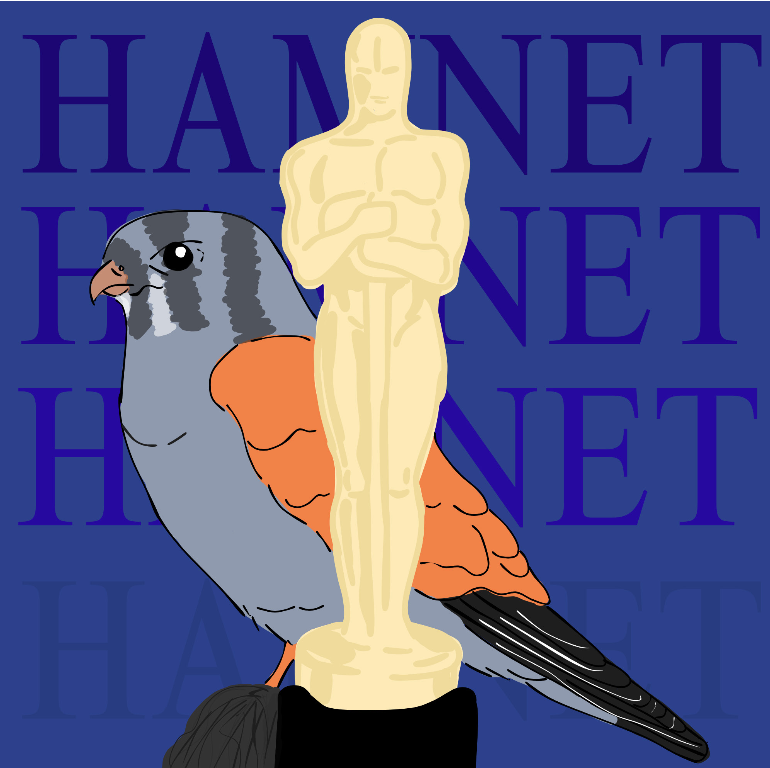
Graphic by Brianna Stockwell ’28
By Chiara Bian ’29
Staff Writer
Chloé Zhao, born Zhao Ting, is a 2005 graduate of Mount Holyoke College. Zhao was born and raised in Beijing and is one of the most acclaimed directors in the film industry, having won two Academy Awards. Her fifth directorial work, and the subject of this review, “Hamnet,” was released a few months ago, in 2025.
For me, this film is like a beating heart. From the first second to the last, I can feel the very pulses of humans, nature and emotions. When the film ended, in a moment of blankness, I clearly heard my own heart trembling powerfully with my stirred breath.
Spoiler alert from here on!
At the very start of the film, Agnes, played by Jessie Buckley, appears as the camera slowly pans down from the lush tree canopy. She is lying on the brown soil in a long red dress, with tree roots winding around her and a dark, bottomless hollowed-out tree beside her. In the background, only the wind, the rustle of leaves and birdsong can be heard. In this quiet environment, I breathe together with the forest and Agnes, the child known as the forest witch.
Later, Agnes meets Will, a Latin tutor played by Paul Mescal, when he visits her in the forest. When Agnes asks to hear a story, he tells her the legend of Orpheus and Eurydice. In this legend, Orpheus, a musician with a moving voice, falls in love with Eurydice, who is killed shortly after their marriage. Grief-stricken, he decides to go to the Underworld to bring her back, overcoming numerous difficulties on the way, before finally finding her. Orpheus was allowed to bring Eurydice back to Earth, but only on the condition that she had to follow him, and he could not look back. Gradually, he could no longer hear her footsteps, only his own heartbeat and silence. When he was almost at the gate of the Underworld, he could not bear it and looked back, trapping Eurydice there forever.
After telling the story, Will looks up and asks Agnes if she likes it. Agnes does not answer. The silence at this moment is a tacit understanding between them, the beginning of their love. Later, they have a child out of wedlock, leading Agnes to cut off ties with her family and move in with Will to marry him. Soon after, she gives birth to their first daughter, Susanna, in the forest. When Will arrives, he picks up the daughter. At this time, the camera moves to the dew-covered leaves and tangled vines. The next scene shows Will jumping into the water, swimming hard forward and then falling into the water. There is no baby's cry in the background; at this moment, only his chest rises and falls. Breathing is not only a symbol of the newborn's life but also a mark of Will's transformation into a father.
Quickly, Agnes is pregnant again and gives birth to twins, a boy and a girl. She names them Hamnet and Judith, respectively. Judith is pronounced dead at birth, but Agnes insists that her daughter is alive. When Agnes holds her in her arms, the baby does not cry, but gradually takes weak breaths. Both children survive. As the children grow, the loving couple teach their children to read, to know the land, and how to use all kinds of medicinal herbs.
Unfortunately, their happiness is short-lived. In Stratford, Judith contracts the plague. Hamnet sees Death in the room. He lies beside his sister and breathes with her, hoping that Death will mistake them and take him instead. The camera shoots from above, and with the faint breathing sounds come Hamnet's whispers: "I give you my life" and "I'll be brave." Judith recovers miraculously, but Hamnet's condition is critical. No matter how hard his mother tries to sprinkle salt and herbs on him, he finally dies in her arms.
At that moment, I thought I would hear a mother's heart-wrenching, continuous wail, with Agnes's mouth wide open, but instead, she cannot make a sound. From that moment on, the loss of her son cries out in her heart every second. Will comes back and is grief-stricken when he sees his son's pale body, but he knows well that the world will not stop turning for this. In the early morning, Agnes silently taps boiled eggs on the table and peels their shells, while Will packs his luggage and is ready to go back to London. Agnes cannot believe he is leaving the family that has just suffered such a heavy blow. The crack of eggshells and the clear sound of a slap signal that a rift has appeared in the family.
Time passes, and Agnes' stepmother, Joan, shows her a playbill for a production of Hamlet in London. Agnes is surprised to find that it is a tragedy, not a comedy as her husband described. She decides to go to the Globe Theatre to watch the premiere of Hamlet.
At first, Agnes is angry that her son's name is profaned. But when she sees William play the ghost of Hamlet's father and speak of his guilt towards his son, she realizes that the play is a tribute to Hamnet. The sword fight scenes interspersed in the play also fulfill the action role that Hamnet dreamed of playing when he grew up, as he told his mother in his childhood.
At the end of the film, when Agnes reaches out to touch the void in the theatre, she is both saying goodbye to her son and accepting art as a form of life continuation. When her son walks towards the dark tree hollow on the stage backdrop, she laughs from the bottom of her heart again. At this moment, Hamlet is a comedy for her, and her alone. It is a reconciliation of personal pain with universal human emotions, and of natural order with civilizational creation. Through this moment, the film reveals its core message: Love can cross the gap of death, and art and memory are the brightest bridges among them.
Through Agnes and Will's different paths, the film shows that true redemption in the face of grief is neither complete forgetting nor blind indulgence, but the act of learning to find a balance between memory and hope, pain and sublimation.
Chloé Zhao’s directorial mark is clearly visible in the film; her focus on the marginalized, her use of natural imagery, and her depiction of the dignity of "failure" all make this historical work resonate with modern audiences. As she said at the 2026 Golden Globe Awards, "The most important thing of being an artist is learning to be vulnerable enough to allow ourselves to be seen."
Through this film, and its beautiful, hopeful, vulnerability, viewers may take away many different messages. For me, this much was clear: we need to listen to every breath we take, whether it is strong or weak.
Emelin Chuquimarca '28 contributed fact-checking.