
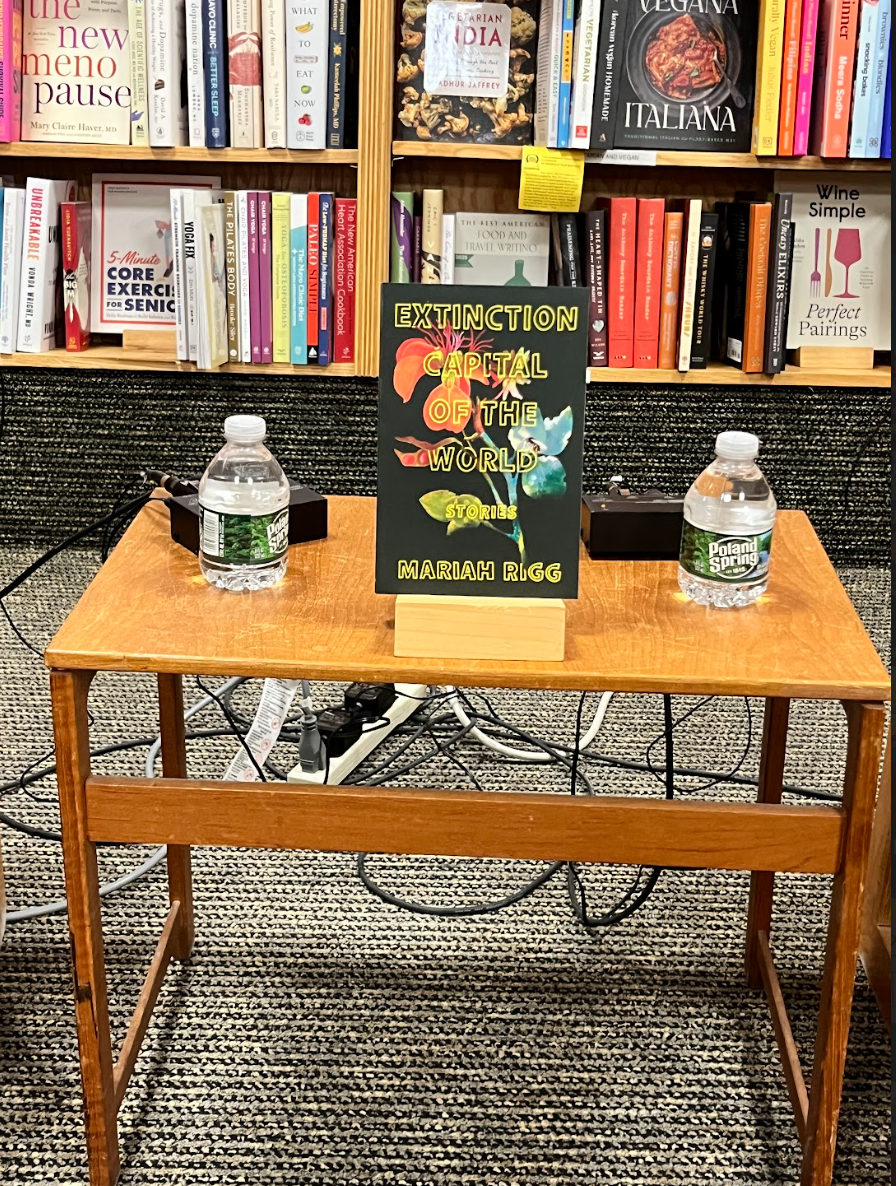
Photo courtesy of MHN
By Honora Quinn ’27 and Cat McKenna ’28
Staff Writers
“Fifty-eight years before Harrison’s granddaughter is born, the U.S. government drops a two-thousand-pound bomb on the island of Kaho‘olawe.”
This is the opening line of the first story, “Target Island,” in “Extinction Capital of the World,” the debut short story collection by Mount Holyoke Fellow and Visiting Lecturer in English, Mariah Rigg. The collection, which quickly gained traction after being released by HarperCollins’ Ecco Imprint in August 2025, has been named a “Best Book of 2025” by Esquire and other publications.
On Feb. 5th, South Hadley’s Odyssey Bookshop hosted Rigg for a reading and conversation with another member of the English Department faculty, Associate Professor Andrea Lawlor, during which Rigg read a portion of “Target Island.”
Ahead of this, Mount Holyoke News was able to sit down with Rigg to ask some of our own questions, ranging from the author’s writing process to the long struggle and resistance against the American Empire in Hawaii, Rigg’s home.
Speaking on that last point, Rigg told Mount Holyoke News, “I hope that my collection is a detour of Hawai‘i for people that kind of have looked at it through a touristic settler-colonial lens in the past,” a sentiment that was returned to at several points during the conversation with Lawlor. In regards to her writing process, she took us on the journey of stitching together the stories for her debut fiction collection.
“I am most classically trained in fiction, my MFA is in fiction, and my Ph.D. is technically in fiction, but it's also English and theory, specifically Indigenous Studies. I actually came out with a creative nonfiction chat book first … But I think that the first book was a short story collection, just because it was what I was most classically trained in, and because it was the thing that I had the most material for,”
The ten stories, ending with the titular "Extinction Capital of the World,” were written over several years, with installments like “Field Dressing” — and the Lawlor-described “Heated Rivalry”-esque “After Ivan” — appearing in Carve Magazine and The Cincinnati Review respectively. But others are original to the collection, further expanding the shared universe on display in Rigg’s previous work.
We asked Rigg which of the stories they think will most surprise readers heading into the collection, and she had this to say:
“Probably the last one, which is the titular story. It's more … veering on the edge of novella, probably more novelette, but it starts off in the point of view of a 50-year-old man who is a professor at the University of Hawai‘i, and so you assume that it's going to be in this guy's point of view the whole time. But then it also jumps into his daughter's point of view in different sections, and actually also tips into … the collective point of view — the “we” point of view — which is actually the point of view of the island and the ancestors. And so I think that … will surprise people. And I think that it's a good wrap up for the collection, in some ways, because it allows some closure, allows many voices to be heard, but also allows for this idea of kind of stepping off into the future too.”
Jumping off of that, we asked Rigg what they hope readers get out of this book.
“I, jokingly, always say that I want readers to stop, or people to stop asking me, why are you here? when I told them I grew up in Hawai‘i, but I think that this idea of pushing against [the] settler colonial images of Hawai‘i is what I really want people to get out of it, and this idea of existing beyond the bounds of imperialism, which is what so many writers are writing towards right now.”
Rigg had these final words of advice for Mount Holyoke students: “A lot of my students in my classes have finished project[s] and don't know what to do with it next. And I feel like just finding a group of people that you can share your work with is one of the most important things, and finding a group outside of the classroom that you can do that with. So often we think that in academia, the classroom is the only place where we can create and be in dialogue with each other. But I think finding third spaces outside of that, and communities outside of that, is so important.,”
“Extinction Capital of the World,” the debut short story collection from Mariah Rigg, is available now wherever you purchase your books.
Sophie Francis ’28 and Maeve McCorry ’28 contributed fact-checking.