
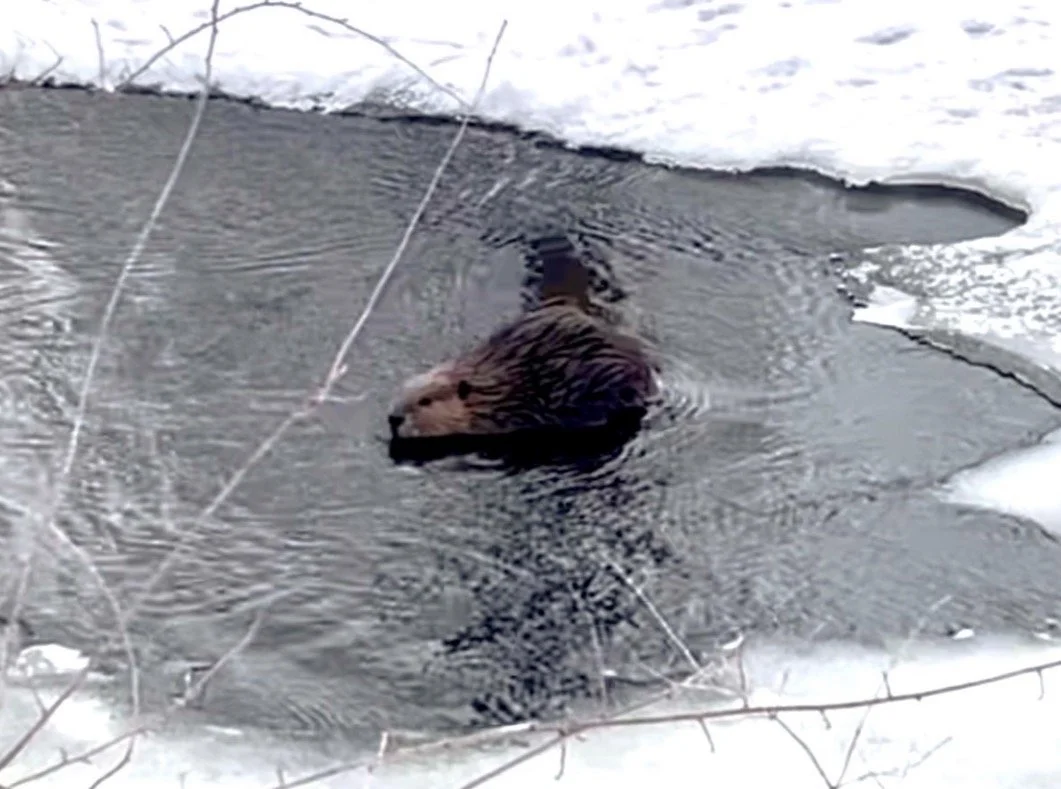
Photo courtesy of Nicole Lasko ’28
Even in the cold, North American beavers keep on swimming! Here’s one in Lower Lake last year.
By Sam McKay ’29
Science & Environment Editor
The North American beaver is the largest rodent in North America and the second largest in the world. Beavers live in pretty much any freshwater area and build dams out of sticks, logs and mud to naturally direct waterflow. They are constantly working to create wetlands and ponds. According to the U.S. Fish & Wildlife Service’s website, their work mitigates climate change impacts by conserving water and carbon storage. They are also very effective flood managers; their dams let water flow but keep the flow in check, not letting too much get through at once.
Beavers are well equipped for land and water, as they have webbed back feet that allow them to swim quickly and also help them balance on land. Beavers’ eyes have three eyelids to protect their eyes from sticks and twigs while their nose and ear canals can shut fully to keep water out. Their feet have special nerves that help them sense predators while on land by feeling vibrations through the ground. Beavers have 20 teeth, but the four in the front are the largest. Their teeth never stop growing so they have to keep chewing on branches to keep them short. The front teeth are used to cut down trees while the molars in the back are used to grind the wood.
Beaver tails are thick, flat and kind of scaly or leathery, which make them more flexible. While the tail is often thought of as a paddle for swimming, it has other uses as well. They use their tails to balance when cutting and carrying sticks, as well as an alarm call. When beavers sense danger they slap their tail against the water in a shockingly loud and effective alarm. This alerts other beavers in the area of danger and can also scare off predators.
Beavers are herbivores and eat mostly plants and trees throughout the year. Before winter, beavers will store edible sticks in the mud by their lodge. This allows them to stay warm inside and not have to travel far to get food when it’s cold. Lodges have underwater entrances to allow discreet entry and exit. Lodges often house two adults and some offspring, Beavers will mate for life but if their mate dies, they will mate with a new partner.
Human intervention has severely impacted North American beavers through infrastructure, logging and human-made dams. During the North American fur trade, the beaver was trapped and killed for their fur excessively. While beaver populations are currently stable, that was far from the truth in the 17th century. Beavers disappeared from many regions and have only recently been popping up again. Trapping from European colonists also harmed Indigenous communities across the U.S.
Mount Holyoke College has at least one beaver pair on Upper Lake! If you keep your eyes peeled this fall, you might catch one drifting through the water munching on sticks. Do be careful if you’re walking your pet though: while they may look cute and fuzzy, beavers can be very territorial. They have two scent glands at the base of their tail that release castoreum. This is a pheromone that is used to claim territory, and if you’re within their territory they will release this pheromone and scare the daylights out of your cat – definitely not from real experience!
Jules Sena ’30 contributed fact-checking.
