
Photo Courtesy of Kami Nishi-Leonard
By Madeleine Diesl ’28
Copy Chief
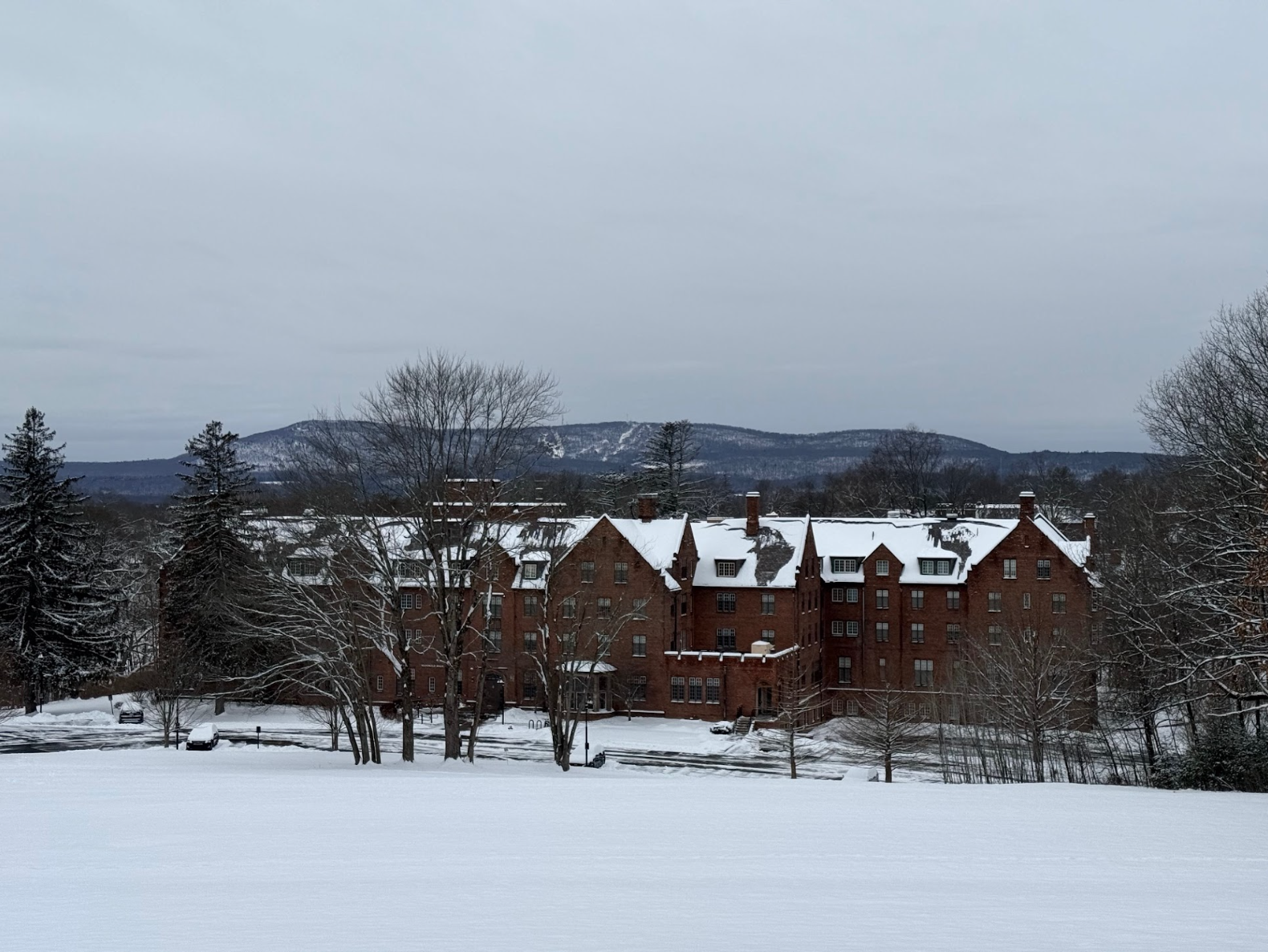
For many Mount Holyoke students, travel back to campus for the spring semester was interrupted by the large winter storm that blew through much of the eastern United States on Jan. 25 and Jan. 26. Since then, western Massachusetts has suffered consistent low temperatures and high wind chill, prompting several cold weather safety emails from the Division of Student Life and the Office of Residential Life.
During this storm, South Hadley saw around two feet of snow and wind chill temperatures as low as -12 degrees Fahrenheit. According to Visiting Assistant Professor in Geology, Kinuyo Kanamaru, these weather events were the result of “a weakening of the polar vortex.”
The National Weather Service defines the polar vertex as “a large area of low pressure and cold air surrounding both of the Earth’s poles.” Kanamaru, who teaches climatology classes at Mount Holyoke College, said that the weakening of this vortex “allowed multiple surges of Arctic air to move southward,” causing both the January snowstorm and the February low temperatures.
“In particular, this winter’s snowstorms were influenced by La Niña conditions, which typically bring colder temperatures and above-average snowfall to the New England region,” Kanamaru said. La Niña, according to the National Weather Service, “refers to persistent colder-than-normal … sea surface temperature anomalies across the central and eastern equatorial Pacific.”
However, Kanamaru also mentioned the storm’s possible connection to climate change: “Reports from the Intergovernmental Panel on Climate Change (IPCC) indicate that as global mean temperatures increase, there is a strong trend toward a weakening polar vortex. … When this cold Arctic air moves southward and interacts with relatively warmer mid-latitude air, it increases the likelihood of precipitation. As a result, the New England region is projected to experience increased precipitation, especially during the winter season.”
Looking forward, Kanamaru said that “while it is difficult to attribute recent snowstorms directly to climate change, it is likely that climate change will contribute to more frequent and intense winter precipitation events in the future.”
Though it may seem like a winter wonderland, this frosty environment can be dangerous. To stay safe during inclement weather, Residential Life recommends staying indoors as much as possible with your windows closed properly. When going outside, make sure to wear layers and cover your extremities to prevent frostbite.
Abigail McKeon ’26 contributed fact-checking.