
By Madeleine Diesl ’28
Copy Chief
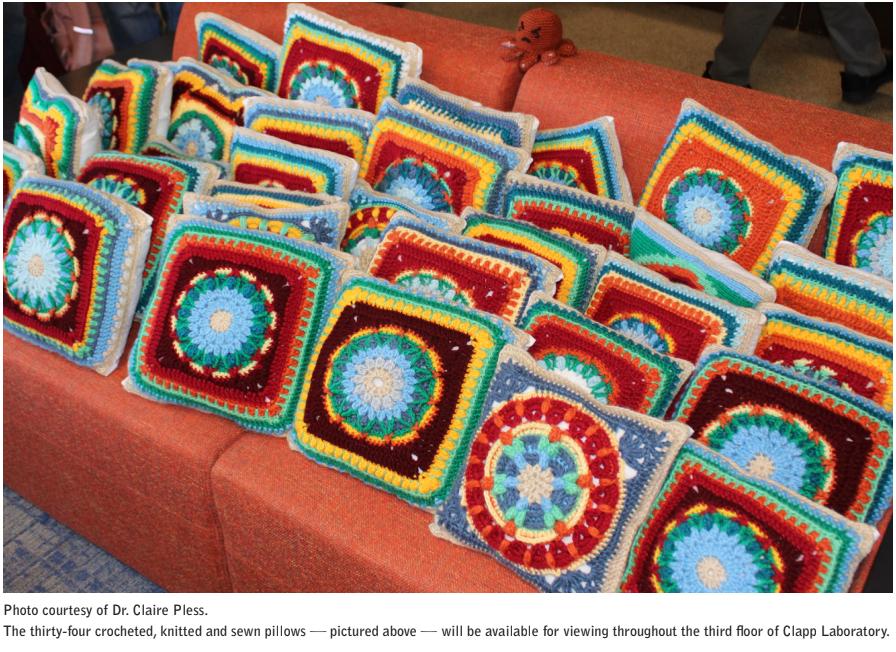
On Thursday, May 7, students and faculty gathered by the Clapp Laboratory third floor stairwell to enjoy pillow-themed snacks and celebrate the hard work of Geoscience Technician and Staff Instructor Dr. Claire Pless, as well as the twenty-six students and alums who have been working with her on a science-arts fusion that has become known as the “Temperature Pillow Project.” Now, the product — thirty-four crocheted, knitted and sewn pillows, each representing a different year of South Hadley monthly temperatures — is complete.
“The project is a display of how the average temperature has changed in South Hadley over the past thirty-eight years or so,” Pless explained in an email interview with Mount Holyoke News. “Each pillow is crocheted or knit by a student [or myself] for a single year, with each row representing the average monthly temperature. The colors [were] assigned by 5 degrees Fahrenheit increments, going from cooler colors to warmer, from below 20 degrees to 80 degrees.” This resulted in each pillow having a unique pattern of colors.
Pless then elaborated further on the process of making the pillows. “The G&G department supplied the materials, which we first had to portion out into the colors needed for each year and distribute to each student. Once the students had their squares made, I sewed and stuffed them into pillows. The pillows are labeled with the student's name, class year, the year they represent, and for the significant La Niña or El Niño years, an ‘A’ or ‘O’ respectively.”
According to NOAA, La Niña and El Niño are global climate patterns that occur irregularly every few years. In the northeastern U.S., El Niño events are characterized by warm, dry weather, while La Niña causes cooler temperatures and heightened precipitation. This winter, for example, New England experienced La Niña conditions.
“I got the idea for the project when I went to a conference about a year ago,” Pless said. “The session was on interactive pedagogy and one person had an ongoing temperature blanket that had a hexagon representing the average temperature for each of the last ten years. I had done my own temperature blanket of daily high and low temperatures for the full year of 2021 and was interested by the idea of a project that I could include student crocheters on.”
Pless expressed surprise at the number of interested students. “I expected this to be a maximum of [around] ten students in the Geology department, but once I advertised it, I got so much more interest in it than that initial expectation, and it got sent to the knitting club, so it became more of a campus-wide project.”
When asked if recent climate change could be observed in the pillows, Pless said that “the trend of increasing warmth that we may have expected to see in this project, while there, is not as distinct as it could have been.” She explained that this was likely due to the fact that the project used “the average temperatures for a full month, rather than displaying the highs and lows.” Temperature data was collected from temperature-blanket.com.
However, there were some interesting years recorded. Specifically, Pless mentioned that 1992 was an “unusually cool [year], with summer temperatures not getting above an average of 65 degrees.”
“We know, geologically, that in 1991, the volcano Pinatubo erupted, sending ash particles into the atmosphere, where they stayed and circled the globe, causing a cooling effect that was seen in 1992,” Pless explained. “That was the coolest thing I saw in this project.”
2000 also revealed itself to be an unusually chilly year, but the reason for this is uncertain, Pless said.
“This project could potentially continue … which is a neat prospect,” Pless added. She mentioned that there was not yet a pillow for the year 2025, so that could be a good start.
If you’re interested in taking a look at some of these pillows, they can be found on the couches in the third floor landing of Clapp Laboratory, as well as scattered about the environmental studies, geology and geography lounge.
Maeve McCorry ’28 contributed fact-checking.