
Photo courtesy of Emma Backbier ’27
BY MIRA CRANE ’27
GLOBAL EDITOR
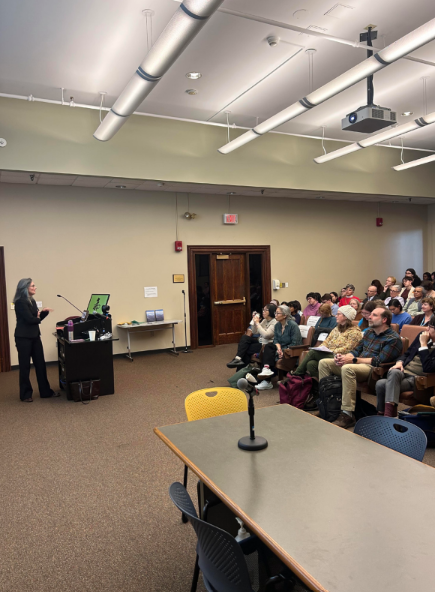
The John Lax Memorial Lecture in History on Oct. 21, 2026 was given by Professor Ruth Rogaski of Vanderbilt University, who provided a fascinating history of a cross-cultural medical development titled “American Qi: Globalized Chinese Medicine in the U.S. South.”
Rogaski was introduced by Professor Lan Wu, chair of Mount Holyoke College’s history department. The Lax lecture began with Rogaski discussing what brought her to the topic of Chinese medicine in the American South.
Rogaski explained that she’d studied how medicine from Europe and the United States shaped health and healing practices in China, but did not think about how this relationship could go the other way until she moved to Nashville, Tenn. and truly saw the influence of Chinese medicine in the American South.
Using the central questions of how Chinese medicine came to the American South, and in turn, how the American South understood Chinese medicine, Rogaski launched into three vignettes. These stories illustrate three crucial developments in this narrative involving Qi — meaning “energy”— a Chinese medical concept that serves as a framework for understanding living systems, according to the Colorado Chinese Medicine University. Through this lecture, Rogaski sought to tell the story of how Qi came to the South, how it moved through and connected to local networks, and how Qi became identified as something American.
Rogaski called her first vignette “A Tale of Two Graves,” which refers to two very different tombstones honoring deceased Chinese-Americans in Chattanooga, Tenn.
One worn-down tombstone belonged to an early Chinese resident of the city. Rogaski explained that there was a small Chinese community in Tennessee in the 19th century, as a result of 400 Chinese laborers being brought over to construct a railroad after formerly enslaved-African Americans had refused. The laborers toiled under abusive conditions, and the enterprise ultimately collapsed, leading most of this fledgling Chinese community to leave Tennessee.
A small group stayed and established businesses, but Tennessee was hardly a welcoming space for them or their traditional practices. Rogaski noted the context of the legacy of slavery and the Chinese Exclusion Act, which created a social environment that was not conducive to the spread of Chinese medicinal practices.
However, a second and far more ornate grave in the same Chattanooga graveyard dating from the 2000s suggests how Chinese presence in the American South took an unexpected trajectory from its origin of exploitation and exclusion. The grave in question belonged to Yeu Quang Wong, Ph.D. who was born in 1939 to a family of martial artists and medical practitioners. In Tennessee, beginning in the 1970s, Wong taught Kung Fu, lectured on Chinese medical philosophy, and treated patients with acupuncture, which was illegal at the time. Wong helped make Qi legal in Tennessee, and used space in local newspapers to educate the local populace about Qi. According to Rogaski, Wong’s story demonstrates how a marginalized group of people were able to take advantage of cracked doors to create opportunity.
Her next vignette, “The Black Doctor and the Black Panther,” adds an important piece to this history: The role that Black doctors and activists played in paving the way for Qi’s popularity in the American South.
Rogaski discussed a 1972 visit to China that U.S. President Richard Nixon and the National Medical Association, an African American group, participated in. The visitors were invited to witness a procedure done only with acupuncture as anesthesia, and became amazed at the capabilities and financial accessibility of the practice.
The Black doctors quickly began introducing acupuncture to the American South when they returned, including Dr. Ralph Cazort, a professor at a medical college in Nashville, Tennessee. His work led to an influx of coverage of acupuncture and Chinese medicine in the city press, and the first acupuncture clinic in Nashville, which was opened by a Black physician.
Rogaski also argued that Black acupuncturists in the South claimed that the practice was not exclusively Chinese, and in fact had originated on the African continent in ancient Egypt. However, they had believed that Qi was something that belonged to everyone. Illustrating this philosophy, Rogaski told the story of Umaru Jutte, who was exposed to acupuncture as a method of addiction recovery while working for the Black Panther Party in the 1970s. He brought acupuncture practices to Nigeria during the then on-going Rhodesian-Bush War before returning to the United States and relocating to Nashville.
Rogaski’s last vignette, “The Acu-Detox Evangelist” was about acupuncture-detox treatments in the American South. Rogaski claimed that the practice of acu-detox offers Americans with substance abuse issues a path to healing with a reinterpretation of Qi.
She explained that the practices of acu-detox were created by a French physician, before becoming a subject of research in the People’s Republic of China and then emerging as a popular medical practice in the Bible Belt of the United States.
Rogaski noted that the National Acupuncture Detoxification Association protocol, which continues to guide contemporary acu-detox, grew out of this period of the United States embracing Qi and Chinese medical theory. She connected the idea of Qi as a higher power in acu-detox to common modes of seeking recovery and healing in American society, such as the twelve-step program and the Serenity Prayer, which was adopted widely by Alcoholics Anonymous in the mid-twentieth century, according to online Christian prayer source Pray With Me.
The concept of “American Qi” emerged from this trend of acu-detox treatment and the encounter between Chinese medicine and Evangelical Christianity. In Rogaski’s words, wider themes of sin and redemption guide American Qi, in which the needle functions as a type of grace in the process that bears resemblance to the Christian ritual of communion.
Rogaski ended her lecture by saying that her work brought her to see the American South in a different light, as a global crossroads of healing. Critically thinking about commonalities between different cultures and flattening prevailing hierarchies, she concluded, can provide us with new insights into globalization.
After the conclusion of Professor Rogaski’s talk, there was a Q&A portion, and then a reception, during which signed editions of her latest publication, “Knowing Manchuria: Environments, the Senses, and Natural Knowledge on an Asian Borderland,” were raffled off to students.
The annual John Lax Memorial Lecture in History is sponsored by the Mount Holyoke Department of History, and named in honor of the late faculty member John Lax.
Sylvie Jarman ’29 contributed fact-checking.
