
Photo courtesy of Carly Celestin
By Kiera McLaughlin ’26 & Alia Bloomgarden ’29
Global Editor | Staff Writer
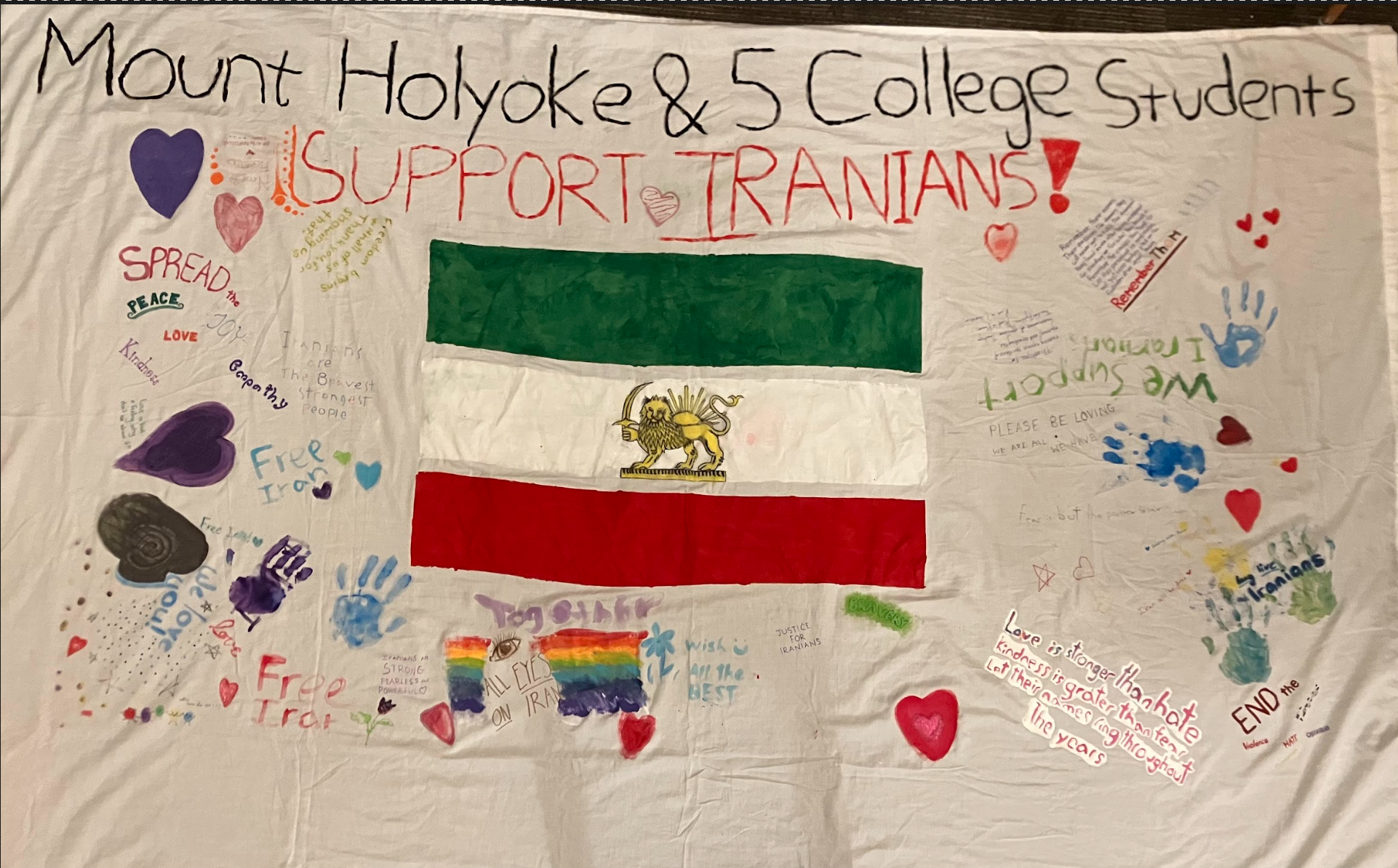
On Feb. 7, Mount Holyoke College and Five College students gathered to stand in solidarity with Iranian protesters at a vigil in North Rockefeller Hall.
Demonstrations across the country began on Dec. 28 after the Iranian currency “plunged to 1.48 million to the dollar,” Time Magazine reported. On the same day, this forced merchants to close their businesses as well as Iranian citizens to watch their money lose worth as the day continued.
Professor Parsa Peykar of Pepperdine University discussed his personal history with Iran in an interview with Mount Holyoke News, “I remember always my parents talking about how different it was [before 1979]. … We were never a threat to the world … we were a very peaceful nation.” Peykar was born in Iran in 1992 and holds a doctorate in Industrial and Organizational Psychology from Liberty University.
Amnesty International noted that while the protests were prompted by the economic crisis, “Protests turned into mass nationwide street demonstrations calling for the end of the Islamic Republic system. Protesters are demanding fundamental change and transition to a new system of government that respects peoples’ human rights and dignity.”
Peykar has found that Iran’s government has impacted the way Iranians are perceived around the world: “[The 1979 Revolution] took us back to so many years and also gave this image of Iranian people that we are like that … there are times … when I travel and people ask me where I'm from and I say Iran, they get a little scared.”
“They don’t know who we [Iranians] are,” Peykar said. “We are very different than what you see, these official leaders of current regime.”
Protesters in Iran have been met with riot police, tear gas and bullets, according to Time.
During the demonstrations, the government has also cut the internet in a national blackout to conceal their crimes, Amnesty International reported.
Peykar believes the ongoing protests in Iran are different from previous dissent. “I see more unity among Iranians, you know, around the world. There was one protest in Toronto, Canada, I heard 80,000 people came. And it would be such cold weather, too,” Peykar stated.
“And of course, the people in Iran, too, I think they're much more united.”
At the vigil on campus, there were posters with photos and information about individuals murdered in the protest. Speeches and public comments were held in front of the Iranian flag and a poster of the people killed during the current demonstrations.
When asked about the U.S.’ relationship with Iran, Peykar said, “I think part of what U.S. is doing, which I think is very good for the world and for others, is to show that the narrative [the Iranian government is] telling is not true. … I do believe they're not going to have any sort of deals with them because it's not possible. I think on the Iranian government side they're trying to buy time because they think if this term of Trump ends, they can deal with the other governments because they're not going to be as tough … on them.”
“They're trying to buy their time, but I don't think it's going to happen,” Peykar stated.
Around 20 Mount Holyoke students participated in the vigil and created a community banner together reflecting their support for Iranians.
“I'm very hopeful. Of course, I feel we are experiencing … a pain now. And with any type of revolution and change, it's like a mom giving a birth to a child. There will be that pain,” Peykar said. “But Iran has a great future.”
Madeleine Diesl ’28 contributed fact-checking.
Editor’s note: The vigil on campus was organized by staff writer Alia Bloomgarden ’29.