
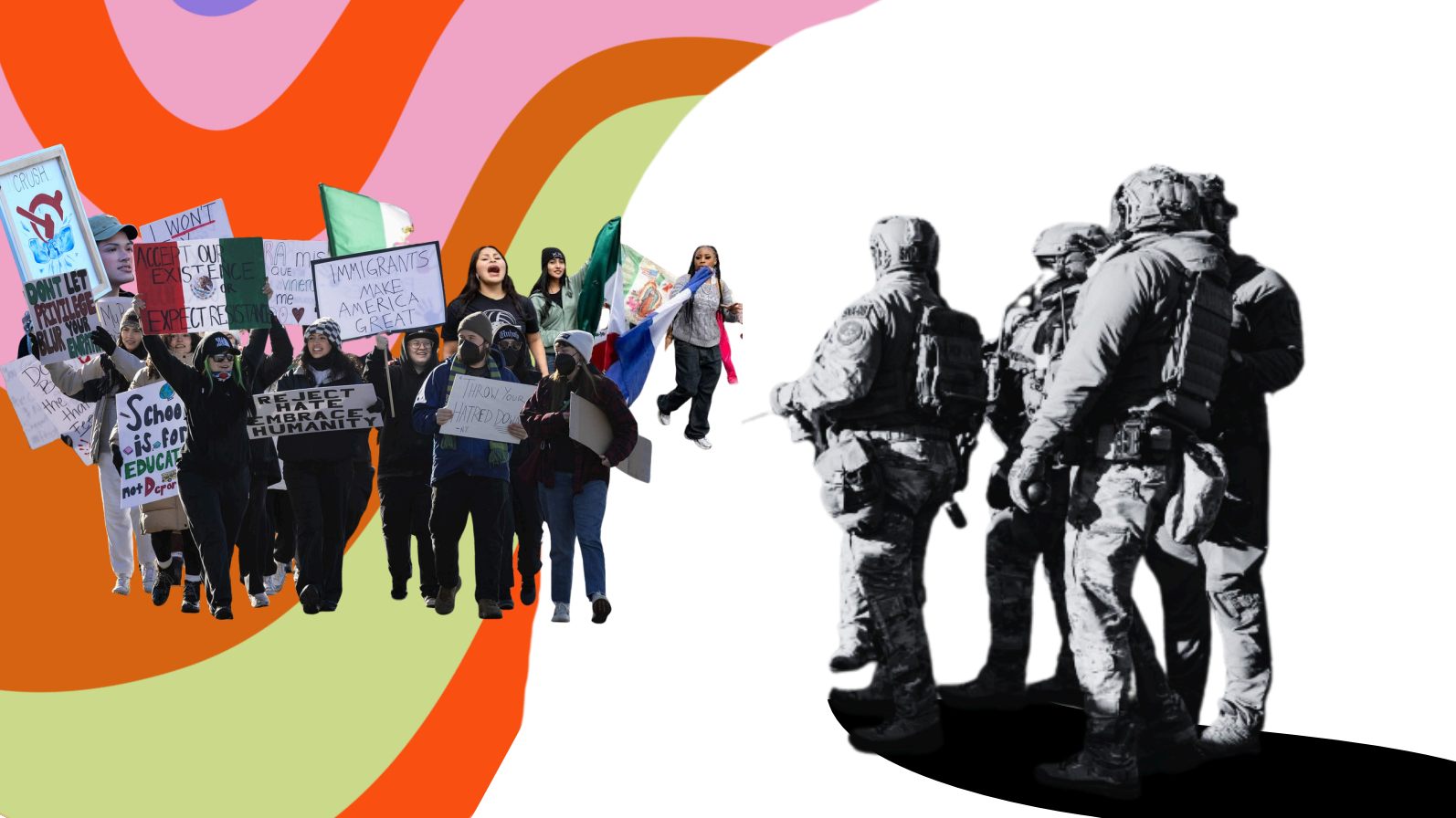
Graphic by Mari AlTayb ‘26
By Sarah Ann Figueroa ’28
Staff Writer
Friday, Jan. 30, guest speaker Erik Esqueda Sánchez from San Diego State University joined Mount Holyoke students and faculty for the “Activism sin Fronteras: Legacies of Liberation and Community Mobilization” workshop, held by the Office of Diversity, Equity, and Inclusion. Centered around peer collaboration and group discussion, the workshop provided its attendees with fresh perspectives on how they can help protect members of their community who may be targets for U.S. Immigration and Customs Enforcement, commonly called ICE.
The official description of the event reads, “This workshop will cover a brief history of undocumented and migrant movements within U.S. context and explore strategies for leveraging your own talents and knowledge to co-build activist spaces.”
Coming all the way from California, this was Sánchez’s first time in Massachusetts. They expressed that they have always wanted to visit Massachusetts, so the excitement to be here outweighed how cold it was. Sánchez is the assistant director of SDSU’s MEChA, the “Movimiento Estudiantil Chicano de Aztlán,” or, in English, “Chicano Student Movement of Aztlán.” Growing up with the MEChA program, they view the work they do today as “Giving back everything that was given to me.”
After introductions around the room, Sánchez made mention of the ongoing ICE raids in Minnesota’s Twin Cities, Minneapolis and St. Paul. On the day of the workshop, residents of these cities called for a nationwide strike against the raids, also referred to as the “ICE OUT” protests. As written in an article by Kimberlee Kruesi and Holly Ramer with the Associated Press, “Protesters held ‘no work, no school, no shopping’ strikes across the U.S. on Friday to oppose the Trump administration’s immigration crackdown.”
A summary of these events, as read during the presentation, states “State violence and criminalization are escalating / We are witnessing murders of civilians in real time / Communities are grieving, mobilizing, and resisting simultaneously.” Sánchez explained that the Activism sin Fronteras workshop was intended to be an extension of this movement, as the information being taught is rooted in the same resistance as the protests in the Twin Cities.
Solidarity with those in Minnesota could be felt throughout campus that day, as students had participated in the strike, and many flocked to the Amherst Common that afternoon to join the ICE OUT protest being held there. Additionally, Sunrise MHC held a student walk out and study-in one week later on February 6, responding to calls from high schoolers in Minneapolis asking other students across the nation to strike in solidarity with them.
With a student body made up of about 20% international students, many people at Mount Holyoke College have expressed concerns for those who may be vulnerable in the event that ICE arrives on our campus, especially since agents have already been seen in nearby towns like Northampton and Amherst. These fears are not unfounded. As the American Immigration Council has stated, “American communities are now seeing a level of immigration enforcement utterly unprecedented in modern history … the conditions that have resulted from this rapid expansion for those caught up in the detention system have increasingly worsened and become more inhumane.” With a combination of the president bypassing due process laws and ICE agents heavily employing racial profiling, legal status offers international students little protection against these targeted attacks. Even if one may not be deported in the end, the trauma that comes from going through the intensifying immigration system merits the protection of those most at risk.
Though the circumstances were grim, Sánchez’s teaching filled the space with hope. Examples of past movements that reflect times similar to ours were given, and together the attendees examined them to determine what has worked in the past that can be applied to current organization strategies. In particular, the workshop focused on the Undocumented and Unafraid movement from 2010 and the Ethnic studies walkouts of the late 60s. The slideshow listed effective tactics used in these movements as, “Civil disobedience, sit-ins / Legal advocacy, policy pressure / Mutual aid and rapid response networks.”
After analyzing these historical examples together, Sánchez noted, “Students have done badass things throughout the history of higher education,” also reminding, “This movement is not new, it’s only intensified.”
The latter half of the workshop focused on the individual, and how one may leverage their own aptitudes to contribute to a cause, such as protecting communities from state violence. Using the Slow Factory’s “Roles for Collective Liberation,” attendees talked about which roles they identified with, and how they could see themselves using their skills with an activist lens. The list of roles contains both creative and pragmatic options, finding space for everybody in a movement.
The workshop culminated with students applying everything they had learned to address the hypothetical but strikingly realistic case study scenario of ICE interference on our college campus, a conversation that has been brewing amongst Mount Holyoke students since last semester. Imagining what to do in emergency scenarios is a complex and mentally heavy topic, often meaning that there will never be one right answer for how to handle them. However, the group effectively addressed what not to do in this scenario, concluding that acting out of anger and without a plan would be the most detrimental to the cause of keeping everyone safe. Many agreed in the end that organized, strategic collaboration and thorough communication are the keys to making it through a situation like the one described in the case study. What that looks like may be different for different individuals, but no matter what, our community coming together to help keep one another safe is essential.
After the workshop concluded, Sánchez agreed to a brief interview with Mount Holyoke News. Reflecting upon the event as a whole, they shared, “My goal … was just to move people from … a place of powerlessness, or feeling like they didn't have an opportunity to be part of a movement.” When asked if they had a message for the Mount Holyoke community, they said, “Keep being critical, to keep questioning, to keep building relationships with one another, and to find the ways that feel good for you to engage during this difficult time.”
Jillian Stammely ’28 contributed fact-checking.