Final senate of the 2025-2026 academic year holds budget vote

By Sarah Ann Figueroa ’28

Staff Writer

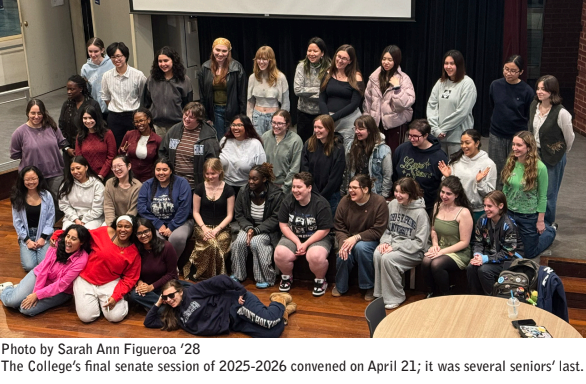
The final senate of the 2025-26 academic year, held on April 21, would be the last senate for many of the executive board members of the Student Government Association, including Senate Chair Coco Athas ’26.

Before the senators began the yearly budget vote, Athas gave her routine rundown of the weekly events, such as end of semester destressers and celebrations. With the change of seasons and upcoming festivities like Pangy Day, student organizations across campus are preparing their final gatherings of the year to give their communities the break they deserve. Once these brief announcements were made, Gabi Mello ’26 took the stage to go over the SGA’s budget.

The total collected from student activity fees this year was around $571,000. For the majority of the last senate, senators were given information about where these funds for the upcoming academic year would be going. A majority of the changes made to the budget for next year were increases in funding for various departments of the College. The Office of Residential Life and the SGA Ways and Means committee will both be receiving extra funds. For the cultural centers on campus, a $7,000 increase was allocated to keep them functioning and to support the events they hold throughout the year.

Chapin Auditorium is the hub for many of Mount Holyoke College’s annual events, both held by the College and by student organizations. The SGA has recognized this and will now be designating funding for events specifically held in Chapin, so all organizers may have the money they need. It is unclear yet how this money will be distributed evenly throughout the semesters.

Overall, the total for next year’s budget comes out to just around $702,000, almost $200,000 more than what was available from student activity fees.

The floor was then opened to a Q&A for senators to ask any questions they had about the new budget. One individual asked about the funding of an upcoming project for health and wellness vending machines around campus. SGA president Nathania Amadi ’26 provided a bit of insight, explaining that these vending machines will be stocked with a variety of hygiene products and over-the-counter medications which are not easily accessible on campus. SGA will be providing a portion of their funding to this project. Students can expect to hear more information about these vending machines in the 2026 Fall semester.

When it came time for the vote, Athas instructed the senators to raise their hands and say “aye” if they agreed to the proposed budget. The vote passed, and Athas took the stage again to conduct the remaining event announcements.

At the end of the senate, a small pinning ceremony was held for senators who would not be returning next year. A song akin to that which is played at an official commencement began, and each senator received a pin and gave an impromptu speech about their time being part of senate. Continuing with the humorous vibes, Athas gave a statement at the end of the ceremony, saying, “I just want to take a moment to thank everybody for their service … I know not everybody wanted to be here. I recognize that … Not all heroes wear capes.”

A group photo was taken with all of the senators and SGA executive board members, commemorating the final senate of the 2025-26 academic year. To the future executive board members in the room, Athas left them with a piece of advice that exemplified her time in the position of senate chair. “You are only as good as your best ice breaker.”

Abigail McKeon ’26 contributed fact-checking.

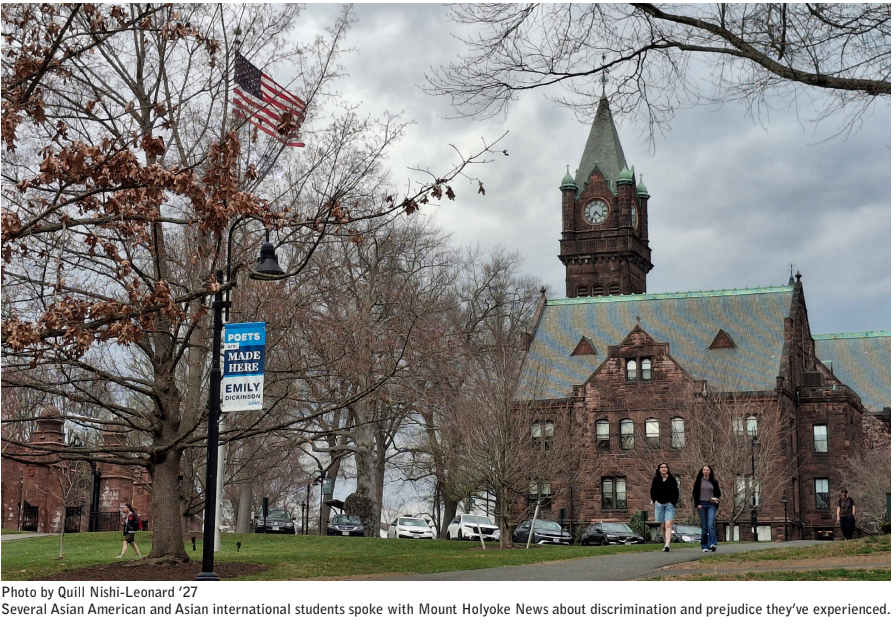
Asian, international students face hate: ‘I don’t feel safe’

By Quill Nishi-Leonard ’27

Editor-in-Chief

On March 11, 2026, Mount Holyoke College President Danielle Holley sent out an email to the Mount Holyoke student body announcing a tuition increase, which was “based on inflation as well as skyrocketing costs for health care, operations and utilities.” This change came following at least two other successive tuition raises — the College’s annual tuition in 2022-2023 was $58,280, over $10,000 less than 2026-2027’s $71,178 —  and instantly provoked student backlash across campus. 

While most criticism of the raise focused on the price increase itself, some students took to social media to direct their frustration at Asian and international students. Several anti-Asian and xenophobic comments were posted on Fizz, an anonymous social media platform for college students. Some posts read, “can the Asian internationals please let us know why they came all the way to America for an education?” and “you [international students] should’ve went to a more affordable institution … or better yet... maybe one in your home country.”

Dean Marcella Runell responded to the comments in her March 13 Dean’s Corner, stating, “The anti-Asian and xenophobic sentiments appearing on anonymous platforms like Fizz in response to the tuition letter are causing significant harm. I am hearing directly from your peers that they feel targeted and unwelcome in the very community that is meant to have their back.”

“This most recent behavior is not who we want to be. It stands in direct opposition to the care we owe one another and is fundamentally at odds with the Mount Holyoke Honor Code and our commitment to an inclusive environment,” Runell wrote.

Fizz: An ongoing issue

However, the comments posted to Fizz following the tuition raise were not the first of their kind that Asian American and international Mount Holyoke students have experienced in the 2025-26 school year. 

Just a few days prior, an anonymous account on Fizz had posted, “Just saw 3 Asian international students eat [at] blanch, get up, and leave their food/plates once they were finished. You know who you are...” 

According to several witnesses present at the scene, the students targeted by the post had only left the table to get ice cream. Many Asian American and Asian international students were hurt by the post and the sentiments it expressed. 

Liz Li ’28 and JJ Guo ’29 wrote about the post to the President’s Office in a March 12 email, saying, “Regardless of the underlying circumstances, the deliberate and unnecessary identification of ‘Asian international students’ in this public accusation is harmful, discriminatory, and reflects a pattern of targeting individuals based on their ethnicity and perceived national origin.”

“The phrase ‘You know who you are’ further lends a threatening and intimidatory tone to the post,” Li and Guo stated.

According to an international first-year student, who has asked to be referred to as Alex for this article, the President’s Office didn’t respond to the email for almost a month. “It took approximately three weeks for the administration to issue a response, and when it came, it felt delayed, generic, and disconnected from the urgency of the situation,” Alex wrote in an email to Mount Holyoke News.

Several hateful posts also circulated on Fizz during the fall semester, after a paper outside of Ham and MacGregor halls was discovered with the words “ching... and so” written on it. 

One anonymous post made shortly after the discovery stated, “What am I missing here? The word ‘ching’ is not racist.” Another read, “hot take some of y’all are begging to be discriminated against like the sign thing.”

Prejudice on campus

For many Asian American and Asian international students, these posts are the direct result of a hostile campus environment. Mount Holyoke News spoke with several to gather their perspectives on the situation.

Angela Kim ’28 stated, “I personally feel that these online incidents are reflective of the campus climate as a whole. The anonymity of Fizz and distance from the institution allow people to get away with hateful sentiments.” 

“Since the institution has made it clear that they can’t get involved in the moderation process, the true solution is to fix campus climate and educate students. This means that not only will students not publicly express these sentiments, but also feel them in the first place,” Kim said.

Liz Li ’28 shared a similar sentiment during an interview when discussing some of the Fizz posts from fall 2025: “I think that's the first time I realized … how widely the anti-Asian [hate] is on campus.”

Alex had parallel experiences outside of social media. “I have experienced clear microaggressions in academic settings. In my first-year seminar, when my fellow international students and I contributed to discussions, the professor would repeatedly say he needed to ‘translate’ our sentences for domestic students, even though we were speaking clear and simple English,” they wrote.

“More broadly, my experience does not align with the College’s portrayal of a ‘close-knit’ and supportive campus environment,” Alex stated.

Microaggressions are reportedly not an uncommon experience on Mount Holyoke’s campus for those of marginalized identities. In an email to Mount Holyoke News, Susan Jiang ’28 stated, “Something else that really left an indelible mark on me is that last semester we did a microaggression survey on campus, and found out that microaggression, heartbreakingly, exists in the living experience of many around us.”

Some students found the College’s response to the ongoing issue of anti-Asian hate and xenophobia on campus and online to be at odds with its commitment to diversity and inclusion.

“The College administration has had mixed responses to these incidents, but overall, I do not feel sufficiently supported by the College,” Kim stated. “Oftentimes … they don’t provide systemic or upstream solutions, so similar incidents can continue to occur.”

“I do not believe the College’s response has been adequate or proportionate to the seriousness of these incidents,” Alex wrote. “When harmful behavior is not addressed promptly and clearly, it sends the message that anti-Asian and anti-international student hate is, in practice, tolerated on this campus.”

“It’s taken forever to send out a statement, to send out an announcement, and we have to keep asking them to do that,” Li said. “They’re just saying, like, ‘International students or Asian students are important to us’ and … there’s a resource, like counseling … but those things … they are helpful, but they are not at the institutional level.”

Mount Holyoke News reached out to Christian Feuerstein, the College’s director of public affairs and media relations, and received a statement from the College: “Mount Holyoke College is committed to ensuring that every student is supported and respected. This emphatically includes Asian American, Asian international and all international students. We affirm that everyone on our campus deserves to be safe, to feel at home and to know that they belong.”

The statement continued, “We are also currently in an active dialogue about campus culture on anonymous apps like Fizz. Students have petitioned to have our Honor Code, which is the backbone of our community, explicitly applied to how we treat one another in digital spaces. The administration is working with student groups to find ways to maintain the safety of our community in these anonymous environments. When we are made aware of something potentially harmful or threatening we have asked Fizz to remove the post. However, they are an independent entity which functions as a for-profit business, and we are typically not successful as they are not obligated to cooperate with us.”
It’s unclear which students and student groups the College is in dialogue with, and what those discussions look like.

A lack of clarity surrounding students' rights — especially those of international students — and what students can do if they’ve experienced prejudice or discrimination on campus was also a common subject during interviews.

 Li stated that an overhaul of the anti-discrimination training new students receive would be helpful: “[Students] don't really know [their rights] until I tell them … but they also have lots of concerns,” Li said. “Like, for example, if they feel microaggression from their professor who they're taking class with, and if they report it, what's going to happen? Will that impact their grade or something?”

Training should also include clearer guidance about “what kind of thing will be regarded as microaggression,” Li said. “And if that happened, what do you do?”

Activists called into disciplinary meetings

Li, Alex, and Kim all stated that several students have been called into disciplinary meetings by Residential life for actions they undertook to raise awareness about issues Asian American and Asian international students have been experiencing at the College.

“I know three students who have been called in for disciplinary meetings. But just for really small things, like [writing in] chalk, put a poster on a table, or just try to post something, like a meme, on a padlet,” Li explained.

“This hasn’t happened to me, but it has happened to multiple students that I know,” Kim shared. “These meetings are systematically broken.”

Alex spoke about one specific incident: “A friend of mine was called into a disciplinary meeting after posting a ‘run away’ meme that had not even been approved on the Experience MHC padlet. Despite this, she received a formal notice in 24 hours stating that her behavior had ‘seriously disrupted other students’ educational experience,’ which is hard to understand given that the content was never seen by others.”

The Experience MHC padlet was a platform where current Mount Holyoke students were encouraged by the College to “share a kind word, message of welcome or any advice that they think would be beneficial” for admitted students. There was no clear prohibition against sharing memes or anecdotes critical of the College, but at least one student was called into a disciplinary meeting for submitting a picture that could have been perceived as negative. 

The meeting took place in a Reslife office from roughly 11:30 a.m.-1 p.m., during which around a dozen Mount Holyoke students sat outside in the hallway in support of the student who had been called in. A reporter from Mount Holyoke News was also present in the hall for the duration. 

Several students who attended expressed frustration about the process in which disciplinary meetings were called. Students who are called into disciplinary meetings by Reslife are not informed why they have been summoned until the meeting itself. Many reported feeling confused and anxious.

“Beginning at the initial letter that is sent out, there is a lack of clarity of what the meeting entails, which does not allow the student to adequately prepare. The letter also doesn’t specify that the student is allowed to bring a support person into the meeting,” Kim stated.

Students interviewed by Mount Holyoke News also expressed feeling a sense of confusion during such disciplinary meetings. 

“During the meeting, a Community Standards staff member, Nashalie, was unable to provide a clear or consistent explanation of the relevant student handbook policies, which raised concerns about how these guidelines are interpreted and enforced. The contrast is striking: the administration demonstrated the ability to act within 24 hours when disciplining a student, yet did not demonstrate the same urgency in responding to incidents of discrimination," Alex said.

“[Reslife] should stop scaring their students that way because the school claims that those kinds of meetings are offering support … but that’s not real,” Li stated. “The way they call students to there, and how they talk to students, will definitely not make students feel supported.” 

According to the College’s website and the statement from the College, the process is supposed to be restorative. “Disciplinary meetings are meant to be educational in nature and are designed to maintain communal boundaries,” the College wrote. “If anyone has any feedback on student conduct at Mount Holyoke it can be shared at dean-students@mtholyoke.edu.”

Despite this, many Asian American and Asian international students present in the hall during the meeting discussed feeling targeted and intimidated.

“I don’t feel safe because I just can see my friends, my fellow students are … called in for disciplinary meetings and since we’re international students, we hold the visas, and the visas depend on the school, and our financial aid also depends on the school,” Li explained during the interview. “So sometimes I will hear my fellow students try to remind me, [to] be careful because you need the school to keep your visa.”

“What happens in the meeting also causes a lot of damage,” Kim stated.

Students seek support, solidarity

Anti-Asian and xenophobic comments made by fellow students, alongside actions undertaken — or not undertaken — by the College have profoundly impacted all of the students who spoke to Mount Holyoke News. Facing a lack of support from the College, many have turned to one another for community.

“These experiences have had a tangible impact on my mental health. I have felt persistent stress, frustration, and emotional exhaustion. I have also seen peers experience significant distress, including emotional crises. Some have even had to take medical leave as a result. These are not isolated or abstract impacts — they are real and ongoing for both myself and other students,” Alex wrote.

“What I’m feeling right now is, I don’t have my life,” Li stated. “I don’t have time to talk to my family, because they ask, ‘Oh, how’s school going? And what fun things are you doing?’ And I cannot tell them, ‘Oh, I’ve been discriminated against.’”

“A campus cannot claim to be inclusive while failing to respond meaningfully and promptly to targeted hate,” Alex stated. “Students deserve more [from administration] than statements that are delayed, superficial, or disconnected from reality … we deserve to feel protected, heard, and valued.”

“We have the responsibility — and everyone has that — to stop [hate], and to do something, ” Li explained. “Right now, for example, Trump … wants to create hate … if we are isolated, or if we are even [fighting] against each other … they will be happy.”

“Over the past few months, the things my peers have done to address the racist incidents happening on our campus have given me lots of encouragement,” Jiang wrote to Mount Holyoke News. “It has been a great fortune for me to meet these wonderful, brave people.”

Kim also stressed the importance of community and friendships in advocacy: “The mental toll of seeing the harm is also taxing, but despite that, I still wouldn’t choose to be anywhere else. I am so grateful for my support systems and community.”

“Having those relationships is essential to organizing and not getting burnt out,” Kim stated.

“It’s really important for us to build solidarity inside Mount Holyoke,” Li concluded. “We should work together.”

Abigail McKeon ’26 and Madeleine Diesl ’28 contributed fact-checking.

Fizz, Native Spirit and upcoming heritage events discussed at Senate

By Genevieve Zahner ’26

News editor

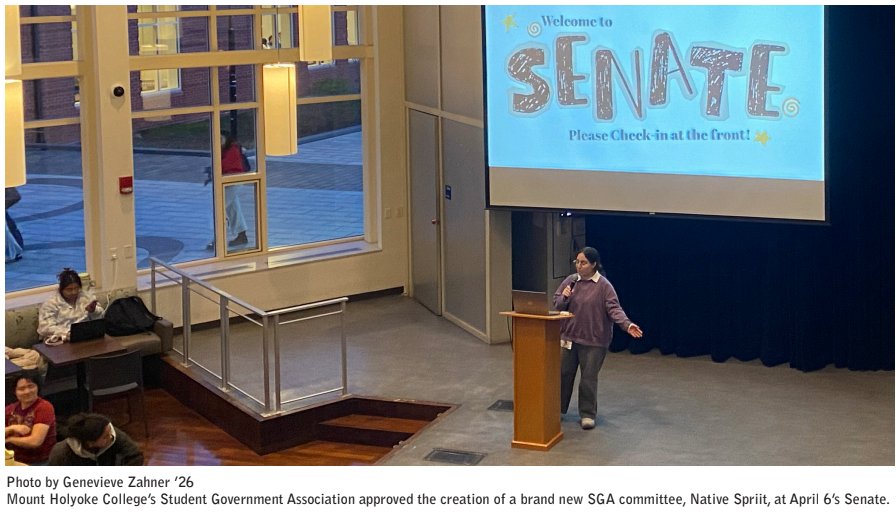
Natasha Rios ’27 opened senate with a land acknowledgement, a moment of reflection, and an ice breaker for those attending before getting into the evening’s agenda.

There was a presentation about a new SGA committee awaiting senate approval, called Native Spirit. The organization’s mission statement is to uplift, acknowledge and support Native and Indigenous students on campus, and to leave an “everlasting legacy of Indigenous led support for students.”

The committee aims to create a space for Native students in a “hegemonic environment” like Mount Holyoke College, and to hold the College accountable as an institution to “move beyond symbolic recognition” and provide sustained investment in the committee. Another goal of the committee is for Mount Holyoke to reconnect with the Native Nations whose land the institution occupies, and create lasting relationships with the nations to “preserve Native epistemologies at the college” as well as a stronger sense of belonging, cultural connection, and support for future Native leaders and trailblazers at the college. The senate then voted and approved the committee.

Those running for chair of senate and chair of halls positions made speeches for their candidacy. The senate will vote later this week. The senate’s prepared presentation closed with several event announcements before moving on to representatives for organizations’ announcements.

The events featured during these announcements were Women and the World of Work which featured alum Sarita Gupta ’96 on April 8, the opening ceremony for Asian, Asian American, Native Hawaiian and Pacific Islander heritage month on April 9, Korea night on April 10, Holi on April 12, Nauryz Festival Celebration on April 13 and Experience MHC for prospective students April 12-13.

The senate then opened up for questions, concerns and announcements from representatives, and began with concerns about the cleanliness of washing machines in Buckland and Abbey, for which facilities management was contacted.

The representative from Queer Action Collective advertised the Civil Disobedience Training on Saturday, April 11 from 11 a.m.-4 p.m. and Protest Marshall Training on Sunday, April 12th from 11 a.m.-1 p.m., both at the Jeannette Marks House.

Asian Students Association advertised the 5PAN conference hosted by the Five Colleges at Hampshire on April 19 from 9 a.m.-6 p.m. and the Nauryz festival, which is a Central Asian holiday celebrating the coming of spring, on April 13 from 6:30-7:30 p.m.

MHC Votes advertised their voting forum with South Hadley town officials from 2-4 p.m. on April 26, which will include opportunities to have one-on-one conversations with state officials Senator Oliveira and Representative Gomez about what to know for the upcoming local elections.

Several students then took the opportunity to speak about incidents on Fizz that have sparked conversations about the treatment of Asian students on campus, including Ivy Zhou ’27, Cindy Ntembe ’27 and Nathania Amadi ’26. The administration as well as President Holley have been contacted regarding the recent uptick in discriminatory posts on Fizz, the anonymous campus app, and on Sunday, April 12, a protest was held. More information about upcoming events and updates regarding anti-Asian hate on campus can be found on @stopasianhatemhc on instagram. The importance of supporting departments that can provide cultural education was noted by Ntembe, along with engaging with local communities and voting in both campus and governmental elections in order for students to educate themselves. Amadi additionally spoke on the importance of students taking accountability for their actions, noting that change has to come from within, saying “when harm is being perpetuated in the community it's our responsibility to curb that hate” especially regarding recent discriminatory Fizz posts that were made against international and Asian students.

Amadi also stated, “People need to unlearn hate and bigotry, do work and educate yourself,” especially regarding the treatment of international and Asian students. She noted the importance of the collective, saying students “need to come together or the change won’t be made” and that students should hold themself accountable in addition to the institution.

The next senate will be held on Tuesday, April 14 at 7:30 p.m. in the Blanchard Great Room.

Jillian Stammely ’28 contributed fact-checking.

Dining Services reports $30,000 worth of missing dishes since Fall ’25

By Paige Comeau ’26

Managing Editor of Content

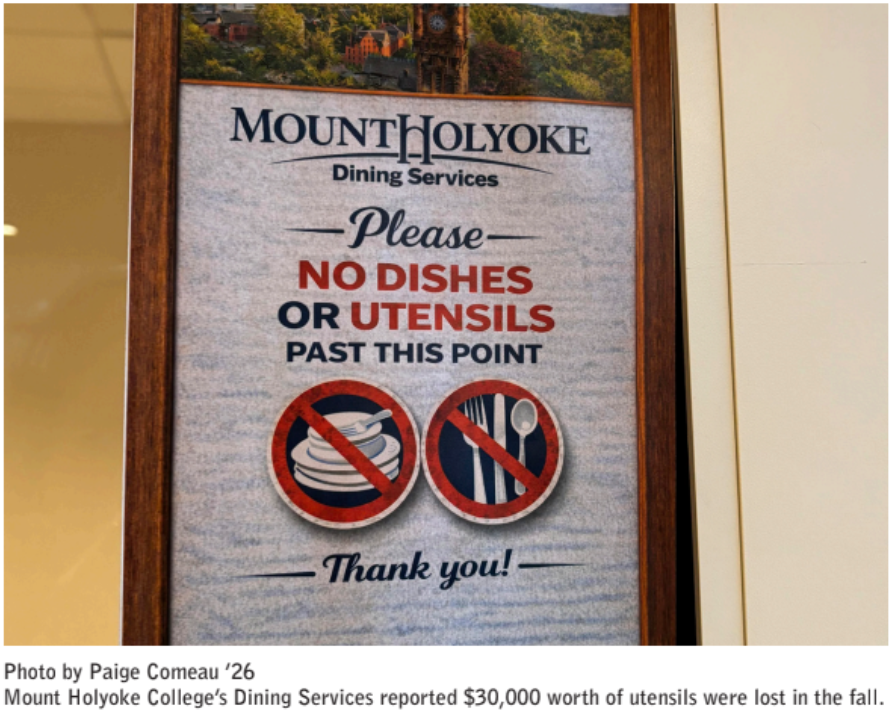
Beginning the week of April 6, 2026, students were greeted by two large signs on the glass doors of the Dining Commons. One sign promotes USEFULL, Mount Holyoke College’s reusable tupperware program, while the other, lettered in a bold red, reads: “Please, no dishes and silverware beyond this point.”

These signs appeared following an email from Dining Services, sent on April 1, titled “Help Us Keep Your Dining Experience Top-Tier: A Reminder on DC Policy.” In this message, Dining Services offered students the reminder that in order “to keep our operations sustainable and our tables fully stocked, we need to ensure that our china, glassware and silverware stay where they belong: right here in the Dining Commons.”

To emphasize the importance of this message, they added that since the fall semester, they have lost almost $30,000 worth of dishes and utensils, or around 3,318 pieces of silverware, 900 large dinner plates, and hundreds of soup cups and bowls. The money they spend replacing these items, constitutes a significant portion of their budget, which they would much rather spend on other things.

In response to this email, many students noted disbelief. “I don’t believe that the couple of borrowed plates and silverware here and there amounts to 30,000 dollars,” Emily Steadman ’26 said in a written statement to MHN.

Similarly, Callie Lantz ’26 stated, “I would like the budget to go to the nice forks if we're going to be spending a lot and [being] hyper vigilant about our silverware.”

Nevertheless, Dining Services has added new procedures to the Dining Commons in order to enforce the seriousness of the issue. Alongside the signs, dining staff will now be more proactive with asking students to finish their food in the Dining Commons, or to use a USEFULL Container. Further, Dining Services will be implementing a No-Questions-Asked return policy around dishware, asking students to drop off any taken dishware on the Dining Commons carousel anytime, with no questions asked.

“We aren’t looking to assign blame,” the email states. “We just want our dishes back so we can keep serving you effectively.”

Jillian Stammely ’28 contributed fact-checking.

Dining unveils various new programs at March town hall

Photo by Emma Quirk ’26

Dining went over many new programs with Senators on March 10, 2026 during a town hall, answering questions about food preparation and disposal.

BY SARAH ANN FIGUEROA ’28

STAFF WRITER

The SGA Senate town hall on March 10 hosted three senior members of the dining staff at Mount Holyoke, who shared exciting new additions coming to the Mount Holyoke dining experience. 

Adorning their signature white chef jackets embroidered with the College’s logo, Shawn Kelsey, associate director of culinary operations, Peter Haas, director of dining services, and Dino Giordano, campus executive chef, all attended Senate for the monthly town hall meeting.

Beginning with what has already been implemented, Kelsey announced the creation of the Dining Ambassador Program. Inspired by the language tables that used to exist in individual dining halls before the creation of centralized dining in 2018, the purpose of this program is to bring meaningful, authentic meals to dining. The dining ambassadors are current students of Mount Holyoke College who represent the diverse communities that exist on campus. They are meant to be accessible for every student to voice their concerns and feedback for dining.

Through these ambassadors, dining staff will learn more about how the dining program can be improved to better serve the needs of our campus. Note that this is not a replacement for preexisting ways of communicating with dining. The QR codes posted around Blanchard Hall are still valid, as well as the MHC dining email, dining@mtholyoke.edu.

Kelsey addressed that everyone at dining really appreciates the positive feedback they receive from the community. “It does genuinely mean a lot to us,” he said. He further added that any high praise given gets printed out and posted around the different stations in the dining hall for staff to see, creating a motivating and encouraging environment.

One of the first dining ambassadors is Cedar Xiao ’29. In an interview with Mount Holyoke News about her perspective on the new program, Xiao said “I feel like I'm really contributing to my community.” Another major component of the dining ambassador role is to provide dining with new recipe suggestions, and Xiao shared how her experience with that aspect of the role has been. She had received feedback from many of her fellow Chinese international students that the meals served at the Wok station are too sweet compared to how they are traditionally made. The fix to this problem isn’t as simple as adding less sugar, as all recipes served in dining are prepared months in advance, and chefs must follow them to the ounce. 

“What I got to do was I found recipes online for other universities in China, and I translated that into English,” Xiao said. “We just did a taste testing yesterday afternoon for more authentic Chinese recipes.” Having invited her friends to provide feedback, many approved of the new recipe.

Hopefully, students can anticipate the quality and authenticity of dishes served in dining to increase with this program. Recounting this taste testing session during the town hall, Giordano noted, “When we get to sit down and eat a meal together, it’s a wonderful and meaningful thing.” If anyone would like to join the dining ambassador program, they should reach out to Shawn Kelsey at kelsey@mtholyoke.edu.

Anyone who has been in the dining hall this semester will have noticed the new dish drop, which was changed over the 2025-26 winter break. Dining shared that the new dish return system is a major improvement for those on the other side of it. 

“It's really helping out the dish room staff,” Haas said. “They are smiling, and the floors are clean, and they're not getting piles of dishes.” It was noted that there are a few technical components in the back of the house that are not yet operational, which may explain why there has been a buildup of dishes during the popular meal time rushes.

One student during the town hall brought up how many students with mobility aids have expressed that the new dish return system is not accessible to them. Kelsey said that the new dish drop is compliant to the Americans with Disabilities Act, however, they are willing to talk with individuals facing challenges to see what they can do to improve the system. 

In terms of other back of house updates, the kitchen now features a new walk-in fridge. This allows for better, more sustainable food storage, and will open up more opportunities for different meals. The expansions to Blanchard Hall in 2018 were not designed with enough storage space for food. As a result, a large refrigerated truck has been parked in the back of the building on weekends to store dairy, produce, and other highly perishable items. With the new fridge, the truck will no longer be needed.

The last new addition to Dining Services is the Grab & Go donation system. Uneaten leftovers from the Grab & Go stations across campus are now being shared with the Food Recovery Network, and sent to Kate’s Kitchen in Holyoke to be distributed. As of March 10, 34 meals have been donated already. These leftovers will be picked up every Tuesday, Wednesday, Thursday, Friday, and Saturday.

Kelsey, Haas and Giordano also unveiled many things that are to come to Dining Services in the near future, the first being a collaboration with the Miller-Worley Center for the Environment. At the Frances Perk cafe, located in the Williston-Memorial library, students will soon be able to check out and return USEFULL cups. Any drink that is ordered with a USEFULL cup will come with a 15 cent discount.

Following spring break, raw fish will enter the sushi program once a week. The first raw fish included will be Ahi Tuna. The program will start slowly and gradually be built upon. Ahi Tuna will be included in premade poke bowls on Tuesdays and premade sushi rolls on Wednesdays, alternating every other week, to be served at both the Sushi station and the Grab & Go stations. 

Another announcement that had many Senators excited was the new smoothie bar to come to the Cochary Pub & Kitchen. The bar will replace the espresso machine, and operate in the same fashion as everything else in the Pub does. Smoothies will be available for purchase via cash, credit or dining dollars. It will be a build your own style experience, with a wide variety of fresh fruit, vegetables, yogurts, smoothie bases and other toppings to choose from. 

Finally, a small yet significant piece of news to come out of this town hall is that food waste across campus is reducing overall, and Dining Services will be doing what they can to continue this trend. It was disclosed that they use an AI program centered around food waste management solutions known as Leanpath to track post consumer food waste leaving our college, and will be taking the usage of it a step further. 

With the Leanpath Spark Program, all of the food coming off of students' plates will be weighed in real time, as workers in the dish room dump all uneaten food into a bin atop a scale. A screen that will be installed in the dish drop area will display and live update the scale’s measurements. Leanpath’s AI will compare the numbers with important metrics, such as how many people could have been fed with the food that has been wasted.

Though there may be something contradictory about using artificial intelligence, a known energy waster and massive consumer of resources, to track food waste in our college, dining made an effort to focus on the positive aspects of this program. 

“It's the right thing to do,” Kelsey stated. “That's why our mission is to reduce that food waste. Not because it's going to save the college money, but because it's the right thing to do. It's something that we can do as a community to help with the global warming issue that we're dealing with.” 

Quill Nishi-Leonard ’27 contributed fact-checking.

Mount Holyoke's production of Melancholy Play runs for three performances

Graphic by Quill Nishi-Leonard ’27 via Canva

BY GENEVIEVE ZAHNER ’26

NEWS EDITOR

The Mount Holyoke film, media and theater department opened their production of Melancholy Play on Thursday, March 5. The play, written in 2002 by Sarah Ruhl, follows the main character, Tilly who “is a bank teller with a melancholy so exquisite it becomes magnetic: everyone she meets falls hopelessly in love. But when Tilly suddenly discovers happiness, her joy unbalances the delicate orbit she’s drawn around her admirers,” according to an email from the film, media and theater department. The play is described as exploring “what it means to live inside intense feeling: the seductive power of sorrow, the disquiet of joy, and the strange, shifting desires that bind us to each other,” the department stated.

This play also served as the directorial debut of Emma Platt ’26, and was the first show that she has solo directed at the College. Though Platt directed Eurydice, another Sarah Ruhl play, in her high school career, this was “a huge and rewarding undertaking” as it had the “most moving parts and largest team” she’d ever worked with. Her Mount Holyoke career thus far has been directing short scenes for class and plays for the 2024 and 2025 short play festivals, and said “A full-length mainstage show of which I am the only director was daunting and a lot of work, but also my most rewarding experience at Mount Holyoke” of her experience with Melancholy Play. 

The play was chosen by the film, media and theater department in fall 2024, and since the play features a live cellist, this part was cast around this time as well. However, production meetings with stage management and design teams began in fall 2025, with auditions and casting happening towards the end of the Fall 2025 semester. 

The entire cast and crew came to campus a week early from winter break to begin rehearsals, including table work, blocking and music learning. “The whole thing has come together in a truly fantastic way, and I couldn't be prouder of the cast, crew, and designers for the incredible work they did,” Platt said. She also expressed her love for directing and the process of working on a play. 

“Working with such wonderful artists and collaborating to make something bigger than all of us, and seeing it come to life, is so rewarding. I have always loved bringing ideas to life and creative collaboration, and directing is the perfect intersection between those things,” Platt stated. 

Kainoa ChesemoreWalling ’27 was the stage manager for the production, and said of the experience, “Last year I got to work as an [assistant stage manager] on Marie Antoinette which was super fun and I was excited to work on another student directed show here. … We also brought in a lot of supporting artists to help us with the production like Jay Doane, our student fight choreographer, and then a dialect coach and intimacy coordinator, which was super fun to collaborate with all of these artists.” 

They spoke more on the process of tech rehearsals, and how that differed from the five weeks of rehearsals they had before starting tech, “At this point I was fine tuning transitions and props shifts so that once we were in tech everything would go as smoothly as possible. In tech we did two days of cue to cue because we had a more tech heavy show. Then by that point we were able to do a full run through some trouble points and then we had three dress rehearsals before we had an audience!” 

ChesemoreWalling said her favorite part of stage managing is seeing everything come together, and that “For the most part everyone works on the production separately until tech. The actors are in rehearsal during the evening and the production teams are working on getting the designs created. As the SM I am one of the people who form a bridge between the two, making sure things are communicated and aligning with the collective vision of the show. Once we hit tech it is magical to see everyone's hard work get pieced together.” They also enjoyed connecting with everyone working on the show, and having “silly and fun moments” together. 

Platt also spoke on the importance and her appreciation for the rest of the cast and crew, saying, “I want to express my endless appreciation, respect, and love for the incredible cast, crew, and design team. This would have been impossible without them. I want to especially emphasize the importance of Kainoa, Juno and Sabine, our stage manager and assistant stage managers. They kept this whole thing running in a way I never could alone. Also, thank you to Michael Ofori for being an incredible faculty advisor for the project.” 

Melancholy Play ran from March 5-8 in Rooke Theatre, and will be followed by the spring production of POTUS in April. Alayna Khan ’28 contributed fact-checking.

CBL welcomes youth from Girls Inc. to visit campus and meet students

By Emma Quirk ’26 & Genevieve Zahner ’26

News & Photos Editor | News Editor

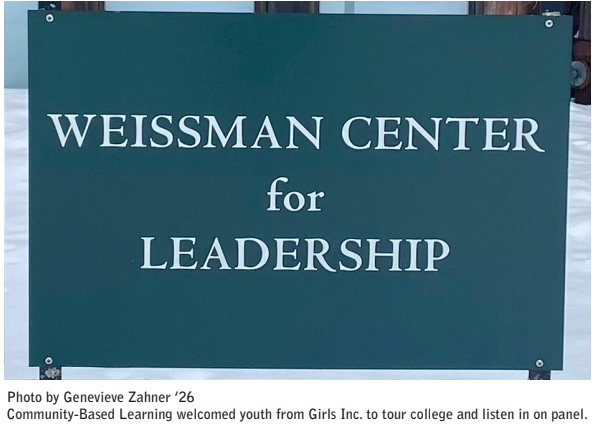
Mount Holyoke Community-Based Learning welcomed Girls Inc. of Holyoke, Massachusetts to campus on Wednesday, Feb. 18 for a visit and panel discussion about college and the opportunities that Mount Holyoke has to offer. 

Girls Inc. works with various partners to “ensure that all girls have what they need to thrive — in school, at home, and in their communities” by providing elementary, middle and high school programs to provide academic support, personal development, career exploration, and bolster physical well-being. They additionally have a program called Eureka!, where girls participate in a five year program from 8th grade through their senior year of high school working with professors at the University of Massachusetts in classrooms, labs and in the field of different professions to boost college and career preparation, building skills and confidence both academically and personally. 

A cohort of girls from Girls Inc. visited campus, taking a tour of the equestrian center andthe greenhouse, before concluding the tour at the Betty Shabazz Cultural Center. There, they had lunch and reflected on what they learned and thought about any questions they might have had. 

The middle and high school students then sat in on a panel discussion with current Mount Holyoke students where they were able to ask questions about the college process, Mount Holyoke and what opportunities are available to them both at Mount Holyoke and at other members of theFive Colleges. The elementary school children sat in on a separate listening circle, where they were able to have a similar conversation, more tailored towards providing early exposure to the college environment for young learners. Trinity Moore ’29 is a CBL Fellow and is partnered with Girls Inc. as an after-school intern. She was part of organizing and running this visit and was pleased with its outcome. “The visit went really smoothly!” she said in an email interview with Mount Holyoke News. “My main concern was that the visit be age-appropriate and interesting to the range of students we would have visiting (5-13-year-olds). Thankfully, we did things that intrigued all ages, like visiting the Equestrian Center and the greenhouse, and offering coloring pages for students during a Mount Holyoke student-unofficial panel.” 

Additionally, she was grateful for the diversity of students part of the panel discussion.  “This kind of visibility is crucial for prospective students, as it allows them to see themselves reflected in the current student body, reinforcing the conviction that they are incredibly capable of succeeding in college,” Moore said. 

Akilah Williams ’26 was another of the student leaders who was part of this collaboration between CBL and Girls Inc. “Leading a segment during the visit was especially powerful for me as it made me feel trusted by CBL and affirmed that they genuinely value us tutors as individuals and leaders,” Williams said. “That trust meant a lot to me as it showed me that my voice matters not just in theory, but in practice.”

Williams found the visit to be particularly meaningful because she had been part of Girls Inc. herself as a middle schooler in New York. “Being able to now give back to a program that once poured into me felt full circle. It reminded me how impactful and empowering Girls Inc. truly is,” she said. “Seeing the girls engage with our campus and ask questions reinforced how important spaces like this are for young people. I’m also really grateful that CBL collaborated with Girls Inc. and gave us, as students, the opportunity to share our experiences about campus life.” 

Reflecting beyond this event, working with CBL has pushed her to be more involved in and take action in the local Western Mass. community. “For me, CBL means refusing to turn my back when I see injustice, discrimination, or inequality,” Williams said. “Community-based learning gives me the tools and the space to respond rather than remain silent. Through CBL, I’ve learned that real change starts with presence. Showing up matters. Listening matters. Advocating matters.” 

Cat McKenna ’28 contributed fact-checking. 

Mount Holyoke holds workshop on how to protect against ICE

Graphic by Mari AlTayb ‘26

By Sarah Ann Figueroa ’28

Staff Writer

Friday, Jan. 30, guest speaker Erik Esqueda Sánchez from San Diego State University joined Mount Holyoke students and faculty for the “Activism sin Fronteras: Legacies of Liberation and Community Mobilization” workshop, held by the Office of Diversity, Equity, and Inclusion. Centered around peer collaboration and group discussion, the workshop provided its attendees with fresh perspectives on how they can help protect members of their community who may be targets for U.S. Immigration and Customs Enforcement, commonly called ICE.

The official description of the event reads, “This workshop will cover a brief history of undocumented and migrant movements within U.S. context and explore strategies for leveraging your own talents and knowledge to co-build activist spaces.”

Coming all the way from California, this was Sánchez’s first time in Massachusetts. They expressed that they have always wanted to visit Massachusetts, so the excitement to be here outweighed how cold it was. Sánchez is the assistant director of SDSU’s MEChA, the “Movimiento Estudiantil Chicano de Aztlán,” or, in English, “Chicano Student Movement of Aztlán.” Growing up with the MEChA program, they view the work they do today as “Giving back everything that was given to me.”

After introductions around the room, Sánchez made mention of the ongoing ICE raids in Minnesota’s Twin Cities, Minneapolis and St. Paul. On the day of the workshop, residents of these cities called for a nationwide strike against the raids, also referred to as the “ICE OUT” protests. As written in an article by Kimberlee Kruesi and Holly Ramer with the Associated Press, “Protesters held ‘no work, no school, no shopping’ strikes across the U.S. on Friday to oppose the Trump administration’s immigration crackdown.”

A summary of these events, as read during the presentation, states “State violence and criminalization are escalating / We are witnessing murders of civilians in real time / Communities are grieving, mobilizing, and resisting simultaneously.” Sánchez explained that the Activism sin Fronteras workshop was intended to be an extension of this movement, as the information being taught is rooted in the same resistance as the protests in the Twin Cities.

Solidarity with those in Minnesota could be felt throughout campus that day, as students had participated in the strike, and many flocked to the Amherst Common that afternoon to join the ICE OUT protest being held there. Additionally, Sunrise MHC held a student walk out and study-in one week later on February 6, responding to calls from high schoolers in Minneapolis asking other students across the nation to strike in solidarity with them.

With a student body made up of about 20% international students, many people at Mount Holyoke College have expressed concerns for those who may be vulnerable in the event that ICE arrives on our campus, especially since agents have already been seen in nearby towns like Northampton and Amherst. These fears are not unfounded. As the American Immigration Council has stated, “American communities are now seeing a level of immigration enforcement utterly unprecedented in modern history … the conditions that have resulted from this rapid expansion for those caught up in the detention system have increasingly worsened and become more inhumane.” With a combination of the president bypassing due process laws and ICE agents heavily employing racial profiling, legal status offers international students little protection against these targeted attacks. Even if one may not be deported in the end, the trauma that comes from going through the intensifying immigration system merits the protection of those most at risk.

Though the circumstances were grim, Sánchez’s teaching filled the space with hope. Examples of past movements that reflect times similar to ours were given, and together the attendees examined them to determine what has worked in the past that can be applied to current organization strategies. In particular, the workshop focused on the Undocumented and Unafraid movement from 2010 and the Ethnic studies walkouts of the late 60s. The slideshow listed effective tactics used in these movements as, “Civil disobedience, sit-ins / Legal advocacy, policy pressure / Mutual aid and rapid response networks.”

After analyzing these historical examples together, Sánchez noted, “Students have done badass things throughout the history of higher education,” also reminding, “This movement is not new, it’s only intensified.”

The latter half of the workshop focused on the individual, and how one may leverage their own aptitudes to contribute to a cause, such as protecting communities from state violence. Using the Slow Factory’s “Roles for Collective Liberation,” attendees talked about which roles they identified with, and how they could see themselves using their skills with an activist lens. The list of roles contains both creative and pragmatic options, finding space for everybody in a movement.

The workshop culminated with students applying everything they had learned to address the hypothetical but strikingly realistic case study scenario of ICE interference on our college campus, a conversation that has been brewing amongst Mount Holyoke students since last semester. Imagining what to do in emergency scenarios is a complex and mentally heavy topic, often meaning that there will never be one right answer for how to handle them. However, the group effectively addressed what not to do in this scenario, concluding that acting out of anger and without a plan would be the most detrimental to the cause of keeping everyone safe. Many agreed in the end that organized, strategic collaboration and thorough communication are the keys to making it through a situation like the one described in the case study. What that looks like may be different for different individuals, but no matter what, our community coming together to help keep one another safe is essential.

After the workshop concluded, Sánchez agreed to a brief interview with Mount Holyoke News. Reflecting upon the event as a whole, they shared, “My goal … was just to move people from … a place of powerlessness, or feeling like they didn't have an opportunity to be part of a movement.” When asked if they had a message for the Mount Holyoke community, they said, “Keep being critical, to keep questioning, to keep building relationships with one another, and to find the ways that feel good for you to engage during this difficult time.”

Jillian Stammely ’28 contributed fact-checking.

Joy and friendship: Swive reflects on first half of 2025-26 season

Photo courtesy of MHC Athletics
Several members of Mount Holyoke’s swimming and diving team spoke with MHN about the sport.

By Bei Jia Viggiano ’28

Sports Editor

As courses conclude and finals approach, the Mount Holyoke College swimming and diving team has completed its first half of the 2025-26 season. December only held a weekend event in New York, allowing the student-athletes to focus on final assignments and exams. Members of the swimming and diving team had quite a bit to say regarding their team’s successes, challenges and the environment.

On the first day of November, the Lyons met with the University of New England in Biddeford, Maine. For the first meet of the 2025-26 season, though Mount Holyoke lost 155-106, the Lyons still had cause to celebrate individual achievements. Evelyn Rousseau ’29 placed first in the 1,000-yard freestyle with a time of 12:20.81, and Maya Oakes ’29 emerged victorious with a time of 1:06.76 for the 100-yard backstroke. Isabel Dunn ’27 placed first in the 100-yard butterfly with a time of 1:06.34 and took second place in the 50-yard butterfly with a time of 29.61.

“[Our coaches’] attention in every practice since the beginning of the season to each of our strengths to design a competitive lineup absolutely contributed to the success,” Rousseau said in an email to Mount Holyoke News.

Two weeks later on Nov. 15, Mount Holyoke attended a meet against Westfield State University at the Mount Holyoke College Natatorium in South Hadley, Massachusetts. The Lyons emerged victorious 166-114.

“During our meet against Westfield State, we were a lot more loose and relaxed,” Naomi Long ’29 said in an email to Mount Holyoke News. “We had two weeks of uninterrupted training after our first meet, and I think we all felt more confident going into this meet. It was also so nice to compete at our home pool!”

“Westfield State was a great meet — it was the first time this season the team swam 100s and 200s (instead of the 50s and 100s we had swum), so it was exciting to see how all the training had been paying off!” Katherine Upton ’28 said in an email to Mount Holyoke News.

“For the Westfield meet, I think our mindsets and energy on deck contributed to a positive attitude across the team, which helped us become more competitive,” Kaylee Barnett ’26 said in an email to Mount Holyoke News. “We were all cheering for one another at the ends of lanes or on the side of the pool. We also were at our home pool, which is always helpful!”

“We had a super strong 200 [yard] medley relay that out-touched Westfield State by 0.35 seconds and clenched first place,” Katie Thomason ’29 explained in an email to Mount Holyoke News. “We had a lot of first-place finishes, but we were also able to fill a lot of lanes in almost every event to gain even more points, which is essential in swimming. We were also lucky to have our amazing diver, Katherine [Upton]. We were really good at cheering for everyone on the team, and it was great to have so much support in the stands.”

“I believe the hard work we’ve been putting in at practices every day, including both pool time and dry land workouts (with [Head Sports Performance Coach] Jay [Mendoza]) have helped us greatly,” Zoey Zhu ’27 said in an email to Mount Holyoke News. “We’ve been working hard in practice, splitting off into groups to train for our specific events (distance/sprint/IM) and doing our best to keep giving our best every day.”

“I think there are many reasons why we can perform well,” Carol Fang ’29 said in an email to Mount Holyoke News. “Everyone on the team loves swimming and works very hard in training. We also try to stay positive even when the training load is heavy. Another very important reason is that we have an amazing coaching team. Our coaches are extremely knowledgeable, give professional feedback, and care about each swimmer’s health. They support us when we feel confused, stressed, or discouraged.”

“Overall, I think that the support that the team has for one another, alongside our hard work in practice leading up to the meet, led to our win over Westfield!” Ellie Lewis ’29 said in an email to Mount Holyoke News.

A week following their victory against Westfield State, the Lyons faced Wellesley College, once again in the Mount Holyoke College Natatorium. Mount Holyoke lost 188-64, though Dunn notably placed first in the 200-yard butterfly with a time of 2:33.79 and took second place in the 100-yard butterfly with a time of 1:05.37.

“As challenges come up like losing a meet or having a hard practice, the team shifts focus to the end-of-season meet, NEWMACs,” Rousseau said. “Every race we swim, every yard at practice, every early morning lift is all building up to that point. So, remaining positive and focusing on growth for the future.”

“We communicate [when challenges arise],” Zhu explained. “We regularly update our coaches and do our best to work through any challenges step by step.”

“In response to the challenges that we have faced, each team member has remained dedicated to the team and our performance, at both the team and the individual level,” Lewis said. “We also have stayed committed to supporting one another, and in the face of challenge, we make sure we are there for our teammates!”

“In facing challenging meets or teams, we’re good at being willing to go outside of our comfort zone and try events that we may not typically compete in,” Thomason said. “[Coach] Dave [Allen] often talks about the importance of ‘grit,’ and I think that’s been a big focus this season.”

“Our coaches have specified the importance of having grit,” Long said. “No matter the obstacle, we have focused on doing whatever we can to overcome any challenges. It has been helpful for me to focus on what I can control and not dwell on outside factors.”

The swimming and diving team began preparing for the Rochester Institute of Technology Invitational held in Rochester, New York, at 4 p.m. on Friday and Saturday, Dec. 5-6.

“We’re all getting really excited!” Thomason said. “[The] RIT Invitational is a two-day meet with three sessions total, which is much longer than a dual meet. We’re already planning all the fun things we’ll do to entertain ourselves on the long bus ride! The events we swim at this meet are usually used to test out potential NEWMAC events, so we’re starting to shift into that competitive mindset. It’s difficult having had the Thanksgiving break right before this big meet, but we’ve been doing a lot of hard training to prepare us for a great meet.”

“To prepare for RIT, we have been doing a lot of pace and sprint work at practice,” Long remarked.

“For RIT, we’ve just been trying to do our usual,” Upton commented. “Nothing super crazy, just taking everything one day at a time, swimming the races we’re in and doing the dives we’re doing at that moment.”

“The team has been putting in a lot of work, both in … and out of the pool to prepare for RIT!” Lewis said. “From hard workouts leading up to November break, to weight lifting during the week, our team has been gearing up to swim well.”

“We’ve been doing more specialized workouts for our particular events,” Rousseau said. “In my case, I’ve been doing a lot of practice holding pace for long-distance events like the 1650. The group that plans to swim the 400 IM event is also putting in a lot of work with our assistant coach, Bill Tyler, on technique.”

“We’ve all been putting in a lot of work in the pool and weight room,” Barnett explained. “We practice five to six times a week, as well as lift two to three times a week. On the swim side, the team splits itself into sprint, stroke and distance practices every day depending on what each athlete’s strengths are.”

“We’ve also been working with a mental performance coach this season to help better prepare mentally for competitions and practices,” she continued. “Our coach [Dave Allen] is big on emphasizing that we should focus on controlling what we can control. After a hard practice or a disappointing meet, it’s not beneficial to spend a lot of time beating ourselves up about it. We can acknowledge that it wasn’t our best, think about what we can do better and move forward towards the next one.”

“For me, I like to think about what technique changes I can implement for the next practice or meet and really focus on that,” Barnett added.

Lewis, Rousseau, Long, Zhu, Thomason, Barnett, Fang and Upton have nothing but love for their team and its environment, both athletically and socially. The collective and individual growth paired with the abundance of support and enthusiasm throughout this semester has poised the Lyons for an exciting and competitive spring semester.

“Personally, I have had such a great experience with this team so far!” Lewis said. “I am so excited for where this season is headed, and I cannot wait to spend more time with the team!”

“My experience with the team so far has been extremely positive,” Rousseau said. “The culture of support and growth has been so beneficial not only to my swimming but to my college experience. We win some meets, lose others, but no matter what, we return to practice more dedicated.”

“Our team has grown close throughout the semester!” Long said. “I have been having fun getting to know everyone more and having my teammates push me in practice! I am very excited for the rest of the season and seeing what everyone accomplishes!”

“I have had a fantastic experience with the team since the beginning of the season,” Zhu said. “This is my third year now, and I have really enjoyed getting to know our first years—they bring such a great spirit to the team!”

“[The semester has] been amazing! The team is so inclusive and welcoming,” Thomason said, “it feels like one big family. As a team, we’re really good at supporting everyone both on deck and outside of athletics … it’s a great way to explore events and activities happening on campus.”

“We’ve always been a really close team, and I don’t think that’s changed this season,” Barnett said. “We all take care of each other and lift each other up, both in and out of the water. I love going to practice and talking with my teammates about their days, their classes and what they’re looking forward to. I also really love encouraging my teammates during practices and meets — more often than not, I’m telling the people in lanes around me that they’re killing it at practice, or cheering loudly for those who are racing.”

“I’m so grateful for the opportunities I’ve gotten to be both a participant and a leader on this team,” she concluded. “And I wouldn’t trade it for the world.”

“I think the [team] is a very warm and welcoming group,” Fang said, “and I have always felt included and supported. The coaches care a lot about every athlete’s physical and mental well-being, and everyone on the team is very friendly. We take part in many team-bonding activities and often eat and chat together after practice, which helps us get to know each other better.”

“Our team also has many traditions,” Fang added. “My favorite one is that before every meet, we draw lots to choose a teammate to make a psych-up poster for, and then cheer for her during the competition. Making the poster helps us learn more about each other, and receiving a poster is always a happy surprise that motivates me to do my best.”

“A special moment for me happened on the day we competed against Westfield State, which was also my birthday,” Fang recalled. “After the meet, my teammates surprised me with a cake. I was truly touched. As an international student, I was far away from home, but I still felt loved and remembered.”

“One moment that I remember clearly was during a meet when I was feeling slightly sick,” Fang continued. “During warm-up, I felt unusually tired. Coach Dave [Allen] somehow noticed right away. He stopped me and asked if I was feeling okay. I told him that I might have a cold. He comforted me and said he knew how hard I had been training, and that my body was probably just tired. He reminded me that this meet did not define my progress, and that after the Thanksgiving break, I would definitely be able to show my hard work at RIT. Hearing his words made me feel so relieved that I almost felt healed.”

“Even though I wasn’t feeling well physically,” Fang reflected, “I ended up breaking my personal best in the 50 free.”

“The team is so great. We have a comparatively big first year class and they’re really hitting their stride,” Upton said. “We’re also thrilled to have five coaches this year — adding [Assistant Swim Coach] Kenzie and [Dive Coach] Joel has made a big difference and I know we’re all really grateful for them.”

Upton proceeded to express her deep appreciation for her teammates: “Rowyn Farley ’28 is swimming distance events and sprint events this year, which is crazy and fairly unusual — it is really impressive how she is balancing the two and the totally different strategies needed.”

“Audrey Stuckert ’27 switched from swimming to diving this year and is picking it up so fast, and her attention to detail is phenomenal,” she continued. “Katie Thomason ’29 came in as a breaststroker but has added distance freestyle and is doing excellent.”

“Carol Fang ’29 has also switched her primary stroke and is getting crazy good results!” Upton wrote. “Maya Oakes ’29 is such a consistent, hardworking swimmer.”

“I could talk about how wonderful my teammates are forever,” she concluded. “We have a really small team this year, which can be tough. We’ve been able to pull together and get through it.”

Mount Holyoke’s swimming and diving team has since attended an invitational with RIT on Friday and Saturday, Dec. 5 and 6, in Rochester, New York. They will next meet with Wheaton College and Clark University on Friday, Jan. 9, 2026, at 10:30 a.m., at the Mount Holyoke College Natatorium in South Hadley, Massachusetts.

Karishma Ramkarran ’27 contributed fact checking. 

Mount Holyoke hosts panel with ACT UP alums on World AIDS Day

Photo Courtesy of Annette Dragon via University of Southern Maine Digital Commons
Members of ACT UP protest outside of George H.W. Bush’s summer residence in Kennebunkport.

By Quill Nishi-Leonard ’27

Editor-in-Chief

On Dec. 1, Mount Holyoke College observed World AIDS Day, “an opportunity for people worldwide to unite in the fight against HIV, to show support for people living with HIV, and to commemorate those who have died from an AIDS-related illness,” according to an Instagram post by the Office of Diversity, Equity & Inclusion. The Office of DEI and Be Well Peer Health Educators began the day tabling in the Williston Library Atrium from around 12-1 p.m.; students were welcome to “stop by to grab a red ribbon, and peruse various select works of HIV/AIDS literature,” as described in the Nov. 24 MHC: This Week email from the College. 

Later that day at 7 p.m., The Office of DEI hosted a virtual panel on Zoom in conjunction with the politics department titled, “Histories & Memories of ACT UP NY.” Several alums of ACT UP — Andrea Lawlor, BC Craig, Debra Levine and Diane Curtis — spoke at the panel, detailing their personal experiences, memories and answering student questions. 

HIV — human immunodeficiency virus — is the virus that causes HIV infection in humans. HIV attacks and destroys helper T cells, which help the body fight off infections and cancers. HIV cannot be spread through casual contact; the virus is only transmittable through blood, semen, pre-seminal fluid, rectal fluids, vaginal fluids and breast milk, according to HIV.gov.

When somebody has HIV for a long time, they may develop AIDS, acquired immunodeficiency syndrome. People with AIDS have critically low levels of T cells, and are much more susceptible to infection and cancer than those without. Today, while there is still no cure for HIV, people with HIV can achieve an undetectable viral load with treatment. Those with an undetectable viral load are not able to transmit the virus, and will not develop AIDS.

Visiting Assistant Professor in Politics Kevin Henderson, who is currently teaching a course on the politics of HIV/AIDS, helped open the event, providing a brief introduction on the history of HIV/AIDS and ACT UP. 

The first cases of HIV reported by the Centers for Disease Control and Prevention were in June 1981, though it’s likely that many people had acquired the virus long before then. ACT UP was founded in response to widespread stigma against those with HIV/AIDS and government inaction on the epidemic. According to Henderson, “ACT UP pioneered the slogan ‘Healthcare is a human right’” and created “some of the most recognizable” protest art of all time. 

“Really, we were a bunch of people in our twenties trying to figure things out,” panelist Diane Curtis said.

The former members of ACT UP discussed how the movement’s energy and the bonds between its members allowed it to thrive during an incredibly difficult time in history. Prior to 1996, there was no effective treatment for HIV/AIDS, and many died. 

Curtis described the number of deaths as having been “overwhelming.” Today, social media has allowed many members of ACT UP to reconnect and mourn those who were lost. “We forgot to grieve, and now we’re going to,” Curtis said.

Debra Levine spoke about how many members of ACT UP coped with stress in the height of the epidemic through humor, “You could have something incredibly weighty, and it’s helpful to have comedians in your group.”

“It really helped to have a good drag outfit,” Levine added.

“Despite how literally life and death everything was, it was so much joy, so much parties and cruising, and around this anger, around these actions, around the risks people were taking, around the many hospital rooms we spent time in and around the many memorials, there was so much life and joy,” BC Craig explained.

Panelists also discussed several protests and actions by ACT UP, and the organization’s commitment to inclusivity. Levine explained that in 1991 on Labor Day, ACT UP transported hundreds of its members to then-President George H.W. Bush’s summer home in Kennebunkport, Maine, in protest of Bush’s inaction on the epidemic. 

Craig expanded upon the difficult logistics of this particular action: “People need to remember when we’re talking about this, an action that’s 1,000 miles away, we needed a complete medical staff, food, and water, and lot of sick people needed wheelchairs.”

While “it took a lot of money,” it was important to ensure “anyone who’s differently abled in any way gets to participate,” Levine said.

The love and dedication members of ACT UP had for one another was one of the most memorable and nostalgic aspects of the organization for many of the panelists. 

“That was a model of possibility [that] I just thought was the world,” Lawlor said.

Jillian Stammely ’28 contributed fact checking.