
Photos by Quill Nishi-Leonard ’27
By Leah Dutcher ’28
Opinions Editor
Who exactly is the man behind the camera? “Primetime,” directed by Lance Oppenheim and written by Ajon Singh, seeks to answer that question through a dramatized behind-the-scenes retelling of the 2004 show “To Catch a Predator.”
“Primetime” follows Chris Hansen, played by Robert Pattinson, as he grows more obsessive with his line of work: Luring sexual predators in online chatrooms, bringing them to decoy houses and filming it all for television. The audience is pulled in as new Actor Dan Plum, played by Skyler Gisondo, is slowly roped into this life. We watch as Plum slowly learns that Hansen might not be as good of a man as the show portrays him to be. We watch as Hansen breaks down, but we also watch and react alongside Plum to Hansen’s breakdown.
In one contentious scene early in the movie, we see Hansen on a plane talking to a man. The man begins to speak about the work Hansen is doing and commends it as incredibly important. The angle and intense lighting make it seem as though the man might do more than just sit there and praise Hansen. The actor grows very intense as the monologue continues. Even Hansen seems unsettled by what the man is saying. We’re given a look into the intense mindset people had — and potentially still have — around the show “To Catch a Predator.” We’re also given a look into what Hansen could become: Someone overtaken by their thirst for so-called justice.
While in the plane scene we see Hansen resistant to this mindset, external factors begin to drive him closer and closer to the breaking point. As “To Catch a Predator” gains traction, the NBC executive Jeff Zucker, who plays himself, pushes Hansen to look for more controversial predators in order to drive up ratings, to find his “white whale.” At the same time, Hansen is withdrawn from his family life, his sons are disinterested in his work and his wife, played by Anna Faris, doesn’t like his constant absence from his family. Whilst on the road, Hansen has an affair which a reporter takes photos of and uses to goad Hansen into a reaction. This plot point ultimately mimics the hyper-surveiled situation Hansen is creating for the people he catches. He feels the burden of his wrongdoing and feels it unjust to have such a personal story blasted to the public.
The professional and familial pressure lead Hansen to a breakdown. We watch as the public praises what he’s doing while he’s lashing out at those around him, even almost alienating his own producer Andie Bender, played by Merritt Wever. The movie culminates with the suicide of Assistant District Attourney Bill Conradt, played by Alex Winter, which was based on actual events. Suddenly, the audience is taken out of the production of it all, right alongside Plum. It’s no longer about a TV show, but a man’s life. The only character we see deeply affected by the man losing his life is Plum. Hansen is seen affected, but one has to wonder if he’s more affected by a man losing his life or how he just lost his show.
I left the theater asking myself, how could a man like Hansen be allowed to run a show policing the behavior of others? While being obsessive about work and detached from reality isn’t as severe of a crime as sexually preying on children, it still feels incorrect to assign Hansen this moral superiority and authority.
Granted, this film was an overdramatized account of events and doesn’t speak to the actual character of the real Chris Hansen. Even if it did, the general population wouldn’t have been aware of the mental state that Hansen had at the time of filming. This begs the question, how much do we know about the integrity of the people who watch us?
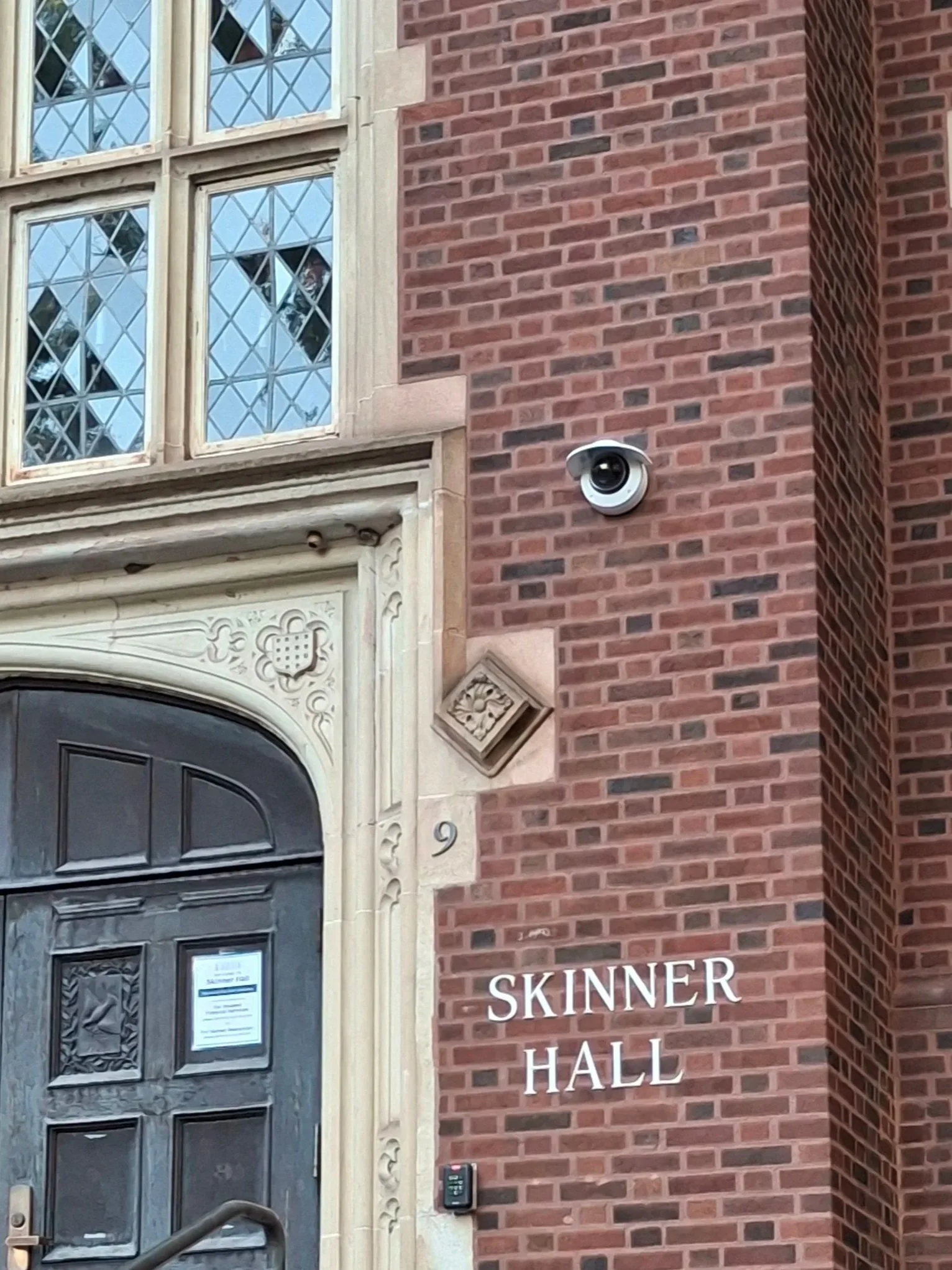
Recently, the topic of security cameras on campus has been one that’s been talked about extensively. Mount Holyoke News has published many articles about it in the last few years. One thing that has left me reeling about the entire situation is the lack of transparency on behalf of the administration in regards to who accesses the footage.
In the College’s Security Camera Acceptable Use Policy it states that all use of camera footage for investigative purposes must pass through at least through the Director of Public Safety and Service or another appointee, sometimes a Human Resources representative if a staff member is involved. However, nowhere does it say who exactly has access to the footage or how the footage is stored to ensure security. I don’t wish this to come off as me relating any specific person working for this campus to Robert Pattinson’s Chris Hansen. My argument isn’t about who currently has access to this footage but who could potentially have access to it in the future.
One could argue that it’s unlikely that the footage could fall into the wrong hands, but it’s difficult to trust this point after being bombarded with examples of professionals using Flock cameras incorrectly. Flock is a company that produces automatic license plate reader cameras, or ALPRs. These are cameras that are constantly on and use artificial intelligence to read every license plate that passes by, unlike other traffic cameras that only record after a specific incident. Police officers in North Carolina, Ohio and Arkansas have been indicted, arrested and fired in the past week for misuse of Flock cameras. That’s not to mention the endless examples that have been written about for the last few months. And these instances can only be written about since they were found out and publicized. The company Flock continues to state that the only people who can access the data and information from their cameras are the companies that purchase the cameras. Similar to the Mount Holyoke College’s security cameras, Flock promises on their website that all information is encrypted and solely accessible to the contractors who work with Flock. But no digital encryption is infallible, so how much trust can we put into these cameras that have the potential to reveal intimate details of people’s lives without their explicit permission?
It feels dramatic to equate AI cameras that have been weaponized to hunt people down, stalk people and other heinous actions to campus security. Flock cameras and campus security cameras are different byproducts of the same problem: The idea that increased surveillance solves and prevents crime. It also shows the different ends of the spectrum of an over-watched world and how cameras that are constantly recording, even if they don’t go anywhere, are normalized and have the potential to lead to the implementation of other security devices such as ALPRs. Similarly, how Hansen can go from a man that wishes to mitigate crimes against minors to a man obsessed with hunting and capturing morally corrupt individuals. Plus, Flock cameras are incredibly relevant to campus, as the closest one is about half a mile away, and there’s 17 cameras within a five mile radius of campus.
The College administration’s justification for security camera usage is a safety evaluation entitled “Summer 2023 Campus Safety and Security Assessment” that was completed by a hired outside group called GoodIvy Safety & Security Consulting. They paid to have this consulting group come in and then they paid for the installation of security cameras. Someone is directly profiting not just from the implementation and purchasing of the cameras, but also from the assessment that led the College to believe it needed cameras in the first place. This assessment hasn’t been made readily available to the community.
Flock itself is an independent company that sends their technology out to be used by the people they work for. The more successful the company looks, the more schools, police departments and other contractors want to purchase their technology. Much like other companies, they have a public image to uphold in order to properly sell their product. Flock markets on their page that they don’t have contracts with ICE. However, this is deceitful as they have contracts with police departments that have knowingly used the cameras to conduct searches on behalf of ICE. Flock requires that users provide information as to why searches are taking place, and many such cases where they are used for ICE are labeled as such.
Flock is trying to rid themselves of the blame regarding this politically contentious topic in order to appeal to a broader audience of people, to sell more cameras. However they are not canceling these contracts as they continue to make the company money. Similarly, in “Primetime,” Hansen is driven further into his spiral when Zucker pushes him to find a larger target in order to usurp the competition on other networks. This increased stress and more intentional searching leads to the assistant district attorney’s house, where Hansen’s downward spiral reaches its peak. In all three cases, profit is intrinsically linked to security.
One point the film barely touched on was just how unsuccessful Chris Hansen was in real life. Almost every single person who was shown on the show was arrested, but rarely were they actually convicted of any crime. While the security cameras on campus have led to two different men being identified on campus and eventually given trespassing notices, there is no comparison published of how many dangerous events went under-investigated or not closed because the event took place in an area without cameras. There is no way to know how either of those events would’ve happened had the cameras not been in place, so there’s no way to tell if cameras are the only option.
Not to mention that the majority of the time in violent crimes, the victim knows the perpetrator, so identification isn’t the only issue in people’s cases not being properly investigated and solved. The only crimes where it’s more likely to be a stranger are crimes against property. It would be interesting to see the statistics on reporting incidents before and after the implementation of the security cameras, especially on how many reports they’ve resolved in that time. But, much like the original campus safety and risk assessment, that information isn’t available publicly.
On Flock’s website they boast about how over 1 million investigations have been assisted using Flock cameras and, in jurisdictions where Flock is deployed, 20% of cases were aided by the Flock cameras. The immediate thought I had after reading was that there’s no definitive way to prove whether or not the use of cameras was essential to those cases, much like the College’s security cameras. Upon further research, there are also some issues with the numbers that Flock provides.
Both the over 1 million statistic and the 20% statistic are rough estimates based on data collected and shared using various different methods from the outside contractors, not data collected by Flock itself. Not only that, but every 1 in 10 license plate readings gets the state of the plate incorrect. And the license plates used in open investigations amount to less than 1% of all the license plates scanned.
There’s a continuous rhetoric out there that if you don’t have anything to hide, you shouldn’t be worried about these matters. However, in an increasingly digitized world, it’s difficult to not feel overanalyzed in a way that leaves very little room for personal autonomy and guaranteed privacy. After leaving the screening of “Primetime” I was left reeling as to what Hansen’s breakdown ultimately represented in the context of surveillance. Perhaps, it was about how capitalism pushes us to remove privacy and put it on display or how being watched, no matter what your sins are, weighs on you. Either way, it leaves one contemplating the current state of surveillance. “Primetime” gives a warning to audiences that sometimes the person behind the camera is more scary than what the camera’s catching. And who, exactly, is watching us?
Madeleine Diesl ’28 contributed fact-checking.
