
By Anna Goodman ’28
Staff Writer
Content Warnings: This article discusses ICE, political violence, transphobia, xenophobia, racism and the impacts of the Trump administration.
The toast is going cold and my shoes are soaked. I don’t notice. It’s 6:17 a.m. on Nov. 6, 2024. My friends and I are sitting together, curled up in a booth like little children hiding under their beds during a thunderstorm. The world tastes like adrenaline and wet asphalt. We’ve all been up for hours, but we can’t sleep. We are not disappointed. We are terrified. We are grieving.
And we aren’t the only ones. The entire campus is glued to their phones. Some people are still in shock. Some are full-on weeping. Some are already angry, already organizing. I am ten years old again, watching the world turn upside down.
Where were you? Maybe you were celebrating. Maybe you woke up your kids to tell them the good news. Maybe you looked at your phone like I did, and then went back to sleep with a shrug.
We are realizing we’re living on borrowed time.
I am told that Donald Trump is unprecedented. The truth is, I don’t remember a time before him. It was only when Biden was elected that I realized the fear that had seized my chest when I had looked at the news over the years before, wondering what rights would be under threat that day, wasn’t normal.
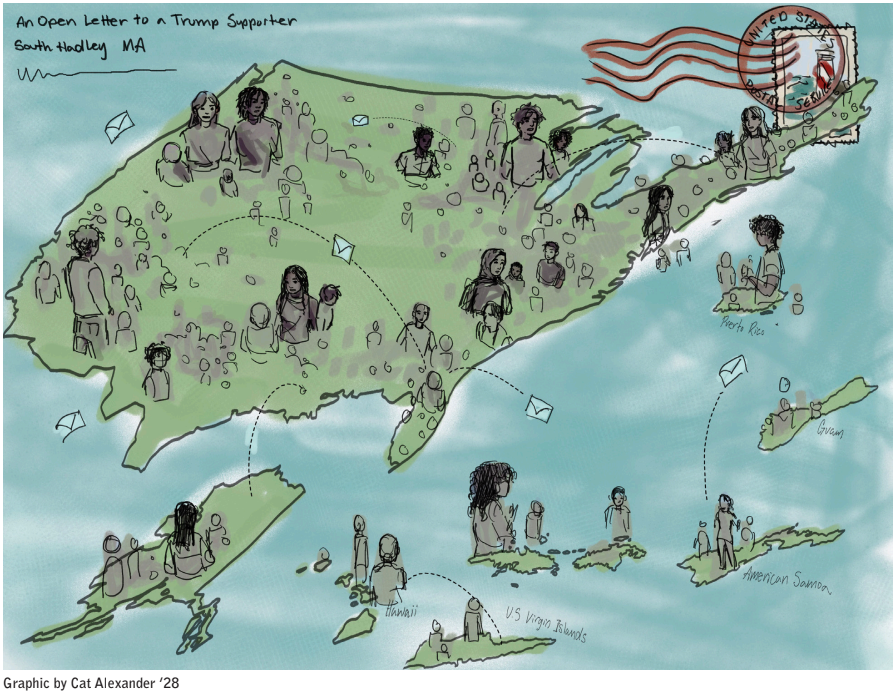
But it is difficult to quantify something so nebulous. Even more difficult when I, for all intents and purposes, am lucky enough to live in a bubble. To live in a place, like Mount Holyoke College, where he is so universally unaccepted. But not everyone has that. So I decided to interview college students from across the country, and ask about the ways they and their loved ones have been affected by the Trump administration.
“I’d been out as trans for several years [when Trump was re-elected],” Gráinne Beltramo-Dolan ’27, from Minnesota, said to me. “[The Trump administration] has certainly instilled a lot of fear. With all the framing trans people as the enemy, I always feel on edge and like I have to be preparing to leave [the country] at any moment. I never know if it’s about to tip over.” She added: “Also, I’m from Minnesota, and all the ICE activity there, especially a few months ago, that was tough to deal with. ... [Minneapolis] is quieter … there’s a lot of businesses and restaurants I love that are struggling because people are afraid to be out and about.”
“My grandfather’s visibly Hispanic [so] he carries his passport everywhere he goes,” Caleb Correa, a sophomore from Oregon, stated. “He’s 85 years old, he’s been here his whole life, you know, he doesn’t even speak Spanish.” He continued, “My mom is immunocompromised [and] she can’t get a measles vaccine. There’s a huge outbreak around us right now, and so I have to be worried. I’m not going to say it’s a death sentence, but she’s in a very vulnerable situation right now.”
“A couple of my friends are more or less fearing for their lives because of ICE at the moment. ICE has been showing up in Maine and patrolling our streets,” Miles Anderson, a freshman, from Maine, said. “It’s been hard to hear them talk about how they don’t feel safe here anymore.”
“My boyfriend’s family has run into lots of issues — with his parents both being psychology professors, [...] they’ve faced issues with what they’ve wanted to teach,” Mikayla Leach, a freshman from Colorado, told me. “My parents [who voted for Trump] have been finding issues with money. I’ve heard them talking about how gas has gone up, how much more expensive groceries have gotten, how they were really upset to find that nursing is no longer a profession paid for by the Department of Education. And my mom is saying, ‘Why is that happening? I don’t understand.’ And it’s hard to explain, but she does and doesn’t believe me [when I tell her that it’s due to the Trump administration].”
I try to temper my anger in my articles, even though they’re opinion pieces. I try to meditate, to breathe, to be an objective observer even when I would prefer to rage.
Still, I was stunned by how measured and calm so many of my interviewees managed to be in the face of such fear: For themselves, for their families, for their partners and friends. Perhaps they’re better people than me, because I am so, so angry.
I am angry that my friends are in danger. I am angry that I have no control over what happens to my body. I am angry that I wake up every morning with the fear of never knowing what will happen, that the night before Trump was inaugurated for a second time, I slept between my parents because I was too scared to sleep alone. I am angry that people are dying needlessly and I am helpless in the face of it.
So on their behalf and on mine, I would like to ask you a question: Was this all worth it?
Gutting our social safety nets. Demonizing vaccines and life saving medicine. Ripping children from their families. Dragging parents and grandparents and community pillars out of their homes in their underwear. Throwing people who have committed no crime into prisons better described as concentration camps.
Going after transgender children in a Lavender Scare-esque witch hunt. Murdering innocent citizens on the street. Sending our soldiers to die in a completely unnecessary war that most of us don’t even want. I could go on for hours and not even scratch the surface.
Maybe you think it was worth it. Maybe you think that those immigrant families like Caleb’s are all criminals and that trans children like Gráinne are all dangerous and that those soldiers like Mikayla, who came from a military family and was in Air Force training herself, all sign up for the danger of war. But I really don’t think you do.
Because I know you know someone who is an immigrant. Who is transgender. Who is a soldier, or who could get drafted. And I know you do, because every single one of my interviewees knew someone like you. Someone who voted for Trump. Even someone who still would.
It would be easier for me just to hate you. Some days I feel like I could live a hundred years on the strength of my own rage. But the truth is it’s too easy, too simple, to imagine you as different to me in some intrinsic way, when you are not. And dehumanizing each other is how our country got where it is in the first place.
The truth is you are just a person who made a decision that you thought, for some reason or another, was the right one.
At the end of our conversations, I asked each of my interviewees what they’d like to say if they could speak directly to a Trump supporter. To you.
“I would say, there is no such thing as ‘it’s too late’ or ‘you’re too far gone,’” Correa answered. “If you’re having regrets, you can make up for it by voting for an anti-MAGA candidate, whether that’s a Republican or a Democrat. ... You can always vote for someone who can stop it from getting worse.”
“If you have benefited [from Trump being elected],” Beltramo-Dolan said, “[ask yourself]: Is that worth the widespread terror that has been inflicted on the country?”
“I know what brought you to vote the way you did,” Leach stated. “I want to challenge you on that and ask, what did Jesus stand for? ... Do you genuinely think that the same Jesus we learned about in church would tolerate innocent people dying? Would he say that sometimes there’s just collateral damage? I don’t think he would.”
She continued, “Don’t let yourself be so close-minded that you won’t let yourself hear the people you’re hurting. It’s okay to be wrong and to admit you’re wrong. I know it’s a hit to the ego. Even if you can’t understand being personally impacted, try to understand where people are coming from. Because looking at the world that way, lacking empathy, lacking compassion, does a disservice to everyone, not only yourself.”
Maybe none of these words have convinced you of anything. Maybe I’m wasting my breath, my time, and the newspaper’s allotted printer money. And maybe you think it hasn’t affected you yet. But it will.
As journalist Kristen Radtke writes about her childhood friend, Alex Pretti, an ICU nurse shot and killed by ICE in January: “We have become familiar with being barraged by videos of people we do not know getting detained and ripped from their families and beaten by agents whose salaries we pay. As social media does its work putting bits and pieces together about each day of unfolding tragedy, more and more of us will realize that those pieces belong to someone we know.”
It is tragic, perhaps, that so many of us will only know the full scope of this breathtaking cruelty when it arrives at our doorstep in the faces of the people we love most. When it arrives with no warrant to take us away.
“Just be careful,” my aunt, who lives in Texas, texted me when I told her I was writing this article. “You know what happened at Columbia [University] … I just don’t want them revoking your degree.”
To which I asked her, “What kind of journalist would I be if I was careful?”
In another world, perhaps we could have the luxury of being careful. In this one, I am standing with one foot on either side of the fault lines between the bravery I claim to possess and the actions that are actually proof of it.
And if you are truly as American as you swear you are, you will know that our country was not made by being careful. That we were an idea whispered in between spies and writers and soldiers whose home was breaking under the iron fist of a tyrant. That the Declaration of Independence, written 250 years ago this July, begins by saying: “We hold these truths to be self-evident: that all men are created equal. That they are endowed by their Creator with certain unalienable rights: Life, Liberty, and the pursuit of Happiness.”
That it says: “When a long train of abuses and usurpations … [reveals] a design to reduce [the people] under absolute Despotism, it is their right, it is their duty, to throw off such Government.”
And I would argue that, though our world may be a different world than theirs, that we too have a duty to throw off such government. A duty to resist, just as our forefathers did. That we, the people who have any modicum of safety, of privilege, have a duty to use it to keep the more marginalized safe.
In 250 years, tell me, will your descendants look upon you as someone who continued that legacy of resistance? Someone who took their “Don’t Tread On Me” flag and stood by it? Or someone who stood off to the side and watched history happen?
You still have time to make that choice. I hope, for my sake, for yours and for everyone we both love that you make the right one.
Madeleine Diesl ’28 contributed fact-checking.