Students enjoy one of Pangy Day’s many activities, the Ciruti World Fair

By Jo Elliott ’27

Features Editor

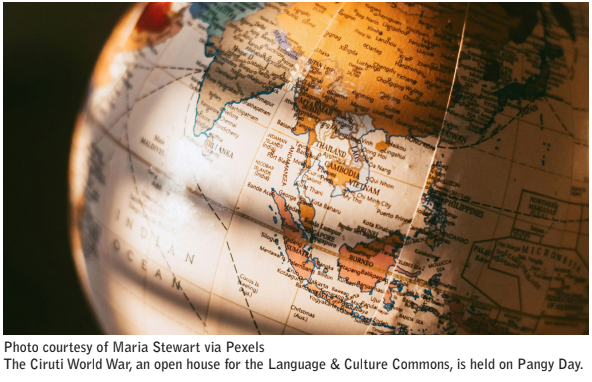
A staple and well-celebrated Mount Holyoke tradition, Pangy Day was held on May 1 this year. Starting in 1979, Pangy Day — short for Pangynaskeia Day — has been a day to celebrate women, with all the College's students, staff and faculty coming together to celebrate. Some of the events included are an all-College picnic on Pageant Green, music, games, face-painting and so much more. One of these events, highlighted in this article, is the Ciruti World Fair hosted by the Language & Culture Commons.

The Ciruti World Fair is the Language & Culture Commons’ open house, where students can enjoy cool drinks, a collection of international snacks, arts and crafts and a photobooth. Some of the international snacks they offered were soft taro-flavored candy, dulce de leche wafer cookies, Ukrainian chocolate marshmallows, Macedonian delights, Korean syrup coated rice senbei, and Spanish deuto cookies with vanilla filling.

The fair offered students the chance to learn about the French and Spanish, Latina/o and Latin American studies and Romance languages departments. Some of the activities offered at the fair included a Zumba Session in Ciruti’s courtyard with Spanish professor Flavia Cunha. Students could also participate in a Korean Calligraphy Art Class, and meet the Five College Centers for World Languages to learn about the language learning opportunities in the 5 Colleges.

On the fair, Sally Rolland ’27 wrote in an email to Mount Holyoke News, “I just returned from study abroad with the IES Nantes program in France. As it happens, I am not currently enrolled at MHC, but I was visiting friends for Pangy Day. I popped by the World Fair because I missed speaking French (my program was full immersion) and because I heard there would be food! I am already familiar with many people in the Mount Holyoke French program, as we are a pretty small group.”

“It was nice to see them and chat with them. I like stretching my foreign language muscles, and it's now been a while since I've seen a lot of people so I was happy to say hi. Many majors who have been around almost my whole time at college will be graduating this spring, so it feels good to check in with the language community before then. It's maybe bittersweet, because it kind of felt like goodbyes, but I also chatted with some underclassmen. I guess there's always a next generation!” Rolland wrote.

Abigail McKeon ’26 contributed fact-checking.

DisOrientation pulled together in spite of weather conditions

Elizabeth Murray ’26

Features Editor

If you were in one of the dorm buildings scattered around campus on April 14 between the times of 7:45 p.m. and 8:15 p.m., you very likely heard the rowdy voices of seniors gathering freshman for DisOrientation, also known as Dis-O. 

Dis-O is a long standing Mount Holyoke College tradition where the senior class, dressed in their graduation robes, gathers the freshman in the spring semester at Mary Lyon’s grave to sing a rendition of the Alma Mater followed by the Anti-Alma Mater, walk over to the President’s House, sing the two songs once again, and enjoy some special M&Cs. 

Originally held in the fall, this tradition dates back to the 1900s and has evolved over the decades. Starting as Freshman Day, it involved the freshman and sophomore classes facing off in games like basketball, while the upperclassmen could have the firsties complete tasks for them. In the 1940s the tradition became Hazing Day. Seniors wore their academic robes, and the freshmen would be dressed in costume and then treated to a night out by the seniors. 

By 1970 it became a week-long tradition, but in 1985 Massachusetts passed an anti-hazing law. This was when it began to be called DisOrientation, and rules were set in place throughout the 1990s about how the event was to be conducted. The class of 1993 protested when the College made a last minute rule change to Dis-O, however the tradition has continued on to this day.

The most recent change to Dis-O occurred in 2017 when it was moved to the Spring semester, to include springies and create more secrecy surrounding the date. 

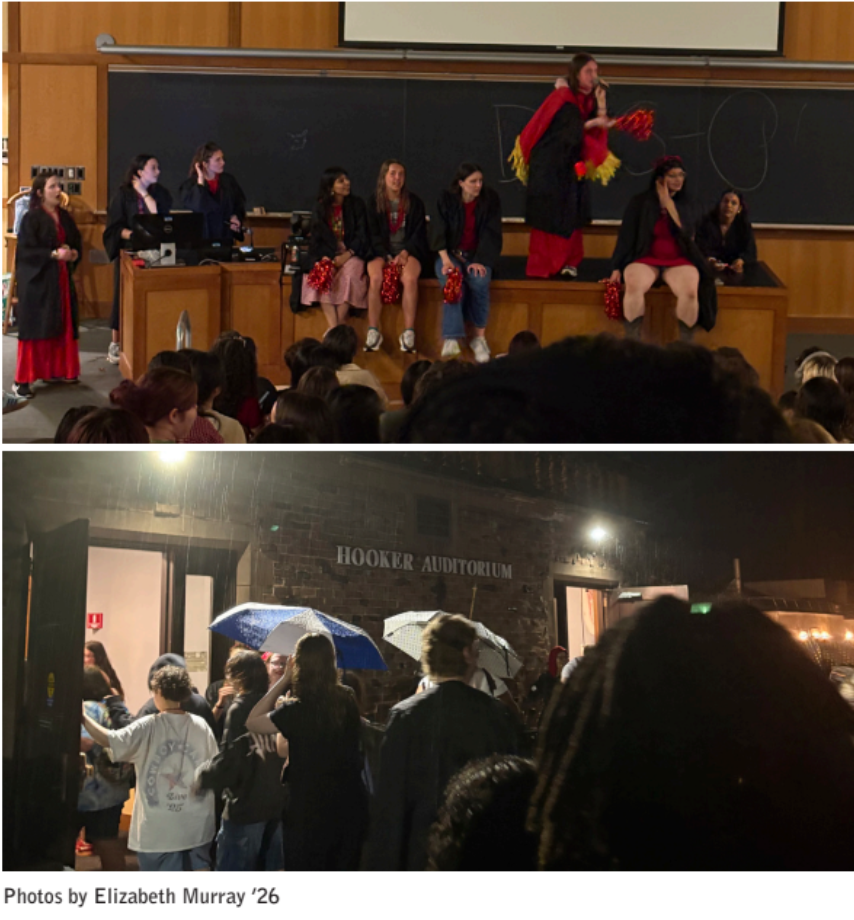
As the saying goes, April showers bring May flowers, and no one was likely more aware than this year's participants in Dis-O. Under the downpour participants gathered in front of Mary Lyon’s grave and were promptly directed to Hooker Auditorium, where the 2026 class board was waiting. 

Justin Bieber's 2012 hit “Beauty and a Beat” played on the projector as the crowd sang along. After welcoming everyone, the senior class board introduced themselves, and led the crowd in a sing along of the Alma and Anti-Alma Maters. The energy was palpable with chants of both 2026 and 2029 ripping through the auditorium. 

Due to the rain, the walk to the President’s House had to be delayed. After a round of Justin Bieber's “Baby” the crowd was delegated outside to the path leading to the cross walk. The energy stayed, with some students chanting their love and support for Hampshire College, who that morning had announced their impending closure. 

By 8:45 p.m., M&Cs was ready and the crowd was directed to the President’s House. President Holley came out to join the crowd, posing for photos, and joined in singing another round of the Alma and Anti-Alma Mater.

“It’s such a gift to be part of this community and I hope all the first years got to feel that themselves at this event,” said Olivia Curtis ’26.

Angelina Godinez ’28 contributed to fact checking 

Mount Holyoke panelists call for allyship for minority groups

By Mia Lewis ’29

Features Section Writer

On Tuesday, April 14, six members of the Mount Holyoke College community gathered together to discuss activism surrounding anti-Asian racism and xenophobia on campus. Angela Kim ’28 and Ivy Zhou ’27 were joined by Professor Joshua Roth, as well as three alums, Addison Beaux ’99, Miki Yamada ’00 and Peggy Chen ’25 to share their experiences with campus engagement and student advocacy. The conversation, hosted by the Office of Diversity, Equity and Inclusion, highlighted both the progress made and the ongoing challenges in fostering a truly inclusive environment.


All panelists emphasized the need for authentic allyship when asked what could be done to improve campus culture. This call to action underscored a recurring theme that performative well-intentioned gestures must evolve into sustained, meaningful engagement to create real change.

“An Instagram repost is not enough, make sure to extend the conversations to the classrooms, the dinner table, even the walk to a party, the harm isn’t just online therefore the allyship cannot stay there either,” Kim said. As a board member for multiple affinity groups on Mount Holyoke’s campus, including Asian American Students In Action, the 5-College Pan Asian Network and the Korean Students Association. Kim recognizes the importance of diversity in community-building. Her involvement reflects a broader trend among students who are redefining advocacy as both a personal and collective effort. 

For Kim, this allyship in advocacy creates value in the work being done by fostering a sense of belonging, “Despite the exhaustion that goes into organizing, surrounding yourself with those doing the same lightens the load and creates value in the labor,” Kim said.

Current students were able to speak with faculty, administration, and alums about the history of the shared advocacy against anti-Asian racism and xenophobia at Mount Holyoke College. Over time, the College has created more opportunities for inclusion, including the creation of cultural centers, “[Cultural centers] are not just symbols of progress; they are also reminders of the exclusion that made them necessary in the first place,” Zhou said. 

This reflection was an important recognition of the community that the college has fostered. “Friends should not be afraid of talking with each other about difficult issues. But it should be done respectfully, acknowledging the real pain that others may be feeling, perhaps delaying the difficult conversation until a period of mourning has passed. To fail to do so is to fail to recognize our shared humanity,” Roth said. 

“If we only care when an issue is our own, we create a culture where everyone does the same,” Zhou said. That is why it is particularly important to form allyship when there is a level of privilege, because the advocate is not personally in the minority group. 

Zhou’s perspective highlighted the role of privilege in advocacy, challenging the community to move beyond passive support. “Even in painful moments, there is still so much possibility for care, solidarity, and love. I know what it feels like to be hurt by discrimination, and I also know what it feels like to be held by the community. Because I have felt both, I want to do what I can so that fewer people have to experience the first, and more people get to experience the second,” Zhou said.

Angelina Godinez ’28 contributed to fact checking

Guardianes Del Cacao workshop spreads awareness throughout Amherst

Angelina Godinez ’28

Managing Editor of Social Media

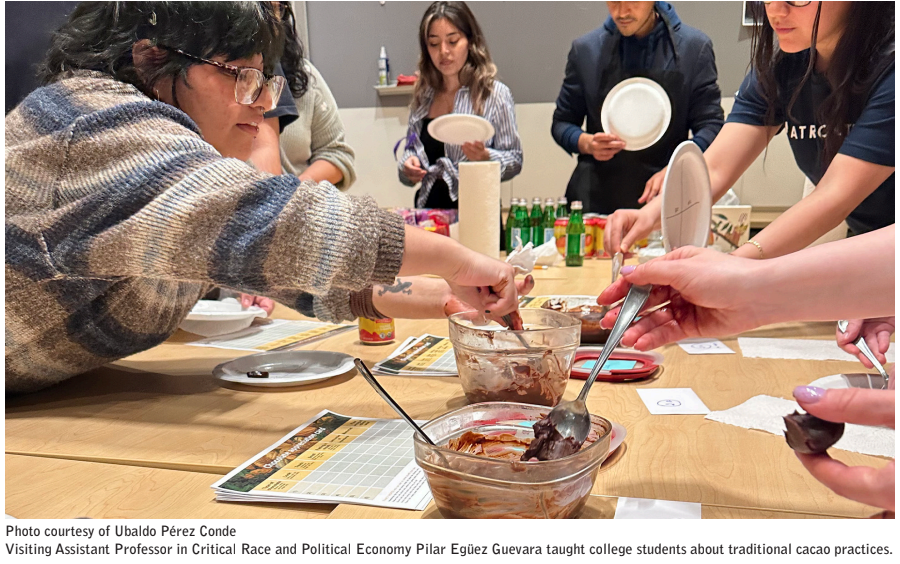
Over the course of two weeks,Visiting Assistant Professor in Critical Race and Political Economy Pilar Egüez Guevara delivered two workshops debuting part one of her film “Guardianes de Cacao” —translated to English as “Keepers of Cacao” — at both Amherst College and the University of Massachusetts Amherst. These workshops were held completely in Spanish, and were just two of five given within Massachusetts and New York. This is Guevara’s second time offering this cacao workshop in her Healing through Language and Culture course, in addition to offering options outside of Mount Holyoke College. Similarly, it was the first time she debuted her film, “Guardianes Del Cacao.”

The workshop began with a journal prompt asking the attendees to reflect on what brought them to the workshop, what expectations or emotions they had and what they hoped to gain. After discussing various skills taught in her class, Healing through Language and Culture, Guevara went on give some background information to her four part docu-series, “following the guardians of fine aroma cacao in Ecuador and Mexico: Afro-Ecuadorian and indigenous elders, agroecological farmers, traditional cooks, artists, and scholars who protect ancestral cacao varieties.”

Not only does this film make an effort to cover the four natural elements of keeping cacao — water, soil, air and fire — but it confronts threatening oppositions to the practice, such as the ability to preserve cultural practices, mining, natural geographic shifts, biodiversity, monocrop expansion and market pressures on endangered rivers. This allowed attendees of this workshop to gain multiple perspectives on the work put into the traditional harvesting of cacao.

Here, attendees learned about the Chocó Andino, an endangered and biodiverse region that spans from Northwest Ecuador through, Columbia and Panama, housing 12 types of forest, 270 mammal species, 210 reptiles and 2110 different plants, including a variety of cacao trees that provide cacao to both small and large agricultural companies.

The Rainforest Partnership, a global non-profit that works with indigenous communities in rainforest conservation, is currently working to attempt to preserve as much of the unique ecosystems, biodiversity and water sources the Chocó Andino has provided for years. This is done by establishing private reserves that “ensure lasting protection of standing forests,” and “allow for natural regeneration of degraded areas,” enabling the traditional harvesting of cacao in the Mashpi conservation area. The importance of preserving this land, specifically the Mashipi region, is further emphasized in the film by Cacao expert, Flor María Castillo Quiñones.

Guevara then went on to demonstrate how Mashpi cacao is special due to the traditional indigenous practices of harvesting cacao, as opposed to machine-made harvesting. Throughout this workshop the importance of traditional practices and cultural preservation were emphasized, sharing the ties it has to one's daily life and how one connects with their culture and ancestry.

Following the presentation, attendees were able to hand-make cacao truffles and experience the importance of physical contact with cultural recipes, shining an overarching light not only on Guevara's work to document these preservation practices, but further illustrate the history behind each bite.

Madeleine Diesl ’28 contributed fact-checking.

Trivia night celebrates Transgender Day of Visibility

By Mia Lewis ’29

Features Section Writer

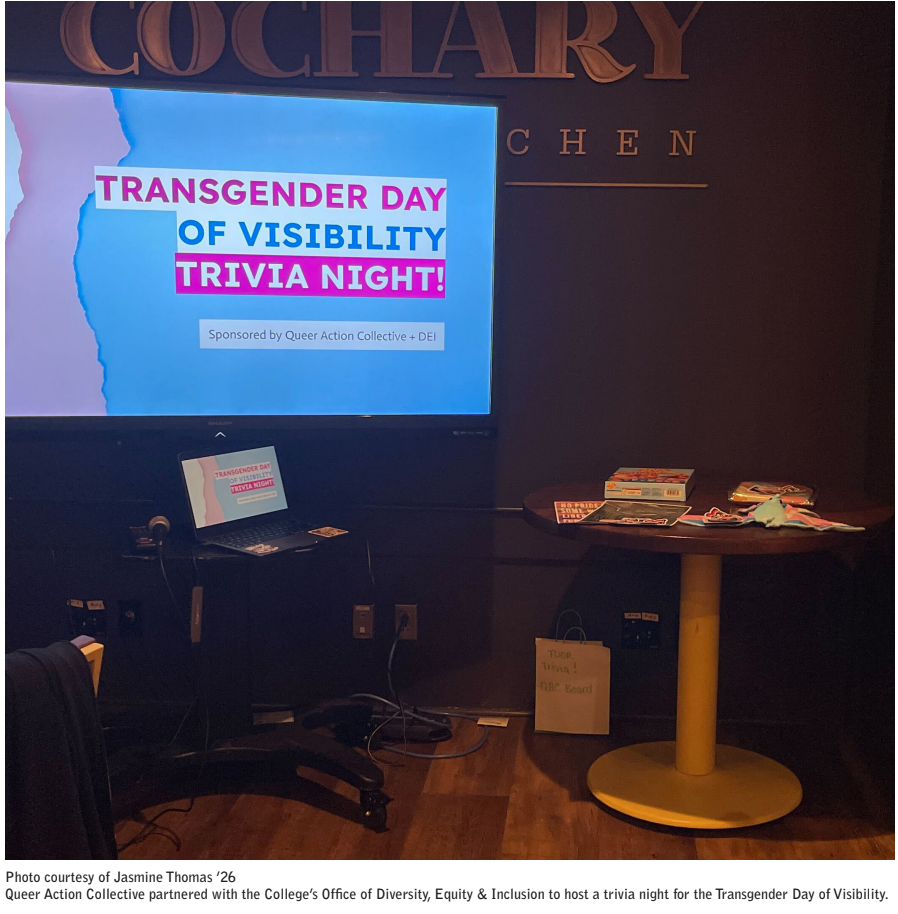
To celebrate Transgender Day of Visibility, Queer Action Collective — abbreviated as QAC — hosted a lively trivia event that drew in a crowd of students eager to learn and engage in queer trivia, held in the Cochary Pub and Kitchen on Tuesday, March 31. Transgender Day of Visibility is an annual day of celebration to honor and recognize the trans community. This event combined education with entertainment, and offered participants a fun way to grow their understanding of queer history, culture, and activism.

Andy Webber ’29, a student who attended the event, excitedly shared their surprise at the turnout. “I expected there to be fewer people honestly, so I am glad there were so many,” Webber said. Like many other participants, Webber had some prior knowledge about Transgender Day of Visibility, but they still found the questions challenging and engaging. These topics ranged from pop culture to historical legislation and the questions accounted for students with any level of knowledge.

“Some of the questions were pretty obscure,” Webber said, “but I was pleasantly surprised by how diverse the questions were.” Webber had a specific interest in questions about queer activists, such as bell hooks, along with icons they had not known before.

Naoise Grybko ’26, one of the event organizers and a member of QAC leadership, expressed similar satisfaction with the turnout of the event. “We had been planning it for a while, so I am glad so many people attended,” Grybko said. The QAC, along with the Office of Diversity, Equity, and Inclusion, had various options for events to celebrate Transgender Day of Visibility. However, they landed on trivia because it struck a balance between educational and enjoyable for all participants.

“At a lot of trans-centered events, there's a lot of important information, and sometimes people just want to have fun,” Grybko said. “Trivia was a great way to do that while still learning about Trans Day of Visibility.”

Events like this show the importance of Transgender Day of Visibility as a moment to recognize and honor transgender experiences. They also demonstrate how creative approaches can make education accessible and enjoyable, encouraging more people to participate in conversations about transgender acceptance.

As the three highest scoring individuals received their prizes, it was clear that the trivia event had succeeded in its mission to celebrate, educate, and bring together Mount Holyoke College students in support of transgender visibility on a gender-diverse campus. The Queer Action Collective and Office of Diversity, Equity, and Inclusion will continue to have educational events intending to bring together members of the community and celebrate all identities.

Madeleine Diesl ’28 contributed fact-checking.

A member of the pre-law board reflects on women of color in law event

Graphic by Quill Nishi-Leonard ’27 via Canva

BY JO ELLIOTT ’28

FEATURES EDITOR

On Sunday, March 8, International Women’s Day was celebrated at Mount Holyoke College by the panel event, “Leading with Perspectives: The Future of Women of Color in Law.” The panel was joined by guest speakers Siqi Zhao ’17, Ashanta Evans Blackwell ’95 and Rhynette Northcross Hurd ’71. The panelists discussed “their career journeys, the challenges and opportunities they have encountered, or advice on navigating uncertainty in the current political or legal landscape.”

Abby Paull ’28, the social media coordinator of the pre-law board, was “encouraged to go to the event, to show our support for the alums.” 

“I thought it was really interesting, [and] I liked the accessibility of it being on Zoom, a lot of times we have our pre-law panels in a conference room, and by this being on Zoom it made it more accessible, for me and a lot of other students to join and learn [new] perspectives.” When asked about the content of the event Paull stated, “I thought their insights on imposter syndrome were the most interesting because we already got into this school so we’re already so much above the curve … but one of them told us we have to take a second to appreciate how far you’ve come.”

When speaking about the alums, Paull said, “They talked about how law can be a gateway to many things, especially working in public policy. That matters a lot to me as someone who wants to potentially go to D.C. post-grad. I think the crucial part is knowing your worth, all of the alums have gone through struggles of their own, and them being confident enough to share that with us and turn that into a positive message meant a lot to me.”

Speaking on what it means for alums to be a part of these events, Paull stated “It gives alums a chance to connect back to their school. We are already a heavily alum based college, and by allowing them to give their perspectives it allows us to learn more about the legal field and understand what it’s like to be a woman in the legal field.”

“I think it’s really important especially with what's happening with all the silencing that's been [going on] in the Trump administration. If I was an alum I would want to be asked to come back. The alum-student relationship is very crucial to our networking, and being able to talk about law and some of the downsides of it, I know one of the panelists talked about her experience being a judge and how she has threats against her and she has to have an officer follow her around the court house, and everything that goes into that. Especially in this trying political climate, we need that connection, we need organization.”

From the alums she was “able to gain insight on what’s happening in the legal field, and if we want to reconsider, perhaps modifying our plans. A lot of them talked about taking time between law school and undergraduate to reassess what you want.”

“Imposter syndrome came up a lot, and they all reaffirmed that you’re here for a reason, you’re already one step there, and Mount Holyoke gets you that foot in the door in the legal field.”

Angelina Godinez ’28 contributed fact-checking.

Editor’s note: Abby Paull ’28 is a staff writer for Mount Holyoke News.

Purses with Purpose: Alpha Kappa Alpha collects for Safe Passage

Photo courtesy of Aisata Diallo ’26

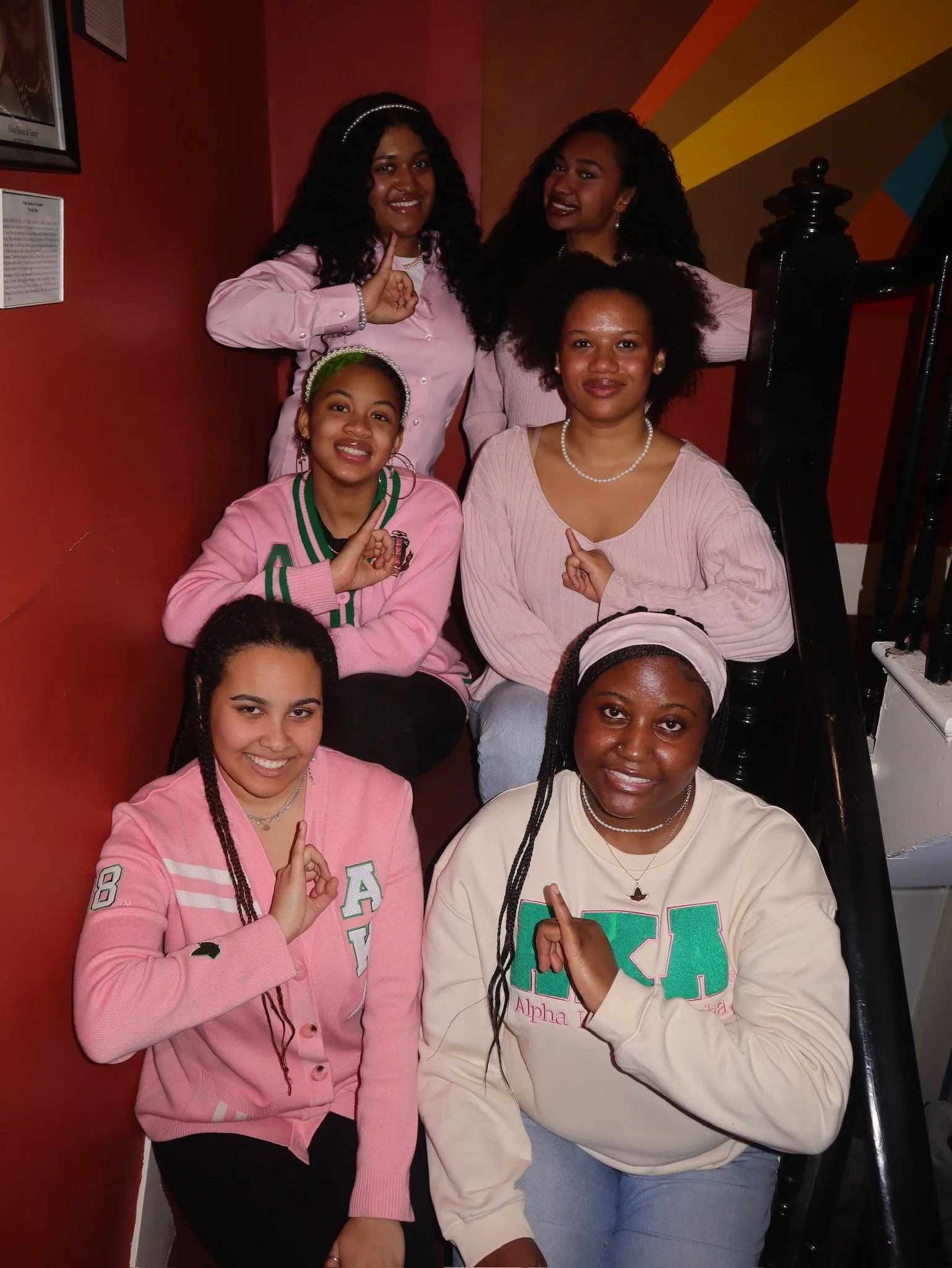
Xi Nu is MHC’s chapter of Alpha Kappa Alpha, a historically Black sorority promoting community.

BY ELIZABETH MURRAY ’26

FEATURES EDITOR

One of the tenets of the Alpha Kappa Alpha sorority is acts of service, with chapters and members regularly conducting service projects. This is where Purses with a Purpose was born, a hygiene drive run by the Xi Nu chapter here at Mount Holyoke College with donations going to Safe Passage in Northampton. Safe Passage is an organization that serves survivors of domestic violence by providing resources like counseling, support groups and prevention training activities. 

Two collections were held for the drive, the first on Feb. 4 and the second on March 6, in the entrance of the Dining Commons. The first round of collections brought in 70 items that were donated to Safe Passage, and the second collection yielded an even higher number of items, donated mainly by students. “It was pretty impressive. People are so generous on campus and they really care … it was amazing that students are putting out their money to help us with our fundraiser and make sure we're taking care of our communities,” Chapter Historian Mooka Dharmapalan ’26 said. 

“I feel like Purses With a Purpose has really allowed us to connect with the women community,” member Mikailah Dukes ’27 stated.

Members of the Xi Nu chapter are passionate about reproductive justice and education. The AKA sorority has five initiatives: “Empower our families, build our economic wealth, enhance our environment, advocate for social justice and uplift our local community,” according to the AKA website 

“Reproductive justice does fall under the [initiative] uplift our local community, and I think people try to make it this really taboo thing and it shouldn't be. So I think that's why we're very geared towards reproductive justice,” chapter member Yeslee Nerris ’26 said. The chapter has held other events surrounding sexual health and reproductive justice in the past, such as workshops and group discussions. 

“Each one of our chapter members are leading one of those initiatives. …  Line sister Caroline led a safe sex workshop where she researched and collected a lot of items from Planned Parenthood so we could provide those items to students on campus, which were like condoms, dental dams [and] Plan B [pills], which are increasing in price. So giving them out for free is a really great resource. We got to do a full sex talk and also have an open conversation about consent, about safe words and the nitty gritty of things that you don't learn in sex-ed in high school,” Dharmapalan said.

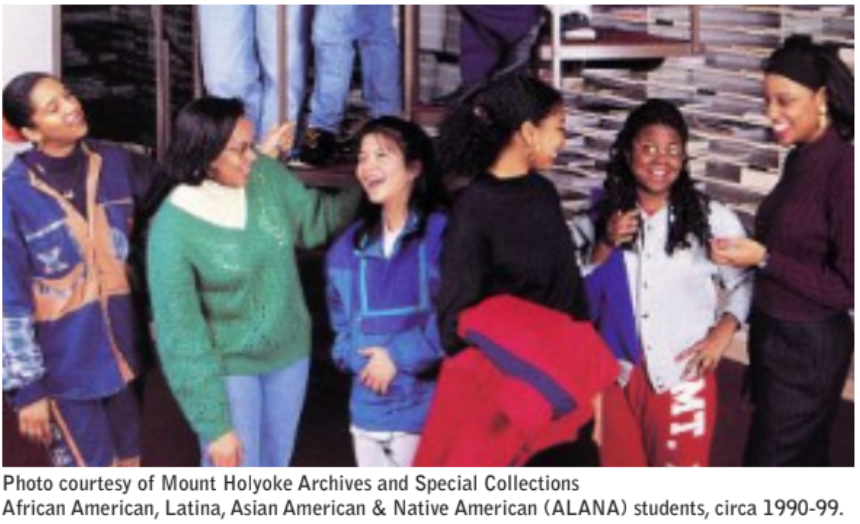
AKA has a long history here at Mount Holyoke. The Xi Nu chapter was founded in 1983, and has continued to serve as an empowering space of community for Black students and students of color at a predominately white institution like Mount Holyoke. There are some challenges that come with this, especially compared to larger institutions where Greek life is more common or historically Black institutions that have a large Divine Nine presence. 

Despite these challenges the Xi Nu chapter remains strong, “We're still [having] just as much impact and I love our line sister[s] so much. We have a really great bond,” Dharmapalan said. This academic year, the chapter had 4 new line sisters who are continuing their service work. Since 2020, the chapter has had some difficulty recruiting, but they still continue the AKA legacy. Looking ahead, Xi Nu is planning more service projects and connecting with other Divine Nine chapters in the region. 

“Seeing what the chapter has done… I am personally so proud,” AKA graduate chapter member Claire Clunis ’25 said.

Angelina Godinez ’28 contributed fact-checking 

Japan Night, hosted by JCC, returns to Mount Holyoke

Photo courtesy of Autumn Gebhardt ’26

Elizabeth Murray ’26

Features Editor

Japan Night at Mount Holyoke College was held for the second time in 26 years in Chapin Auditorium on Friday, Feb. 20. Hosted by the Japanese Culture Club, Japan Night is a celebration of Japanese culture featuring performances by students, a fashion show and a festival with games and food.

The theme of the night was “The Springtime of Youth,” with board members, performers and volunteers dressed in Japanese high school uniforms. A Bunkasai followed the performance. A Bunkasai is a festival held in Japanese high schools that features food, games and prizes to be won, adding to the youthful energy of the night.

The two co-chairs, Hana Takahashi ’28 and and Sakura Wakui ’28, opened the night’s performance with the land acknowledgement, before welcoming the audience, introducing the JCC Board and encouraging the crowd to use the glowsticks left on their chairs to cheer on the performers.

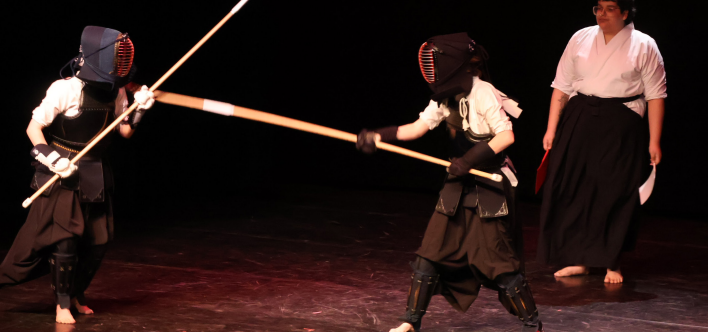
The first two performances were dances, one by student group Cindi, Linda, Tooba, Jourden and Christy to “Ringo” by ITZY. Then ODotteMita, the Five Colleges-based J-pop dance team, took the stage to dance two numbers, “Live Beautifully” and "Moonwalker.” This was followed by two naginata showcases by Kachimushi Naginata. Naginata is a traditional Japanese martial art dating back to the middle ages. The first showcase was a choreographed performance, and the second a sparring match.

Following these first three performances, another student played a piano medley of famous music from several iconic Ghibli films, like “Spirited Away,” “My Neighbor Totoro” and “Howl’s Moving Castle,” followed by a duet performance by the JCC co-chairs. They performed “Sukidakara” by Yuika, a song about two high school students with feelings for each other but who don’t know how to act on it. The JCC Board then followed up with a dance number to several famous Jpop songs, including “Koi” by Gen Hoshino, “Night Dancer” by Imase, “Otana Blue” by Atarashii Gako!, “Sukisugite Metsu” by M!lk and “Koi Suru Fortune Cookie” by AKB-48.

The performance part of the night concluded with a fashion show. The first half of the fashion show was dedicated to traditional Japanese fashion, with the latter half to more modern styles.

Once the performances ended, the Bunkasai began with ticket holders able to play games for prizes, enjoy some food and mingle for the rest of the evening.

When asked for a comment, Takahashi said, “We were so glad that people were able to have fun and enjoy Japanese culture with us! This is only the second Japan Night in the last 26 years. We didn’t have a lot to build off of, but we’re so glad that the night was successful! We hope to continue to celebrate Japanese culture with everyone through future Japan Nights! Thank you to everyone who attended and participated in the Bunkasai!”

Jillian Stammely ’28 contributed fact-checking.

Spring semester Involvement Fair held in Chapin Auditorium

Graphic by Quill Nishi-Leonard ’27 via Canva

Elizabeth Murray’26

Features Editor

Chapin Auditorium was abuzz on Sunday, Feb. 1, as the College’s spring Involvement Fair was in full swing. Held on the first Sunday after the start of classes every semester and hosted by the Office of Student Involvement, the Involvement Fair is where student organizations of Mount Holyoke come together to showcase what they do and hopefully gain new members. “The Involvement Fair is always busy every year; I really enjoyed representing my orgs and learning about old and new ones,” Art Society Co-Chair and Secretary, Mariyah Al-Tayb ’26 said.

These clubs can range from more action oriented clubs like Precious Plastic MHC, which works to create a sustainable way to use plastic on campus, cultural organizations such as Liga Filipina, which celebrates Filipino culture and spreads awareness about the Philippines, or recreational like the Pick-up Games club, which hosts fun recreational matches with no experience required.

Student organizations use the opportunity to drum up interest and reach students who may not have considered joining before. “I tabled for the Mount Holyoke College Economics Review, and I was honestly so happy to see how many people stopped by with questions. What surprised me most was that a lot of them weren’t even economics majors, they were just genuinely curious and excited to learn more about what we’re building. That kind of interdisciplinary interest made it feel really meaningful.” Tiko Dolidze ’26 said.

With the Involvement Fair occurring so close to the start of the semester, it is additionally a great way for new and returning students to meet and get to know each other over shared interests. “The spring Involvement Fair gave me the opportunity to meet some of [the] Springies this semester. It was wonderful to see some new faces and exchange ideas of what events we want to see more of in the future.” Dominique Smith ’26 said.

The Involvement Fair is usually a lively event with students mingling and showcasing what makes their organization special. “The whole atmosphere was upbeat and welcoming. One of the orgs started playing music, and at one point people started dancing together, which was such a highlight. It reminded me how lively and connected our campus community is. I love that students stay so active outside the classroom and that every year there are new organizations forming that reflect such a wide range of interests. It made me feel proud to be part of it.” Dolidze said.

Cat McKenna ’28 contributed fact checking

Mount Holyoke alum Chloé Zhao’s ‘Hamnet’ wraps up run at Tower Theaters

Photo by Emma Quirk ’26

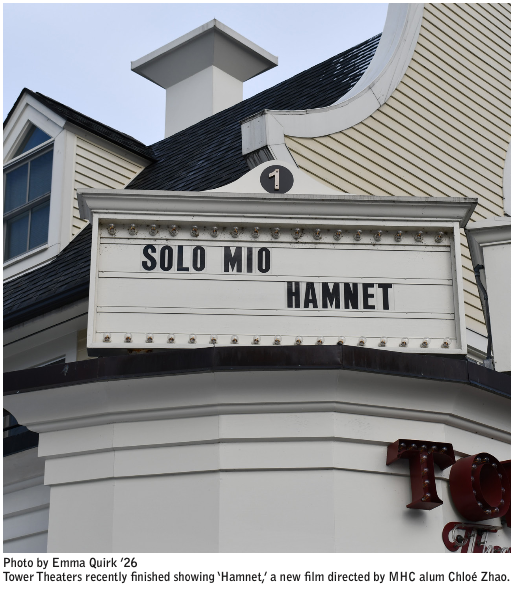
Tower Theaters recently finished showing ‘Hamnet,’ a new film directed by MHC alum Chloé Zhao.

By Aspen Pearson ’28

Staff Writer

Chloé Zhao was once a student at Mount Holyoke College, graduating in 2005 with a major in political science and a minor in film. Since her time at Mount Holyoke, she has received multiple Academy Awards, including Best Director and Best Picture for Nomadland.

Her latest film, “Hamnet,” is a film adaptation based on the book “Hamnet,” written by Maggie O’Farrell. Rather than the traditional biopic structure, which may focus on historical exploration, this film functions as an expansive exploration of grief, love and loss. It centers on the emotional aftermath of tragedy rather than the event itself, creating a story that is inward-looking and deeply reflective.

Paul Mescal and Jessie Buckley gave some of the best performances of the year as Will and Agnes. Buckley delivers a performance that is tender, heartbreaking, and transformative; viewers can’t help but feel what she is feeling. She is both a nominee for the Oscar Best Actress in a Leading Role and a recipient of a Golden Globe for this performance. Further, Jacobi Jupe, who plays Hamnet, delivers a deeply emotional performance that is especially striking given his young age.

A particularly powerful aspect of Hamnet is its focus on motherhood and the bond between mother and child. Agnes stands at the emotional center of the film, and some of its most moving moments involve her longing for her own mother and her relentless attempts to protect her children, even when those efforts prove futile. One of the most stand out parts of the film is how throughout this, Agnes never loses her spirit. Her bohemian nature remains intact, and she does not surrender her identity in order to fulfill the roles of mother and wife.

Another key theme is the role of art in processing grief. Creation is portrayed not as an escape from pain, but as a way of giving it structure and meaning. This idea feels especially relevant in a contemporary context, as many people turn to art to navigate collective loss and uncertainty. Shakespeare’s life seeps into his work, and that work becomes vital for both Agnes and Shakespeare as they attempt to process the loss of their son. “Hamlet” is transformed for the viewer not simply as a literary masterpiece, but as a living act of mourning.

Beyond the very moving, emotional themes within the movie, one of the film’s strongest elements is its cinematography. It features many long-held camera shots in moments of intimacy, artistic glimpses into the natural world, and close-ups that feel raw and unedited. It is a stunning watch from start to finish.

Tower Theaters recently finished showing Hamnet, which had been priced at $12 per student ticket. Hamnet is a must-see for Shakespeare fans or anyone simply looking for a good cry. For anyone seeking cinema that lingers long after the credits roll, Hamnet delivers.

Emelin Chuquimarca '28 contributed fact-checking.

Reviewing a Smithie author’s debut: ‘The Last Bookstore on Earth’

Graphic by Brianna Stockwell ’28

By Emily Finnila ’27

Contributing Writer

In her debut novel, “The Last Bookstore on Earth,” Smith College senior Lily Braun-Arnold imagines our modern world after an apocalyptic event. In this novel, the “Storm” has brought intense acid rain down all over America and left the nation in shambles, as seen in New Jersey, where the main character Liz Flannery lives. After tragedy strikes her family in the Storm, Liz chooses to live in her old workplace: A bookstore nestled in the abandoned suburbs. As she survives by bartering books with the few customers who still visit her bookstore and eating old stockpiled food, Liz learns of another impending acid rainstorm that her broken-down store is not prepared to handle. 

Luckily for Liz, one night a stranger breaks into her bookstore looking for shelter, and she just so happens to be skilled at repairs. This is Maeve, the book's second main character, who agrees to help Liz fix up the bookstore in the hopes that its shelter will protect them both from the approaching storm. The book then follows their lives in this still recently-apocalyptic world, as they deal with their past trauma from the Storm, their current impending doom and their feelings for each other.

While the premise is exciting, this novel also has a few pitfalls. The book confronts the idea of the end of the world for a very specific and privileged group. Told from a first-person perspective, the reader hangs out with Liz for the entirety of the novel, and Liz doesn’t get out much. Having never left the bookstore for a year, Liz hasn’t seen how the rest of the world is fairing after this massive event. The story only explores Liz’s personal world ending: The world of an upper-middle class white family from the American suburbs. There is no mention of the wider world. 

When Liz receives visitors at the bookstore, she writes down their stories of the Storm and their new lives, so we get a glimpse of how other parts of the U.S. were affected; mostly places in the East Coast and Northampton are mentioned! But the worldbuilding details stop there. This leaves readers with multiple questions, like did the Storm happen globally? How did this world’s population lose the ability to communicate online? What’s the state of the U.S. government? What happened to all the cars and infrastructure? None of these questions are really answered because the protagonist, Liz, doesn’t know the answers herself. 

So, this book isn’t one to pick up if you’re looking for a rich new apocalyptic/dystopian world, like “The Hunger Games.” Instead, it would be one to read if you were interested in an introspective story about someone coming to terms with a changed world and life that will never be the same. Liz isn’t someone you would expect to have survived an apocalypse. She has zero survival instincts or skills and is entirely reliant on Maeve for everything. This makes her a very realistic protagonist in an apocalypse — albeit a frustrating one — that readers may find themselves in. This book often prompts you to question what the end of your life as you currently know it would look like. How would you deal with it, and how would you move on? 

You may survive by becoming a hermit like Liz, or you may go out and explore this new world like Maeve. Either way, the end of the world may be closer than you think because — reminiscent of the movie “Don’t Look Up” this book’s apocalypse comes when everyone is trying to pretend that everything is fine, much like the world today. 

Despite my criticisms of “The Last Bookstore on Earth,” if I had discovered this book in my local library when I was younger, I would’ve devoured it. Reading about queer women taking on an apocalypse from a bookstore would’ve been right up my alley. And so, I’m immensely glad that this book will be discovered by other queer kids searching for these stories. This is the first of hopefully many books from Lily Braun-Arnold, and I’m excited to see what she writes next in the world of queer literature. 

Abigail McKeon ’26 contributed fact checking. 

College alum Yutian An lectures on judicial power in China

Graphic by Betty Smart ’26

By Kennedy Olivia Bagley-Fortner ’26

Staff Writer 

On Nov. 21, Yutian An ’13 returned to Mount Holyoke College to present her collaborative research on how juries extend judicial power in China. During her time at Mount Holyoke College, An majored in political science and economics. Currently, she is a Ph.D. candidate in politics at Princeton University, and in January 2026 she will join the UCLA School of Law faculty as an assistant professor.  

An “examines how legal systems structure state-building activities, sociopolitical legitimization and administrative entrenchment in both authoritarian and democratic regimes, with a focus on criminal law institutions.” 

An began her lecture by sharing the framework and hypothesis of her research, which surround the judicial system in China. While China is led by an authoritarian government, “we should not assume that judicial institutions are irrelevant to political life in authoritarian politics.” 

Through her research, An wants to ask and answer these questions: Why are autocrats turning towards law? How can a legal institution create support for the regime? Similarly, she wants to show how authoritarian leaders solve the participation dilemma without creating backlash against the regime. Finally, she wants to reflect on the importance of the lay assessor system. While the lay assessors might not understand everything about a given case, she highlights that they are an important part of Chinese politics. 

In 2018, the People’s Assessors Law was enacted which made “improvements for lay participation.” According an article by Zhiyan Guo’s  in the Chicago-Kent Law Review, the People’s Assessor System can be divided into three phases starting from the late 1970s to 2018: The Restoring Phase, Fast Development Phases, and the New Era, which is what An focuses on. 

While China doesn’t have an explicit “jury system” like other countries, they utilize people’s assessors, who, with the judges, form a panel to hear cases. Most ordinary cases consist of a three member panel which has one judge and two jurors. A high profile case would consist of a seven member panel: Three judges and four jurors.

The People’s Assessor System allows assessors to “attend hearings in civil, criminal and administrative cases involving public interests, [which] attract widespread public attention or have crucial social impact,” stated Li Chenglin, an official from the Supreme People’s Court in an interview with Dawn News. 

In her lecture, An discussed her research which examines why autocrats are turning towards the law and how a legal institution can create support for the regime. According to An, the institutionalization of the lay assessor system in China serves to “promote democratic participation in judicial decision-making, enhance justice and improve judicial legitimacy.”  

As China Justice Observer reported, “the people’s assessors have equal rights and obligations as judges. Therefore, in court, they sit at the bench,” and the assessors have the same ‘one person, one vote’ right. In these ways, the Chinese lay assessor system is significantly different from the American jury system. In America, anyone can be summoned to participate in a jury case, but in China not everyone is allowed to participate. In China, there is a designated pool of assessors and they are selected every 5 years. There are about 300,000 assessors, which is only 1 out of 4,000 people. 

With this in mind, An transitioned to her last segment of her lecture: The “why” behind the lay assessors. Since China is a single-party authoritarian state, how and why could there be “democratic participation" in their judicial system? Through her research, An comes to various conclusions. 

Her general theory is that autocrats establish participatory institutions for various benefits. In the case of China, she argues these institutions neutralize political opponents, reduce information asymmetry and increase governance quality, and can generate legitimacy effects through participation which in turn creates a sense of voice. 

However, these institutions also show the dilemma of authoritarian participation. To the general public, lay assessors and similar institutions can be seen as performative and a political show, which could negatively impact the authoritarian regime. According to An, once people begin to enter the sphere of political participation, they might want more participation. This then leads into An’s point about the way in which the government’s legitimacy might decrease because of this greater political participation. 

To conclude her lecture, An showed her empirical data about how effective the lay assessor system is. She found that, based on interviews, most assessors don’t actively engage or participate during the trial. Additionally, she found that people had little knowledge about the lay assessor system as a whole. 

She did find that there was a high supply and demand for lay assessors. According to her research, 83.5% of Chinese citizens were willing to serve as a lay assessor; however, she also found that many Chinese citizens don’t understand the job of a lay assessor is. Almost 77% think that jurors should have some form of expert knowledge, which is different from the American context, where jurors are expected to judge fairly and neutrally, without having any background knowledge. 

Her findings led her to two major hypotheses: Firstly, that the existence of jurors would help create the perception of fairness; secondly, jurors with voting power would enhance the perception of government legitimacy. 

Maeve McCorry ’28 contributed fact checking. 

'In Bloom': Asian Student Association celebrates VariAsians

Photo by Karishma Ramkarran ‘27

VariAsians is an annual celebration of Asian culture and creativity hosted at Mount Holyoke College; it began in the 1970s as a potluck by the ASA.

BY KARISHMA RAMKARRAN ‘27

COPY CHIEF

On Nov. 14, students and members of the Mount Holyoke College community gathered in Chapin Auditorium for the College’s 51st celebration of VariAsians, an annual cultural showcase of Asian culture, talent and heritage. The event was hosted by the Asian Student Association — abbreviated as ASA — a Pan-Asian organization dedicated to increasing awareness and appreciation of those of Asian descent on campus and in the wider community. 

The theme for this year’s VariAsians was “In Bloom,” a choice that was not only visually stunning but teeming with complex Pan-Asian references. When introducing the theme, the ASA board members pointed to inspiration from the 2025 Nepalese Gen Z protests, numerous flower festivals throughout Asia and the Hindu holiday Diwali. Each table donned hand-painted flowers as centerpieces, through which ASA aimed to demonstrate the uniqueness of Asian culture and both demographic and environmental diversity. 

In an interview with Mount Holyoke News, ASA Senior Co-Chair Maggie Doig ’26 described the process of planning one of the College’s largest cultural events of the year:  “The obstacles faced were ensuring we represented as many cultures as possible and correctly. We made sure to get the information out to as many student organizations and students as possible to represent different cultures through performances while expanding the restaurants we catered from to include more, within our budget restraints.”

Indeed, this year’s VariAsians included an impressive amount of variety in terms of both catering and performances. Students at Mount Holyoke were able to register for free tickets for both dinner and the show; food was provided by Kiao Wan Thai, Priya’s, India House and Ichiban Chinese and Japanese Restaurant, and entertainment by Five College performers such as Raunak Bhangra, Lion Dance and Rainbow Jelly. 

Although VariAsians brought vibrant energy to both the stage and the audience, the event harmoniously balanced both an appreciation of Asian culture and an awareness of issues facing the Pan-Asian community today. Throughout the showcase, the audience was reminded of the intersection between heritage and activism: “ASA would not be here today without the activism and petitioning done by those who came before us to establish our organization in 1973. We would like to recognize and remember that this event is one of many that created space for unity and allows us to celebrate our cultures,” Yurim Oh ’26 said. 

As a preface to the elaborate performances, the ASA board members spoke of VariAsians of the past. The event, one member noted, originally began as a potluck in 1977. It was not until 1999 that VariAsians bloomed into the massively successful cultural showcase held each fall semester. 

VariAsians has come far from its origins, with 14 performances necessitating extensive organization and collaboration. The event was planned in three months, with most preliminary planning of the theme “In Bloom” taking place during last year’s VariAsians 2024: All Around Asia. 

“The most rewarding aspect of planning was seeing everything come together as we envisioned after countless hours of planning and collaboration. Hearing the board, audience and performers enjoying the event was what made everything worth it,” Doig said. 

The event kicked off in a darkened Chapin, with the only light centered on the stage’s runway. Cheers and applause filled the room as numerous students from the College walked the runway in their cultural clothing, ranging from Myanmar’s Burmese longyi from the Konbaung dynasty to Pakistan’s kurta originating from nomadic tunics in ancient Central and South Asia. 

Immanuelle Niez ’28 orchestrated the cultural fashion show. “Each ensemble represents the story of a unique cultural heritage, offering a window into the craftsmanship and prosperity of the past and present civilizations,” she said in an interview with Mount Holyoke News. 

The diversity of Asia was not only demonstrated through beautiful cultural wear, but also through the variety of performances that took place. 

For Doig, the Pan-Asian focus of VariAsians inspired her in 2021 when she saw a virtual recording of it as a prospective student. “I wanted to be part of an event that brought together students from different backgrounds to create a space of community and celebration of our differences and similarities,” Doig said. 

Siyan Zhang ’28 commenced the live performances with a self-choreographed classical Chinese dance that was inspired by the novel “The Dream of the Red Chamber.” Zhang was perfectly emblematic of the theme, “In Bloom,” as she exercised almost effortless command over the stage. Although the performance was classical in nature, it promised a night filled with vibrant energy in Chapin. 

Amherst’s K:NETICS, DJB Dance Crew, Smith K-Pop Dance Crew and Mount Holyoke’s very own Rainbow Jelly Dance Crew brought a wide range of high-energy and high-production performances inspired by the K-Pop genre. With excellent synchronization and intense passion, each dance demonstrated how group performance could be both an incredible source of community and of individuality. Rainbow Jelly Dance Crew performed KATSEYE’s “Gnarly,” which was a particular crowd favorite. 

The sound of ankle bells behind the curtains was followed by energetic performances by Raunuk Bhangra and Jhumka, which represented South Asian dance culture. The performers utilized various props, from suitcases to poles, to aid in their celebration. Bursts of energy in the performance elicited ecstatic crowd reactions. 

“Bhangra isn’t just a dance,” one ASA board member said, “but an explosion of energy, laughter and love.” 

Puja Chakraborty ’27, Ishita Panigrahi ’27 and Lam Dinh ’29 performed an amalgamated combination of “Mora Saiyaan” and “Burn” from the American musical “Hamilton.” On the stage with just their instruments and their cultural clothing, the trio demonstrated with ease the convergence and divergence of Asian identity. In fact, most performances of the night represented how Asian students at the College personally interpret and interact with their heritage. 

Asian American Students In Action — also known as AASIA — took center stage to share poems from  Palestinian writers. AASIA board members read out loud Refaat Alareer’s poem “If I Must Die,” and Mosab Abu Toha’s “What is Home?” Alareer was killed by an airstrike on Dec. 6, 2023 during Israel’s still-ongoing genocide against the Palestinian people. 

“If you’re enjoying the culture tonight, sit with the fact that culture is never apolitical … The joy you see on stage exists because our communities and our ancestors have lived through and continue to live with and resist those colonial legacies, occupation, displacement and genocides,” one AASIA board member said. 

The student organization left the audience with a moment of reflection: “Tonight, consider what it means to stand in solidarity with all of those ongoing struggles, because none of us are free until all of us are free.” 

Leah Dutcher ’28 contributed fact-checking.

Dr. charlie amáyá scott gives her Indigenous transfeminine manifesto

Photo by Elizabeth Murray ‘28

dr. scott came to MHC to speak about her life.

BY ELIZABETH MURRAY ‘28

FEATURES EDITOR

To mark the start of Indigenous Heritage and Trans Awareness Month, Mount Holyoke College’s Office of Diversity, Equity and Inclusion, the Zowie Banteah Cultural Center and the Office of Community and Belonging welcomed Dr. charlie amáyá scott for a two-day residency on campus. scott gave a talk on Thursday, Nov. 6 about the Indigenous transfeminine experience, intergenerational wisdom, ancestors and community, which was held in Gamble Auditorium and featured a Q&A segment.

Emma Quirk ’26 opened the talk with the College’s Land Acknowledgment. This was followed by Kijua Sanders-McMurtry, vice president of equity and inclusion at the College, who highlighted Mount Holyoke’s Indigenous alums, such as Zowie Banteah and Ruth Muskrat, and their work to advance the rights and representation of Indigenous people on campus. Sanders-McMurtry also highlighted the work around inclusion of trans and gender-nonconforming students on campus. 

scott was then introduced by Ashley Mantanico ’27, who is an assistant at the Zowie Banteah Cultural Center. scott, who is a member of the Diné nation, also known as the Navajo, has a Ph.D. in education and has amassed a substantial following on social media, where she shares her culture and advocates for Black and Indigenous people of color as well as decolonization. 

scott began by introducing herself and her background. She was raised in the Diné nation and uses the English pronouns of she/her; the Diné language does not use pronouns. scott explained that her content addresses serious topics with humor and education. She also took a moment to recognize the genocides and wars occurring across the globe, and reminded the audience that they can make the world a better place.

The talk began with a poem of scott’s called “In My Dreams,” which was written in 2021, and features artwork done by her sister. scott then explained that she dreamed of a world where Two-Spirit and Indigenous LGBTQ+ people are “offered reciprocity rooted in radical kinship and unconditional love.” 

The second part of the talk focused on scott’s manifesto. She first began by giving a crash course on what a manifesto is. scott, a self-described “theory ho” finds healing in theory and its use as a tool for liberation. In Indigenous culture, stories are a tool to pass down memories and lessons from generation to generation. 

Her manifesto was broken down into several parts, with each title written in a drawing of several flowers joining at the stem. The first two parts of the manifesto highlight the sanctity of Indigenous womanhood and its traditions, with scott telling the story of her people’s survival of U.S. colonization and their intergenerational healing journey. The third part is a reclamation of sovereignty and power, followed by the importance of listening to others’ experiences with our hearts to understand them. 

The next part focuses on a relationship with one’s environment. scott highlights how, on her reservation, recycling is not an option, and they must find their own ways to use and reuse local materials and support local artists. 

The final part of scott’s manifesto ties back to intergenerational healing and decolonization. scott shares the story of how her mother came to accept her gender identity. She had originally come out as nonbinary, but later realized she felt more gender euphoria with she/her pronouns. 

scott never made this known to her mother, but one day her mother began referring to her with she/her pronouns. She shared an anecdote about when her mother first referred to her as her daughter, which occurred when her mother was in the process of adopting scott’s three younger siblings. Her mother told the social worker that she had two older daughters. This moment served as a marker of healing in their relationship.

The talk closed with a Q&A with Lily Rood ’27 and Ashley Mantanico ’27. This discussion drifted into different topics around what is currently happening across the U.S., processing the feelings of grief for what is lost and hoping for better in the future. The Q&A also touched on the work of education, and specifically how institutions of higher learning benefit off of the work, or “heartwork,” of activists and academics of color, while also having profited off of colonization and the Atlantic Slave Trade. scott noted the importance of rest and care, and making sure one’s well-being is not taken away by oppressive institutions.

Leah Dutcher ’28 contributed fact-checking. 

SJP calls for greater financial transparency from College

Photo by Karishma Ramkarran ‘27

Students for Justice in Palestine in South Hadley rallied outside the Williston Memorial Library on November 19, 2025, gathering in the morning.

BY QUILL NISHI-LEONARD ‘27

EDITOR-IN-CHIEF

On Nov. 19, Students for Justice in Palestine in South Hadley —1837 SJP — held a rally outside of the Williston Memorial Library. The event coincided with the National SJP’s Day of Action protesting Israel's ceasefire violations in Gaza, which have killed at least 242 Palestinians, according to the Palestinian Ministry of Health. The event was also held in protest of a series of U.S. military strikes on boats off the coast of Venezuela and in the Caribbean, which experts at the U.N. have described as “extrajudicial executions” in a press release. 

The rally began at 9:30 a.m. and lasted about an hour. During the rally, representatives of 1837 SJP read off a list of demands, calling for Mount Holyoke College administration to formally condemn Israel’s genocide in Gaza, disclose all of the College’s investments, renegotiate its contract with Duo, and encourage UMass Amherst to sever its relationship with Raytheon, a U.S. defense contractor.

Duo is the two-factor authentication system that all Mount Holyoke students must use in order to access many College-related websites and resources. Organizers voiced concerns about Duo’s parent company, Cisco, which “supplies critical networking hardware, servers, and telecommunications equipment that form the backbone of Israel's military infrastructure,” according to the Business & Human Rights Resource Centre. 

Rally organizers also echoed U.N. criticism of the U.S.’ attacks on Venezuelan boats, with one stating, “We believe that Venezuela has a right to exist free of imperial violence.”

The “grief and anguish [caused by violence] will be felt by generations to come,” organizers said. 

Although the U.N. Security Council has just approved a resolution set forth by the United States to create “an international force to restore order in Gaza, protect civilians and open the way for large-scale aid and rebuilding,” many have expressed confusion about what its uncertain specifics may mean for people in Gaza.

The Guardian’s Senior International Correspondent Julian Borger has described the resolution as “one of the oddest in United Nations history.” It sets forth the creation of a “board of peace” to be chaired by U.S. President Donald Trump, alongside a conditional offer of potential Palestinian statehood “if the Palestinian Authority reformed itself satisfactorily,” Borger wrote.

Representatives of 1837 SJP stated that this move was “the tried and tested blueprint used by the U.S. in many … countries”.   In reference to the U.S.’ 2003 military campaign to overthrow Saddam Hussein and subsequent plan to rebuild Iraq, which has since been described as a “failure” by many experts, including Anthony Cordesman of the Center for Strategic & International Studies. 

At its peak the rally attracted around 40 attendees, who stood in a semi-circle around the entrance to the library chanting, “Not another nickel, not another dime, no more money for Israel’s crimes,” and “From the Caribbean to Palestine, occupation is a crime,” as students walked to and from their classes.

“The imperialist violence [in Venezuela and Gaza] are inextricably linked by the U.S.’ war machine,” a representative of 1837 SJP explained during the rally.

Before 1837 SJP’s rally concluded, organizers handed out informational zines and led attendees in singing “Down by the Riverside” and “Solidarity Forever.”

One organizer summarized the impact of international conflict and violence on everyday people: “While we are able to peacefully take classes at Mount Holyoke, students in Palestine have to put classes on pause indefinitely.”

Karishma Ramkarran ’27 assisted with coverage.

Angelina Godinez ’28 contributed fact-checking.

In the midst of a major constitutional crisis’: an interview with President Holley

By Liliana Stinson ’27

Staff Writer

Since the start of the second term of President Donald Trump’s administration, the Supreme Court of the United States — commonly abbreviated as SCOTUS — has become increasingly political in its decisions. The current fall term looks to be no exception. The Court will hear cases on LGBTQ+ rights, free speech, racial gerrymandering, campaign finance regulation and presidential power, all of which have the potential to be extremely consequential.

To help students understand this upcoming term, legal scholar and Mount Holyoke College President Danielle Holley offered her analysis to Mount Holyoke News in an interview.

Before surveying the cases ahead, it is crucial to note the Court’s actions this past summer to provide context for the justices' rulings and the role of the Supreme Court amid a so-called constitutional crisis.

While the Court typically goes on break between July and October, the justices have stayed busy this summer, issuing a large number of pro-Trump rulings through the so-called shadow docket, sometimes also called the “emergency docket”. This includes “anything the Supreme Court does that's not in the regular docket [of appellate cases],” Holley explained.

Shadow docket decisions generally lack written opinions or legal explanation and are often unsigned. Most shadow docket cases are primarily procedural, diminishing the need for extensive explanation. However, this summer, the Court used its shadow docket in an unprecedented manner, subverting precedent to rule in favor of the president.

As Holley noted, “The shadow docket has become another way for the 6-3 majority to really empower Trump.”

There is no indication that the Court will change course this fall. On Oct. 7, SCOTUS began its term by hearing oral arguments for the case Chiles v. Salazar, which asks whether conversion therapy bans infringe on the First Amendment rights of therapists; specifically Christian therapists, who seek the ability to interact with their clients how they see fit.

The Colorado law in question already contains exemptions on religious grounds and for non-licensed counselors. Additionally, Colorado has never enforced this law, which, as Associate Justice Sotomayor noted in oral arguments, puts the legal standing — the right to bring a suit in court, which typically requires demonstrated harm or capacity of harm — of the therapist into question.

Yet, the Court seems inclined to rule in favor of the therapist challenging the law. There is precedent for this. “What’s interesting about this case is that it has a real comparison to Masterpiece [Cake]shop and a case called 330 Collective,” Holley pointed out, citing two cases in which Christian plaintiffs argued that being required to serve LGBTQ+ couples would infringe upon their First Amendment rights. In both of these cases, the Supreme Court decided in favor of the Christian plaintiffs.

Through all three cases, “The Supreme Court is establishing a theology of the First Amendment, where the First Amendment acts completely differently for people who are expressing Christian ideology,” Holley argued. “It is really insidious, what they're doing with the First Amendment.”

The Supreme Court is hearing two other cases involving the LGBTQ+ community this term: West Virginia v. B.P.J. and Little v. Hecox. Both of these cases argue that laws banning trans women and girls from playing women's sports violate Title IX and the Equal Protections Clause in the 14th Amendment.

Lindsey Hecox, one plaintiff in Little v. Hecox, has asked the Supreme Court to dismiss her case. Hecox is worried that if the case continues further, she will be subject to harassment that will harm her mental health and ability to graduate college. It is unknown whether the Court will in fact drop Little v. Hecox from their docket, but, regardless, they will hear West Virginia v. B.P.J.

The Court’s decision is predicted to be disastrous. “I think we all know where this is going, based on Skrmetti,” Holley stated, referring to the Court’s previous decision that allowed laws banning gender affirming care for minors to stand across the country.

“Unfortunately, these cases are based in both Title IX and in the 14th Amendment, and so it allows the Supreme Court to make a devastating Plessy v. Ferguson type decision, in which they say that Title IX and the 14th Amendment do not recognize gender identity, they only recognize biological sex.”

“There is nothing outside of bigotry that would allow for this law to stand,” Holley said. “This is about the Supreme Court creating a legal construct that will support the marginalization of communities for another 100 years. They are trying to set back the rights of women, of Black people, of Latine people, of trans people, of the LGBTQ+ community. This is their agenda.”

Indeed, the Court’s anti-rights agenda blazes forward this term with the case Louisiana v. Callais. Callais is first and foremost an attempt to dismantle Section 2 of the Voting Rights Act, its only remaining active provision. Section 2 primarily serves to prohibit racial gerrymandering. The litigants — the state of Louisiana and non-Black residents — are arguing that the court-mandated creation of a majority-minority district violates the 14th and 15th Amendments.

There is little doubt that the Court will rule in favor of Louisiana. For over a decade now, the Court — and Chief Justice John Roberts in particular — has worked to strike down the entirety of the Voting Rights Act by invalidating many of its key provisions. This record includes Shelby County v. Holder, which eliminated the VRA’s ability to require states with a history of racial discrimination to pre-clear any changes to voting laws or district maps with the Department of Justice.

Shelby County v. Holder was an extremely consequential case, explained Holley, “that essentially gutted the effectiveness [of the VRA], because people could do things like racially gerrymander and never get it pre-cleared. Now you can only challenge [racial gerrymandering] in the aftermath.”

Holley anticipates Callais will not be an exception to the Court’s anti-VRA quest. “[The Court] will strike the death knell [of the Voting Rights Act] in this case, and find essentially the same thing they found in Shelby. Racism is over, or it never existed, and so therefore there is no continuing justification for the Voting Rights Act.”

If the Court does in fact strike down Section 2, there will be immense consequences. “To have racial gerrymandering approved in our law again is going to take us back to the 19th century, back to Jim Crow,” Holley said.

However, she explained regressive and oppressive decisions are a feature — not a bug — of the United States’ highest judicial body: “Some people would argue [there are] less than 10 major cases in the entire history of the Supreme Court that define them as anything other than an oppressive institution that works to undermine democracy for anyone who does not traditionally have power.”

The Court has yet another opportunity to undermine elections and democracy this term, in National Republican Senatorial Committee v. Federal Election Commission. This case primarily concerns coordinated party expenditure limits, which restrict the amount that political parties can spend on their candidates’ advertisements. The National Republican Senatorial Committee argues that these limits on coordinated spending violate the First Amendment rights of political parties.

Coordinated funds have long been regulated — including by the Supreme Court itself — as they are seen as just as corrupting as cash contributions. As explained by the Campaign Legal Center, large donors can donate over 10 times more to political parties than specific candidates. This means that if parties were allowed to coordinate with their candidates, candidates could effectively circumvent individual contribution limits.

Under Chief Justice John Roberts, the Supreme Court has greatly limited the ability to regulate campaign contributions, especially from corporations and PACs. The most significant of these rulings is Citizens United v. FEC, in which the Court decided that “Political spending is a form of protected speech under the First Amendment, and the government may not keep corporations or unions from spending money to support or denounce individual candidates in elections,” per SCOTUSblog.

The precedent of Citizens United makes it extremely likely that the Court will rule in favor of the National Republican Senatorial Committee. This could deal a massive blow to our remaining democracy, argues Holley.

“This is essentially Citizens United two. This is another complete degradation of any idea that we, as the public, would have an equal voice in terms of elections. Instead, they have handed over our elections to the corporations and to the billionaires.”

“There's no other way to say it: We're essentially in the midst of a major constitutional crisis,” Holley summed up.

Alayna Khan ’27 contributed fact-checking.

Answering your questions about the College’s budget: Part two

Graphic by Audrey Hanan ’28

By Betty Smart ‘26

Graphics Editor

Over a month ago, Mount Holyoke College’s workers went on strike, and I came to the realization that I had next to no idea how the College’s budget worked, both under normal and abnormal situations. While the College’s annual financial statements are available for public viewing on the MHC website, most students’ only real exposure to the budget comes from experiencing increases in tuition. I sat down with the College’s Vice President for Finance and Administration and Treasurer, Carl Ries, to break down the budget. This is part two of what I learned about the bigger picture of the College’s budget. The first part of this article can be found in Mount Holyoke News’ 9/29 publication and on our website.

How does Mount Holyoke pay for bigger projects?

One big mystery for me surrounding the budget centered on the College’s big building and renovation projects and how they fit into the College’s financing. I learned from Ries that Mount Holyoke actually has two budgets. The first is the operating budget, which was discussed in more detail in the first part of this article, and concerns the everyday costs of the College. The second is the capital budget, which is primarily concerned with the College’s larger projects.

The capital budget is paid for with debt, the occasional grant, and, this year, $5 million out of the entire operating budget. Doing some quick math on this, out of a total budget of around $165.5 million, 5 million would be 3%. Even if this amount were entirely composed of tuition revenue, each student — 2,209 total in 2024 — would have paid approximately $2,263.47.

Putting this number with an average 2024 tuition of $44,448.16 — $98,186,000 from 2,209 undergraduates’ total tuition, housing, and food revenue — each student would have paid at most approximately 5% of their total tuition towards the capital budget.

Ries went into this in more detail, saying the College “[doesn’t] use regular revenue to support [bigger projects.]” Because the funds in the College’s endowment are protected and hence cannot be used, the College can either fundraise, or take out a loan. Previous projects like renovations to the Community Center and construction of “SuperBlanch” were a mixture of both; “a little bit of borrowing, but mostly fundraising,” according to Ries.

Depreciation of buildings in general is another big expense for the operating budget. A hypothetical building that is initially worth $50 million, according to Ries, would go on the College’s balance sheet as an asset. As time goes on, however, its value would fall; going off an estimated useful life of 50 years, that would be an annual loss of $1 million from its original value. This loss is what “hits [the] operating budget as depreciation,” according to Ries; while depreciation isn’t directly spent, like other expenses, the reduced monetary value it represents counts as a loss. Last year, depreciation cost the college $12,280,000, about 7% of its total expenses. Ries went on to say, “This last fiscal year … is probably the first year in which we will have had a deficit from operations. And a large portion of that is because of increased depreciation.”

What happens in the case of budget deficits or surpluses?

According to the College’s annual financial summary, Mount Holyoke ended the 2024 fiscal year with a deficit of $452,000, which was a noticeable change from the previous year’s surpluses. Ries said this was something that hadn’t happened in “several years.”

The College’s 2024 financial summary partly attributes this drop to “reduced vacancies,” particularly following COVID-19. “For years after COVID, when people weren't coming back to work as quickly, or it was harder to find employees to fill those positions, we saved a little bit of money because we weren't spending as much money on personnel,” Ries stated.

Despite the “very small” surpluses, the College had no intention to continue with a smaller staff, as Ries told me, “Being fully staffed is important because if the Dining Commons isn't fully staffed or if Student Life isn't fully staffed, that means that the students are not getting the experience that we want them to have.”

According to the 2024-2025 financial summary, the deficit is the result of increasing wages and benefits, and more work being done on buildings and their subsequent depreciation. In situations like this, deficits are covered with reserves. These reserves are not from the endowment, instead they are made up of surpluses from previous years that earn interest in the operating account funds. “We can cover a few years of operating deficits through the use of reserves, but they’re there [for]support when times get tough,” Ries said.

In what other ways does the College respond to inflation?

Inflation is all around us, and not going away anytime soon. Ries told me that while Mount Holyoke is unfortunately “not large enough” to stock up on heavy equipment like that for the building projects, the rising cost of food is another story. The College does not want to have to stop doing business with local suppliers because of rising prices. “We do a ton of local purchasing, so we try to avoid [choosing different products] as much as possible.”

“One thing that they were talking about doing this year,” he went on, “was ordering a larger quantity of a particular ingredient, prepping it … ahead of time, [and then] freezing or refrigerating it to then be used at specific times in the year.” Ries said the biggest questions the College tries to answer when doing this are, “How much does it cost to buy a certain ingredient? Should we be buying it prepared, or do we do it from scratch the way we do it now?” Ries gave me an example, saying that for the College, “buying pre-chopped onions is very expensive, [but] buying a box of onions and paying somebody to do it has been cheaper for us.”

All in all, Ries said, the College’s efforts around inflation boil down to “choosing products, thinking about preparation … and avoiding all the sort of ancillary costs of buying stuff that comes shipped in from California or from Florida because there’s an environmental impact, there’s a cost to that. So we try to do as much local [purchasing] as we can.”

What would happen with a loss of federal funding?

Although a loss of federal funding is a real possibility, the College is not in over its head yet. Overall, it truly depends on the extent and nature of the losses. Regarding something like a hypothetical ban on international students, Ries said the College would immediately “have to stop everything and figure out how to deal with that … there's no contingency that can really prepare you … you'd have to restructure a lot of the budget.” However, for certain smaller things, the College is more confident. Ries said certain losses could be made up for by fundraising, or outside grants or philanthropy. “It may mean that we'd have to cut expenses in a certain area, but we haven't had to do that yet … Some of it is really thinking about, ‘Do we have to make changes to the operating budget or can we replace that revenue?’”

An example Ries gave was Pell Grants, a federal program that pays financial aid for those it describes as “undergraduate students who display exceptional financial need,” and usually does not need to be paid off. If the College were to lose access to them, it would likely turn to privatized student loans, something that it is already doing for international students.

Right now, 70% of all undergraduate students at Mount Holyoke apply for financial aid, and 82% of those applicants receive some aid from grants they don’t have to repay. Ries said that no matter what, the College would always prioritize its students. “We have a commitment that we've made to them, and it would depend on the long-term impact, but the College would find a way to make sure that we didn't lose students because of a loss of federal funding. That's something that we've been saying since the beginning of all of these threats, that we'll find a way to make it work.”

Madeleine Diesl ’28 contributed fact-checking.
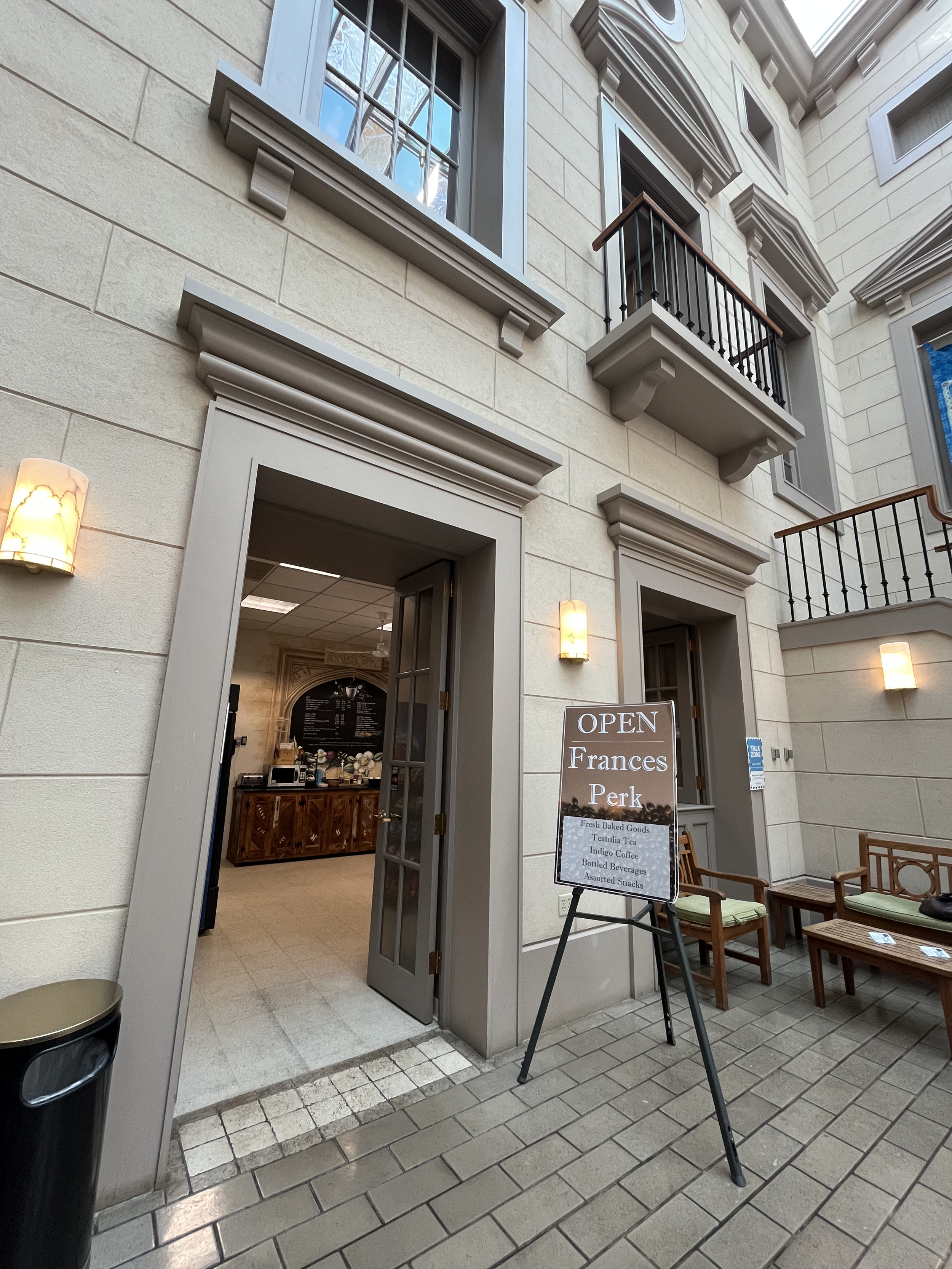
Discontent brewing amongst Frances Perk café staff

Photo by Sydney Wiser ’27

The Frances Perk, located inside the Williston Library’s Atrium, is a staple for many students; they serve snacks, coffee, teas, and a few baked goods.

Elizabeth Murray ’26

Features Editor

The Frances Perk café is a popular stop for students in between classes or on a study break. Located in the Williston Memorial Library Atrium, the Perk is managed by Mount Holyoke’s Dining Services and staffed almost entirely by students. The café is open most days of the semester and offers a mix of beverages and pastries.

Recently, baristas have grown more frustrated with their treatment by upper management. “Especially this semester, it kind of feels like we're on our own,” one Perk staff member who asked to remain anonymous said. Another anonymous student echoed this sentiment, stating, “It feels like [the administration] doesn't care about us at all.”

One concern is the onboarding of new baristas. The Perk hires staff once the café is open, which isn’t until students return for a new semester. Hired staff must have experience working as a barista, and they are normally trained in three training sessions before they can work on their own. Recently, new staff have had difficulty being able to schedule training sessions, leaving experienced staff to train during regular shifts, adding to their usual duties. This can be incredibly difficult during particularly busy shifts that overlap with rush times. One of the staff members we spoke to voiced their frustration, saying, “It was solely up to the students and it felt like management knew, but they were like, oh, it's not that big of a deal. You guys should figure it out on your own. That's how it felt.”

During a regular shift, there are ideally two or three baristas present to ensure that things run smoothly, but this hasn’t been standardized across shifts. Lately, there have been scheduling issues caused by an overall staffing shortage, meaning there is no one to fill in if someone calls out sick. This can leave staff members in a tight spot, having to manage the café by themselves. Other times shifts have to be left open because of conflicting class schedules. One of the employees Mount Holyoke News spoke to mentioned that management has scolded employees for not being able to fill empty shifts.

There has also been frustration around how management chooses to enforce certain policies over others. Baristas expressed frustration with management’s enforcement of the dress code policy in particular. “I've heard some people complain about misogynistic dress coding,” one barista said. Another employee said “managers cornering students and commenting on their bodies showing” was an issue. It isn’t clear to either staff member what is considered a dress code violation, and despite having contacted Dining Services they have received no answer.

The students continuously expressed how frustrated they were with upper management and felt that they made work for the employees harder. “They make it harder, not easier to open [and] close and they expect unreasonable hours … there's just a lack of communication.” one staff member said. Employees interviewed by MHN feel that upper management doesn’t understand the struggles students are having managing the Perk, and fail to include them in decision making. “We're the ones actually doing the work and I feel like maybe we have a better insight to how things work.” one staff member said.

“I think management needs to acknowledge that they've never run a coffee shop before. They run dining halls, which are very different things … it's a different beast entirely but the majority of students who work at the Perk… actually have worked at a coffee shop before,” another student said.

The Perk’s staff have reached out to Dining Services to voice their frustrations. “We have contacted management and collectivized. We sent them emails. They have not responded … We've been contacting them … since the beginning of the semester. They know the issues,” one student said.

When baristas were asked about potentially forming a union, one responded, “As far as I know, there won't be any unionizing. Our complaints are just easy, easy fixes, maybe in the future.” Another staff member said they were not comfortable with answering that question themselves.

Mount Holyoke News asked baristas what management can do to improve. One answered, “Management needs to do better with their hiring process and with the training process.” Another responded, “[I] think they need to start listening and engaging with us and acknowledging that we really care about the work we do, as well as … considering what is a priority for rules that need to be enforced and what is not, and also re-examining ways that they can make their staff feel like they’re cared for.”

Madeleine Diesl ’28 contributed fact-checking.
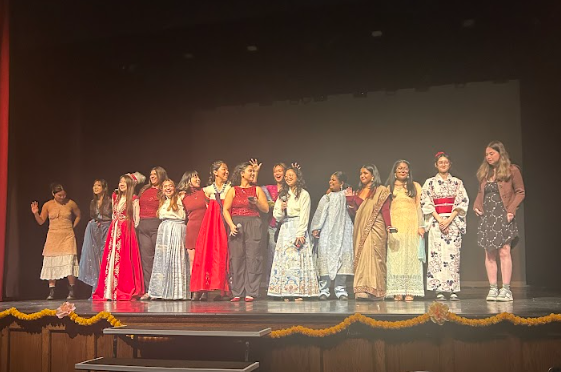
MHC After Dark bingo held

Photo by Jo Elliot ’28

Students congregate in the Great Room to all play bingo during a Mount Holyoke After Dark event.

By Jo Elliott ‘28

Staff Writer

Almost every Friday evening, the Great Room is home to MHC After Dark’s substance-free events. The events rotate in themes and events, Oct. 3’s event being bingo. MHC After Dark’s programming offers students the opportunity to participate in late night events without the use of substances, offering community and fun to those who don’t consume substances.

The series of events runs every Friday and Saturday night from 10 p.m. to 12 a.m. Both the Office of Student Involvement and BeWell host these events. Some of their past nights include Just Dance parties and craft nights. Most MHC After Dark programs are held in the Great Room at Blanchard Hall.

Mia Gonzales Jackson ‘26 attended the bingo night on, and noted that, “I am a big fan of bingo events on campus! The event I attended was hosted by the Division of Student Life and part of the MHC After Dark programming. Personally, I enjoy playing bingo because it is simple and fun.”

Another attendee who spoke highly of the event, Maddie Stith ‘26, said, “I like events like these because I feel like it forces me to not stay in my dorm for the whole day, and it allows me to connect with people that I don't get to see often because it's a mutual enjoyment for such activities and allows me to spend time with groups of people that I know.”

Both attendees highlighted the importance of having these drug-free events on campus with Jackson saying, “I think offering this program supports Mount Holyoke's campus-wide drug-free policy and offers a different position on what an enjoyable college experience contains. For those who do not follow the crowd, it is a reminder that we are not left out or denied opportunities to have fun.”

Similarly, Stith stated, “I feel like it gives time and an open space for people who are not really into [drinking or consuming other substances] or people who literally cannot due to whatever medical reasons because that's also a thing.”

Substance-free events on college campuses can help ensure students who don’t use drugs or alcohol feel isolated from other students. Especially when it comes to the pressure of being in close proximity to substances, which often feature prominently at student-hosted parties.

“The college experience provides a context where experimentation with alcohol and other substances is facilitated by new freedoms, ample free time, reduced supervision, transitions to new social contexts, and a culture of partying,” Pennsylvania State University researchers state. “Studies suggest that students who spend more time in naturally-occurring alcohol-free activities including academics, volunteering, and campus activities (excluding fraternity and sorority activities) report less alcohol use.”

Stith touted the social benefits of going to events like these for herself: “It's also a really nice thing to be able to do so you don't have to worry about feeling excluded or left out or like you're not fitting in with the environment.”

Madeleine Diesl ’28 contributed fact-checking.
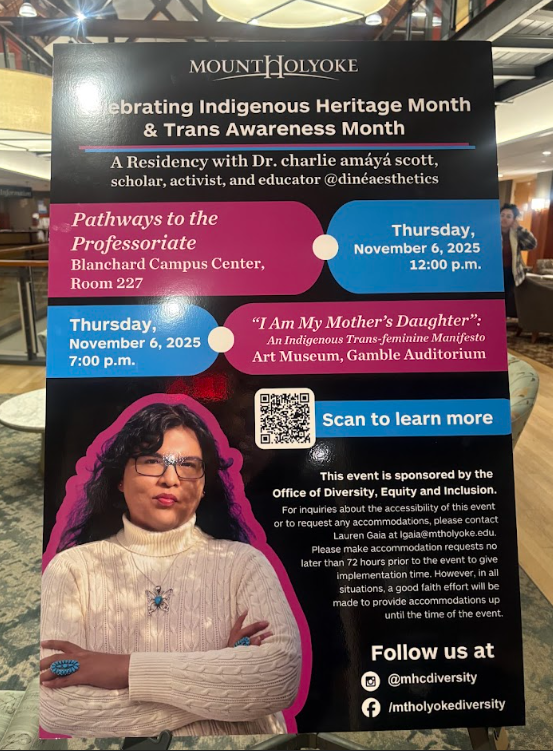
The Great Goose Chase: Where is our beloved Jorge?

Graphic by Audrey Hanan ’28

By Quill Nishi-Leonard ’27

Editor-in-Chief

For many years, Unofficial LITS Mascot Jorge starred in new students’ introduction to LITS: The Great Goose Chase Scavenger Hunt. During the game — which took place during both fall and spring Orientation — students were encouraged to “solve puzzles and find clues” to locate Jorge “before he gets into TOO much trouble,” according to the event listing on Embark.

Following the real goose’s death in December 2024, Jorge continued to appear in spirit on LITS’ website, Instagram, and the spring 2025 scavenger hunt. However, in the days leading up to this semester’s Orientation, posts featuring squirrels began appearing on LITS’ Instagram. Then, on Aug. 29, LITS hosted the Mean Squirrels Scavenger Hunt. The new game was functionally similar to the Great Goose Chase, but saw Jorge replaced with a squirrel some have dubbed "Regina Forage,” according to LITS.

Mount Holyoke News interviewed some students about their thoughts on Jorge, Regina Forage and the title of LITS’ unofficial mascot.

“Now that Jorge is gone, campus does feel different,” Sophia Virgadamo ’27 said in a text interview with Mount Holyoke News. “A little bit of that mystical whimsy is gone which I will miss but never forget … Jorge was a beautiful icon and should remain the mascot as to honor his memory.”

Saturn Barnes ’27 has also been impacted by Jorge’s death. “[Jorge] was such a core part of my memories on this campus … I still get sad when I see the Canada geese without him,” Barnes said. “I totally get why they had to replace Jorge, and the squirrels are cute, but it doesn’t really feel unique to us.”

In an email to Mount Holyoke News, LITS wrote, “The squirrel … is, for now, only a character in our new student orientation Mean Squirrels scavenger hunt.” While Regina Forage has featured prominently in LITS’ branding this year, Jorge remains LITS’ unofficial mascot. 

“If there was ever to be a new unofficial mascot, we think it should grow organically out of the love of the MHC community like Jorge did,” LITS further clarified.

“I definitely miss his presence,” Barnes spoke about Jorge’s lasting influence on the College. “I feel like he could be a new campus myth or legend.”

For some students, Jorge has already ascended to the status of campus legend. Virgadamo and their friends decided to research Jorge’s history after his death: “After his passing my friends and [I] became even more dedicated to uncovering the truth to Jorge's lore, this culminated in a … visit to the archives where we discovered that according to school records Jorge has been the same goose for the past … 30 years.”

“In his death he may live on, every time we need help with the two factor authentication or some phishing scam gets into our emails,” Virgadamo concluded.

Madeleine Diesl ’28 contributed fact checking.