Popular music of India in concert at Mount Holyoke College

By Ani Mecca ’27

Staff Writer

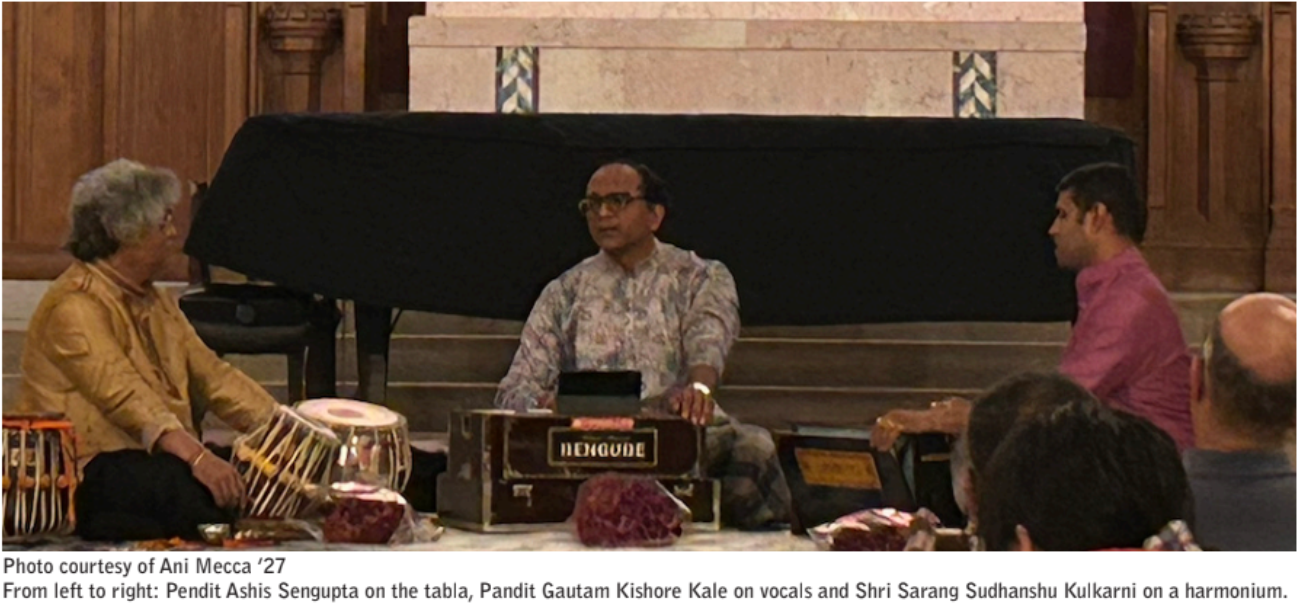
On April 18, Mount Holyoke College enjoyed semiclassical Indian music performed by renowned Northern Indian performers, in an event titled “Popular Music of India.” The musicians included Pandit Gautam Kishore Kale on vocals, Pandit Ashis Sengupta on tabla or handrums, and Shri Sarang Sudhanshu Kulkarni on the harmonium. 

The concert was held in Abbey Memorial Chapel and attracted a mix of Mount Holyoke students, South Hadley locals and enthusiasts of Indian music. Abbey Memorial Chapel’s wide, open space and lofty ceilings provided ideal acoustics for the emotional and heartfelt performances of  Kale, Sengupta and Kulkari. 

The first three performances of the night were described by Gautam Kale as emotional compositions. They included devotional pieces to the Hindu deities Ganesha and Vishnu, and renditions of famous Indian poems from the modern era. 

The next compositions were Ghazals, a genre of music in which Urdu poetry is sung against intricate musical melodies, according to Serenade Magazine. 

According to the  classical music platform Serenade, the Ghazal tradition originated in Persia, eventually making its way to the Indian subcontinent during the medieval period. 

In the contemporary period, Ghazal compositions continue to draw appeal, whether they are featured in Bollywood films, intertwined with other genres including rock, electronica and jazz or performed in live settings such as here at Mount Holyoke.

This performance was the third installment in a series of free concerts comprising “A Festival of Indian Music” across the Five Colleges. On Wednesday, April 15, Gautam Kale, Ashis Sengupta and Sarang Kulkari explored the intersectionality between music and devotional traditions in India at Amherst College. The following day, at Smith College, the three performed a concert celebrating classical Hindustani music.

The concert was sponsored by the Department of Art History and Architectural Studies, the McCulloch Center for Global Initiatives, and the Amy M. Sacker Memorial Lecture Fund.

Quill Nishi-Leonard ’27 contributed fact-checking.

Hungary’s Viktor Orban’s regime comes to a close

By Kennedy Olivia Bagley-Fortner ’26

Staff Writer

On April 12, 2026, Viktor Orban’s 16-year rule came to an end, ushering in a new wave of politics for the newly elected Prime Minister Peter Magyar. 

Orban first served as prime minister from 1998 to 2002. He returned in 2010, remaining in office until he and his political party, Fidesz, was backed into a corner and voted out of power, according to Britannica. 

Under Orban’s rule, Hungary has faced numerous challenges such as the erosion of political institutions, a struggling economy, and rising tensions with the EU. 

On that Sunday millions of Hungarians came together to vote for Peter Magyar, the figurehead for the Tisza Party. This election “broke an all-time turnout, at nearly 80%, and resulted in a landslide victory for Magyar’s Tisza party,” the Center for European Policy Analysis stated. 

Magyar has promised to lead Hungary in what the CEPA is  calling a “new dawn” of Hungarian leadership and politics. 

In order to understand the significance of this election, we must go back in time to uncover how Orban changed the political landscape of the state. 

Johan Norberg, a senior fellow from the CATO Institute, an American libertarian thinktank, wrote in an article, “Viktor Orban was once very different. He represented hope for the future of Europe.” In the early years, along with the political party Fidesz, Orban actually “helped open up Hungary,” and went against the one party rule and played a major role in the creation of democratic institutions. 

However, this positivity did not last for long for one obvious reason, “Orban has always been quick to move to where it is politically convenient for him to be,” Norberg stated. 

In this case, Orban and Fidesz veered more towards the right, utilizing what many right-wing politicians do these days, promoting religious values, and introducing anti-immigration policies.  

In a 2014 speech Orban said, “The Hungarian nation is not simply a group of individuals but a community that must be organized, reinforced and in fact constructed. And so in this sense the new state that we are constructing in Hungary is an illiberal state, a non-liberal state.” 

Orban continued to reject checks and balances, and put an emphasis on taking away people’s individual freedom by making the state more involved with controlling Hungarian society and its citizens. 

From 2010 to 2011, Orban and his political party pushed various legislative changes that were officially adopted in 2012, Britannica reported. 

The push for legislative change resulted with the Fidesz using its powers to rewrite the electoral law to support their own political agendas. “Until 2010, local constituencies used a two-round system,” however, “after the reforms, there was only a single round,” the CATO Institute stated. 

Orban also significantly “reduced the number of parliamentary seats from 386 to 199 and gerrymandered constituencies.” While this happens in other countries “Fidesz’s position made it possible for the government to do it through Hungary,” the CATO Institute added. 

This is especially significant because with changes like that, the Fidesz were able to keep a majority in parliament in 2014, “with just a one-seat margin, despite the vote for his party declining from 52.7 percent to 44.9 percent. If the elections had been following previous rules, Fidesz would have lost its supermajority.”  

In addition to changing aspects of voting to help him stay in power, Orban then went after the free press. According to the Reporters Without Borders index, which “measures the violations of press freedom in the world,” Hungary dropped from having the 23rd most free press in 2010 to 68th in 2025.

While Orban changed numerous parts of Hungarian society, one crucial element that cost him his reelection was the economy.

“By the end of Orban’s second term in office the state had taken control of around 300 to 400 companies in such diverse sectors as banking, energy, shipyards, airports, restaurants, broadcasting … Many of these companies were eventually redistributed to the government’s friends and allies, creating a network of dependent companies” the CATO Institute stated.


In this case, when the state has control of various industries and markets it can negatively impact people. One example of this was when the National Gallop, a horse racing festival in Budapest was suddenly denied “the traditional permit to use public space until it had been sold to a friend of the government,” the CATO Institute stated. 

By doing actions like this, the Hungarian government was able to ban private companies and create a new monopoly over various markets. 

In doing as much, Orban had not only damaged political institutions, but also the free press and citizens’ individual liberty. 

This raises a question of why did Hungarians decide to vote for Peter Magyar, and not past Orban opponents if Orban’s hold on society was so extreme?  

In an interview with Mount Holyoke News, Chair of International Relations Christopher Mitchell said that there are two major reasons why Magyar has had more success than previous Orban opponents. 

One being that the “Hungarian economy has continued to stagnate, leading to growing dissatisfaction with the regime from people who otherwise were willing to tolerate Orban in a growing economy” 

Two being that “Magyar did a good job of casting Orban’s authoritarianism as not just a problem in principle, but also in practice. Earlier Orban opponents focused on democracy erosion as the problem in itself, but Magyar cast the Orban regime as essentially a criminal organization, focusing not just on authoritarianism in the abstract but also as the Orban government enriching itself at the expense of the Hungarian people,” Mitchell added. 

According to Mitchell, all of this “linked well with growing economic dissatisfaction” that helped to “convince people who were unmoved by the importance of defending democracy in principle that Orban’s authoritarianism was having a practical and harmful effect on them.” 

For Mitchell, “Magyar has campaigned on restoring Hungarian democracy, and won a supermajority, which will allow him to reverse Orban’s changes.” While it took Hungary more than a decade to exit the extreme right, it’s now up to Magyar to push the country into a new era of politics. 

Quill Nishi-Leonard ’27 contributed fact-checking.

College departments host discussion about Latin America’s far right

By Kennedy Olivia Bagley-Fortner ’26

Staff Writer

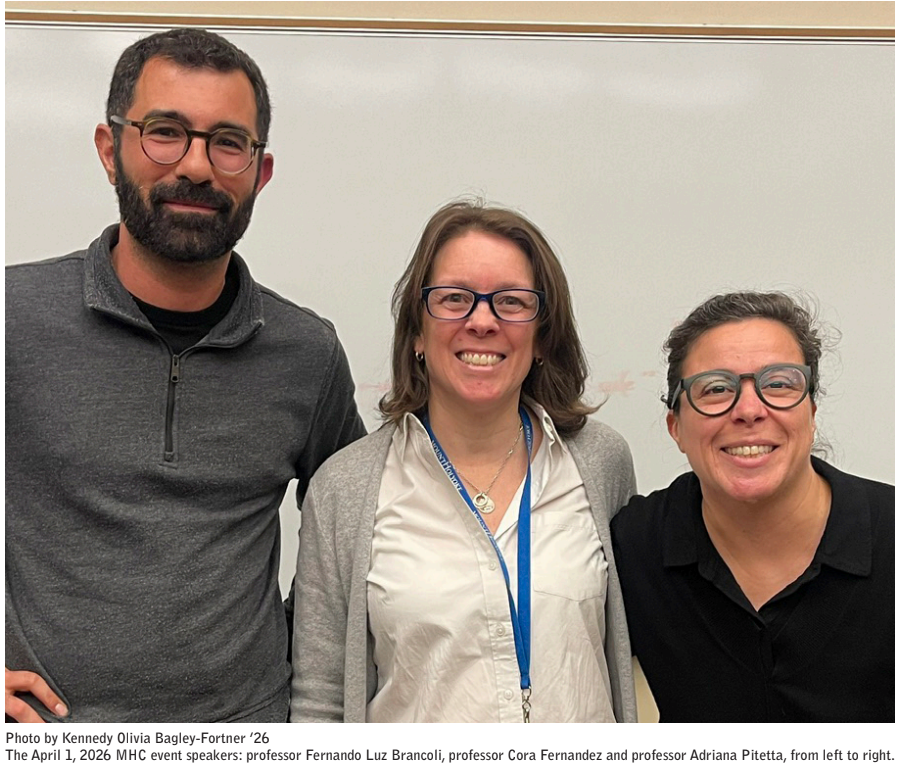
On April 1, the McCulloch Center for Global Initiatives, the College’s politics department and the Spanish and Latin American studies department hosted an insightful discussion titled “The Far Right in Latin America: A Conversation with Fernando Luz Brancoli.”

Brancoli is an associate professor of international security and strategic studies at the Federal University of Rio de Janeiro. The panel’s conversation also included two Mount Holyoke professors: Assistant Professor of Spanish Adriana Pitetta, and Associate Professor of Politics Cora Fernandez Anderson, who also serves as chair of the politics department.

The rise of right-wing movements and politics in America gives us crucial insight into our current political climate, and the same can be said for Latin America. Brancoli kicked off the conversation by giving an overview of the far right in Latin America.

The far right in Brazil is still very connected to its authoritarian past; in fact, as Brancoli puts it, the far right is “deeply embedded” as a part of the “authoritarian movement that was never completely erased.” Brancoli made the point that many Brazilian leaders were never charged for their past brutal actions.

Brazil’s rise to democracy was a tumultuous one. After the end of World War II, Brazil emerged as a Populist Republic, from 1946-64. During this period, Brazil transformed into a “more democratic political regime,” according to the Library of Congress. Brazil held official presidential elections, and focused on various economic, developmental and social changes. However, the country’s democratic system did not last for long.

The Populist Republic continuously struggled “over control of Brazil’s national political scene, [which] prompted interventions from Brazil’s military,” the Library of Congress states. Brazilian presidents became accustomed to threatening military action. During this time, the Brazilian government went through numerous ups and downs, including political polarization and military instability.

Fearful that the Brazilian government was shifting towards communism, the United States supported the military coup of 1964. This coup resulted in Brazil’s 21-year military dictatorship.

Under this dictatorship, about “4,841 elected representatives [were] removed from office, [about] 20,000 people were tortured, and 434 people [were] killed or disappeared” Human Rights Watch reported. In addition to this, the Human Rights Watch stated, “Nobody has ever been held accountable for those abuses.”

This circles back to Brancoli’s point on how the Brazilian government and many other Latin American administrations have not yet confronted their brutal pasts. If governments are not willing to confront their pasts, they are more likely to repeat the crimes of the past, Brancoli stated.

For Brazil’s far right, “You have to make points about the past, you can’t just forget them,” Brancoli said. Here, Brancoli’s message is clear: if governments and politicians do not acknowledge and confront the past, history will repeat itself.

In addition to the reluctance of Brazilian leaders not wanting to confront its past, Brancoli also commented on the country’s progressive movements, and stated that many of these groups do not know how to deal with the far right. This has caused internal fragmentation for the left.

This kind of fragmentation and instability can lead to bolstered support for the far right. This has caused many left-wing politicians to suggest that they should use similar tactics to those of the right. Brancoli pointed out that some Brazilian politicians feel they have centered their political agendas on supporting progressive movements, which in turn has allowed the right to directly counter them on numerous issues.

“Brazil has some of the world’s strongest legal protections for queer and trans people,” the U.S Committee for Refugees and Immigrants reported. In addition to the legalization of same-sex couples in 2013, “Trans citizens can change their identity card to reflect their lived gender identity, and do not have to vote under their dead name.”

This has caused the far right to counter arguments about the destruction of the nuclear family, which has instilled anxiety into the older Brazilian population about the government supporting LGBTQ+ rights. This emphasis on going back in time, or for Brazilian left politicians to start adopting a right-wing political agenda, is frightening to Brancoli. He stated that the country wants to “go back to the basics, which is scary.”

Towards the end of the discussion, Brancoli discussed the similarities between the United States Capitol attack on Jan. 6, 2021 and the Brazilian Congress attack on Jan. 8, 2023.

In an interview with the University of Illinois Urbana-Campaign, Brazilian History Professor Jerry Dávila said the goal of this attack “was to create a siege situation that would provoke a military intervention that [instigators] believed would bring ousted president Jair Bolsonaro back to power.” Similarly, the Jan. 6 attackers “believed that they could halt the congressional certification of President Biden’s election,” Dávila added.

According to PBS, Bolsonaro was sentenced to a 27-year prison sentence for this coup, while Trump never faced any real consequences. While this was a huge step for Brazil’s democracy, Brancoli added how, after Bolsonaro was jailed, many felt that the far right had been sufficiently combated, which made the left vulnerable.

His imprisonment gave the left a sense of security, making them forget that there was much more work to do to protect democratic values. This provides the opportunity for the far right to seize control again.

To end the conversation, Brancoli told the audience that a “great way to [understand] Latin America is through the security lens.” It all boils down to wanting to feel safe, and if one side sees a threat to their security, then the other side will also retaliate.

Sophie Frank ’26 contributed fact-checking.

U.S.-Israel attacks on Iran: What Mount Holyoke students should know

Photo Courtesy of The White House via Wikimedia

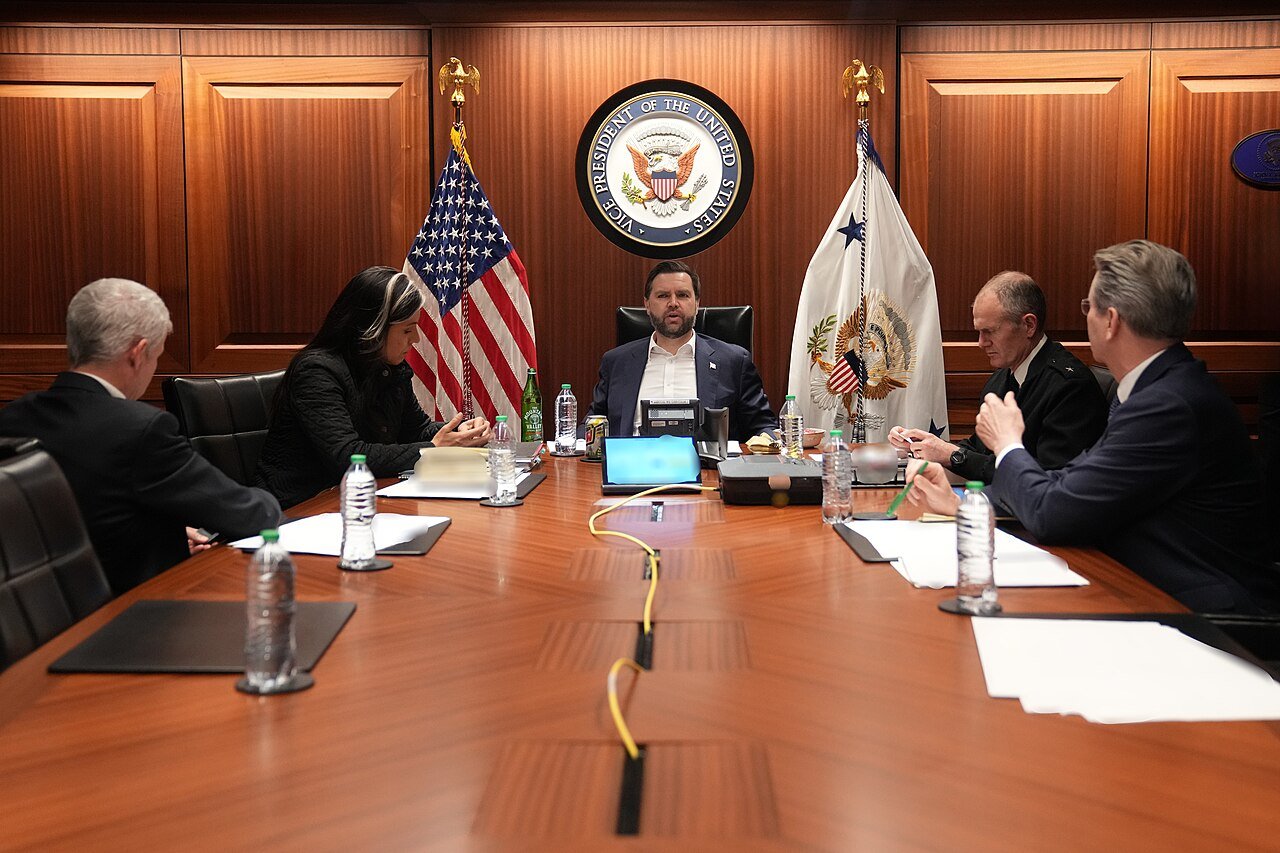
On Feb. 26, 2026, the United States and Israel began a joint bombing campaign against Iran; as of March 21, 2026,

BY ANI MECCA ’27

STAFF WRITER

On Feb. 28, 2026, the United States and Israel carried out a joint bombing campaign against Iran, with the Israeli Defense Ministry calling the attack a “pre-emptive strike,” according to CBS News. The New York Times reported that two central goals guided the collaborative attack: To debilitate Iran’s nuclear and military capabilities, and to assassinate the country’s top leaders.

“In recent months, the tyrants in Iran have been plotting to rebuild their nuclear and missile capabilities and to bury them underground so we won’t be able to strike them,” Israeli Prime Minister Benjamin Netanyahu said in a statement delivered on Feb. 28. “If we don’t stop them now, they will become invulnerable." 

Secretary of State Marco Rubio said that the United States was knowledgeable about Israel’s plan to strike Iran, and also sought to act pre-empitively because of expected Iranian attacks on American forces in the region, according to the BBC. 

In executing these attacks, both Netanhayu and U.S. President Donald Trump have expressed hope for regime change in Iran. “When we are finished, take over your government … This will probably be your only chance for generations,” Trump said in an address to the Iranian people, posted on the social media platform Truth Social on Feb. 28. 

Since the Iranian Revolution of 1979, which toppled the Pahlavi monarchy and established a republic based on strict adherence to Shi’a Islam, Iran’s government has regarded the United States and Israel as existential foes. 

Ayatollah, or supreme leader, Ali Khamenei, who succeeded the founder of the Islamic Republic, Ayatollah Ruhollah Khomeini, furthered Iran’s uncompromising anti-Western stance since his rise to power in 1989, The New York Times reported.

Khamenei was killed during the first phase of strikes on Feb. 28. Trump announced his death on Truth Social, saying: “Khamenei, one of the most evil people in History, is dead.” The Iranian government confirmed his assassination later that day. 

Despite both the U.S. and Israel claiming that their primary targets were senior officials and military and nuclear sites, the strikes have led to an onslaught of civilian casualties. According to the Iranian-founded Human Rights Activists News Agency, the first week of attacks alone killed around 1,172 civilians. In the week since the military campaign began, the strikes have predominantly targeted the capital Tehran, but provinces across the country have also been hit.

One of the deadliest attacks occurred in the southern Iranian town of Minab on Feb. 28, during which a missile strike killed at least 175 people, most of them children, at the Shajarah Tayyebeh elementary school. 

While neither the United States nor Israel claimed initial responsibility for the strike, an investigation by The New York Times confirmed that the school building was hit at the same time as the U.S. and Israel attacked a nearby Iranian military compound.

Since Feb. 28, Iran has retaliated by striking Israel, U.S.-allied states in the Gulf region, and U.S. military bases across West Asia. In turn, Israel has carried out attacks on neighboring Lebanon to destroy Iran-linked militia forces operating in the country, according to Al Jazeera.

While anxiety over a potential Third World War has skyrocketed across social media platforms such as TikTok, Instagram and X, what some people may envision — an all-out nuclear conflict, with the U.S. being targeted — isn’t likely to occur, Dazed reported. 

Iran’s ballistic missiles are incapable of reaching U.S. soil, and despite decades of accusations from both the U.S. and Israel, Iran has not produced a nuclear bomb.. 

As for the conflict’s effects on Mount Holyoke students, study abroad programs in Israel have been suspended since late February, but several programs still operate in Jordan. While Jordan has not been a primary target of either the U.S. and Israel or Iran, missile debris was reported to have fallen in several regions of the country amidst the attacks, with no injuries or deaths confirmed, according to the Anadolu Agency based in Türkiye.

“The McCulloch Center for Global Initiatives has been working with all of our study abroad partners and the MHC student who was studying in the region has been evacuated safely,” Christian Feuerstein, Director of Media and Public Affairs, said in a statement to Mount Holyoke News.

The White House has indicated that military action could proceed for four to six more weeks, while Israel said the campaign would “continue as long as needed,” the BBC reported.

This is the second armed conflict between American-Israeli forces and Iran within a year, the first being the Twelve Day war of June 2025, which also began with a joint attack by the U.S. and Israel on Iranian military and nuclear sites. Anti-government protests in Iran also erupted in late December of last year, continuing into January and resulting in at least an estimated 6,000 civilian deaths, Time magazine reported. 

Angelina Godinez ’28 contributed to fact-checking.

Mount Holyoke brings in the Year of the Horse with China Night

By Ani Mecca ’27

Staff Writer

On Feb. 13, 2026, Mount Holyoke ushered in the Chinese New Year with China Night, an annual celebration that brings together the campus community for a night of Chinese culture and food.

Also known as the Spring Festival or Lunar New Year, this holiday marked the beginning of the Year of the Horse for several countries including China, Vietnam and Korea, as well as their global diasporas.

During China Night, the new year was welcomed in Chapin Auditorium, adorned with red lanterns and banners containing messages of good fortune and happiness. Organized by the Chinese Cultural Association — abbreviated as CCA — the main elements of the event included a dinner of dishes traditionally eaten during the new year, as well as a litany of performances.

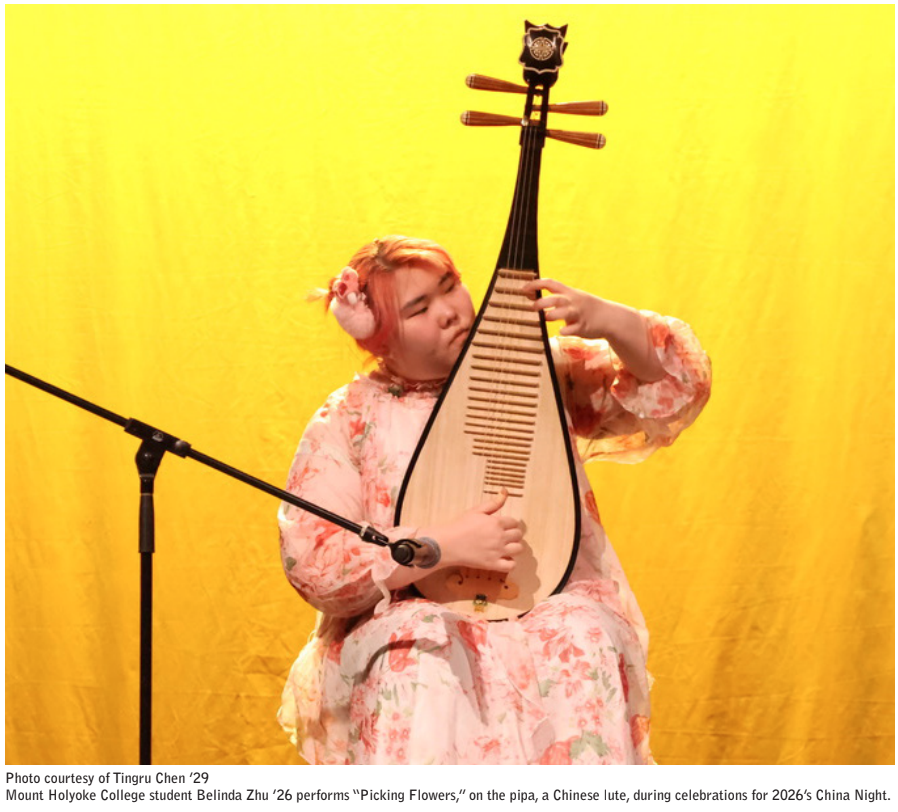
This year’s show highlighted many aspects of Chinese artistic expression and culture, and featured songs, dances, martial arts, traditional instruments such as the pipa — a Chinese lute —, diabolo — Chinese yo-yo — tricks and a fashion show.

A notable element of this year’s event was the participation of many acts from the Five College Consortium and local surrounding area, including UMass Amherst’s Illusions Dance Team, Plus86 Dance Crew and TASC, as well as the Shaolin Kung Fu Center of Hadley.

The show was inspired by the Spring Festival Gala, or Chunwan, a television program broadcasted annually from China and enjoyed by Chinese communities around the world.

The Spring Gala Festival serves a particular purpose: “We have a tradition in China … to stay up late until the next year comes, and that’s the way we guard our good luck,” Cindy Zhang ’28, vice-chair and photography coordinator of CCA, said in an interview with Mount Holyoke News.

With China Night, CCA aims to create a version of this experience at Mount Holyoke, “to let Chinese students who share this specific culture to enjoy and to feel like they’re home.”

But it’s also a chance to reimagine the typically state-produced Spring Festival Gala. “[We want to] negotiate around the performances that are being consumed, and we sort of want to exercise more of our agency to do the celebration in the way that we want to do it,” Tiffany Lai ’28, design coordinator of CCA, said.

Preparations for China Night began in November, with CCA responsible for auditioning performers, selecting emcees — who are an important part of the traditional Spring Gala Festival — and rehearsing the acts multiple times.

The dishes are also an important yet hectic part of the planning process. “It’s really a challenge to buy [food] and serve two-hundred-plus [people],” Winnie Wu ’28, chair of CCA, said.

The food is served not just to the large audience, but also to the performers, emcees, crew and team members of CCA. “So it’s really hard to consider what to buy, and what not to consider,” Wu said.

This year, dinner included dishes such as sweet and sour pork, spicy garlic fish, and fried potato strips, among many other options. “This year we tried to have more diverse food, like vegan food and non-spicy food,” Wu said.

The atmosphere of China Night was joyful and exciting, but it also provided an opportunity to meaningfully address issues of inclusion regarding Mount Holyoke’s Asian student population.

“CCA is not just an association for people to share and spread culture, but also a community to provide a safe space for Chinese students … to feel safe and be seen and heard,” Zhang said in a speech delivered at the event.

“After the show, one of our members came to me, and she said she had water in her eyes when she heard me … she was really touched by my little speech,” Zhang recalled.

China Night is also a time for connection among Mount Holyoke’s wider community. The event “has a long history, so it’s [one of the] most important experiences for Chinese students here,” Carolina Yao ’28, social media coordinator of CCA, said.

“I've seen, for example … alums who came back just for China Night, and professors,” Lai said.

This year, with the inclusion of more performers from the other institutions in the Five College Consortium and the Pioneer Valley, China Night brought together an even larger group.

“I feel like it’s also a bridge of connections,” Winnie Wu said. “I think it’s definitely a real bond between all these communities, whether from South Hadley or Northampton … and also within Mount Holyoke itself.”

Quill Nishi-Leonard ’27 contributed fact-checking.

American foreign policy in action: What does it look like?

By Kennedy Olivia Bagley-Fortner ’26

Staff Writer

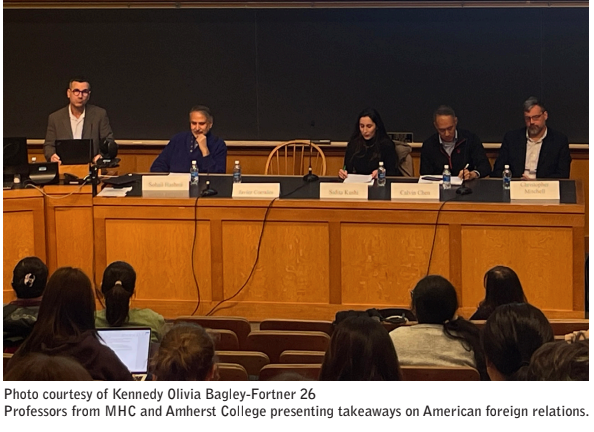
On Feb. 12, the McCulloch Center for Global Initiatives brought together four professors from Mount Holyoke College and one professor from Amherst College to discuss and analyze the Trump administration’s foreign policy. The panel was called “US Foreign Policy: The ‘Donroe Doctrine’: Where Is It Leading Us?”

“There have been few figures as polarizing as Trump,” stated the moderator, Professor Sohail Hashmi, who specializes in politics and ethics at Mount Holyoke College.

During this past year, we have seen global divisions that have been created by domestic and foreign policy.

As Professor Hashmi closed his opening remarks, he asked the audience to consider some fundamental questions that shaped the panel discussion and the future of American policy: Are we witnessing the inevitable policy shift that comes with each new administration in Washington D.C.? Are we witnessing something much more elemental and dramatic? Or are we watching the unraveling of the rule-based post-World War II international order?

While politics is a deeply complex and nuanced subject, Hashmi presented a statement on the issue that can resonate with many people. By looking at the Trump administration’s foreign policy, our goal is “to think together beyond the next Truth Social post.”

The panel was divided into four sections, tackling a wide array of subjects. Mount Holyoke College Professor of Politics, Sidita Kushi, focused on Trump’s second first term and his newfound enthusiasm for military intervention.

Amherst Professor of Politics Javier Corrales gave his expertise on the United States’ intervention in Venezuela and Latin America. Mount Holyoke Professor of Politics Christopher Mitchell talked about Trump’s tariff policies and U.S.-EU relations.

Lastly, Mount Holyoke College Professor of Politics Calvin Chen gave crucial insight on the current state and the future of the U.S.-China relations, and relations within the Indo-Pacific.

Professor Kushi argued that the United States has prioritized its military force at the cost of its diplomatic relations. Even though Trump has stated numerous times that his main focus has been on domestic issues, his current foreign policy begs to differ.

In her explanation, Kushi cited the Foreign Affairs article “Imperial President at Home, Emperor Abroad” to give the audience a better understanding of Trump’s policies. Foreign Affairs explained that Trump’s “unrestrained executive power” has been creating tension domestically as well as internationally.

Trump has the power to “do whatever he wants when it comes to anything related to foreign policy or national security,” according to Foreign Affairs. He has shipped noncitizens to prison camps in El Salvador, attempted to impose widespread tariffs on countries around the world, gut foreign aid, bully allies and deploy the military on American citizens.

Kushi added on to her argument by stating that the current administration has scaled up its militaristic operations, and seeks to “supercharge the U.S. militarization base.” In December 2025, the house passed a “$900 billion defense policy bill that would give U.S. troops a raise and codify much of President Trump’s national security agenda,” The New York Times reported.

In early January 2026, Trump “proposed setting U.S military spending at $1.5 trillion in 2027,” according to AP News. Here, we can see that the United States military budget will likely continue to grow.

According to Kushi, the Trump administration is prioritizing military and direct force over diplomacy. This administration has moved away from traditional diplomacy and resorted to another option: military operations.

Professor Corrales added onto Kushi’s point by analyzing the startling case of Venezuela.

Corrales emphasized that throughout the history of U.S. interventionism, there has been an effort to get rid of the global “troublemakers,” However, in the case of Venezuela, Trump might have removed the big troublemaker — Venezuelan President Nicolás Maduro — but left the rest at play.

According to Corrales, the Trump administration has said, “Let’s take the bad guys and start to become friends with them,” especially in the oil business.

While getting rid of Maduro can be viewed positively, leaving his administration as it is can be seen as a huge mistake, which the current administration doesn’t seem concerned about. As Corrales put it, this administration feels no embarrassment at getting rid of other political powers. On the flip side, there is a complete acceptance to work with the Maduro administration.

While the case of Venezuela is very unusual, Professor Corrales still has hope that with Maduro gone, new forces can emerge that can create a model of fair rules and democracy.

Professor Mitchell brought up Trump’s tariff policies and gave a brief overview of what tariffs are and how they operate. When the government raises tariffs, import and domestic prices rise, and as Mitchell puts it, it’s a tax on consumers.

While implementing tariffs can be beneficial, Mitchell points out that they can do more harm than good. He summarized that Trump’s policies have three complications: Firstly, these tariffs have caused legal uncertainty. They prompt people to ask the question: Is Trump allowed to do this? The current answer is no. After a long-awaited tariff announcement, on Feb. 20, the Supreme Court ruled that his “reciprocal” tariffs were unconstitutional, according to AP News.

The second complication that Mitchell raised is the topic of political uncertainty. Mitchell used the phrase TACO, meaning “Trump Always Chickens Out.” In the case of Trump’s tariffs, “he has threatened far more than he has carried through on,” NBC reported. A specific example that we’ve seen in the TACO effect was with his E.U. tariffs.

He threatened Europe with a “20% tariff as part of his ‘reciprocal’ tariffs which were announced April 2. But hours after those tariffs were scheduled to go into effect, Trump reduced tariffs on Europe and most other countries to 10% for 90 days to give his administration time to work out individual trade deals,” added NBC News.

Mitchell ended his explanation by listing the third complication: Tariffs affect everything. Countries don’t create and produce standalone items all on their own. Everything is a collaboration, and countries rely on the importation of materials from around the globe. When tariffs are raised, this limits global trade and stunts affected countries’ economies.

Professor Chen started his discussion by asking a question: Does the “Donrone Doctrine” represent a major “rupture” in the U.S.-China relations?

The “Donroe Doctrine” is “a Trumpian twist on a 19th-century idea” of the original Monroe Doctrine, The New York Times reported.“In 1823, President James Monroe aspired to stop European powers from meddling in the [western] hemisphere.”

However, Trump has taken a completely opposite approach to the original doctrine, where he has been focused on asserting American dominance in the western hemisphere. Secretary of Defense Pete Hegseth wrote that “the Western Hemisphere is America’s neighborhood – and we will protect it,” added the New York Times.

In Chen’s analysis, he stated that this “Donrone Doctrine” does not represent a major rupture in U.S.-China relations, but an acceleration and intensification of a clear pattern of bipartisan American hostility.

China has been accustomed to policies of this kind. Prior to COVID-19, Trump imposed 20% tariffs on Chinese goods, and President Biden kept those same tariffs in place.

Using his comparative studies background, Chen prompted the audience to talk about this issue not only on an international scale but also domestically. Chen stated that we should think about the recent developments in “intermestic” terms to understand the future of U.S.-China relations.

One development has been in Venezuela. As Chen puts it, the capture of Nicolás Maduro was a “surprising blow to Chinese ambitions, but not fatal.” While China is the largest purchaser of Venezuelan oil, that oil only makes up about 4 to 4.5% of China’s seaborn imports. This means that if Venezuelan exports were disrupted, it would only affect the CCP for a short time. China can make up its oil consumption from other countries such as Canada, Iran and Iraq.

However, Chen does point out that this conflict could potentially affect China’s prestige.

For the past two decades, “Beijing has sought to build influence in Latin America,” not only for economic opportunities but “to gain a strategic foothold on the doorstep of its top geopolitical rival,” Reuters reported.

President Trump’s “move against Maduro was intended in part to counter China’s ambitions,” Reuters reported. “Beijing can protest diplomatically, but it cannot protect partners or assets once Washington decides to apply direct pressure,” Craig Singleton of the Foundation for Defense of Democracies added.

While the world of politics can be difficult to grasp, it is panels like this that bring issues to the forefront.

As we progress further under the rule of the Trump administration, it is important that we ourselves stay informed to fight back against this “imperial president.”

Quill Nishi-Leonard ’27 contributed fact-checking.

Five college students show their support for Iranian protesters

Photo courtesy of Carly Celestin

By Kiera McLaughlin ’26

Global Editor

On Feb. 7, Mount Holyoke College and Five College students gathered to stand in solidarity with Iranian protesters at a vigil in North Rockefeller Hall.

Demonstrations across the country began on Dec. 28 after the Iranian currency “plunged to 1.48 million to the dollar,” Time Magazine reported. On the same day, this forced merchants to close their businesses as well as Iranian citizens to watch their money lose worth as the day continued.

Professor Parsa Peykar of Pepperdine University discussed his personal history with Iran in an interview with Mount Holyoke News, “I remember always my parents talking about how different it was [before 1979]. … We were never a threat to the world … we were a very peaceful nation.” Peykar was born in Iran in 1992 and holds a doctorate in Industrial and Organizational Psychology from Liberty University.

Amnesty International noted that while the protests were prompted by the economic crisis, “Protests turned into mass nationwide street demonstrations calling for the end of the Islamic Republic system. Protesters are demanding fundamental change and transition to a new system of government that respects peoples’ human rights and dignity.”

Peykar has found that Iran’s government has impacted the way Iranians are perceived around the world: “[The 1979 Revolution] took us back to so many years and also gave this image of Iranian people that we are like that … there are times … when I travel and people ask me where I'm from and I say Iran, they get a little scared.”

“They don’t know who we [Iranians] are,” Peykar said. “We are very different than what you see, these official leaders of current regime.”

Protesters in Iran have been met with riot police, tear gas and bullets, according to Time.

During the demonstrations, the government has also cut the internet in a national blackout to conceal their crimes, Amnesty International reported.

Peykar believes the ongoing protests in Iran are different from previous dissent. “I see more unity among Iranians, you know, around the world. There was one protest in Toronto, Canada, I heard 80,000 people came. And it would be such cold weather, too,” Peykar stated.

“And of course, the people in Iran, too, I think they're much more united.”

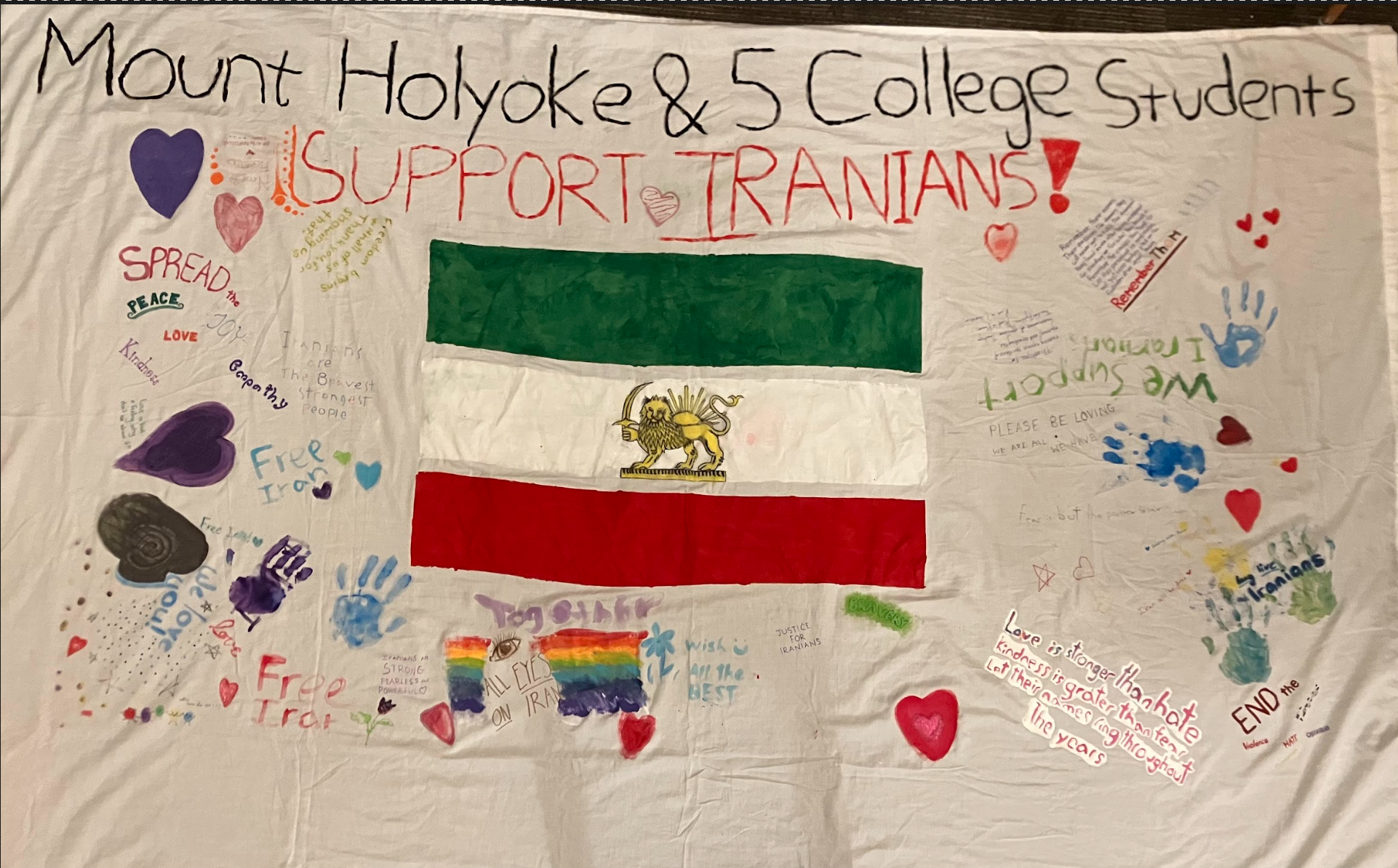
At the vigil on campus, there were posters with photos and information about individuals murdered in the protest. Speeches and public comments were held in front of the Iranian flag and a poster of the people killed during the current demonstrations.

When asked about the U.S.’ relationship with Iran, Peykar said, “I think part of what U.S. is doing, which I think is very good for the world and for others, is to show that the narrative [the Iranian government is] telling is not true. … I do believe they're not going to have any sort of deals with them because it's not possible. I think on the Iranian government side they're trying to buy time because they think if this term of Trump ends, they can deal with the other governments because they're not going to be as tough … on them.”

“They're trying to buy their time, but I don't think it's going to happen,” Peykar stated.

Around 20 Mount Holyoke students participated in the vigil and created a community banner together reflecting their support for Iranians.

“I'm very hopeful. Of course, I feel we are experiencing … a pain now. And with any type of revolution and change, it's like a mom giving a birth to a child. There will be that pain,” Peykar said. “But Iran has a great future.”

Madeleine Diesl ’28 contributed fact-checking.

Editor’s note: The vigil on campus was organized by staff writer Alia Bloomgarden ’29. Alia Bloomgarden ’29 assisted with coverage.

Confronting the global shift towards right-wing politics

Graphic by Mari AlTayb ‘26

By Kennedy Olivia Bagley-Fortner ’26

Staff Writer

If you’ve been following the news for the past few years, you’ll have noticed some conversations about how the world is shifting toward more right-wing politics across the board.

The shift between left wing and right wing politics is nothing new. We have seen a constant back and forth between political parties for decades. However, in recent years that shift has been more consistently towards the right.

In 2024, Vox News wrote an article attempting to explain the movement of far-right politics across the globe. Here, they cited political theorist Francis Fukuyama’s take on the future of global affairs, arguing that a “liberal democracy was the ultimate stage in the evolution of society,” but that this stage wouldn’t last forever.

Fukuyama states that it’s not possible to satisfy everyone, “this includes [in a] liberal democracy … dissatisfaction arises precisely where democracy has triumphed most completely: it is a dissatisfaction with liberty and equality.”

Vox goes on to explain how this “dissatisfaction” has begun to reveal itself.

In the 1990s, the far right started to assert its influence in European elections. Vox writes “the 2000s and early 2010s saw varying signs of antidemocratic activity in consolidated democracies.” Then around the 2010s, the “reactionary right had risen to power in the United States, Hungary, Israel, India, Brazil, and Poland.”

Each of these “movements” presented itself as “deeply and authentically democratic,” however their parties would attack democratic values such as “liberalism, multiculturalism, or secularism” Vox reports.

In a statement to the Mount Holyoke News, Andy Reiter, a professor in the politics and international relations department at Mount Holyoke College, shared his reasoning behind this move towards the right.

Reiter stated, “The global shift towards the right is driven by many factors including migration, cultural erosion, economic inequality, and rising crime levels. Many people feel like the world is changing quickly and they are worse off now than before.”

All of this discontent “makes it easier for right-wing politics to gain support by promising to provide more jobs, increased security, and a return to more traditional values,” he added.

People have been observing this shift across the globe, including in the United States, where President Donald Trump has campaigned on numerous far-right topics that have appealed to many Americans.

For instance, he has talked about launching the “largest deportation program in American history,” has tried to end birthright citizenship in order to put a ban on what he has called “birth tourism.” Further, he has imposed countless tariffs on various countries as an attempt to improve the American economy, bring back “American” manufacturing and create jobs, according to NBC News.

Similar actions can be seen in East Asia, with Japan’s Prime Minister Sanae Takaichi, who is more conservative, “focus[ing] mainly on Japan’s economy and its defense,” the Council on Foreign Relations reported.

“She has advocated for tougher immigration restrictions and embraced [aggressive] policies on China,” NPR stated.

On Feb. 1, Costa Rica elected right-wing candidate Laura Fernández. Fernández ran her campaign on tackling crime. Costa Rica was “once the most peaceful nation in Central America,” however it’s been struggling with an “escalation of violence fueled by transnational drug trafficking … the situation has instilled fear that many Costa Ricans say they have rarely experienced,” the New York Times reported.

These examples circle back towards Professor Reiter’s explanation of what has been driving this global shift; fear and dissatisfaction with change.

Americans were worried about rising costs and national security, so Trump promised the American people he would fix those issues, an article by NBC reported.

Prime Minister Takaichi campaigned on similar issues and has been working towards immigration reform and promoting traditional values, NPR stated.

Costa Rica has been struggling with immense crime therefore the people elected a President that they believed would tackle that specific issue, the New York Times reported.

Today it seems, constantly and consistently, fueled by xenophobia and fear, people are turning towards right-wing candidates and politics because they believe that it supports their own interests.

Madeleine Diesl ’28 contributed fact-checking.

Pope Leo embarks on first foreign trip of his papacy, travels to Middle East

Graphic by Betty Smart ’26

By Mira Crane ’27

Global Editor

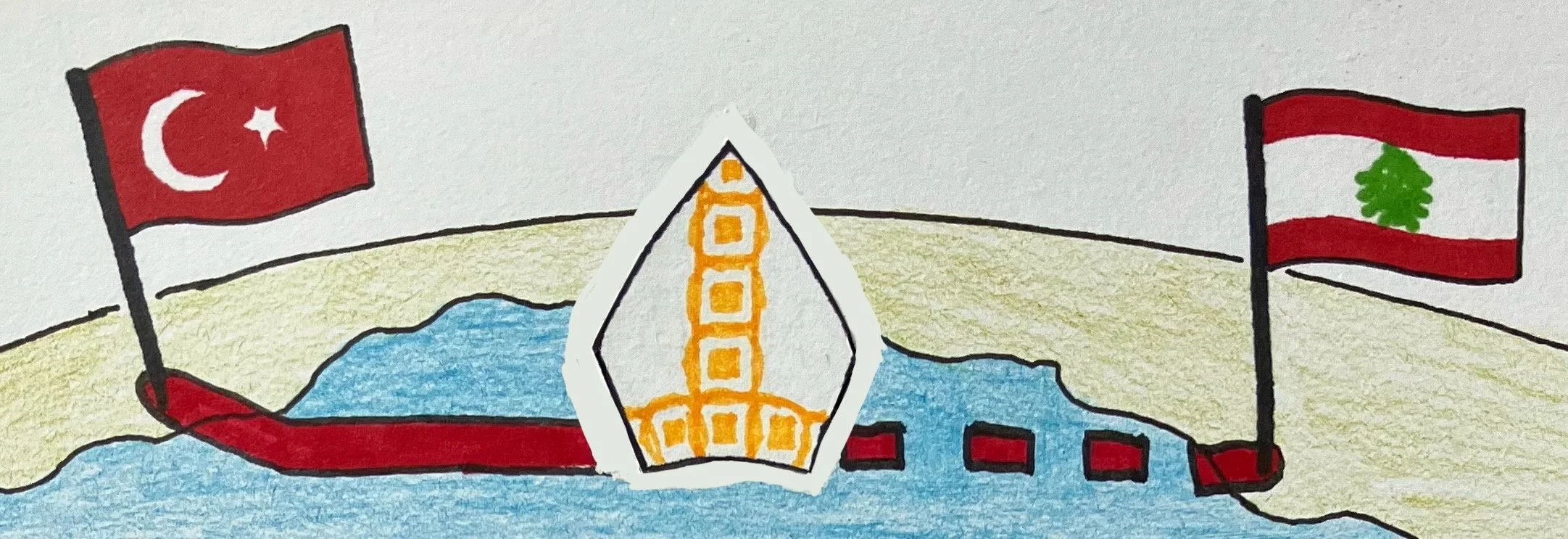
In late November, the new pope traveled to the Middle East. According to The New York Times, Pope Leo XIV began this visit, the first foreign trip of his papacy, by going to Turkey. 

He was there for four days. 

On Thursday, Nov. 27, the pope had a meeting with President Recep Tayyip Erdogan. In the following days, the pope visited Catholic clergy in the area and representatives of other Christian denominations, including the Head of the Eastern Orthodox church, Ecumenical Patriarch Bartholomew I of Constantinople.

NPR reported that the pope spoke at Istanbul's Cathedral of the Holy Spirit, giving praise to the church for its work helping migrants and immigrants in Turkey. According to NPR, the pope went to the location of the Council of Nicaea, where a statement of faith — still used by a number of Christian denominations today — was created 1700 years ago. 

The New York Times reported that the pope took part in an ecumenical service near the ancient ruins of the Byzantine Basilica depicting Saint Neophytos. Moreover, according to BBC News, Pope Leo also followed in the footsteps of his predecessors by going to the Blue Mosque and meeting with other religious leaders. 

BBC News reported that Pope Leo warned against giving into "a heightened level of conflict on the global level" at the beginning of his time in Turkey. 

NPR reported that the aim of the pope’s trip was to call for the cooperation of world leaders in creating peace. At the start of his trip, Pope Leo stated, "We hope to announce, transmit, proclaim how important peace is throughout the world and to invite all people to come together to search for greater unity, greater harmony." He added that he hopes "to look for the ways that all men and women can truly be brothers and sisters in spite of differences, in spite of different religions, in spite of different beliefs." 

According to the New York Times, Pope Leo affirmed his support for a two-state solution to the Israel-Palestine conflict, which has long been the Vatican’s position.

The New York Times reported that the pope continued his trip by traveling to Lebanon, where he met with church and government officials. Lebanon is the home of the largest Catholic community in the Arab world. 

The pope made this journey during a delicate moment. Even though Israel and Lebanon are currently observing a fragile truce, Israel claims to have struck Hezbollah targets inside the country in response to alleged violations of ceasefire terms, according to BBC News. There have been accusations of ceasefire violations on both sides. 

The visit proved to be a test of the pope’s diplomatic skills. BBC News reported that, while Pope Leo has not been as overtly political as his predecessor, Pope Francis, he has spoken out about issues that are important to him, like the dignity of migrants. 

Pope Leo has quietly maintained many of Pope Francis’ progressive ideals while also taking in the messages of traditionalists. According to BBC News, Pope Leo ended his visit to Lebanon by attending mass at the site of the port explosion that occurred on the Beirut waterfront in 2020. The pope prayed for more than 200 people who were killed and 7,000 others who were injured. 

Karishma Ramkarran ’27 contributed fact checking. 

BONDHU hosts Nov. 22 Bengali game night at Mount Holyoke

Photo by Alia Bloomgarden ’29

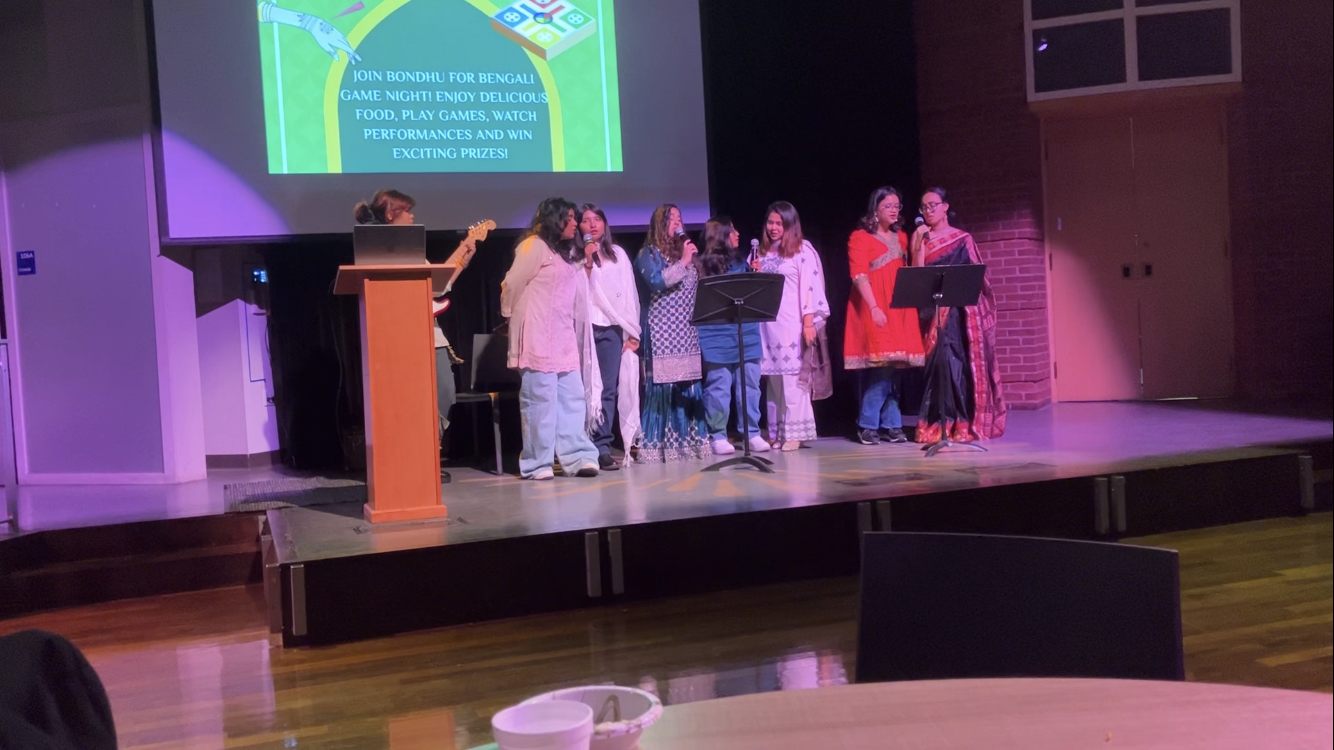
BONDHU hosted a Bengali game night on November 22, 2025; all students were welcome to join.

By Alia Bloomgarden ’29

Staff Writer

On Saturday, Nov. 22, BONDHU, Mount Holyoke College’s Bangladeshi student organization, hosted a Bengali game night. 

On this night, students gathered to play games, eat Indo-Chinese food, listen to Bengali music and watch three singing performances by Bangladeshi students. Shanum Sarkar ’29, a Bangladeshi student, explained in an interview with Mount Holyoke News, “Bengali game night…  is very close to my heart, and — I can speak for all my friends —  to their hearts, too … [board games are] such an important thing to have at every event.” 

Sarkar further reminisced, “I learned how to count because I knew how to play ludo, and I knew I had to beat my dumb brother at ludo, so I knew how to count before he did. The fierce competitiveness, the joys, the screaming at your cousins, the throwing over the entire board because you're losing … Game nights bring out this whole personality of Bengali people that you've never seen before.”

BONDHU ordered the Indo-Chinese food from Priya, an Indian cuisine restaurant. Sarkar stated that “Desi-Chinese [or Indo-Chinese] is a famous thing back at home … It's basically … like Chinese fried rice, dumplings [and] other things, but cooked in Desi spices.” She explained that this food is in-between everyday and fancy food. She added, “It also reminds you of home because of the spice and the fragrances.”

The Bangladeshi students performed three songs: a mashup of Rabindranath Tagore’s Mayabono Biharini and Yellow by Coldplay, Tomar Ghore by Hasan Raja, and Jodi Dekhar Iccha Hoy, a folk song about love. 

Sarkar explains that Mayabono Biharini is “heart-wrenching because it's an ode to an elusive yet alluring beloved whose beauty remains unattainable. And I think that nothing quite captures unrequited love like Rabindranath Thakur's work does, especially this song … this song is very popular… from the 90s to Gen Alpha [today].” 

Yellow is also a song about unconditional love and devotion. And we just felt like those two songs would go very well together because the beat matched really well,” Sarkar said. Tomar Ghore is about “the multiple facets of our personality.” 

This event showcased Bondhu’s “community and festive nature” that attracted Sarkar to Mount Holyoke in the first place. When Sarkar was asked about how she feels about the Bengali community on campus, she said she has found the Bengali community to be “more helpful than [she] thought [it] would be.” 

“Even before I came here, they were like older sisters … [from] answering these annoying little questions like it was no bother at all, to involving us very heavily in the events… despite most of us not being on the board, to organizing Nobin Boron,” which is a “welcome event for new students who come to the campus,” she explained.

 “I'm just very grateful for the Bangladeshis who've looked after us like we're their own, and I hope to one day be like them. And there are more little Bangladeshis on campus. I hope to learn more from them and be as supportive as them.” 

Karishma Ramkarran ’27 contributed fact checking. 

Alum Gloria Xiong lectures on China's economic statecraft

Photo courtesy of Professor Calvin Chen
Mount Holyoke Alum Gloria Xiong ’17 came to the College to present recent research on China’s statecraft to Mount Holyoke students.

BY KENNEDY BAGLEY-FORTNER ‘26

STAFF WRITER

On Oct. 31st, Gloria Xiong ’17 returned to Mount Holyoke College to present her research on China’s coercive statesmanship. During her time at Mount Holyoke College, Xiong majored in politics and later received a Ph.D. in government from Cornell University in 2024.

 Xiong “studies economic statecraft, sanctions, and domestic politics of international relations, with a focus on China.” Currently, she is an assistant professor in the Government Department at Colby College, and she is working on her book project which “investigates the drivers and consequences of China’s coercive statecraft.”  

In an email interview with Mount Holyoke News, Xiong emphasised the personal significance of coming back to the College to present her research on China’s economic statecraft. Xiong wrote, “The opportunity to present my research as an alum is particularly meaningful because the research itself was catalyzed by the transformative teaching at Mount Holyoke [College].”

She also touched upon the importance of others learning about China’s coercion policies, “because of the globalized economy, we may all be under the potential influence of China’s economic statecraft. It is, therefore, important to understand the strategy and rationale behind such weaponization of economic interdependence.”  

Xiong began by discussing how and why China’s political pressure tactics work. Her first example of China’s reliance on pressure tactics was within a domain not typically associated with international politics: The National Basketball Association. 

“The NBA’s popularity in China exploded after Yao Ming was drafted by the Houston Rockets as the No. 1 pick in 2002 … nearly 500 million people, more than a third of China’s population, were tuning in to watch the league’s content,” according to CNN Sports. 

Xiong writes, “In 2019, when the then-general manager of the Houston Rockets sent a [post on the social platform X] that voiced support for protests in Hong Kong, the Chinese government swiftly orchestrated a series of economic decisions in backlash against the NBA.” 

While the then-general manager Daryl Morey hadn’t been posting in an official capacity in affiliation with the NBA, it “set off a firestorm in China,” reported Eurasia Group. This started an uproar between China and the NBA. Morey had to take down the post on X, and the NBA issued apologies on his behalf. 

“Various state-owned and private streaming services suspended all NBA broadcasts, while sponsors and business partners withdrew millions of dollars in deals.” Xiong stated. 

CNBC reported that NBA Commissioner Adam Silver  “admitted the NBA suffered ‘substantial’ losses as the rift intensified. ”For the past six years, the NBA almost ceased to exist in China, a huge economic loss for the company.

When, according to an article by the NBA, “for the first time since 2019, NBA preseason basketball returned to China with the 2025 NBA China games,” it was clear that China’s pressure tactic worked.

With this in mind, Xiong smoothly transitioned to her main focus: economic coercion. Economic coercion can take many forms, however the Stimson Center summarizes it as “attempts to weaponize economic dependencies by forcing the target state(s) to comply and conform.”

Economic coercion “differs” from traditional trade policy measures “in that the coercive measures are often extralegal and target a political outcome that may not have a direct relationship to policy.”

For example, in 2022 , China suspended trade with Lithuania, after a Taiwanese representative office in Lithuania used the word “Taiwanese” instead of China’s preferred term “Taipei,” said the Brookings Institute. 

China uses the word “Taipei” instead of “Taiwan” to proclaim their “One China” principle. By using Taiwan instead of Taipei, the representative office broke with China’s official preferences. 

This is a great example of China’s reliance on economic coercion to combat “perceived challenges to Chinese territorial sovereignty, national and economic security, and domestic political legitimacy,” Xiong wrote. 

Xiong also highlighted how China’s coercive tactics can have various outcomes. She emphasized how public opinion of both civilians and the local government can impact the retaliation from other countries. Take, for example, differences in public opinion between South Korea and Australia, who faced similar pressure from China on different issues. 

The South Korean issue began in 2016 when the U.S. and South Korea announced a plan to install a mobile anti-ballistic missile system, known as THAAD. While the official purpose of THAAD was to defend South Korea against North Korean ballistic missiles, China opposed this defense system citing “concerns about the system’s potential impact on Chinese national security,” CSIS reported.  

Regarding THAAD, "Conservatives and progressives were divided on how to handle the issue…conservatives argued that THAAD is a necessary deterrent against North Korea and China had no place opposing it,” according to the German Institute for Global and Area Studies. On the other hand, progressives “raised the concern that THAAD only benefits the US’s strategic interests and somewhat serves to stoke tensions with China and Russia.”

In retaliation, Beijing “launched a concerted economic campaign against South Korea,” stated Lawfare. This campaign targeted the multinational corporation Lotte Group, the owners of the land that would house the defense system.

Rather than explicitly punishing the Lotte Group “on the mainland, Beijing shut 74 of Lotte Mart’s 99 outlets, citing fire violations,” according to an article by Forbes. These “fire violations” are part of Chinese efforts to use their quiet coercion policies to achieve their goals. The total losses for 2017 were estimated at $1.7 billion, Lawfare reported. Additionally, China started to crack down on tourism to South Korea.

Relations were only stabilized after South Korea’s announcement of the “Three Nos”: “No additional THAAD deployment, no participation in the U.S. missile defense network, and no trilateral alliance with the United States and Japan,” according to the CSIS report. 

Essentially, the South Korean government coalesced to China’s demands due to increasing economic pressure and public backlash. 

Conversely, in 2017, the Australian parliament brought up legislation to “combat foreign interference in Australian politics,” CSIS reported. Malcolm Turnbull said that his proposed reforms “[were] not about any one country,” in an address reported by CNBC, but the Chinese government took the legislation as an attack. 

Beijing “responded with a diplomatic freeze, along with reported trade restrictions against Australian beef and wine,” according to CSIS. 

Following this, from 2018 to 2020, “Austrialia-China relations deteriorated further,” CSIS reported. This deterioration of relations put strain on both economies.

Xiong discussed how in 2020, the Chinese Embassy in Canberra leaked “China’s 14 Grievances.” The grievances ranged from a Huawei ban, visa cancellations, counter foreign interference legislation  to the cancellation of the Belt and Road Initiative under the Foreign Arrangements Bill, in a declassified report from the Australian Department of Foreign Affairs and Trade. 

While the diplomatic freeze ended in November of 2022, trade tensions still remain.

In her lecture, Xiong provided these two examples which highlight the variety of outcomes. According to her, in the case of South Korea it resulted in a “tactical compromise,” whereas with Australia it resulted in “tactical resistance.”

Xiong’s research of China’s economic coercion is highly relevant in today’s globalized world. According to Xiong, the Chinese government moves stealthily, swiftly, and powerfully. 

Sophie Francis ’28 contributed fact-checking. 

Mount Holyoke student celebrates Guru Nanak Gurpurab on Nov. 5

Photo courtesy of Aneet Brar ‘29

On November 5, Aneet Brar travelled to a gurdwara in Connecticut to celebrate Guru Nanak Gurpurab, a Sikh holiday celebrated around the around.

BY ALIA BLOOMGARDEN ‘29

STAFF WRITER

On Nov. 5, around 30 million people celebrated the Sikh holiday Guru Nanak Gurpurab.

Aneet Brar ’29 is a Sikh student at Mount Holyoke College. According to Brar, “Sikhism is an Indic ethno-religion that was founded about 600 years ago in the Punjab region of what is Northwestern India and Eastern Pakistan today. … Actually, Sikhism is kind of like the Anglicized word for the religion. It’s also called Sikhi.”

On Gurpurab, Brar explained that to celebrate she “[goes] to the gurudwara, which is the Sikh temple. Usually, there's a prayer, something akin to a sermon, and then also hymns are sung. We also have a free communal meal called langar. Actually, Guru Nanak Dev Ji, or Baba Nanak, he’s the person who started langar … so we all have a langer together.”

This Gurpurab, Brar went to a gurdwara in Connecticut. “It was really, really nice. In the community, there was really, really accepting, and I felt very happy to go there, especially after not going to Gurdwara in so long,” Brar said.

Moreover, she noticed that whenever she goes to the gurdwara, “People are very quick to help others. If there's someone who's sitting down eating and they need…something else, like…another dish or something, they won't [have to] get up because another person is going to be there to be like, hey, what do you need? I’ll go get it for you.”

She explained that one of the main ideas  in Sikhism is “ of one God, or rather this belief in the oneness of God. God is kind of understood as not really like this, this person in the sky who's controlling things or looking over you. It's more of just like this feeling and the oneness of the universe. God can be understood as a benevolent universe.”

This idea is called Ek Onkar. 

Brar said, along with Ek Onkar, the most important principles in Sikhi are Seva — service to their community — and “ the idea of being equal under God, that we're all creations of God or we're creations within the universe, and because of that, we're all equal.”

She continued by explaining that there are two smaller, but still important, principles: Kirat, living an honest life, and Vand Chakna, giving to the underprivileged.

Guru Nanak Dev Ji, the Guru celebrated on Gurpurab, is the first of ten Gurus.

“Guru means teachers, so our gurus are some kind of spiritual or religious teacher,” Brar said.

Additionally, the third Guru, Guru Amar Das, created the concept of pangat sangat, which means everybody, regardless of rank, caste, or anything else sits together and eats together as equals, according to Learn Religions, a website dedicated to providing education about different religions and spiritualities.  

“Sometimes people also light fireworks, or they'll also light divas,” which are clay oil lamps that are often also lit on Diwali, Brar added. 

When asked if Brar’s view of Sikhi changed from growing up to now at college, she said, “When I was a bit younger, I was quite areligious … but I realized that religion or faith or spirituality, whatever it is … It's just something about my identity.”

She reflected further on her Sikh identity, explaining, “I actually wrote my college essay about Sikhism, and after I wrote that essay, I became, I would say, a lot more appreciative of my identity and my family and my ancestors.”

In the Punjab region, there is a lot of religious syncretism, which Brar describes as meaning “we have a lot of different beliefs that are present in Punjab, such as Islam, Sikhism, Hinduism, Christianity. Because of this, a lot of people partake in other religions and other festivals and other holidays, and they follow specific principles or gods or whatever it may be in other religions.” 

At Mount Holyoke, Brar says while there are some people who “follow or celebrate certain Sikh holidays” to her knowledge, “it's not like they come from a Sikh family.” According to Brar, “generally being the only person that's from a Sikh family, it's been a little bit isolating at times.”

She grew up with a small South Asian community in Indiana, and they were usually Sikhs. 

Here it’s the reverse. “There's a lot of South Asians here, and there's a strong, very vibrant community here, but nobody here is Sikh. So because of that, sometimes I do feel a little bit alone. But I will say that the South Asian community here is still very, very accepting and very, very inclusive, which I really appreciate,” Brar said. 

Sophie Francis ’28 contributed fact-checking.

Students voice discontent over Russian and Eurasian department closure

By Ani Mecca ’27 

Staff Writer

Hanna Heneghan ’25 did not expect to take courses about Russia, Eastern Europe or Eurasia during her time at Mount Holyoke, as someone with no cultural connection or familiarity with the region. Neither had Cat Dippell ’25.  However, a class about the works of Russian playwright Anton Chekov — taught by now retired Professor Peter Scotto — changed that for both students. 

Scotto “was so much more involved and passionate than most other professors,” Dippell recalls. “He would stay after class and give us extra classes in Russian phonetics just for fun.” 

For Heneghan, the rest of the Russian and Eurasian studies — abbreviated as RES — department echoed this enthusiasm. Once she began taking classes in the department, she found that “[RES] was such a vibrant community … even though the number of people [in the department] was small, it was so much more … active than other departments I was involved in.” 

For several years, the RES department has offered an interdisciplinary study of the literature, politics, history, culture and language of a vast region, including Russia, Eastern Europe, the Caucasus and Central Asia. Heneghan ended up graduating in 2025 as a Russian and Eurasian studies and romance languages and culture double major, while Dippell minored in Russian and Eurasian language and culture. They were some of the last to be able to do so, however; it was disclosed in spring 2023 that after fall 2026, the entire department is to be dissolved.

The announcement was first publicly made at the spring 2023 department teas for German studies and Russian & Eurasian studies. At the semesterly gathering for students and professors, Provost and Dean of Faculty Lisa Sullivan broke the news that both departments would be phased out over the next three academic years. Although current RES majors and minors had been assured that they would be given the resources to continue their programs of study until graduation through June 2027, it was a heartwrenching moment for the gathering.

“Certain professors and students had started tearing up,” Heneghan recalled. 

The officially cited reasons were budgetary constraints and a perceived lack of interest in the department; only 12 RES majors had graduated from Mount Holyoke between 2018 and 2025. Despite the numbers, Dippell criticized the idea that the RES community isn’t as passionate as other departments on campus. “If you talked to any of the students, this was plainly not true,” Dippell said. 

Heneghan gave the example of Mount Holyoke College’s enthusiastic involvement at Yale University’s Spring 2025 Russian, East European and Eurasian Studies Northeast Network Student Conference. There, Mount Holyoke had the largest concentration of students represented per university. 

Since the 2024-25 academic year, students have not had the ability to declare a major in Russian and Eurasian studies, or in one of the three minors offered by the department including language, culture and literature, and Russian and Eurasian studies. Additionally, fall 2024 was the last semester in which elementary Russian courses would be offered at Mount Holyoke. 

One element of the RES department that Heneghan and Dippell pointed to was the engaging and passionate faculty. Currently, the only professor on staff is Professor Daniel Brooks, who took over teaching literature and language courses in 2022 after Scotto went on medical leave. 

In an interview with Mount Holyoke News, Brooks said that the Russian and Eurasian major program, which requires courses in the Russian language as well as literature and politics, “touches on every aspect of the liberal arts curriculum.” This is crucial for not only the development of students’ critical thinking skills but also their understanding of our current geopolitical reality, especially in light of Russia’s full-scale invasion of Ukraine. 

Courses that delve into the complex languages, histories, and cultures of Russia, Eastern Europe and Eurasia help one “understand why the full-scale invasion is dragging on, [and] the fact that it’s not without precedent.” With the closure of the RES department, the education necessary for Mount Holyoke students to understand this area of the world could be under threat. Furthermore, Brooks’ own standing as a professor is uncertain. “I don’t think I will be in academia for much longer,” he said.

The sunsetting of RES affects more than just the academic department. The Eurasian & Eastern European Cultures Club, formerly the Russian Club, acts as a parallel organization to RES, hosting events such as lectures, dances, craft activities, film screenings and other cultural programming. 

As the child of Russian immigrants, current club president Sasha Shishov ’26 has found the organization  to be both an affinity space for students from Eastern Europe and Eurasia, as well as an educational space where a diverse range of cultures can be represented and celebrated. This is especially crucial because of Russia’s centuries-long cultural and linguistic domination over the region, a history reflected by the club’s name change. 

“The club is acknowledging the lingering effects of 20th century geopolitics,” Shishov said, and it aims to “look harder at questions of colonialism” that have concerned the region in both the past and present. 

However, the future of the club after the discontinuation of RES is uncertain. Not only is the organization affiliated with the department, but Brooks serves as its advisor, and his loss of professorship at Mount Holyoke puts the club’s existence in jeopardy.

Several students began a #SaveMHCLanguages campaign, which aimed to bring attention to the discontinuation of both the Russian and German language programs. “I think there was a lot of outrage because it felt that the school was hoping to keep this very quiet; it was done at a department tea, and for that year it was not advertised that the school was cutting the program,” Shishov said. 

The campaign was certainly passionate. Dippell and Heneghan hand-delivered letters about the importance of preserving the RES department to over 200 faculty, and several alums vowed to cease any donations to the College after the closure. Nonetheless, the decision on whether to discontinue the Russian and Eurasian studies program was put to a faculty vote on May 9, 2023. The results were split by about half, but the motion to dissolve the department won out by a slight majority. 

The College’s decision to axe the Russian and Eurasian studies department followed a slew of similar cuts to language programs over the past ten to fifteen years. The closure of a Russian and Eurasian department will result in the discontinuation of any classes specifically centered around Russian literature and history, while Russian language instruction is already not being offered in spring 2026. 

When Brooks loses his position at the College, it will bring about sadness for many. “He was the best professor I’ve had in my life, for him to no longer be teaching in the [Five College Consortium] would be an immense loss,” Heneghan said. 

While the closure is definite, Shishov said that she hoped students will show enthusiasm for Russian and Eurasian programming at Mount Holyoke in its last remaining year, whether it is events through the Eurasian & Eastern European Cultures Club,  or by taking part in the last few courses offered by RES next semester. 

“The biggest thing I want is that the [College] feels … that the department cannot be dissolved,” Shishov said. “Daniel Brooks cannot lose his job in such a demeaning and unceremonious way.” 

Shannon Bazir ’27 contributed fact-checking.

Edited Nov. 14 2025

Sanae Takaichi becomes Japan’s first woman prime minister

By Kennedy Olivia Bagley-Fortner ’26

Staff Writer

On Oct. 21, the National Diet — Japan’s federal legislature — confirmed Sanae Takaichi as the first woman prime minister of Japan.

Takaichi was born and raised in Nara Prefecture, according to the BBC. Her father worked as an office worker, while her mother worked as a police officer. Before she entered politics, she worked as a television host and entered into the realm of politics during the 1980s.

In 1992 she ran as an independent in her first parliamentary election, but it resulted in a loss. For the next 20 years, Takaichi continued to solidify her position in politics by holding senior positions in the government, including minister for economic security, minister for trade and industry, among others, the BBC reported.

While some have seen Takaichi’s election as a rather progressive and enormous feat for the country, her politics lean more conservative.

“Sanae Takaichi is a conservative with a traditional view of gender roles and a penchant for heavy metal music,” NPR stated. “She has advocated for tougher immigration restrictions and embraced [aggressive] policies on China.”

NPR reported that she is known for expressing admiration of Margaret Thatcher, who “she has drawn comparisons to.” She “often wears blue suits in tribute” of the former British Prime Minister, according to the same article.

Also, similarly to Thatcher,“Takaichi has also courted controversy with her disdain for immigrants and even tourists, a rapidly growing industry in Japan,” NPR reported.

She has cited unconfirmed reports of tourists kicking deer in Nara Park in the hopes of rallying the public to support her campaign against immigrants and tourists. She has also called for restrictions on non-Japanese people buying property.

Takaichi’s popular policies seem rather conservative. While she has advocated for women’s rights and the expansion of hospital services for women, even through speaking about her own struggles to conceive, Takaichi “has also advocated for traditional gender roles, opposes same sex marriage and supports male-only succession to the Japanese throne,” NPR reported.

After taking office, Takaichi met with U.S. President Donald Trump, where they took part in a signing ceremony at Akasaka Palace on Oct. 28.

The two signed two proclamations. One declared a “new golden age of the US-Japan alliance,” and another intended to expand the supply chain for rare earth metals, according to the New York Times.

Like former Prime Minister Shinzo Abe, Takachi is actively working on facilitating a strong bond with the United States. “Abe was one of Trump’s ‘best friends’ in global politics, as well as being Takaichi’s political mentor,” CNN reported.

On Oct. 31, Mount Holyoke News interviewed Professor Calvin Chen — who studies the political economy of East Asia — to get his political expertise on Takachi’s strategy for dealing with Trump and the relationship between the United States and Japan.

“I think one of the things that you’re seeing change now in Trump’s second term is that many leaders have actually adjusted … It’s a case of them learning over time, what the so-called more effective or best practices with dealing with Trump are,” Chen said.

One of these practices being flattery. “In Korea, they gave him a golden crown. He likes gold ... so they tap into some of his tendencies, and then they actually have been able to negotiate a slightly better deal … it’s actually quite overt … and he eats it up,” Chen added.

Like South Korea, Takaichi’s strategy with dealing with Trump hinges on this kind of flattery. “Takaichi announced that Japan would give the United States 250 cherry trees and provide fireworks for a July 4 celebration to mark the 250th anniversary of the country’s founding,” the Washington Post reported.

In a joint press meeting with Takaichi, Trump stated, “I want to just let you know, anytime you have any questions, any doubt, anything you want, any favors you need, anything I can do to help Japan, we will be there. We are an ally at the strongest level,” NHK World Japan reported.

However, it’s important to note that behind this diplomacy, a sense of uncertainty still lingers beneath the pages, especially on their agreement on the exchange of rare minerals. Chen explained, “I think in the short and long term, we will actually not see a whole lot of change ... primarily because — the mining and enrichment of critical rare earth minerals — that whole industry takes time. So they have an agreement to actually work together to secure more sources.”

“But Japan doesn’t have any. The U.S. ... had mines in Utah, but they shot those down because of environmental concerns decades ago. So all of that kind of stuff will be restarted,” Chen added.

At the same time, the mineral agreement could raise some concerns in regards to relations between the U.S. and China. Many prominent leaders in the United States are worried about the country’s reliance on China-made goods, trades and minerals.

According to the Congressional Research Service, “a critical mineral is a nonfuel mineral that is essential for use and faces considerable supply chain vulnerabilities.” Some examples are silicon and lithium. Silicon is used for manufacturing computer chips and lithium is used for manufacturing batteries. Other minerals are essential for the production of magnets, batteries, electric vehicles, and petroleum refining.

“China and Canada supplied the largest number of these nonfuel mineral commodities with 21 mineral commodities,” the 2025 U.S. Geological Survey reported.

This is one of the many reasons why the Trump administration is seeking other avenues for the collection of these minerals, such as collaborating with Japan. “It’s nice that they’re trying to find these kinds of deals. Australia also had one,” Chen said.

Chen explained, “It’s just more of a reassurance to the administration itself that we’re not alone, that we’re not going to be somehow forced to bend the knee even more than we already do to China. But it’s going to take a long time, and China hasn’t changed anything.”

In other words, this agreement is the first step to sustain relations between the U.S. and Japan.

While it is impossible to know what the future holds, in the short term, as Chen pointed out, this agreement “allows them to breathe,” and see how Sanae Takaichi will navigate the political landscape.

Shannon Bazir ’27 contributed fact-checking.
Meet the International Student Organizing Committee

By Mira Crane ’27

Global Editor

As of the 2024-25 school year, international students make up around 20% of Mount Holyoke’s student population, hailing from over 80 different countries. 

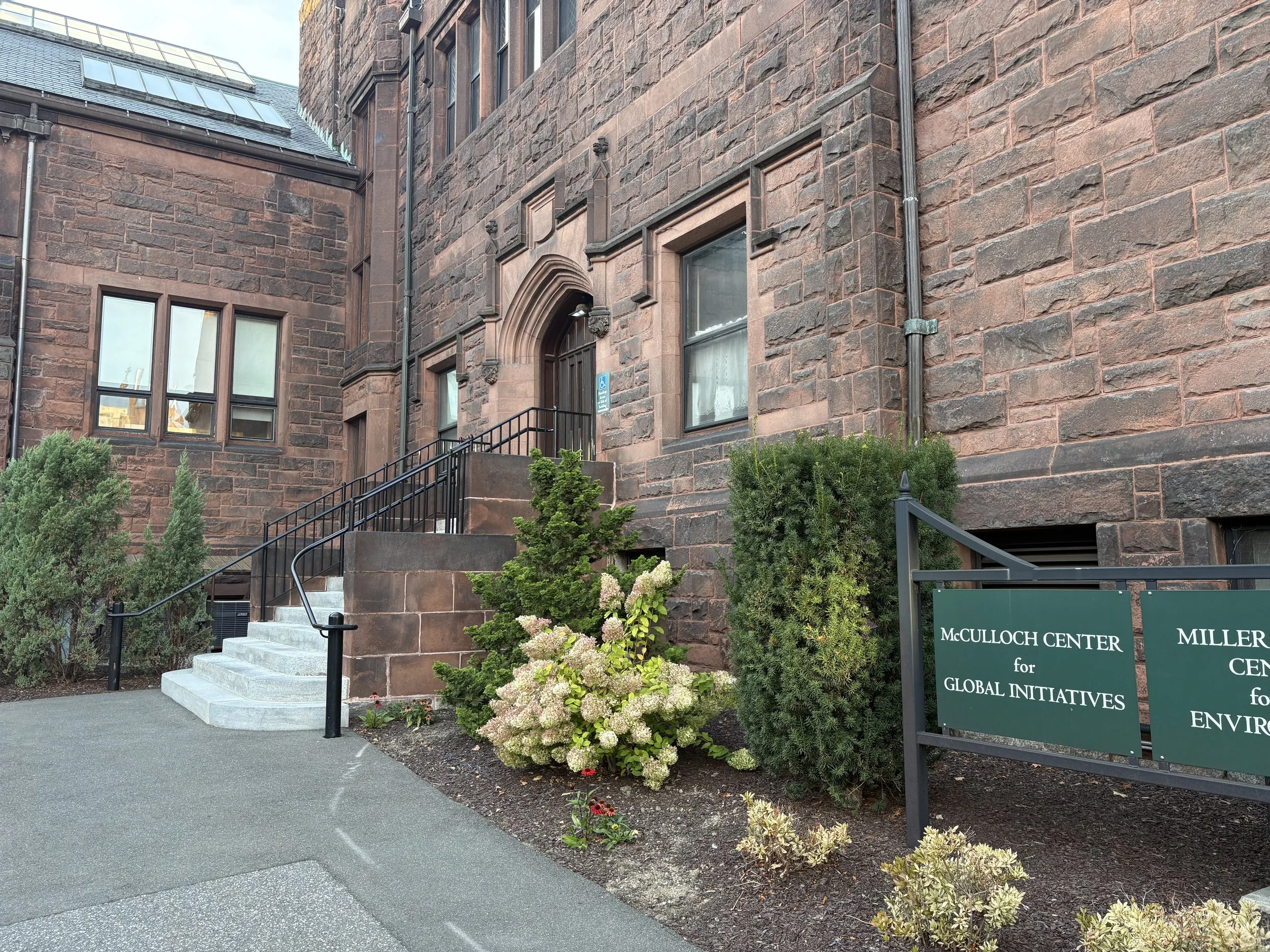
On-campus resources for international students include the McCulloch Center for Global Initiatives, a variety of student organizations and the International Student Organizing Committee, abbreviated as ISOC. 

According to their website, ISOC works under the McCulloch Center for Global Initiatives and focuses on providing support and a welcoming environment for international students. 

Their work includes leading Orientation for international students and promoting cross-cultural connections between students through various events they host. 

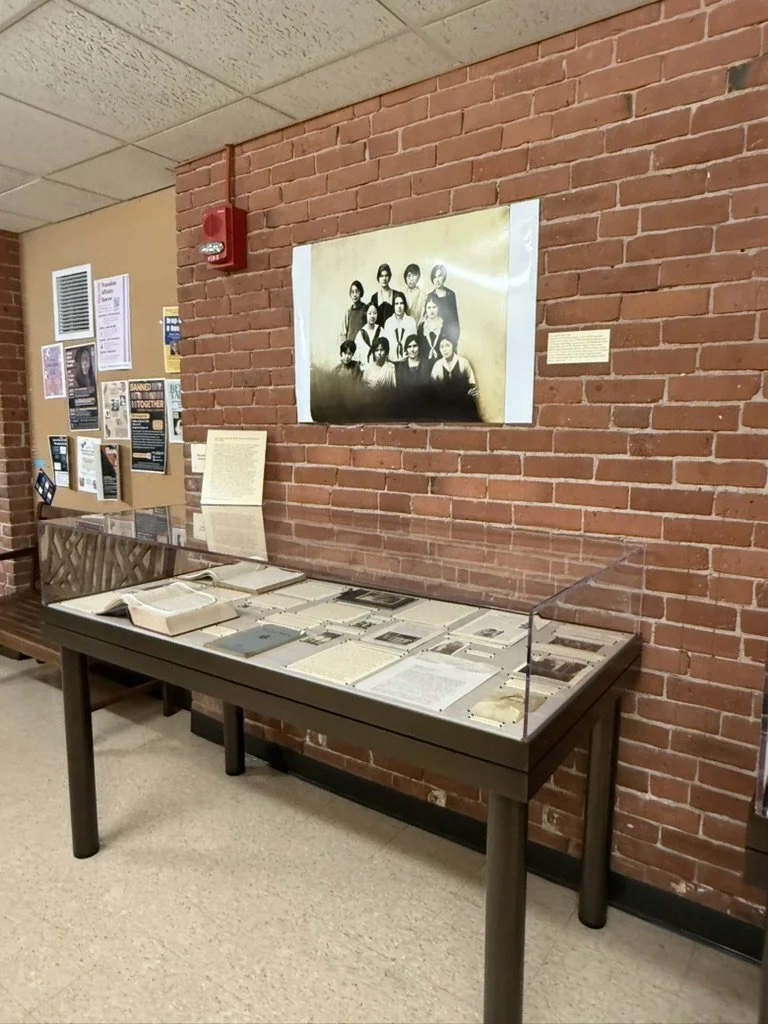
ISOC was originally known as the “International Student Orientation Committee,” and, according to a new Archives exhibit on the history of international students at Mount Holyoke College, originally began more narrowly as an orientation group. The organization expanded to take on its larger current role in 2013. 

When asked about ISOC’s role on campus, Maria Diana Alecu ’26 of the ISOC Board’s publicity subcommittee said, “[ISOC] focuses on building community through events. Our role is to create spaces where international students can connect with one another, share their cultures, and engage with the wider campus. We aim to make sure international students feel represented and included, while also fostering cross-cultural understanding for everyone.”

One of the organization’s most prominent events, which happens every spring, is Global Fest. The event is a  partnership between ISOC and Dining Services that celebrates different foods, crafts, and traditions from around the world. Different cultural organizations have their own booths at the event. 

ISOC also has other events planned for this year. 

“We’re excited to bring back some of our signature cultural and social events, like the International Student Appreciation Week in March and Friendsgiving in November. We’re also organizing smaller gatherings to help students meet each other in a relaxed setting. In addition, we’re looking to collaborate with other student groups on events that highlight global perspectives and celebrate cultural diversity,” Alecu explained.

When asked about how ISOC’s role has changed in the present moment, Alecu said, “In addition to planning fun and engaging events, we’ve taken on more of a support role for international students who may be facing challenges around adjusting to campus life or just finding a sense of belonging. My role has grown to include more behind-the-scenes coordination to ensure our events are not only enjoyable, but also accessible and responsive to what students need right now.”

Sophie Francis ’28 contributed fact-checking. 
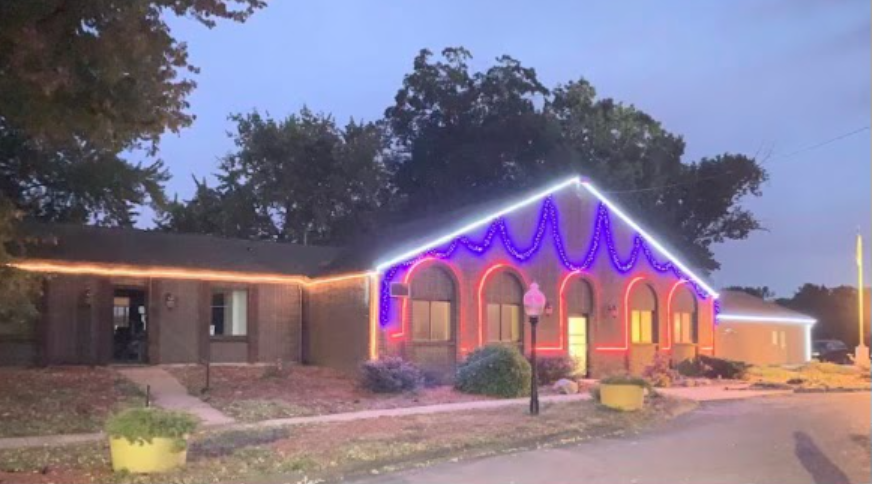
UN holds 80th session of the General Assembly high-level week

Graphic by Brianna Stockwell ’28

Alia Bloomgarden ’29

Staff Writer

On Sept. 22, the United Nations kicked off its most pivotal week of this year’s General Assembly. The high-level week lasted from Sept. 22-30 as part of the 80th session of the United Nations General Assembly held in New York.

According to the United Nations website, the week hinged on the general debate, the anniversary of the general assembly, the 30th anniversary of the Fourth World Conference on Women and the World Programme for Action for Youth, and the International Day for the Total Elimination of Nuclear Weapons. They focused on six specific topics: Palestine and the two-state solution, the climate, the global economy, noncommunicable diseases and mental health and well-being, AI governance, and Rohingya Muslims in Myanmar.

These topics were generally expected as they are major issues, Professor Christopher Mitchell, chair of the department of international relations, explained. He was surprised that Rohingya Muslims “made the agenda along with some things that sort of indisputably are major and controversial issues.” He added, “I’m glad to see they’re getting that attention,” as they “have not gotten nearly as much international attention as a lot of other crises in the world.”

On Sept. 23, President Donald Trump addressed the U.N., making a slew of controversial claims. During his speech, he claimed that all the U.N. does is “write a really strongly worded letter and then never follow up on this letter.” Mitchell explains that, while these remarks are “not tremendously significant, the Trump presidency obviously is.” These remarks and Trump's previous hostility to the U.N. are an “exaggeration and a continuation of the George W. Bush administration towards the United Nations, though with the caveat that the Bush administration consistently cast itself as broadly pro-United Nations, and opposed to the United Nations on the specific question of … the invasion of Iraq, whereas the Trump administration is more hostile to the notion of the United Nations as a whole.”

Despite Trump's hostility to the U.N., he told U.N. Secretary-General António Guterres that “our country is behind the United Nations 100%.” In addition to his criticisms of the U.N. in general, Trump criticized Europe’s handling of migrants. He warned European countries about the crisis of “uncontrolled migration,” claiming their “countries are being ruined. The U.N. is funding an assault on Western countries and their borders” and adding that London “want[s] to go to Sharia Law.”

Sir Sadiq Khan, the mayor of London, rejected this claim. He said that London is a “liberal, multi-cultural, progressive and successful city,” while claiming that Trump is “racist, … sexist … misogynistic and … Islamophobic.”

Mitchell explained that Trump’s remarks “link in with the idea that there is this common trend of right-wing populism across a lot of the democracies of the world. It’s an interesting aspect that all these countries … are both nationalistic and international in that there’s a nationalist international, … where the right-wing populists in Europe and the right-wing populists in the United States of America and the right-wing populists in Latin America all are looking to each other and aligning with each other and raising the same issues and concerns to a large degree.”

According to Mitchell, Trump is “signaling to his ideological allies in these countries.”

Trump re-emphasized his stance on climate change, referring to the carbon footprint as a “hoax,” and global warming as a “con job.” He insulted Europe for reducing its carbon footprint by 37%, which cost them “a lot of jobs, a lot of factories closed.”

Meanwhile, there’s been a “global [job] increase of 54% [with] much of it coming from China and countries that are thriving around China.” He also emphasized his executive orders to “hunt for oil.”

On the other hand, according to Reuters, China’s President, Xi Jinping, committed to reducing greenhouse gas emissions by 7-10% and increasing its wind and solar power capacity six times from its 2020 levels by 2035. Xi stated, “Green and low-carbon transformation is the trend of our times. Despite some countries going against the trend, the international community should stay on the right track, maintain unwavering confidence, unwavering action, and undiminished efforts,” clearly referring to Trump’s anti-environmentalist stance.

Mitchell explains that Trump's statements are yet another example of the continuation and exaggeration of the Bush presidency’s stances, which were hostile towards climate change. However, Bush was “less inclined to reject the science of climate change and more inclined to quibble as to questions of severity and necessity of action.” Essentially, Bush claimed that the climate crisis is “too expensive to do anything about and therefore we should not worry about it,” according to Mitchell.

On the other hand, Trump has taken a “much more aggressive … position” by denying that climate change exists entirely. Mitchell explains that America’s lack of action on climate change obviously makes it much harder for the rest of the world to deal with it, but this is not a new issue.

Mitchell states, “Obama talked a lot about climate change, but his actual record was pretty weak.”

This hypocrisy was something Trump pointed out in his speech, saying, “President Obama would get into Air Force One, a massive Boeing 747, and not a new one, an old one with old engines that spew everything into the atmosphere. He’d talk about the carbon footprint: ‘We must do something.’”

Mitchell believes that Europeans should stop “looking towards the U.S. for leadership that isn’t coming.” It may “spur them to act in a more dramatic fashion.”

On the other side of the issue, Mitchell explains that because the U.S. does not invest in renewable energy, they “[cede] space in what might well be the leading industry in the next half century.” This gives China the opportunity to become a dominant player, leaving “the U.S. in a worse position to reap the benefits of the green transition.” This may also lead Europeans to work with China.

On Sept. 21, Britain, Canada, Australia and Portugal recognized a Palestinian state, despite having traditionally allied with Israel, according to Reuters. This went against Trump’s stance and angered him and Netanyahu, who both said this rewards Hamas. Additionally, during Netanyahu’s speech at the General Assembly, many delegates walked out in protest.

Mitchell explains that the “practical effect is negligible … the real importance is symbolic,” indicating that Israel has lost a lot of support and trust on the world stage. He adds, “There’s always been a significant portion of the United Nations skeptical of Israel and Israel’s commitment to the peace process. That it’s reached states like Britain and France is a new level.” Additionally, this also “indicates a declining U.S. influence because, especially for the Anglosphere countries that have recognized Britain and Australia and Canada, one of the main factors has not just been their view of Israel, but that the United States urged them not to do it.”

At the end of Trump’s speech, he said, “Let us protect religious liberty, including for the most persecuted religion on the planet today. It’s called Christianity.” Mitchell explains that he thinks it’s “factually inaccurate” and “says more about the loss, the feeling of Christians that they’ve lost their primacy.”

When asked about his overall thoughts and what Mount Holyoke College students should take away from the General Assembly, Mitchell said that the importance of it is “almost entirely symbolic … This is about signaling to the rest of the world where you stand on certain issues.”

During the General Assembly, Trump has shown that the most interesting point of comparison is himself “versus George W. Bush, and the ways his positions can be seen as a continuity with those of the old Republican Party, the pre-Trump Republican Party, but also the very significant ways in which they’re not continuous but break from that position,” according to Mitchell.

Overall, Mitchell’s biggest takeaways are that “the U.S. has lost influence and Israel has lost influence that it had vis-à-vis where they both were a few years ago.”

Alayna Khan ’28 contributed fact-checking.
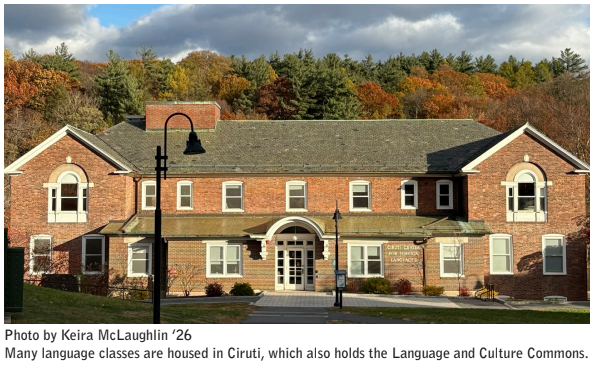
‘Regina di fiori e di perle’: Gabriella Ghermandi and Ethiopian pride

Photo by Kannille Washington ’28

Photgraph of Gabriella Ghermandi’s lecture and performance on “Queen of Flowers and Pearls.”

By Kannille Washington ’28

Staff Writer

“I must make peace with my land.” Gabriella Ghermandi echoes the words of her mother as they moved from Italy back to Ethiopia.

On Oct. 2, in Dwight Hall, Gabriella Ghermandi gave a lecture and performance on her novel, “Queen of Flowers and Pearls.” The annual Giamatti Lecture is given through the Italian department in honor of Mount Holyoke’s Valentine Giamatti, who was an Italian professor at the College in the 1940s.

This year, Gabriella Ghermandi came to speak about her book, which has become a classic in Italian literature. Ghermandi shared insights on the Italian occupation of Ethiopia and the reasons why storytelling and oral history are important in preserving cultural heritage in the face of colonization.

“I grew up in Ethiopia, and I attended the Italian school. And it was a very racist environment, very fascist,” Ghermandi said in an interview with Mount Holyoke News the day before the lecture.

In her lecture, she began by addressing how people and history disregard Italy’s colonialism. Compared to the reach of other countries such as France and Spain, Italy is least often held accountable for the harm they have caused to the Ethiopian community during their occupation from the 1930s to the 1940s, and its lasting impact.

Despite this occupation and, additionally, mass levels of immigration in Italy, there is little acknowledgment of the racial diversity in the country.

“It’s a very old issue that belongs to fascism and even before. Just trying to maintain the purity of the Italian blood, which belongs to the Roman Empire,” Ghermandi said.

Ghermandi, eloquently, introduced her novel as personal, but not autobiographical. She presented the idea that there is still a “bleeding wound” in her maternal history.

“Regina di fiori e di perle” — which translates to “Queen of Flowers and Pearls” — is the story of a young girl who finds value in storytelling and oral history while retracing the centuries of history in her Ethiopian heritage. Ghermandi said, “I always had my eyes fixed on the Italian community because I felt threatened, but I never turned to the other one, which was the Ethiopian one, which was the one that actually supported me.” This late connection to her heritage led to her decision to write the novel.

The Italian occupation was organized in such a way so as to control the movement of Ethiopian pathways, people and cultures. This control extended to Ghermandi and her mother’s own perceptions of their identities.

In her lecture, Ghermandi told the story of her mother’s childhood. She shared that her mother was taught a game in which kids would run away from the “Black man.” Eventually, Ghermandi’s mother taught her the same game: To run away from anything Black. As she grew older, this was how she went about life, trying to run away from anything Black about herself. “But my body, heart and soul are rooted in Ethiopia,” Ghermandi came to realize.

Through music, Ghermandi shared her culture and traditions. She speaks on the sounds that made up her childhood in Ethiopia, as well as other artists she admires that have distinct ways of braiding culture and tradition into their music. Pathways open, free to move in her identity, her voice filled the room with passion and an unmistakably playful nature. There is an assuredness to her culture and to her passion.

But for her mother, there is still something to find. Italy is not the land of superiority, which Ghermandi’s mother realized once she spent time in Bologna. “I want to make peace with my land,” Ghermandi recounts her mother saying.

So Ghermandi and her mother traveled back to Ethiopia in search of their family, a long line of strong women.

As the lecture came to a close, Ghermandi highlighted Shawaragad Gadle, Kebedech Seyoum and Senedu Gebru to reinforce the legacy and impact of Ethiopian women. Very poignantly, she stated, “I feel very proud of being Ethiopian.”

Alayna Khan ’28 contributed fact-checking.
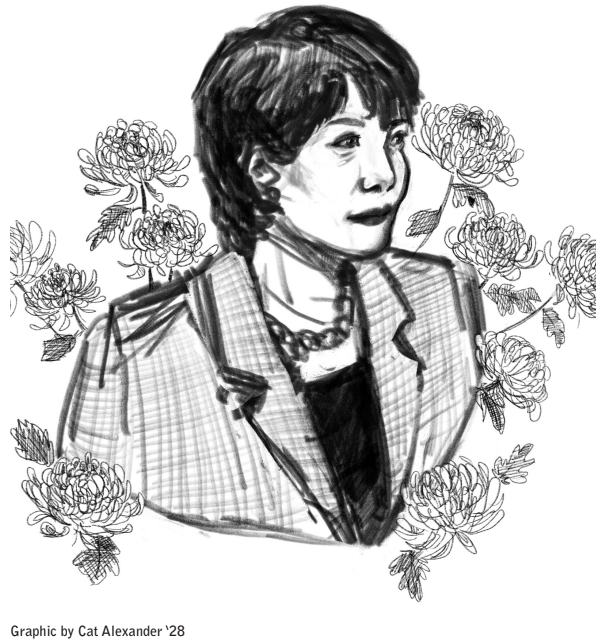
New Archives exhibit on the history of international students at Mount Holyoke

Photo by Mira Crane ’27

A photo of one of the cases displaying the new archives exhibit on international students at MHC.

By Mira Crane ’27

Global Editor

On Sept. 25, Mount Holyoke College’s Archives and Special Collections held the opening reception for its new exhibit "Across Oceans, Across Time: A History of International Students at Mount Holyoke." The event was hosted by Archives and Special Collections, the McCulloch Center for Global Initiatives, and the International Student Organizing Committee, with food provided.

The evening began with an introduction from Deborah Richards, head of the Archives and Special Collections, who explained that this exhibit was completely student curated by six students: Mavis Xu ’26, Charlotte Blandino ’27, Phoenix Nehls ’27, Amelia Potter ’26, Anju Ito ’28, and Sky Cho ’25.

Richards explained that creating an exhibit is a massive undertaking and commended the students for the detailed, hard research they did over the summer. Richards then passed the baton to the student curators, who took the attendees around each of the exhibit cases and discussed the case they worked on.

Mavis Xu talked about individual international students, with an approximate timeframe of 1906 to the 1970s.

When reading through folders on student histories from the stacks, Xu looked at their lives before coming to Mount Holyoke College, their activities at the College, and their postgraduate experience. Xu found a variety of exciting stories.

Xu explained that international students carried on the legacy of Mary Lyon by doing work to support women. While researching, Xu “looked at administrative papers, club files, and individual student files, which included their photographs, letters, essays and sometimes records of the enterprise[s] they engaged in post-graduation.”

On that note, Charlotte Blandino discussed the international students’ early leadership in women’s education. She mentioned that the first international student was Susanna Major in the class of 1843. Blandino also noted that another early international student was Toshi Miyagawa, who arrived in the United States in 1890 to attend Mount Holyoke.

Phoenix Nehls explained that her research led her semi-chronologically through the history of international students at the College. She looked at the ways in which international populations changed and influenced the College over time.

Nehls noted that more specific international communities began to form in the 20th century. Lastly, she discussed Mount Holyoke’s presence during World War II and their establishment of scholarships for refugees.

This led into Amelia Potter’s research and curation of a case focused on the evolution of international students’ population makeup, beginning after World War II and spanning to the 1980s.

She explained that, post-World War II, Mount Holyoke began to receive more students from Latin American countries. Potter talked about her philosophy of letting these historical international students speak for themselves and tell their own stories.

She commented on the centrality of international students at the College and their great contributions, both to this community and beyond, through a variety of essential works. Potter articulated that the strength of the College comes from bringing together so many perspectives. She argued that in the danger of the current moment, Mount Holyoke’s diversity is more important than ever.

Conversely, Anju Ito’s research was focused more narrowly on the International Student Organizing Committee, also known as the ISOC. Ito explained that ISOC mainly works on events to promote international students and increase belonging. According to Ito, ISOC originally started as an orientation group. The organization took on its current role in 2013.

Ito highlighted historical ISOC events and how they helped students to connect with each other. She discussed the International Student Journal and the “What’s My Name Project,” two historical ISOC projects done with international students.

Sky Cho talked about the honor of highlighting ISOC as an international student coming from a diverse background, and the ways in which ISOC is personally meaningful to her. She described history as a story about what each person adds to the past, and discussed her intention of honoring the strength and solidarity of international students.

After the conclusion of the tour, attendees had the chance to ask questions of the exhibit curators. Nehls told a story about two international students who stole a car and drove across the country in the 1920s, coming back to the College just in time for convocation.

The exhibit is open to all students who want to visit, and there is a digital version which can be accessed by scanning the QR code on the exhibit’s display cases.

Speaking about the importance of the exhibit, Xu explained, “Speaking as a history major, I think the history of international students [is] integral to the history and identity of Mount Holyoke College. It is part of the diverse and liberal culture we are always proud of. It is through their eyes that we gain a fuller understanding of how the world out there looks, and free ourselves from ignorance and arrogance.”

As an international student, Xu found it comforting to imagine the paths of others who came before her, and she hopes that this exhibit reminds attendees that they are not alone.

Alayna Khan ’28 contributed fact-checking.

International student visas 101: What has changed and what to know

Photo by Kiera McLaughlin ’26

The McCulloch Center for Global Initiatives’ office can be found on the first floor of Dwight Hall.

By Kiera McLaughlin ’25

Global Editor

Last semester, on April 14, students, faculty and staff filled the Great Room for a closed forum hosted by Mount Holyoke College’s administration about federal attacks on academic freedom and immigration. At the time, international students around the country were being targeted for their social media posts and participation in protests supporting Palestine, as previously reported by Mount Holyoke News.

When school ended, the discussion came to an end for most. Domestic students, like myself, still did not truly understand the visa process, let alone the threat international students face when the government terminates their papers. 

Starting this past summer, international students have been forced to share social media when interviewed during their visa application to ensure they do not “pose a threat to U.S. national security,” according to a post by the State Department.

Then on Sept. 19, President Donald Trump issued a proclamation requiring a $100,000 annual fee for employers of H-1B visa applications, a temporary, nonimmigrant work visa for international workers in technology sectors, The Guardian reported. According to Duke University’s Career Hub, H-1B visas are commonly used by international students after graduating. 

In order to better understand the issues that have resulted from these policies, both past and present, here’s a brief 101 on student visas and what has changed since the beginning of the second Trump administration.

The majority of the international students at MHC have an F-1 visa, a nonimmigrant visa for students studying at an accredited U.S. college or English-language school, according to the U.S. Department of State. There are also several J-1 visa holders, for international students participating in an exchange program. 

Jennifer Medina, assistant director of the McCulloch Center of Global Initiatives and senior immigration advisor, explained the visa application process for Mount Holyoke students to MHN in an interview.

After being accepted into Mount Holyoke College, international students reach out to Medina to request required documents and share their passport, proof of funding, and family contribution information. Once everything is in order, Medina sends an I-20 form to them, which is required for the F-1 visa.

As soon as the student receives an I-20 form, the visa application officially begins. With everything available online through the Department of State website, the student fills out forms and pays fees to schedule an interview, according to Medina.

This interview process lasts around five minutes, and consists of the student explaining their personal situation and sharing relevant documentation. According to Medina, interviewers analyze interviewees’ English skills and how long they intend to stay in the U.S., since both the F-1 and J-1 visas are specifically nonimmigrant visas. 

“For an undergrad student, they're really looking at your immediate family. Do you have many aunts and uncles that are already in the U.S? Does that lead the visa officer to think, ‘Hmm, the student may end up staying there on a permanent basis,’ and that's not something the non-immigrant visa is for, regardless of what you're going to do in the future,” explained Medina.

As of now, they also require that your social media be publicly accessible. Medina explained that in the past the interview took a day to process, but with the social media vetting process it can now take up to 10 days.

“They are going to vet your social media to make sure there’s nothing antisemitic, there’s nothing anti-American, there’s nothing anti-Trump … they’re going through it much more carefully,” Medina said. 

Sometimes when entering the country, international students are required to once again hand over their phone for screening. Medina said this has caused lots of questions about whether the confiscator will think they are hiding something for people that do not have social media.

Despite this simple-sounding process, the visa application requires students to successfully jump through hurdles in and out of their control, including potential problems with documentation, communication, timeliness and the interview process before they can come to South Hadley. 

This year, Medina explained there was a two week pause period in June by the U.S. Department of State which made it hard for students to apply on time or process their application. 

“We did have some students not be able to get here for the fall semester just because they couldn’t get a visa … so we do have students coming in the spring, more students than we normally would,” Medina said.

If the federal government were to terminate a student visa at Mount Holyoke College, the international student would likely receive a message to the email they originally applied with, and the information would be recorded on their Student and Exchange Visitor Information System — or SEVIS — record, which contains an international student’s enrollment status and visa information for both F-1 and J-1 applicants. There is also the possibility that a student’s SEVIS record may be directly terminated. The McCulloch Center of Global Initiatives has access to each student’s SEVIS and can monitor the status.

“We’re always here for help and questions that students have just because we know that everything is so uncertain and there’s so much out there in the media. There’s so many things that are happening to friends at other schools,” Medina said.

When it comes to the role of domestic students, Medina recommends students “just be there to listen and then point students in the right direction.” 

For previous reporting about the situation last spring, http://www.mountholyokenews.com/news/2025/4/15/what-to-know-trumps-immigration-actions-and-mount-holyoke 

For more information and immigration resources, https://offices.mtholyoke.edu/global/international_students/visa_immi 

Quill Nishi-Leonard ’27 contributed fact checking. 

Vigil raises awareness about political turmoil in Nepal

Photo by Mira Crane ’27

NEPSO hosted a vigil on September 13 to raise awareness about the ongoing situation in Nepal.

By Mira Crane ’27 & Alia Bloomgarden ’29

Global Editor | Staff Writer

During the first week of September, Nepali youth overthrew the government.

Violence erupted on Sept. 8 with student demonstrations protesting a government ban on multiple social media platforms, as well as allegations of government corruption, according to The New York Times.

Government security forces opened fire on the protesters, and the controversy led to the prime minister’s resignation. The following day, Sept. 9, parliament and other government buildings were set aflame by angry crowds.

An interim prime minister, Sushila Karki, was named that Friday. Karki is a former chief justice of Nepal’s Supreme Court and will be the first female prime minister Nepal has seen, the BBC reported. Karki’s appointment was supported by Gen Z leaders.

Prashuna Tamang’26, president of the Nepali Student Organization — abbreviated as NEPSO — explained many Nepali citizens' view of the government leading up to the regime change. She said, "Growing up, we would always only learn about how the government's corrupted.”

According to Tamang, the government was inefficient, with no transparency and a large income gap within the country. Although Nepal went through many prime ministers, alternating almost every year, the same few prime ministers and two political parties were always in power, Tamang stated.

Many small parties didn't have a say or chance of gaining power in the government. She said that this system felt like a joke and her friends would call it a "love triangle.”

A month before the regime change, there was a movement on TikTok to expose corrupt politicians and their families. But Tamang never realized the movement had gotten so huge.

She explained, “I went back home this summer and everything was okay. And this was literally a month ago.”

A few weeks later, her sister told her she was going to a protest. Tamang didn’t think much of it. It was supposed to be a peaceful protest, after all.

However, according to Reuters, on Sept. 8 nineteen students were killed and more than 100 injured as police fired tear gas and rubber bullets.

Tamang was shocked when she awoke to the news.

She explained, “I knew that people had anger in them. I get where the rage came from.”

While the students began the protests, Tamang said, “Other political parties took this as a means to, like, spread their own propaganda … they were the ones who started the violence and it was not the peaceful protestors. So I think the infiltration kind of really made the situation bad.”

Tamang and NEPSO wanted to honor those who fought and died battling corruption. So, on Sept. 13, NEPSO held an evening vigil open to the entire Mount Holyoke College community.

The event was held in the Gettell Amphitheater, which was adorned with a poster collage about the crisis and the Nepali flag. Members of NEPSO also drew a chalk version of the flag and a chalk map of Nepal; statements in English and Nepali were written in chalk on the stage.

The event opened with an introduction from Tamang, who thanked everyone for coming and explained that the event was about honoring the Gen Z student protestors in Nepal and the lives that have been lost.

She passed the mic on to another member of NEPSO, who spoke about the context behind the events that unfolded in Nepal during the week of Sept. 8. This member discussed protests where students lost their lives and the appointment of a new caretaker prime minister. According to her speech, there is now a fragile but genuine sense of hope, and what happens next will shape Nepal’s future.

After this speech, attendees went up to the stage to receive candles, which were then placed around the Nepali flag and other pieces of chalk art. Tamang gave a speech about how the event was in solidarity with Nepal, and was intended to honor those who lost their lives and educate the Mount Holyoke community about recent events in Nepal. She also mentioned that the political turmoil was personal for members of NEPSO, many of whom have family in Nepal. All those present observed a moment of silence, and the evening ended with Tamang playing Nepal’s national anthem.

She explained that NEPSO’s goal is to spread awareness of the situation in Nepal across campus. “We felt personally for our own selves that we needed to honor the lives lost. Because we are here in a foreign country, we're not able to do anything, but at least we can spread awareness about what's happening to a wider audience and also stand together,” she said. “Because, since the event that has occurred in Nepal till present, the Nepali students have been very strong knit, and we've been there for each other and we also want the campus community to know what's happening and also support us.”

When asked what she wanted people on campus to know about the situation in Nepal, Tamang said, “At least from the NEPSO community we want, we want the campus community to know that the situation, the Gen Z protest that was happening in Nepal was just not about social media. It was as a result of youth, just citizens getting fed up [with] the long standing corruption, the bureaucracy, the oppression that the youth were facing in Nepal.”

She wants the wider audience to understand why the protests started, and to know that lives were lost during them. Tamang believes the future is hopeful. She explained that although Interim Prime Minister Karki was chosen in chaos, she believes Karki was the best candidate. As chief justice, Karki stood up against corruption. Tamang also believes the chosen cabinet members are good candidates.

According to Tamang, while the future of Nepal has a bright potential, the situation is confusing. Although the prime minister has been overthrown, the political parties that had a strong hold on Nepal still exist and corruption is so strongly rooted in the current system.

As Tamang put it, “The war has just begun.”

Quill Nishi-Leonard ’27 contributed fact checking.