
By Kennedy Olivia Bagley-Fortner ’26
Staff Writer
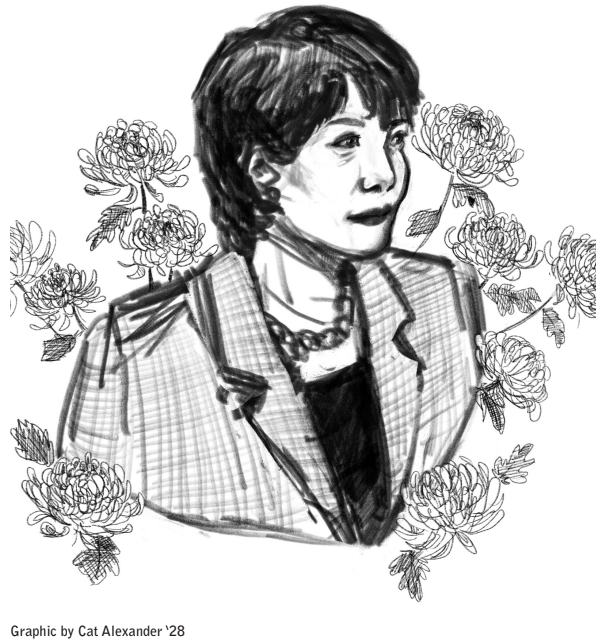
On Oct. 21, the National Diet — Japan’s federal legislature — confirmed Sanae Takaichi as the first woman prime minister of Japan.
Takaichi was born and raised in Nara Prefecture, according to the BBC. Her father worked as an office worker, while her mother worked as a police officer. Before she entered politics, she worked as a television host and entered into the realm of politics during the 1980s.
In 1992 she ran as an independent in her first parliamentary election, but it resulted in a loss. For the next 20 years, Takaichi continued to solidify her position in politics by holding senior positions in the government, including minister for economic security, minister for trade and industry, among others, the BBC reported.
While some have seen Takaichi’s election as a rather progressive and enormous feat for the country, her politics lean more conservative.
“Sanae Takaichi is a conservative with a traditional view of gender roles and a penchant for heavy metal music,” NPR stated. “She has advocated for tougher immigration restrictions and embraced [aggressive] policies on China.”
NPR reported that she is known for expressing admiration of Margaret Thatcher, who “she has drawn comparisons to.” She “often wears blue suits in tribute” of the former British Prime Minister, according to the same article.
Also, similarly to Thatcher,“Takaichi has also courted controversy with her disdain for immigrants and even tourists, a rapidly growing industry in Japan,” NPR reported.
She has cited unconfirmed reports of tourists kicking deer in Nara Park in the hopes of rallying the public to support her campaign against immigrants and tourists. She has also called for restrictions on non-Japanese people buying property.
Takaichi’s popular policies seem rather conservative. While she has advocated for women’s rights and the expansion of hospital services for women, even through speaking about her own struggles to conceive, Takaichi “has also advocated for traditional gender roles, opposes same sex marriage and supports male-only succession to the Japanese throne,” NPR reported.
After taking office, Takaichi met with U.S. President Donald Trump, where they took part in a signing ceremony at Akasaka Palace on Oct. 28.
The two signed two proclamations. One declared a “new golden age of the US-Japan alliance,” and another intended to expand the supply chain for rare earth metals, according to the New York Times.
Like former Prime Minister Shinzo Abe, Takachi is actively working on facilitating a strong bond with the United States. “Abe was one of Trump’s ‘best friends’ in global politics, as well as being Takaichi’s political mentor,” CNN reported.
On Oct. 31, Mount Holyoke News interviewed Professor Calvin Chen — who studies the political economy of East Asia — to get his political expertise on Takachi’s strategy for dealing with Trump and the relationship between the United States and Japan.
“I think one of the things that you’re seeing change now in Trump’s second term is that many leaders have actually adjusted … It’s a case of them learning over time, what the so-called more effective or best practices with dealing with Trump are,” Chen said.
One of these practices being flattery. “In Korea, they gave him a golden crown. He likes gold ... so they tap into some of his tendencies, and then they actually have been able to negotiate a slightly better deal … it’s actually quite overt … and he eats it up,” Chen added.
Like South Korea, Takaichi’s strategy with dealing with Trump hinges on this kind of flattery. “Takaichi announced that Japan would give the United States 250 cherry trees and provide fireworks for a July 4 celebration to mark the 250th anniversary of the country’s founding,” the Washington Post reported.
In a joint press meeting with Takaichi, Trump stated, “I want to just let you know, anytime you have any questions, any doubt, anything you want, any favors you need, anything I can do to help Japan, we will be there. We are an ally at the strongest level,” NHK World Japan reported.
However, it’s important to note that behind this diplomacy, a sense of uncertainty still lingers beneath the pages, especially on their agreement on the exchange of rare minerals. Chen explained, “I think in the short and long term, we will actually not see a whole lot of change ... primarily because — the mining and enrichment of critical rare earth minerals — that whole industry takes time. So they have an agreement to actually work together to secure more sources.”
“But Japan doesn’t have any. The U.S. ... had mines in Utah, but they shot those down because of environmental concerns decades ago. So all of that kind of stuff will be restarted,” Chen added.
At the same time, the mineral agreement could raise some concerns in regards to relations between the U.S. and China. Many prominent leaders in the United States are worried about the country’s reliance on China-made goods, trades and minerals.
According to the Congressional Research Service, “a critical mineral is a nonfuel mineral that is essential for use and faces considerable supply chain vulnerabilities.” Some examples are silicon and lithium. Silicon is used for manufacturing computer chips and lithium is used for manufacturing batteries. Other minerals are essential for the production of magnets, batteries, electric vehicles, and petroleum refining.
“China and Canada supplied the largest number of these nonfuel mineral commodities with 21 mineral commodities,” the 2025 U.S. Geological Survey reported.
This is one of the many reasons why the Trump administration is seeking other avenues for the collection of these minerals, such as collaborating with Japan. “It’s nice that they’re trying to find these kinds of deals. Australia also had one,” Chen said.
Chen explained, “It’s just more of a reassurance to the administration itself that we’re not alone, that we’re not going to be somehow forced to bend the knee even more than we already do to China. But it’s going to take a long time, and China hasn’t changed anything.”
In other words, this agreement is the first step to sustain relations between the U.S. and Japan.
While it is impossible to know what the future holds, in the short term, as Chen pointed out, this agreement “allows them to breathe,” and see how Sanae Takaichi will navigate the political landscape.
Shannon Bazir ’27 contributed fact-checking.