Fizz, Native Spirit and upcoming heritage events discussed at Senate

By Genevieve Zahner ’26

News editor

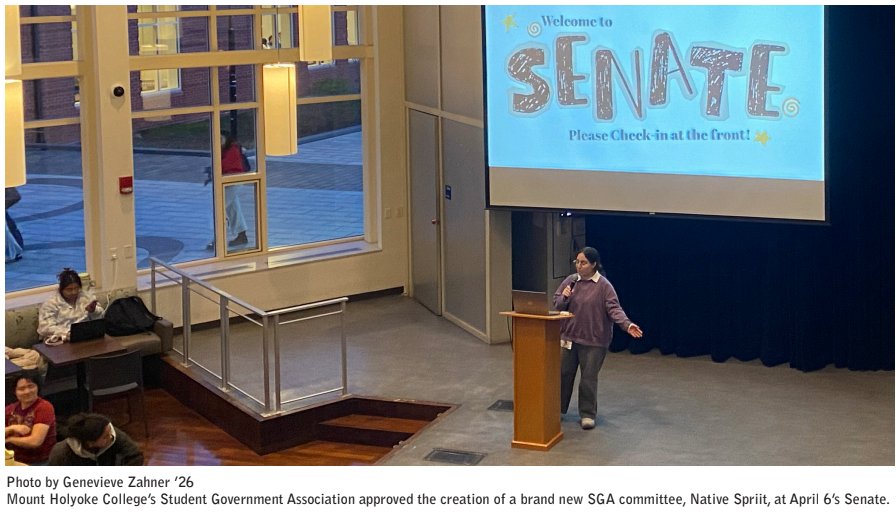
Natasha Rios ’27 opened senate with a land acknowledgement, a moment of reflection, and an ice breaker for those attending before getting into the evening’s agenda.

There was a presentation about a new SGA committee awaiting senate approval, called Native Spirit. The organization’s mission statement is to uplift, acknowledge and support Native and Indigenous students on campus, and to leave an “everlasting legacy of Indigenous led support for students.”

The committee aims to create a space for Native students in a “hegemonic environment” like Mount Holyoke College, and to hold the College accountable as an institution to “move beyond symbolic recognition” and provide sustained investment in the committee. Another goal of the committee is for Mount Holyoke to reconnect with the Native Nations whose land the institution occupies, and create lasting relationships with the nations to “preserve Native epistemologies at the college” as well as a stronger sense of belonging, cultural connection, and support for future Native leaders and trailblazers at the college. The senate then voted and approved the committee.

Those running for chair of senate and chair of halls positions made speeches for their candidacy. The senate will vote later this week. The senate’s prepared presentation closed with several event announcements before moving on to representatives for organizations’ announcements.

The events featured during these announcements were Women and the World of Work which featured alum Sarita Gupta ’96 on April 8, the opening ceremony for Asian, Asian American, Native Hawaiian and Pacific Islander heritage month on April 9, Korea night on April 10, Holi on April 12, Nauryz Festival Celebration on April 13 and Experience MHC for prospective students April 12-13.

The senate then opened up for questions, concerns and announcements from representatives, and began with concerns about the cleanliness of washing machines in Buckland and Abbey, for which facilities management was contacted.

The representative from Queer Action Collective advertised the Civil Disobedience Training on Saturday, April 11 from 11 a.m.-4 p.m. and Protest Marshall Training on Sunday, April 12th from 11 a.m.-1 p.m., both at the Jeannette Marks House.

Asian Students Association advertised the 5PAN conference hosted by the Five Colleges at Hampshire on April 19 from 9 a.m.-6 p.m. and the Nauryz festival, which is a Central Asian holiday celebrating the coming of spring, on April 13 from 6:30-7:30 p.m.

MHC Votes advertised their voting forum with South Hadley town officials from 2-4 p.m. on April 26, which will include opportunities to have one-on-one conversations with state officials Senator Oliveira and Representative Gomez about what to know for the upcoming local elections.

Several students then took the opportunity to speak about incidents on Fizz that have sparked conversations about the treatment of Asian students on campus, including Ivy Zhou ’27, Cindy Ntembe ’27 and Nathania Amadi ’26. The administration as well as President Holley have been contacted regarding the recent uptick in discriminatory posts on Fizz, the anonymous campus app, and on Sunday, April 12, a protest was held. More information about upcoming events and updates regarding anti-Asian hate on campus can be found on @stopasianhatemhc on instagram. The importance of supporting departments that can provide cultural education was noted by Ntembe, along with engaging with local communities and voting in both campus and governmental elections in order for students to educate themselves. Amadi additionally spoke on the importance of students taking accountability for their actions, noting that change has to come from within, saying “when harm is being perpetuated in the community it's our responsibility to curb that hate” especially regarding recent discriminatory Fizz posts that were made against international and Asian students.

Amadi also stated, “People need to unlearn hate and bigotry, do work and educate yourself,” especially regarding the treatment of international and Asian students. She noted the importance of the collective, saying students “need to come together or the change won’t be made” and that students should hold themself accountable in addition to the institution.

The next senate will be held on Tuesday, April 14 at 7:30 p.m. in the Blanchard Great Room.

Jillian Stammely ’28 contributed fact-checking.

Dining Services reports $30,000 worth of missing dishes since Fall ’25

By Paige Comeau ’26

Managing Editor of Content

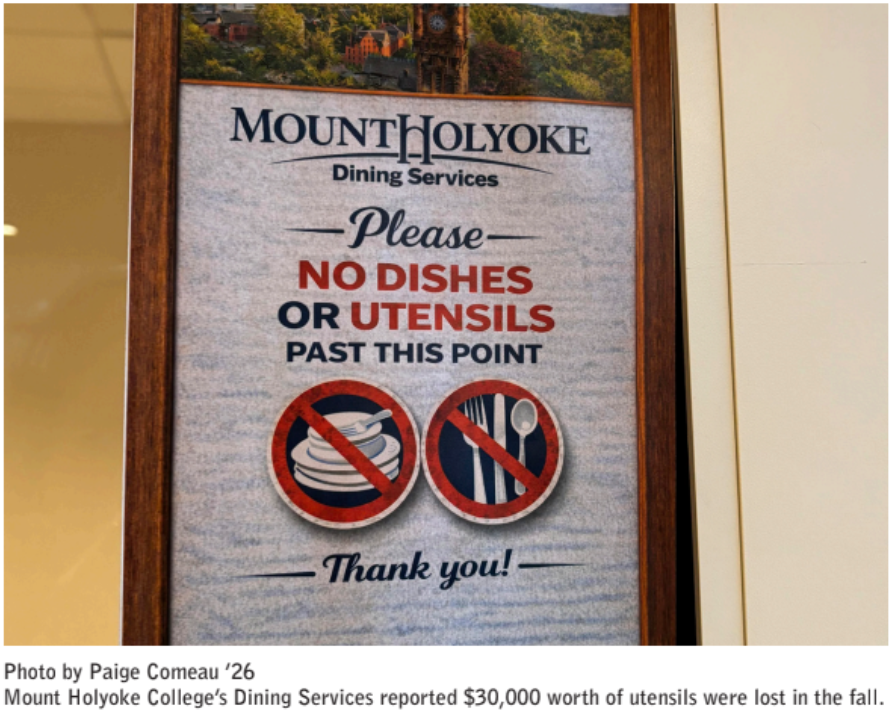
Beginning the week of April 6, 2026, students were greeted by two large signs on the glass doors of the Dining Commons. One sign promotes USEFULL, Mount Holyoke College’s reusable tupperware program, while the other, lettered in a bold red, reads: “Please, no dishes and silverware beyond this point.”

These signs appeared following an email from Dining Services, sent on April 1, titled “Help Us Keep Your Dining Experience Top-Tier: A Reminder on DC Policy.” In this message, Dining Services offered students the reminder that in order “to keep our operations sustainable and our tables fully stocked, we need to ensure that our china, glassware and silverware stay where they belong: right here in the Dining Commons.”

To emphasize the importance of this message, they added that since the fall semester, they have lost almost $30,000 worth of dishes and utensils, or around 3,318 pieces of silverware, 900 large dinner plates, and hundreds of soup cups and bowls. The money they spend replacing these items, constitutes a significant portion of their budget, which they would much rather spend on other things.

In response to this email, many students noted disbelief. “I don’t believe that the couple of borrowed plates and silverware here and there amounts to 30,000 dollars,” Emily Steadman ’26 said in a written statement to MHN.

Similarly, Callie Lantz ’26 stated, “I would like the budget to go to the nice forks if we're going to be spending a lot and [being] hyper vigilant about our silverware.”

Nevertheless, Dining Services has added new procedures to the Dining Commons in order to enforce the seriousness of the issue. Alongside the signs, dining staff will now be more proactive with asking students to finish their food in the Dining Commons, or to use a USEFULL Container. Further, Dining Services will be implementing a No-Questions-Asked return policy around dishware, asking students to drop off any taken dishware on the Dining Commons carousel anytime, with no questions asked.

“We aren’t looking to assign blame,” the email states. “We just want our dishes back so we can keep serving you effectively.”

Jillian Stammely ’28 contributed fact-checking.

Dining unveils various new programs at March town hall

Photo by Emma Quirk ’26

Dining went over many new programs with Senators on March 10, 2026 during a town hall, answering questions about food preparation and disposal.

BY SARAH ANN FIGUEROA ’28

STAFF WRITER

The SGA Senate town hall on March 10 hosted three senior members of the dining staff at Mount Holyoke, who shared exciting new additions coming to the Mount Holyoke dining experience. 

Adorning their signature white chef jackets embroidered with the College’s logo, Shawn Kelsey, associate director of culinary operations, Peter Haas, director of dining services, and Dino Giordano, campus executive chef, all attended Senate for the monthly town hall meeting.

Beginning with what has already been implemented, Kelsey announced the creation of the Dining Ambassador Program. Inspired by the language tables that used to exist in individual dining halls before the creation of centralized dining in 2018, the purpose of this program is to bring meaningful, authentic meals to dining. The dining ambassadors are current students of Mount Holyoke College who represent the diverse communities that exist on campus. They are meant to be accessible for every student to voice their concerns and feedback for dining.

Through these ambassadors, dining staff will learn more about how the dining program can be improved to better serve the needs of our campus. Note that this is not a replacement for preexisting ways of communicating with dining. The QR codes posted around Blanchard Hall are still valid, as well as the MHC dining email, dining@mtholyoke.edu.

Kelsey addressed that everyone at dining really appreciates the positive feedback they receive from the community. “It does genuinely mean a lot to us,” he said. He further added that any high praise given gets printed out and posted around the different stations in the dining hall for staff to see, creating a motivating and encouraging environment.

One of the first dining ambassadors is Cedar Xiao ’29. In an interview with Mount Holyoke News about her perspective on the new program, Xiao said “I feel like I'm really contributing to my community.” Another major component of the dining ambassador role is to provide dining with new recipe suggestions, and Xiao shared how her experience with that aspect of the role has been. She had received feedback from many of her fellow Chinese international students that the meals served at the Wok station are too sweet compared to how they are traditionally made. The fix to this problem isn’t as simple as adding less sugar, as all recipes served in dining are prepared months in advance, and chefs must follow them to the ounce. 

“What I got to do was I found recipes online for other universities in China, and I translated that into English,” Xiao said. “We just did a taste testing yesterday afternoon for more authentic Chinese recipes.” Having invited her friends to provide feedback, many approved of the new recipe.

Hopefully, students can anticipate the quality and authenticity of dishes served in dining to increase with this program. Recounting this taste testing session during the town hall, Giordano noted, “When we get to sit down and eat a meal together, it’s a wonderful and meaningful thing.” If anyone would like to join the dining ambassador program, they should reach out to Shawn Kelsey at kelsey@mtholyoke.edu.

Anyone who has been in the dining hall this semester will have noticed the new dish drop, which was changed over the 2025-26 winter break. Dining shared that the new dish return system is a major improvement for those on the other side of it. 

“It's really helping out the dish room staff,” Haas said. “They are smiling, and the floors are clean, and they're not getting piles of dishes.” It was noted that there are a few technical components in the back of the house that are not yet operational, which may explain why there has been a buildup of dishes during the popular meal time rushes.

One student during the town hall brought up how many students with mobility aids have expressed that the new dish return system is not accessible to them. Kelsey said that the new dish drop is compliant to the Americans with Disabilities Act, however, they are willing to talk with individuals facing challenges to see what they can do to improve the system. 

In terms of other back of house updates, the kitchen now features a new walk-in fridge. This allows for better, more sustainable food storage, and will open up more opportunities for different meals. The expansions to Blanchard Hall in 2018 were not designed with enough storage space for food. As a result, a large refrigerated truck has been parked in the back of the building on weekends to store dairy, produce, and other highly perishable items. With the new fridge, the truck will no longer be needed.

The last new addition to Dining Services is the Grab & Go donation system. Uneaten leftovers from the Grab & Go stations across campus are now being shared with the Food Recovery Network, and sent to Kate’s Kitchen in Holyoke to be distributed. As of March 10, 34 meals have been donated already. These leftovers will be picked up every Tuesday, Wednesday, Thursday, Friday, and Saturday.

Kelsey, Haas and Giordano also unveiled many things that are to come to Dining Services in the near future, the first being a collaboration with the Miller-Worley Center for the Environment. At the Frances Perk cafe, located in the Williston-Memorial library, students will soon be able to check out and return USEFULL cups. Any drink that is ordered with a USEFULL cup will come with a 15 cent discount.

Following spring break, raw fish will enter the sushi program once a week. The first raw fish included will be Ahi Tuna. The program will start slowly and gradually be built upon. Ahi Tuna will be included in premade poke bowls on Tuesdays and premade sushi rolls on Wednesdays, alternating every other week, to be served at both the Sushi station and the Grab & Go stations. 

Another announcement that had many Senators excited was the new smoothie bar to come to the Cochary Pub & Kitchen. The bar will replace the espresso machine, and operate in the same fashion as everything else in the Pub does. Smoothies will be available for purchase via cash, credit or dining dollars. It will be a build your own style experience, with a wide variety of fresh fruit, vegetables, yogurts, smoothie bases and other toppings to choose from. 

Finally, a small yet significant piece of news to come out of this town hall is that food waste across campus is reducing overall, and Dining Services will be doing what they can to continue this trend. It was disclosed that they use an AI program centered around food waste management solutions known as Leanpath to track post consumer food waste leaving our college, and will be taking the usage of it a step further. 

With the Leanpath Spark Program, all of the food coming off of students' plates will be weighed in real time, as workers in the dish room dump all uneaten food into a bin atop a scale. A screen that will be installed in the dish drop area will display and live update the scale’s measurements. Leanpath’s AI will compare the numbers with important metrics, such as how many people could have been fed with the food that has been wasted.

Though there may be something contradictory about using artificial intelligence, a known energy waster and massive consumer of resources, to track food waste in our college, dining made an effort to focus on the positive aspects of this program. 

“It's the right thing to do,” Kelsey stated. “That's why our mission is to reduce that food waste. Not because it's going to save the college money, but because it's the right thing to do. It's something that we can do as a community to help with the global warming issue that we're dealing with.” 

Quill Nishi-Leonard ’27 contributed fact-checking.

Mount Holyoke's production of Melancholy Play runs for three performances

Graphic by Quill Nishi-Leonard ’27 via Canva

BY GENEVIEVE ZAHNER ’26

NEWS EDITOR

The Mount Holyoke film, media and theater department opened their production of Melancholy Play on Thursday, March 5. The play, written in 2002 by Sarah Ruhl, follows the main character, Tilly who “is a bank teller with a melancholy so exquisite it becomes magnetic: everyone she meets falls hopelessly in love. But when Tilly suddenly discovers happiness, her joy unbalances the delicate orbit she’s drawn around her admirers,” according to an email from the film, media and theater department. The play is described as exploring “what it means to live inside intense feeling: the seductive power of sorrow, the disquiet of joy, and the strange, shifting desires that bind us to each other,” the department stated.

This play also served as the directorial debut of Emma Platt ’26, and was the first show that she has solo directed at the College. Though Platt directed Eurydice, another Sarah Ruhl play, in her high school career, this was “a huge and rewarding undertaking” as it had the “most moving parts and largest team” she’d ever worked with. Her Mount Holyoke career thus far has been directing short scenes for class and plays for the 2024 and 2025 short play festivals, and said “A full-length mainstage show of which I am the only director was daunting and a lot of work, but also my most rewarding experience at Mount Holyoke” of her experience with Melancholy Play. 

The play was chosen by the film, media and theater department in fall 2024, and since the play features a live cellist, this part was cast around this time as well. However, production meetings with stage management and design teams began in fall 2025, with auditions and casting happening towards the end of the Fall 2025 semester. 

The entire cast and crew came to campus a week early from winter break to begin rehearsals, including table work, blocking and music learning. “The whole thing has come together in a truly fantastic way, and I couldn't be prouder of the cast, crew, and designers for the incredible work they did,” Platt said. She also expressed her love for directing and the process of working on a play. 

“Working with such wonderful artists and collaborating to make something bigger than all of us, and seeing it come to life, is so rewarding. I have always loved bringing ideas to life and creative collaboration, and directing is the perfect intersection between those things,” Platt stated. 

Kainoa ChesemoreWalling ’27 was the stage manager for the production, and said of the experience, “Last year I got to work as an [assistant stage manager] on Marie Antoinette which was super fun and I was excited to work on another student directed show here. … We also brought in a lot of supporting artists to help us with the production like Jay Doane, our student fight choreographer, and then a dialect coach and intimacy coordinator, which was super fun to collaborate with all of these artists.” 

They spoke more on the process of tech rehearsals, and how that differed from the five weeks of rehearsals they had before starting tech, “At this point I was fine tuning transitions and props shifts so that once we were in tech everything would go as smoothly as possible. In tech we did two days of cue to cue because we had a more tech heavy show. Then by that point we were able to do a full run through some trouble points and then we had three dress rehearsals before we had an audience!” 

ChesemoreWalling said her favorite part of stage managing is seeing everything come together, and that “For the most part everyone works on the production separately until tech. The actors are in rehearsal during the evening and the production teams are working on getting the designs created. As the SM I am one of the people who form a bridge between the two, making sure things are communicated and aligning with the collective vision of the show. Once we hit tech it is magical to see everyone's hard work get pieced together.” They also enjoyed connecting with everyone working on the show, and having “silly and fun moments” together. 

Platt also spoke on the importance and her appreciation for the rest of the cast and crew, saying, “I want to express my endless appreciation, respect, and love for the incredible cast, crew, and design team. This would have been impossible without them. I want to especially emphasize the importance of Kainoa, Juno and Sabine, our stage manager and assistant stage managers. They kept this whole thing running in a way I never could alone. Also, thank you to Michael Ofori for being an incredible faculty advisor for the project.” 

Melancholy Play ran from March 5-8 in Rooke Theatre, and will be followed by the spring production of POTUS in April. Alayna Khan ’28 contributed fact-checking.

CBL welcomes youth from Girls Inc. to visit campus and meet students

By Emma Quirk ’26 & Genevieve Zahner ’26

News & Photos Editor | News Editor

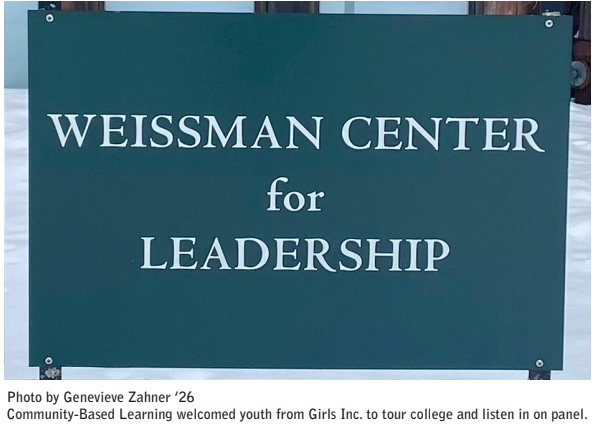
Mount Holyoke Community-Based Learning welcomed Girls Inc. of Holyoke, Massachusetts to campus on Wednesday, Feb. 18 for a visit and panel discussion about college and the opportunities that Mount Holyoke has to offer. 

Girls Inc. works with various partners to “ensure that all girls have what they need to thrive — in school, at home, and in their communities” by providing elementary, middle and high school programs to provide academic support, personal development, career exploration, and bolster physical well-being. They additionally have a program called Eureka!, where girls participate in a five year program from 8th grade through their senior year of high school working with professors at the University of Massachusetts in classrooms, labs and in the field of different professions to boost college and career preparation, building skills and confidence both academically and personally. 

A cohort of girls from Girls Inc. visited campus, taking a tour of the equestrian center andthe greenhouse, before concluding the tour at the Betty Shabazz Cultural Center. There, they had lunch and reflected on what they learned and thought about any questions they might have had. 

The middle and high school students then sat in on a panel discussion with current Mount Holyoke students where they were able to ask questions about the college process, Mount Holyoke and what opportunities are available to them both at Mount Holyoke and at other members of theFive Colleges. The elementary school children sat in on a separate listening circle, where they were able to have a similar conversation, more tailored towards providing early exposure to the college environment for young learners. Trinity Moore ’29 is a CBL Fellow and is partnered with Girls Inc. as an after-school intern. She was part of organizing and running this visit and was pleased with its outcome. “The visit went really smoothly!” she said in an email interview with Mount Holyoke News. “My main concern was that the visit be age-appropriate and interesting to the range of students we would have visiting (5-13-year-olds). Thankfully, we did things that intrigued all ages, like visiting the Equestrian Center and the greenhouse, and offering coloring pages for students during a Mount Holyoke student-unofficial panel.” 

Additionally, she was grateful for the diversity of students part of the panel discussion.  “This kind of visibility is crucial for prospective students, as it allows them to see themselves reflected in the current student body, reinforcing the conviction that they are incredibly capable of succeeding in college,” Moore said. 

Akilah Williams ’26 was another of the student leaders who was part of this collaboration between CBL and Girls Inc. “Leading a segment during the visit was especially powerful for me as it made me feel trusted by CBL and affirmed that they genuinely value us tutors as individuals and leaders,” Williams said. “That trust meant a lot to me as it showed me that my voice matters not just in theory, but in practice.”

Williams found the visit to be particularly meaningful because she had been part of Girls Inc. herself as a middle schooler in New York. “Being able to now give back to a program that once poured into me felt full circle. It reminded me how impactful and empowering Girls Inc. truly is,” she said. “Seeing the girls engage with our campus and ask questions reinforced how important spaces like this are for young people. I’m also really grateful that CBL collaborated with Girls Inc. and gave us, as students, the opportunity to share our experiences about campus life.” 

Reflecting beyond this event, working with CBL has pushed her to be more involved in and take action in the local Western Mass. community. “For me, CBL means refusing to turn my back when I see injustice, discrimination, or inequality,” Williams said. “Community-based learning gives me the tools and the space to respond rather than remain silent. Through CBL, I’ve learned that real change starts with presence. Showing up matters. Listening matters. Advocating matters.” 

Cat McKenna ’28 contributed fact-checking. 

Mount Holyoke holds workshop on how to protect against ICE

Graphic by Mari AlTayb ‘26

By Sarah Ann Figueroa ’28

Staff Writer

Friday, Jan. 30, guest speaker Erik Esqueda Sánchez from San Diego State University joined Mount Holyoke students and faculty for the “Activism sin Fronteras: Legacies of Liberation and Community Mobilization” workshop, held by the Office of Diversity, Equity, and Inclusion. Centered around peer collaboration and group discussion, the workshop provided its attendees with fresh perspectives on how they can help protect members of their community who may be targets for U.S. Immigration and Customs Enforcement, commonly called ICE.

The official description of the event reads, “This workshop will cover a brief history of undocumented and migrant movements within U.S. context and explore strategies for leveraging your own talents and knowledge to co-build activist spaces.”

Coming all the way from California, this was Sánchez’s first time in Massachusetts. They expressed that they have always wanted to visit Massachusetts, so the excitement to be here outweighed how cold it was. Sánchez is the assistant director of SDSU’s MEChA, the “Movimiento Estudiantil Chicano de Aztlán,” or, in English, “Chicano Student Movement of Aztlán.” Growing up with the MEChA program, they view the work they do today as “Giving back everything that was given to me.”

After introductions around the room, Sánchez made mention of the ongoing ICE raids in Minnesota’s Twin Cities, Minneapolis and St. Paul. On the day of the workshop, residents of these cities called for a nationwide strike against the raids, also referred to as the “ICE OUT” protests. As written in an article by Kimberlee Kruesi and Holly Ramer with the Associated Press, “Protesters held ‘no work, no school, no shopping’ strikes across the U.S. on Friday to oppose the Trump administration’s immigration crackdown.”

A summary of these events, as read during the presentation, states “State violence and criminalization are escalating / We are witnessing murders of civilians in real time / Communities are grieving, mobilizing, and resisting simultaneously.” Sánchez explained that the Activism sin Fronteras workshop was intended to be an extension of this movement, as the information being taught is rooted in the same resistance as the protests in the Twin Cities.

Solidarity with those in Minnesota could be felt throughout campus that day, as students had participated in the strike, and many flocked to the Amherst Common that afternoon to join the ICE OUT protest being held there. Additionally, Sunrise MHC held a student walk out and study-in one week later on February 6, responding to calls from high schoolers in Minneapolis asking other students across the nation to strike in solidarity with them.

With a student body made up of about 20% international students, many people at Mount Holyoke College have expressed concerns for those who may be vulnerable in the event that ICE arrives on our campus, especially since agents have already been seen in nearby towns like Northampton and Amherst. These fears are not unfounded. As the American Immigration Council has stated, “American communities are now seeing a level of immigration enforcement utterly unprecedented in modern history … the conditions that have resulted from this rapid expansion for those caught up in the detention system have increasingly worsened and become more inhumane.” With a combination of the president bypassing due process laws and ICE agents heavily employing racial profiling, legal status offers international students little protection against these targeted attacks. Even if one may not be deported in the end, the trauma that comes from going through the intensifying immigration system merits the protection of those most at risk.

Though the circumstances were grim, Sánchez’s teaching filled the space with hope. Examples of past movements that reflect times similar to ours were given, and together the attendees examined them to determine what has worked in the past that can be applied to current organization strategies. In particular, the workshop focused on the Undocumented and Unafraid movement from 2010 and the Ethnic studies walkouts of the late 60s. The slideshow listed effective tactics used in these movements as, “Civil disobedience, sit-ins / Legal advocacy, policy pressure / Mutual aid and rapid response networks.”

After analyzing these historical examples together, Sánchez noted, “Students have done badass things throughout the history of higher education,” also reminding, “This movement is not new, it’s only intensified.”

The latter half of the workshop focused on the individual, and how one may leverage their own aptitudes to contribute to a cause, such as protecting communities from state violence. Using the Slow Factory’s “Roles for Collective Liberation,” attendees talked about which roles they identified with, and how they could see themselves using their skills with an activist lens. The list of roles contains both creative and pragmatic options, finding space for everybody in a movement.

The workshop culminated with students applying everything they had learned to address the hypothetical but strikingly realistic case study scenario of ICE interference on our college campus, a conversation that has been brewing amongst Mount Holyoke students since last semester. Imagining what to do in emergency scenarios is a complex and mentally heavy topic, often meaning that there will never be one right answer for how to handle them. However, the group effectively addressed what not to do in this scenario, concluding that acting out of anger and without a plan would be the most detrimental to the cause of keeping everyone safe. Many agreed in the end that organized, strategic collaboration and thorough communication are the keys to making it through a situation like the one described in the case study. What that looks like may be different for different individuals, but no matter what, our community coming together to help keep one another safe is essential.

After the workshop concluded, Sánchez agreed to a brief interview with Mount Holyoke News. Reflecting upon the event as a whole, they shared, “My goal … was just to move people from … a place of powerlessness, or feeling like they didn't have an opportunity to be part of a movement.” When asked if they had a message for the Mount Holyoke community, they said, “Keep being critical, to keep questioning, to keep building relationships with one another, and to find the ways that feel good for you to engage during this difficult time.”

Jillian Stammely ’28 contributed fact-checking.

Joy and friendship: Swive reflects on first half of 2025-26 season

Photo courtesy of MHC Athletics
Several members of Mount Holyoke’s swimming and diving team spoke with MHN about the sport.

By Bei Jia Viggiano ’28

Sports Editor

As courses conclude and finals approach, the Mount Holyoke College swimming and diving team has completed its first half of the 2025-26 season. December only held a weekend event in New York, allowing the student-athletes to focus on final assignments and exams. Members of the swimming and diving team had quite a bit to say regarding their team’s successes, challenges and the environment.

On the first day of November, the Lyons met with the University of New England in Biddeford, Maine. For the first meet of the 2025-26 season, though Mount Holyoke lost 155-106, the Lyons still had cause to celebrate individual achievements. Evelyn Rousseau ’29 placed first in the 1,000-yard freestyle with a time of 12:20.81, and Maya Oakes ’29 emerged victorious with a time of 1:06.76 for the 100-yard backstroke. Isabel Dunn ’27 placed first in the 100-yard butterfly with a time of 1:06.34 and took second place in the 50-yard butterfly with a time of 29.61.

“[Our coaches’] attention in every practice since the beginning of the season to each of our strengths to design a competitive lineup absolutely contributed to the success,” Rousseau said in an email to Mount Holyoke News.

Two weeks later on Nov. 15, Mount Holyoke attended a meet against Westfield State University at the Mount Holyoke College Natatorium in South Hadley, Massachusetts. The Lyons emerged victorious 166-114.

“During our meet against Westfield State, we were a lot more loose and relaxed,” Naomi Long ’29 said in an email to Mount Holyoke News. “We had two weeks of uninterrupted training after our first meet, and I think we all felt more confident going into this meet. It was also so nice to compete at our home pool!”

“Westfield State was a great meet — it was the first time this season the team swam 100s and 200s (instead of the 50s and 100s we had swum), so it was exciting to see how all the training had been paying off!” Katherine Upton ’28 said in an email to Mount Holyoke News.

“For the Westfield meet, I think our mindsets and energy on deck contributed to a positive attitude across the team, which helped us become more competitive,” Kaylee Barnett ’26 said in an email to Mount Holyoke News. “We were all cheering for one another at the ends of lanes or on the side of the pool. We also were at our home pool, which is always helpful!”

“We had a super strong 200 [yard] medley relay that out-touched Westfield State by 0.35 seconds and clenched first place,” Katie Thomason ’29 explained in an email to Mount Holyoke News. “We had a lot of first-place finishes, but we were also able to fill a lot of lanes in almost every event to gain even more points, which is essential in swimming. We were also lucky to have our amazing diver, Katherine [Upton]. We were really good at cheering for everyone on the team, and it was great to have so much support in the stands.”

“I believe the hard work we’ve been putting in at practices every day, including both pool time and dry land workouts (with [Head Sports Performance Coach] Jay [Mendoza]) have helped us greatly,” Zoey Zhu ’27 said in an email to Mount Holyoke News. “We’ve been working hard in practice, splitting off into groups to train for our specific events (distance/sprint/IM) and doing our best to keep giving our best every day.”

“I think there are many reasons why we can perform well,” Carol Fang ’29 said in an email to Mount Holyoke News. “Everyone on the team loves swimming and works very hard in training. We also try to stay positive even when the training load is heavy. Another very important reason is that we have an amazing coaching team. Our coaches are extremely knowledgeable, give professional feedback, and care about each swimmer’s health. They support us when we feel confused, stressed, or discouraged.”

“Overall, I think that the support that the team has for one another, alongside our hard work in practice leading up to the meet, led to our win over Westfield!” Ellie Lewis ’29 said in an email to Mount Holyoke News.

A week following their victory against Westfield State, the Lyons faced Wellesley College, once again in the Mount Holyoke College Natatorium. Mount Holyoke lost 188-64, though Dunn notably placed first in the 200-yard butterfly with a time of 2:33.79 and took second place in the 100-yard butterfly with a time of 1:05.37.

“As challenges come up like losing a meet or having a hard practice, the team shifts focus to the end-of-season meet, NEWMACs,” Rousseau said. “Every race we swim, every yard at practice, every early morning lift is all building up to that point. So, remaining positive and focusing on growth for the future.”

“We communicate [when challenges arise],” Zhu explained. “We regularly update our coaches and do our best to work through any challenges step by step.”

“In response to the challenges that we have faced, each team member has remained dedicated to the team and our performance, at both the team and the individual level,” Lewis said. “We also have stayed committed to supporting one another, and in the face of challenge, we make sure we are there for our teammates!”

“In facing challenging meets or teams, we’re good at being willing to go outside of our comfort zone and try events that we may not typically compete in,” Thomason said. “[Coach] Dave [Allen] often talks about the importance of ‘grit,’ and I think that’s been a big focus this season.”

“Our coaches have specified the importance of having grit,” Long said. “No matter the obstacle, we have focused on doing whatever we can to overcome any challenges. It has been helpful for me to focus on what I can control and not dwell on outside factors.”

The swimming and diving team began preparing for the Rochester Institute of Technology Invitational held in Rochester, New York, at 4 p.m. on Friday and Saturday, Dec. 5-6.

“We’re all getting really excited!” Thomason said. “[The] RIT Invitational is a two-day meet with three sessions total, which is much longer than a dual meet. We’re already planning all the fun things we’ll do to entertain ourselves on the long bus ride! The events we swim at this meet are usually used to test out potential NEWMAC events, so we’re starting to shift into that competitive mindset. It’s difficult having had the Thanksgiving break right before this big meet, but we’ve been doing a lot of hard training to prepare us for a great meet.”

“To prepare for RIT, we have been doing a lot of pace and sprint work at practice,” Long remarked.

“For RIT, we’ve just been trying to do our usual,” Upton commented. “Nothing super crazy, just taking everything one day at a time, swimming the races we’re in and doing the dives we’re doing at that moment.”

“The team has been putting in a lot of work, both in … and out of the pool to prepare for RIT!” Lewis said. “From hard workouts leading up to November break, to weight lifting during the week, our team has been gearing up to swim well.”

“We’ve been doing more specialized workouts for our particular events,” Rousseau said. “In my case, I’ve been doing a lot of practice holding pace for long-distance events like the 1650. The group that plans to swim the 400 IM event is also putting in a lot of work with our assistant coach, Bill Tyler, on technique.”

“We’ve all been putting in a lot of work in the pool and weight room,” Barnett explained. “We practice five to six times a week, as well as lift two to three times a week. On the swim side, the team splits itself into sprint, stroke and distance practices every day depending on what each athlete’s strengths are.”

“We’ve also been working with a mental performance coach this season to help better prepare mentally for competitions and practices,” she continued. “Our coach [Dave Allen] is big on emphasizing that we should focus on controlling what we can control. After a hard practice or a disappointing meet, it’s not beneficial to spend a lot of time beating ourselves up about it. We can acknowledge that it wasn’t our best, think about what we can do better and move forward towards the next one.”

“For me, I like to think about what technique changes I can implement for the next practice or meet and really focus on that,” Barnett added.

Lewis, Rousseau, Long, Zhu, Thomason, Barnett, Fang and Upton have nothing but love for their team and its environment, both athletically and socially. The collective and individual growth paired with the abundance of support and enthusiasm throughout this semester has poised the Lyons for an exciting and competitive spring semester.

“Personally, I have had such a great experience with this team so far!” Lewis said. “I am so excited for where this season is headed, and I cannot wait to spend more time with the team!”

“My experience with the team so far has been extremely positive,” Rousseau said. “The culture of support and growth has been so beneficial not only to my swimming but to my college experience. We win some meets, lose others, but no matter what, we return to practice more dedicated.”

“Our team has grown close throughout the semester!” Long said. “I have been having fun getting to know everyone more and having my teammates push me in practice! I am very excited for the rest of the season and seeing what everyone accomplishes!”

“I have had a fantastic experience with the team since the beginning of the season,” Zhu said. “This is my third year now, and I have really enjoyed getting to know our first years—they bring such a great spirit to the team!”

“[The semester has] been amazing! The team is so inclusive and welcoming,” Thomason said, “it feels like one big family. As a team, we’re really good at supporting everyone both on deck and outside of athletics … it’s a great way to explore events and activities happening on campus.”

“We’ve always been a really close team, and I don’t think that’s changed this season,” Barnett said. “We all take care of each other and lift each other up, both in and out of the water. I love going to practice and talking with my teammates about their days, their classes and what they’re looking forward to. I also really love encouraging my teammates during practices and meets — more often than not, I’m telling the people in lanes around me that they’re killing it at practice, or cheering loudly for those who are racing.”

“I’m so grateful for the opportunities I’ve gotten to be both a participant and a leader on this team,” she concluded. “And I wouldn’t trade it for the world.”

“I think the [team] is a very warm and welcoming group,” Fang said, “and I have always felt included and supported. The coaches care a lot about every athlete’s physical and mental well-being, and everyone on the team is very friendly. We take part in many team-bonding activities and often eat and chat together after practice, which helps us get to know each other better.”

“Our team also has many traditions,” Fang added. “My favorite one is that before every meet, we draw lots to choose a teammate to make a psych-up poster for, and then cheer for her during the competition. Making the poster helps us learn more about each other, and receiving a poster is always a happy surprise that motivates me to do my best.”

“A special moment for me happened on the day we competed against Westfield State, which was also my birthday,” Fang recalled. “After the meet, my teammates surprised me with a cake. I was truly touched. As an international student, I was far away from home, but I still felt loved and remembered.”

“One moment that I remember clearly was during a meet when I was feeling slightly sick,” Fang continued. “During warm-up, I felt unusually tired. Coach Dave [Allen] somehow noticed right away. He stopped me and asked if I was feeling okay. I told him that I might have a cold. He comforted me and said he knew how hard I had been training, and that my body was probably just tired. He reminded me that this meet did not define my progress, and that after the Thanksgiving break, I would definitely be able to show my hard work at RIT. Hearing his words made me feel so relieved that I almost felt healed.”

“Even though I wasn’t feeling well physically,” Fang reflected, “I ended up breaking my personal best in the 50 free.”

“The team is so great. We have a comparatively big first year class and they’re really hitting their stride,” Upton said. “We’re also thrilled to have five coaches this year — adding [Assistant Swim Coach] Kenzie and [Dive Coach] Joel has made a big difference and I know we’re all really grateful for them.”

Upton proceeded to express her deep appreciation for her teammates: “Rowyn Farley ’28 is swimming distance events and sprint events this year, which is crazy and fairly unusual — it is really impressive how she is balancing the two and the totally different strategies needed.”

“Audrey Stuckert ’27 switched from swimming to diving this year and is picking it up so fast, and her attention to detail is phenomenal,” she continued. “Katie Thomason ’29 came in as a breaststroker but has added distance freestyle and is doing excellent.”

“Carol Fang ’29 has also switched her primary stroke and is getting crazy good results!” Upton wrote. “Maya Oakes ’29 is such a consistent, hardworking swimmer.”

“I could talk about how wonderful my teammates are forever,” she concluded. “We have a really small team this year, which can be tough. We’ve been able to pull together and get through it.”

Mount Holyoke’s swimming and diving team has since attended an invitational with RIT on Friday and Saturday, Dec. 5 and 6, in Rochester, New York. They will next meet with Wheaton College and Clark University on Friday, Jan. 9, 2026, at 10:30 a.m., at the Mount Holyoke College Natatorium in South Hadley, Massachusetts.

Karishma Ramkarran ’27 contributed fact checking. 

Mount Holyoke hosts panel with ACT UP alums on World AIDS Day

Photo Courtesy of Annette Dragon via University of Southern Maine Digital Commons
Members of ACT UP protest outside of George H.W. Bush’s summer residence in Kennebunkport.

By Quill Nishi-Leonard ’27

Editor-in-Chief

On Dec. 1, Mount Holyoke College observed World AIDS Day, “an opportunity for people worldwide to unite in the fight against HIV, to show support for people living with HIV, and to commemorate those who have died from an AIDS-related illness,” according to an Instagram post by the Office of Diversity, Equity & Inclusion. The Office of DEI and Be Well Peer Health Educators began the day tabling in the Williston Library Atrium from around 12-1 p.m.; students were welcome to “stop by to grab a red ribbon, and peruse various select works of HIV/AIDS literature,” as described in the Nov. 24 MHC: This Week email from the College. 

Later that day at 7 p.m., The Office of DEI hosted a virtual panel on Zoom in conjunction with the politics department titled, “Histories & Memories of ACT UP NY.” Several alums of ACT UP — Andrea Lawlor, BC Craig, Debra Levine and Diane Curtis — spoke at the panel, detailing their personal experiences, memories and answering student questions. 

HIV — human immunodeficiency virus — is the virus that causes HIV infection in humans. HIV attacks and destroys helper T cells, which help the body fight off infections and cancers. HIV cannot be spread through casual contact; the virus is only transmittable through blood, semen, pre-seminal fluid, rectal fluids, vaginal fluids and breast milk, according to HIV.gov.

When somebody has HIV for a long time, they may develop AIDS, acquired immunodeficiency syndrome. People with AIDS have critically low levels of T cells, and are much more susceptible to infection and cancer than those without. Today, while there is still no cure for HIV, people with HIV can achieve an undetectable viral load with treatment. Those with an undetectable viral load are not able to transmit the virus, and will not develop AIDS.

Visiting Assistant Professor in Politics Kevin Henderson, who is currently teaching a course on the politics of HIV/AIDS, helped open the event, providing a brief introduction on the history of HIV/AIDS and ACT UP. 

The first cases of HIV reported by the Centers for Disease Control and Prevention were in June 1981, though it’s likely that many people had acquired the virus long before then. ACT UP was founded in response to widespread stigma against those with HIV/AIDS and government inaction on the epidemic. According to Henderson, “ACT UP pioneered the slogan ‘Healthcare is a human right’” and created “some of the most recognizable” protest art of all time. 

“Really, we were a bunch of people in our twenties trying to figure things out,” panelist Diane Curtis said.

The former members of ACT UP discussed how the movement’s energy and the bonds between its members allowed it to thrive during an incredibly difficult time in history. Prior to 1996, there was no effective treatment for HIV/AIDS, and many died. 

Curtis described the number of deaths as having been “overwhelming.” Today, social media has allowed many members of ACT UP to reconnect and mourn those who were lost. “We forgot to grieve, and now we’re going to,” Curtis said.

Debra Levine spoke about how many members of ACT UP coped with stress in the height of the epidemic through humor, “You could have something incredibly weighty, and it’s helpful to have comedians in your group.”

“It really helped to have a good drag outfit,” Levine added.

“Despite how literally life and death everything was, it was so much joy, so much parties and cruising, and around this anger, around these actions, around the risks people were taking, around the many hospital rooms we spent time in and around the many memorials, there was so much life and joy,” BC Craig explained.

Panelists also discussed several protests and actions by ACT UP, and the organization’s commitment to inclusivity. Levine explained that in 1991 on Labor Day, ACT UP transported hundreds of its members to then-President George H.W. Bush’s summer home in Kennebunkport, Maine, in protest of Bush’s inaction on the epidemic. 

Craig expanded upon the difficult logistics of this particular action: “People need to remember when we’re talking about this, an action that’s 1,000 miles away, we needed a complete medical staff, food, and water, and lot of sick people needed wheelchairs.”

While “it took a lot of money,” it was important to ensure “anyone who’s differently abled in any way gets to participate,” Levine said.

The love and dedication members of ACT UP had for one another was one of the most memorable and nostalgic aspects of the organization for many of the panelists. 

“That was a model of possibility [that] I just thought was the world,” Lawlor said.

Jillian Stammely ’28 contributed fact checking. 

Mount Holyoke students walk out in protest of Trump's Campus Compact

Photo by Sarah Ann Figueroa ‘28

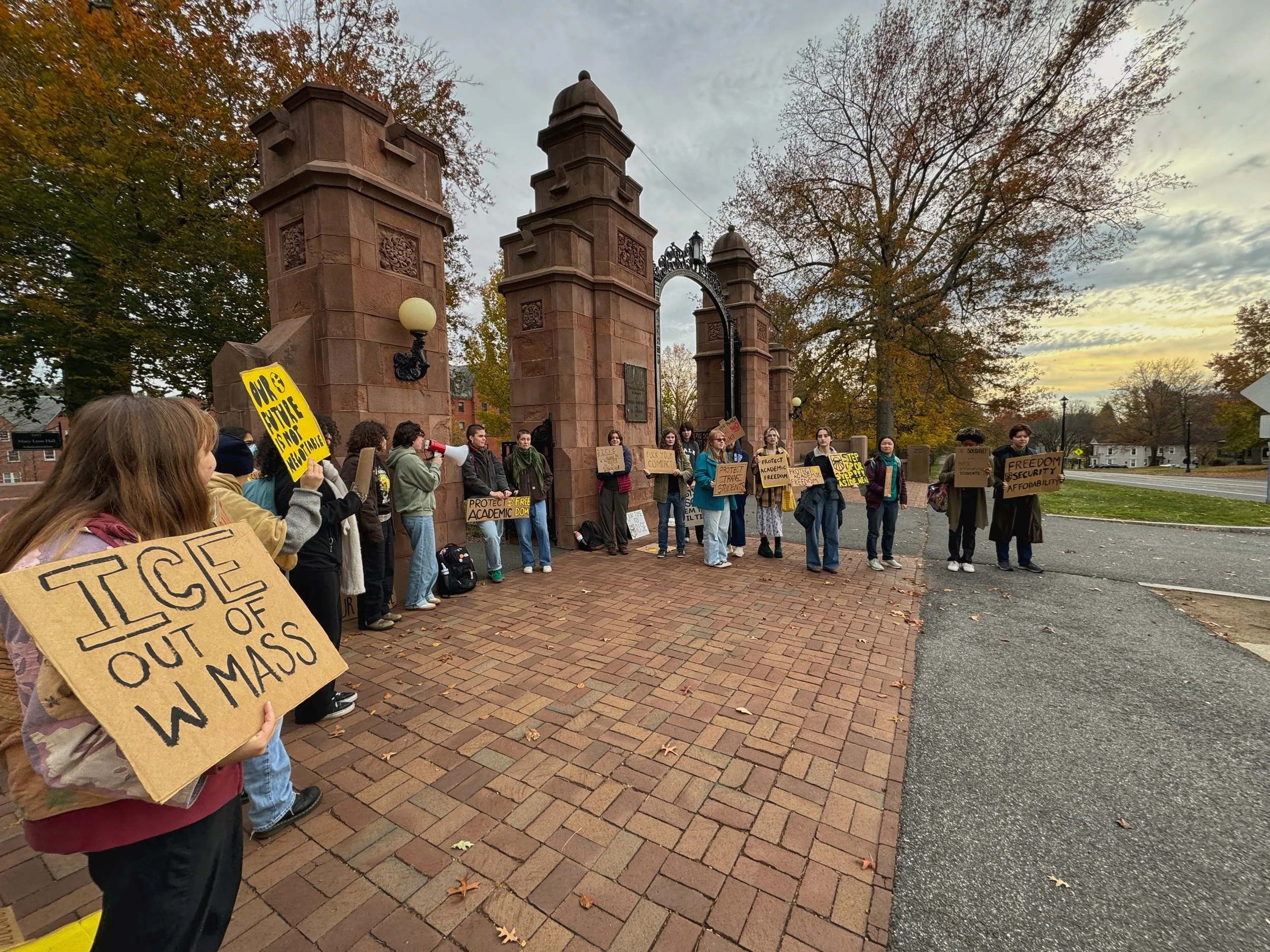
Sunrise MHC organized a walkout in front of the College’s gate on Friday, Nov. 7 in protest of President Donald Trump’s proposed Campus Compact.

BY SARAH ANN FIGUEROA ‘28 & ANNA COCCA GOODMAN ‘28

STAFF WRITERS

On an average Friday, Mount Holyoke College’s campus tends to be quiet. There’s the usual cawing of geese and the wind rustling through the trees, students reluctantly shuffling out of their dorms to get a late breakfast, and sometimes a South Hadley resident walking their dog. 

But not on Friday, Nov. 7.

There was a slight chill in the air when just past noon, a small crowd of students stood at the College’s front gate, holding up blindingly yellow signs with slogans like “Melt Ice Not The Planet,” “Step Up For Students Or Step Aside” and “Our Future Is Not Negotiable.” As the size of the group grew, chants of “The people united will never be defeated” and “When democracy is under attack? What do we do? Stand up! Fight back!” rang out alongside honks from passing cars and cheers from the crowd.

The rally at the gates was just one of many student walkouts happening all across the nation on Nov. 7. Organized by a new youth-led group known as Students Rise Up — also called Project Rise Up – students and workers at over 100 universities walked out to protest President Donald Trump’s Compact for Academic Excellence in Higher Education. The campaign is built on three pillars: Freedom for students to engage in activism, security for all students — especially international and transgender students — and affordability of higher education.

One of the primary sponsors of Students Rise Up is the Sunrise Movement, a climate activist organization. Members of Sunrise were encouraged to join the day of action, with each chapter — referred to as “hubs” — organizing their own walkout to participate. The hub at Mount Holyoke College also participated.

Students walked out of classes on Nov. 7 in protest of a policy proposal rolled out by the Trump administration known as the Compact for Academic Excellence in Higher Education, also referred to as the “Campus Compact.” The Compact was originally sent to a handful of universities on Oct. 1,, and later extended to every institution of higher education in the United States. The contents of this proposal, which demands universities “limit international undergraduate enrollment to 15 percent of the student body,” and “define and interpret ‘male,’ ‘female,’ ‘woman’ and ‘man’ according to reproductive function and biological processes,” as explained by Katherine Knott of Inside Higher Ed, is in direct conflict with the pillars of Students Rise Up.

Though the consequences of a university rejecting the Campus Compact are vague, the wording makes it clear that the rejecting university is at risk of losing access to federal funding. Even a private college like Mount Holyoke could be affected by this, as most schools, regardless of whether or not they are administered by the government, receive some amount of federal funding.

With the extreme stipulations of the College Compact and their potential to greatly affect education across the United States looming large, the Students Rise Up walkout on Nov. 7 commenced that afternoon. The  participating students at some universities urged their administrations to explicitly reject the College Compact and promise to protect their students.  Students at the University of Massachusetts Amherst did exactly this, orchestrating a march that culminated in a meeting with Chancellor Javier Reyes.

At Mount Holyoke College, Sunrise organized a group to gather by the gates at 12:30 PM. For an hour of fervent chanting and passionate cheering, participating students at the College united over a shared love of education and belief in the freedom of it.

Speeches were given by the board members of Sunrise MHC throughout the event. Hub Coordinator and Chair Keira Gillin ’26 spoke first, stating, “We'd like to see our administration continue to stand with students in a strong stance against the Trump administration, and what they've been doing to attack academic institutions across the country.”

Stepping away from the action for an interview on why they showed up to the rally, Secretary of Sunrise MHC Yan Hernandez ’28 told Mount Holyoke News they were protesting “because my parents are immigrants and nearly all of my family in the United States had to fight to come here. And so being here today really means standing up for not only myself but for my family and for so many other children of immigrants and for other immigrants as well.” With over 20% of its student body composed of international students, Mount Holyoke College would be devastated if the terms of the College Compact were accepted.

When asked if they thought the walkout would make a change, student Addie Schlegelmilch ’28 said, “I think that on its own this probably won't, but as a whole there's a lot of different schools walking out. I know that Smith and UMass are both walking out today, and I'm sure there's others across the country. So I think the fact that it's so spread out and there's so many is more important than just focusing on the one.” 

This walkout marks the beginning of many more demonstrations to come. Students Rise Up aims to coordinate an act of “mass non-cooperation” in May 2026 to push back against what Professor Mary Renda of the College’s history department has called “an authoritarian takeover” from Trump. Renda stated that she showed up to the walkout that day because “we need organizing everywhere we can have it, [and] students are a huge part of that.”

“The Compact is a next step to try to take down a major institution that is central to democracy,” Renda said in an interview with Mount Holyoke News. “When institutions like universities and colleges go along with this authoritarian takeover under whatever excuse that comes, that is how fascism gets established … Every time we can stand up together and say no to that, it's essential.”

The rally concluded at 1:30 p.m., with most of the participating students returning to their Friday afternoons. A few, however, kept the momentum going even after the event formally wrapped up, heading over to the Stone Shelter outside of the Williston Memorial Library and hopping on the 38 Pioneer Valley Transit Authority bus. These Mount Holyoke College students, along with students from Smith College also partaking in the walkout, joined the action over at UMass Amherst to support their march. 

Over 200 strong, the Sunrise Movement hubs of the Pioneer Valley sought to prove that students have the energy to make a change together. Their movement, according to an informational slideshow by Sunrise MHC, is “on a mission to put everyday people back in charge and build a world that works for all of us, now and for generations to come.”

Angelina Godinez ’28 contributed fact checking. 

History, heritage and Broadway: Justice Jackson at Public Forum

By Liliana Stinson ’27 & Quill Nishi-Leonard ’27

Staff Writer | Editor-in-Chief

One of Justice Ketanji Onyika Brown Jackson’s earliest memories is sitting at the kitchen table alongside her father, coloring as he studied law. Her relationship with her parents — her father, who inspired her by pursuing a career in law and her mother, who taught her she could “do or be anything [she] wanted” — was just one of the many subjects she and Mount Holyoke College President, Danielle Holley discussed on Oct. 27 at the Springfield Public Forum.

Just a few hours earlier, at approximately 4:30 p.m., two buses full of Mount Holyoke College students departed campus for the event. Due to the limited number of tickets available, the College had held a raffle earlier in the month for those interested in attending. Students who received a seat were informed via email on Tuesday, Oct. 14.

Students were seated at about 5:30 p.m. and around 30 minutes after, SGA President Nathania Amadi ’26 formally opened the event by providing an introduction for Jackson. Before Jackson had the opportunity to speak, she received a standing ovation; many attendees stood and cheered as she took the stage.

Jackson began by reading an excerpt from her new memoir, “Lovely One.”As she would later explain, the title is a translation of her name, Ketanji Onyika. “My parents gave me an African name because they always wanted me to know where my people came from,” Jackson stated.

She was born in 1970 — a few years after the passage of the 1964 Civil Rights Act and 1965 Voting Rights Act — and remarked that there was “so much enthusiasm among African Americans” because “people like my parents who grew up under a system of oppression, under a system that did not give them the opportunity to fully participate in society” had seen the end of Jim Crow-era segregation laws.

African pride has been a driving force for Jackson throughout her life. From a young age, she aspired to be the first Black woman Justice in the U.S. Supreme Court. One of her biggest inspirations as a child was Judge Constance Baker Motley, the first Black woman to become a federal judge: “I learned about her in middle school, flipping through one of the … magazines that my parents allowed us to have, [like] EBONY or JET … and I just thought, ‘Here’s this woman, who’s not just a lawyer, she’s a judge. I could be a judge.’ And that encouraged me.”

Jackson was also “struck” by the realization that she shares a birthday with Motley; the two were born exactly 49 years apart.

Jackson later cultivated the skills she would use as a lawyer and judge through her public school’s debate team. From 9th-12th grade, she participated in original oratory, where participants write and memorize a speech, performing it several times throughout a school year. Her team travelled to Harvard University three times for debate tournaments, and as a high school senior, she decided to apply there.

In her admission essay, she wrote that she hoped to become the first Black woman justice in the Supreme Court to have performed on Broadway.

In an email interview with Mount Holyoke News, Holley noted that she found Jackson’s drive extremely impressive: “I was struck by Justice Jackson’s singularity of vision. In one of her junior high yearbooks, she said she wanted to be a federal judge. Check! She wrote in her application to Harvard that she wanted to be the first Black woman Supreme Court justice … Check!”

Jackson ultimately received both her bachelor’s degree and juris doctor from Harvard with honors.

Jackson’s skills in communication and performance were put to the test during the confirmation hearing for her Supreme Court appointment. Before a Supreme Court nominee can officially become a justice, they must first undergo a confirmation hearing and obtain the approval of at least 51 members of the Senate. Typically, a nominee has about six weeks to prepare for the hearing. Jackson only had around three. During those few weeks, aides spent “a great deal of time … preparing [her] for the hearing” by conducting what Jackson called “murder boards.”

During the murder boards, aides would pretend to be members of the Senate to simulate a real confirmation hearing. Jackson recalled that once, when she began to get frustrated, an aide stopped the session and reminded her, “You can either get angry, or you can be a Supreme Court Justice.” After that, Jackson was motivated to remain collected, and used her communication skills to stay calm under questioning.

In the weeks before her confirmation hearing she also met with 24 senators, which she described as having been “the absolute best thing I could do.” In private, the senators she met were “lovely” and “terrific,” but during the public confirmation hearing, “they [were] not.” Jackson realized the hearing was a performance — much like the events her high school debate team had participated in — and used her expertise to successfully navigate it, thus securing her appointment in the process.

Jackson’s confirmation hearing took place over the course of four days. She described the second day as having been a “very very stressful, long session” that lasted around ten hours. Near its conclusion, Senator Cory Booker chose to give a speech instead of asking questions, giving Jackson time to rest.

Booker spoke about his pride in her success and their shared heritage: “It's hard for me not to look at you and not see my mom, not to see my cousins … I see my ancestors and yours … Nobody is gonna steal that joy. You have earned this spot. You are worthy.”

Jackson was moved to tears by Booker’s words. “It was extraordinary,” she said.

Booker wasn’t the only one to uplift Jackson during the confirmation process. She described the support she received from family and friends as also having been a key component of her successful appointment. Her partnership with her husband and his support has been “everything,” Jackson said. “I certainly could not do what I do now without my husband, who has taken care of everything and given me the opportunity to do the work I do.”

Jackson’s friends have also aided her throughout her life and career. “I had the very good fortune of meeting other Black women in a class my freshman year, a Black woman’s literature class, and we supported one another … Four of us became very close, and all four of us got into Harvard law school … We have just been, you know, sisters,” she stated. “We have done life together, and it was amazing to have their help.”

After she had received her nomination to the Supreme Court, Jackson explained, they had organized to do interviews with media outlets in support of her appointment: “They literally, basically set up a war room of their own, and were doing a media campaign on my behalf.”

As an associate justice of the Supreme Court, Jackson has become known for her intricately crafted dissents. During the 2024-25 term, Jackson delivered 25 opinions, 10 of which were in dissent: more than any other single justice. “Dissent is one of the most extraordinary aspects of American legal tradition,” Jackson said. “It embodies something that we value here, in this country, which is freedom of expression.”

Jackson further explained that when she authors a dissent, she writes for both the public and for history. “What tends to happen for me is that I either get assigned a dissent or I think … I have a particular interest or perspective on the issue in this case that I think is important,” she said.

“Justice [Ruth Bader] Ginsburg used to say that when you write a dissent, you are writing for history, not just for the present,” Jackson elaborated. “I also have to write for the present to a certain degree. Writing not just for your colleagues and the parties … but you’re writing for the public, so the people understand what is going on at the Court.”

“Judges are public servants … we have a responsibility to communicate,” she concluded.

Holley echoed this point while speaking to Mount Holyoke News, “Justice Jackson sees herself as writing for history, but just as importantly she’s writing on behalf of American jurisprudence, and on behalf of the people in the present moment whose lives are directly affected by Court decisions.”

However, Jackson is much more than just a dissenter, Holley noted. As the first Black woman justice on the Court, she provides an extremely valuable perspective: “Something Justice Jackson captured so beautifully in her book and spoke eloquently about … was why diversity matters in an institution such as the Supreme Court. In addition to inspiring people of all backgrounds to dream big, a diverse judiciary is able to evaluate a question from the perspectives of different backgrounds and viewpoints.”

Holley continued, “[Jackson] spoke about the justice for whom she clerked, Justice [Stephen] Breyer, who believed pragmatism must play a role in rulings. In other words, context matters. And if that is true, then it is critical that different contexts be considered when making a ruling, which is only possible if the Court is made up of people from different circumstances.”

Jackson’s historic role is also personally important to Holley, a Black woman who has shattered many glass ceilings herself. “Justice Jackson is a true trailblazer, so it was an honor to be able to talk to her about her life and career. We also have a lot in common: our Southern roots, high school speech and debate, a love of the history of the civil rights movement. It was a special night — one I won’t forget any time soon.”

As the event began to come to a close, Jackson and Holley discussed Jackson’s hobbies and interests outside of the law. Since becoming a Supreme Court justice, Jackson has continued to read and write in her free time, scarce as it may be. Currently, Jackson is reading “Quiet: The Power of Introverts in a World That Can't Stop Talking” by Susan Cain. As an introvert who “draws energy from withdrawing,” she finds the book empowering. Now that she’s finished her memoir, “Lovely One,” she also has plans to begin writing children’s literature.

Moreover, Jackson recently fulfilled her dream of appearing on Broadway. Last year, the producers of “And Juliet” read about her goal in her memoir and offered her an ensemble role. “I got to sing … It was a one-night only performance, but I loved it,” Jackson said.

One of Jackon’s favorite aspects of being a Supreme Court justice has been “bringing young people to court … seeing their faces and excitement.” She hopes her success will inspire more young people to pursue careers in law and politics. “I try to encourage them,” Jackson stated. “I hope for them to want to go into law, and to want to make our country better.”

When asked by Holley if she had any advice for students interested in law, Jackson responded, “First I congratulate them … We need you.” She explained that while some think success can only come from innate talent, true progress is made through hard work: “Anything worth doing takes effort. Sometimes, young people mistake talent for effort … When it's hard, when it's difficult … Take pride in [your] ability.”

“You have to keep going,” Jackson said.

Holley hopes if the community takes anything away from the event, it is that advice. “[Justice Jackson] enjoined the young people in the audience…to work hard, to put in the sweat equity. That’s how one turns a seemingly audacious goal into reality.”

Elizabeth Murray ’26 assisted with coverage and contributed fact-checking.