
By Honora Quinn ’27
Staff Writer
Many of us living in Western Massachusetts have at one time or another ventured into the pits of Boston and had the (mis)fortune of traversing the city via the Red Line of the MBTA. Missing the train is a rite of passage, perhaps a universal annoyance. So, for author John Chu — who left the city to visit us in South Hadley for a chat about his debut novel, “The Subtle Art of Folding Space” — it felt like the perfect place to begin his protagonist Ellie’s tale.
Revolving around the complex and mult-generational family dynamics of the main character, Ellie, this science fiction novel has been described by Booklist as “a mystery wrapped in quantum physics and family trauma,” and Library Journal calls it the “intersection between the multiverse, family dysfunction and dim sum.”
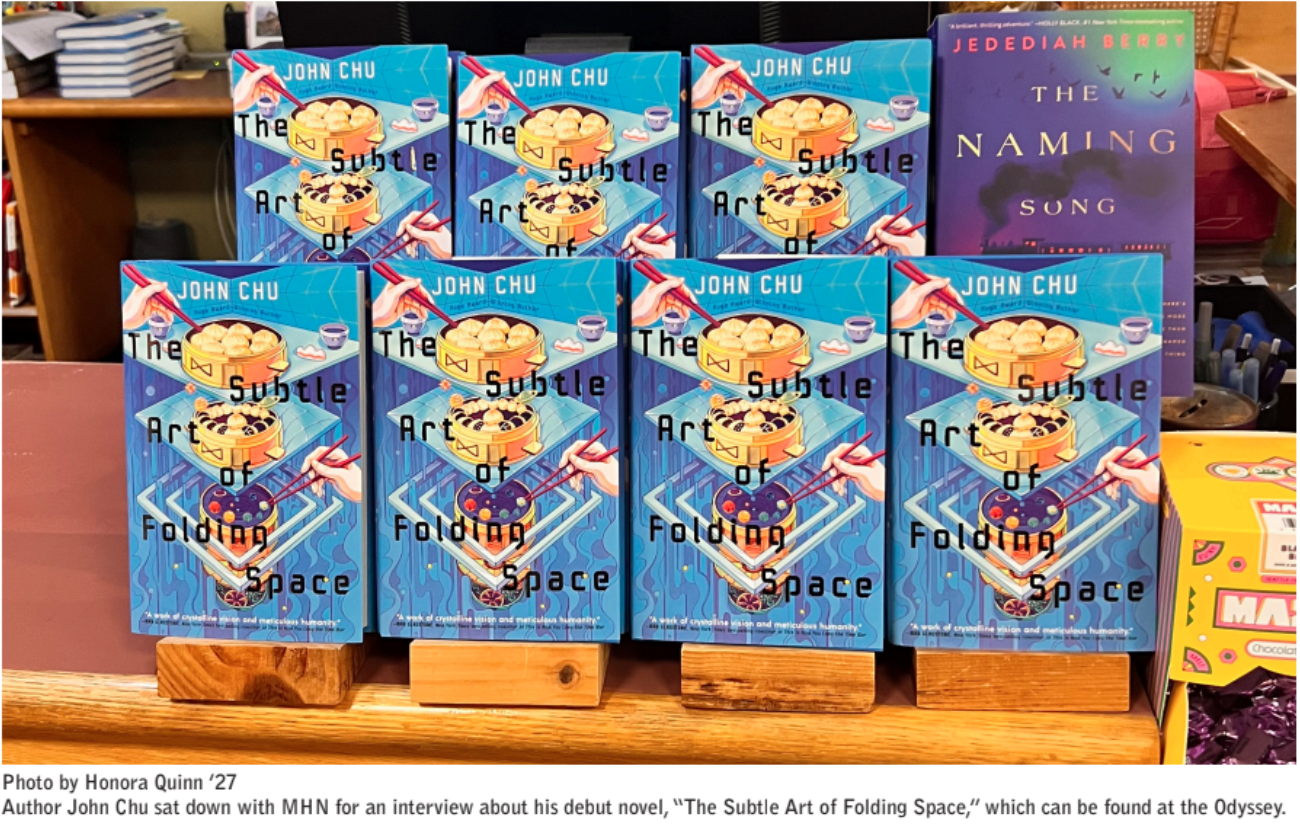
On April 8, 2026, just a day after the book hit the shelves, Chu came to the Odyssey Bookshop. He was joined in conversation by fellow author Jedidiah Berry, author of “The Naming Song,” to dive into his debut novel, exploring both its origins as a work of short fiction and the real life family inspirations that bled their way into the fantastical world. Before the doors of the event even opened, Mount Holyoke News was able to sit down with Chu to ask some questions of our own.
The following interview has been edited for clarity.
Q: What are three words you would use to describe this book?
A: The [first] word that sort of comes to mind is “physics.” Because this is a book about people who maintain the physics of the universe and then what happens when physics goes wrong. The second word, I think, is probably “family.” Ultimately, the story is about the relationships between the characters. Ellie, my main character, has to deal with her sister Chris, and how that relationship evolves is very much at the center of this novel. In addition, this is a novel that is based in part on my experience and actually my entire family's experience with my mother's illness and the choices that we had to make … My third word has to be “fun.” [The book] is about this family drama, but it's also sort of this very quick-paced, very zippy, very weird, fun ride.
Q: What were the seeds of inspiration for this book?
A: Well, I wrote a novel mostly to see if I could write a novel. But there were a couple of [inspirations]. This novel is an outgrowth of a short story that I wrote called “Hold-time Violations,” and the initial seed of that was basically I kept missing the train at Alewife, which is actually the thing that happens to my main character Ellie in chapter 1. So part of it was reading about the international prototype kilogram… but that led to the sort of the science fiction-y question of, well, what if our fundamental constants were not constant for some reason? What is a science fiction-y reason why that might be the case?… and like I said, finally, a lot of the heart of the novel is based very much on my experiences dealing with my mom's death. I should point out this is all fictionalized — you're not going to be able to read about my mom's death in this book. But those experiences very much informed the writing of it.
Q: You’re being interviewed for a college newspaper, so what advice do you have for college writers that would like to write like you do?
A: My advice always sounds really depressing, and I do not mean it this way … you have to enjoy the process. You have to enjoy what you're doing. You have to enjoy improving as a writer and you have to like parts of writing which can to some people be really tedious, and you have to find some way of enjoying that and wanting to do that over and over again… Your reward is that you write better today than you did yesterday … I find myself extremely lucky in that I have a publishing track record at all, and just mind-blowingly lucky that I have a published novel. But, that's not something you should expect or count on. And to the extent that I've gotten there, it's because I enjoy the process of writing.
Whitney White ’28 contributed fact-checking.