
By Sarah Grinnell ’26
Books Editor
Associate Professor of English Professor Andrea Lawlor began the Contestants’ Reading of the 103rd Glascock Intercollegiate Poetry Competition by urging the audience to “watch these poets” well beyond the conclusion of the contest. And if the work the six students read is any indication of the bright poetic careers they have ahead of them, Lawlor’s statement was indeed a well-placed one.
The Glascock Competition is an annually occurring event in which Mount Holyoke College hosts three poet judges to review the work of six students: One from Mount Holyoke and five others from various institutions across the country. The competition has a long and illustrious history, with the contestants of its 103rd iteration joining the impressive company of Sylvia Plath, Mary Jo Salter and James Agee, among other past contestants. This year’s contest was judged by the powerhouse panel of Miller Oberman, Dianelly Antigua and George Abraham, who follow in the stead of past judges like Robert Frost, Audre Lorde and W.H. Auden.
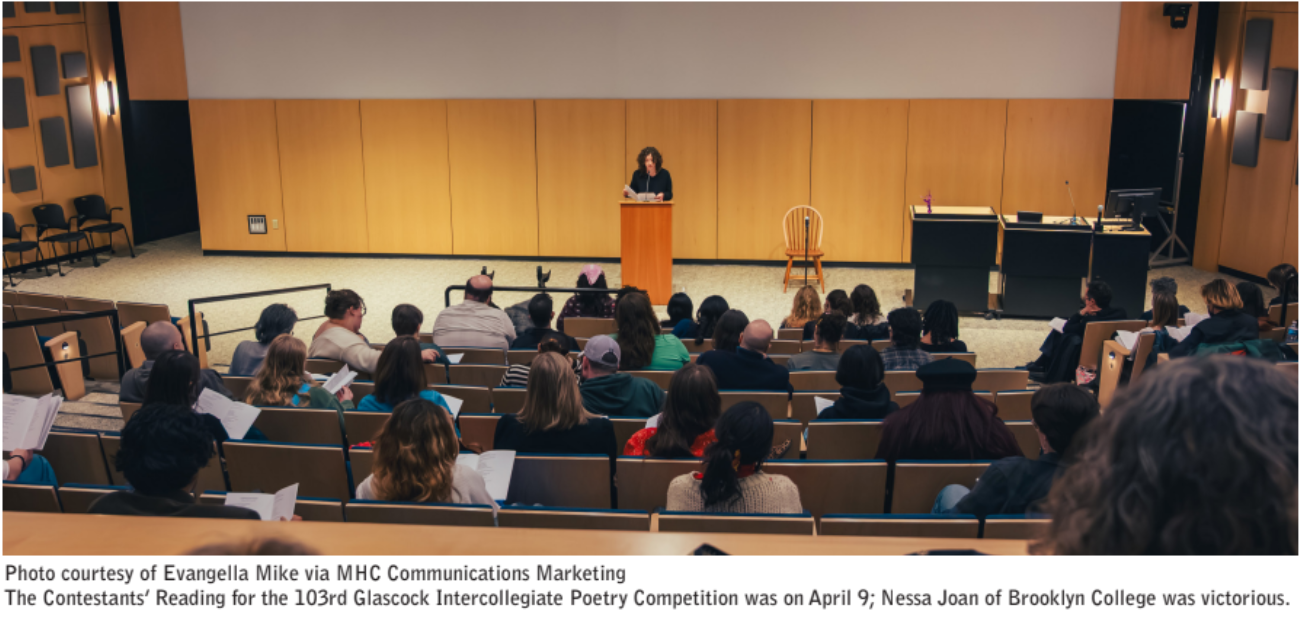
The Contestants’ Reading, held on April 9 in Gamble Auditorium, began with opening words from the Chair of the Glascock Committee, Associate Professor of English Andrea Lawlor, before the students took to the podium.
First up was Nessa Joan of Brooklyn College. According to the poet’s personal statement, they “[use] NYC’s grittiness, gutting imagery, syringe-deep tone and hazy allusions to weave a basket of surreal and visceral experience of works.” Innovatively playing with dialect and language in poems like “GUNABIA, JUANA BE,” Antigua praised Joan’s particular “talent for rhythm and sound” at the Judges’ Reading the following day.
Kiara Korten, from the University of Connecticut, delivered a very calm, commanding reading of poems that explored themes of place and memory. Oberman singled out her use of line breaks “in surprising ways,” and Antigua heralded her work as being “as grounding as it is imaginative,” with “a sensory richness that is striking and also very tender.” “I’ll never look at a lizard the same way,” she joked, alluding to Korten’s poem “Off Biscayne Bay.”
Next was Tess Nelson of Bard Microcollege Holyoke, who read an incredibly endearing set of poems that painted intimate snapshots of everyday life. Nelson earned many chuckles from the audience for wry titles like “Dick, I Really Miss You” and “Ode to That Morning on the PVTA.” The judges were impressed by her ability to “[linger] in the core, essential simplicity of living,” as well as the strength of their voice; as Abraham expressed, “I always want to tell young poets that when you have a clarity of voice, that matters more than anything else,” and Nelson is a poet that Abraham “knows they know who they are.”
Following Nelson was Mount Holyoke’s own Amelia Potter ’26. Potter’s concentration in public history and archival studies was on skilled display in her poems that wove together history and time, with her personal statement expressing her belief that poetry can be used as a way “to question and attend to the past and to find a redressive orientation toward the future.” Each of her poems were precise in their historical quotations, yet far-reaching in thematic scope; at once timeless and strikingly relevant. The judges expressed being “taken by [her] sense of historicity” and ability to hold “beauty and devastation” simultaneously.
In a text interview with Mount Holyoke News, Potter reflected on her experience by saying that “seeing all the unique, experimentative styles of the other student poets has definitely given me new perspectives on writing. They were playing so compellingly with form, and silence, and illegible sound in ways that I really envy/admire!”
Potter shared that one of the major insights she received from the judges and contestants was that “if poetry has any political use, it’s in functioning as a rehearsal for future action” — which the content of her own poems certainly displayed.
Reem Thakur of Tufts University then read a selection of poems drawing from South Asian culture and poetic forms, such as the “THE CHUDAIL’S SESTINA,” in which she identified herself with the mythical, witch-like creature of the same name. Abraham called the sestina “a feat,” even saying that it will be the poem they will most remember from the competition. Although Thakur read just two poems, both were expansive in length and vision, exploring race and identity on the level of embodiment as well as language.
Last to read was María Vielma-Baxter from Hampshire College, who shared the “Playlist Poems” from her collage poetry thesis. The pieces were a mix of more traditionally structured poems, as well as unique formal experimentations in “Metamorphosis,” which utilized blanked-out elements to give the poem a gaspy cadence when read aloud. “Metamorphosis” was particularly praised by the judges for its “inventiveness” and use of visuality and sound.
The next day, students and community members had the opportunity to hear the judges read their own work on Friday, April 10 in the Stimson Room. Each judge was very movingly introduced by student members of the Glascock committee.
First to read was Oberman, a self-described “trans Jewish anti-Zionist” and the author of two poetry collections, “Impossible Things” and “The Unstill Ones.” Oberman read a number of poems from “Impossible Things,” such as “The Wind is Loud,” that explore fatherhood and the haunting presence of his dead brother. He also writes extensively about his subjectivity as a trans man, in poems like “The Centaur,” which play with pronouns and hybridity.
Following Abraham was Diannely Antigua, a Dominican American poet, Massachusetts native and the Thirteenth Poet Laureate of Portsmouth from 2022-2024. The author of two poetry collections, “Ugly Music” and “Good Monster,” much of Antigua’s work draws from experiences with mental illness, such as in “The Moon is on Wellbutrin.” The title “Good Monster” derives from a therapeutic strategy called “internal family systems,” and according to Antigua, this process involved naming her own “monster” as her “depression, anxiety, and boundless need.” Antigua envisioned the collection as a “love letter” to this monster.
Last to read was George Abraham. A Palestinian American poet and current writer-in-residence at Amherst College, Abraham has worked with a number of Mount Holyoke students in their classes and joked that they want “more Mount Holyoke students at Amherst, please for the love of god!”
They began by reading the words of “Palestinians who aren’t in the room with us” in the form of Maya Abu Al-Hayyat’s “Autobiography of Fear.” Through their own politically-driven work, they expressed to the audience that one of the things poetry is most useful for is as “a vessel for confronting fear within oneself.”
Once the judges concluded their readings, the winner of the contest was finally announced. While Oberman made a point to note that it “felt silly and hard to choose a winner” — and the Contestants’ Reading made clear what a tall order such a decision was — Nessa Joan was ultimately crowned as the victor, looking visibly stunned by the result.
Antigua assured them that they are “really doing something special” with their work, though it is an understatement to say that the future of poetry is in very capable hands with each and every one of the participating student poets.
Whitney White ’28 contributed fact-checking.