
By Isabelle Peterson ’28
Staff Writer
In the words of the Nobel Prize-winning Russian language poet, Anna Akhmatova, “Wild honey smells like freedom.” As Mount Holyoke College’s German and Russian programs pooled resources to host a final poetry night, these words, potentially the inspiration behind the biannual celebration’s name, felt particularly relevant.
Wild Honey has its roots in the conservative, recitation-heavy teaching methods favored by the political exiles who helped shape Russian language pedagogy in the U.S. However, this year, participants emphasized it as a gesture of humanistic defiance in a world that seems to place increasing emphasis on more lucrative, STEM-adjacent programs, if it places any emphasis on education at all.
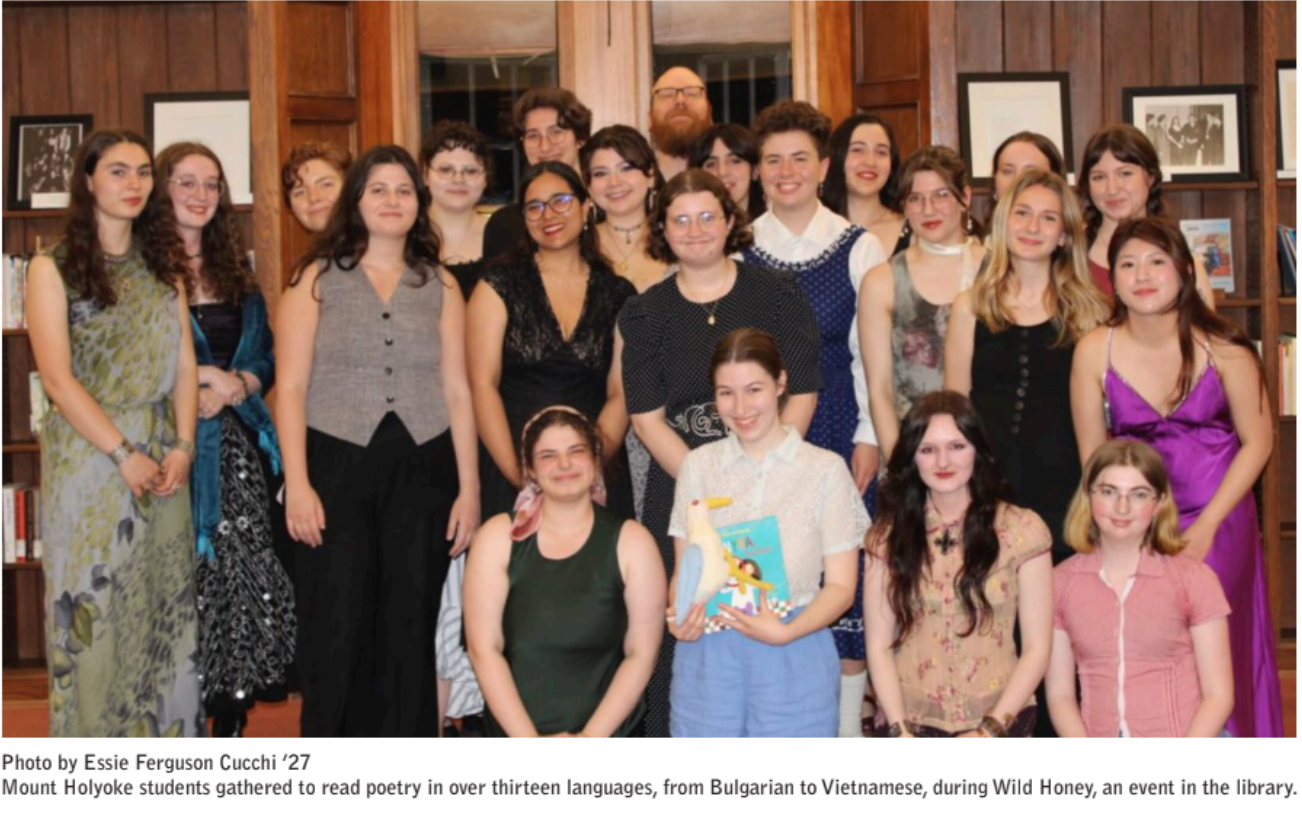
The event, located in Williston Memorial Library’s Stimson Room, was well attended, with a record number of over twenty readers reciting poems in thirteen languages: Bulgarian, Finnish, French, Georgian, German, Hungarian, Italian, Japanese, Polish, Russian, Serbian, Spanish and Vietnamese. Presenters came from a variety of different language backgrounds. Some were native speakers eager to share their language with a broader audience, some were beginners looking for an opportunity to improve their pronunciation, while others were advanced students excited to share how far they had come. Side-by-side translations were provided in the program, and a multitude of subjects were covered, ranging from tyrants to snails to the moon.
In the wake of Russia’s ongoing war on Ukraine, which began Jan. 24, 2022, and Mount Holyoke College’s decision to cut its Russian and German language departments, the event expanded in size. It first grew to accommodate other Slavic languages, such as Georgian and Polish, and finally, as of this semester, all non-English languages.
Professor Daniel Brooks of the Eastern European and Eurasian Studies Department describes it as shifting “from kind of a cursory fun event at the end of the semester to something which occurs twice a semester, pulls in a lot more people, redirects funds towards meaningful causes and involves a wider swath of the campus.” The event, which has been raising money for various Ukrainian aid organizations since 2023, is estimated to have generated around $1,500 through donations.
When interviewed about the significance of multi-lingual events such as Wild Honey, Giselle Spalding ’28, a German student, stated, “It’s really important to me that we continue to show up for languages, because they’ve really been dismissed and kind of put to the side … I think it’s a really beautiful way of just showing a part of humanity that doesn't get appreciated enough.”
The need for supportive spaces where poetry is appreciated and shared came up again when I interviewed Tobias Hawe ’28, a student reading at Wild Honey for the first time. “A lot of us have a very self-directed perfectionism, where all the grace that we need to give back to ourselves is directed at other people, and not ourselves. We’re so kind to each other, which really helps at events like this.”
Meanwhile, Sasha Shishov ’26, the president of the Eastern European and Eurasian Club, stressed how imperative it is that we continue to work towards making Mount Holyoke a more globally-oriented place. Shishov said, “Having an event that can be cross-cultural [and] cross-linguistic is really, really important, now more than ever given the fact that one of the most fascist tools of oppression is limiting our global reach and connection to outside communities … by suppressing language acquisition.”
As language departments at Mount Holyoke College continue to face closures, budget cuts and staff reductions, it is more important than ever to showcase that we, as a student body, remain deeply invested in celebrating languages and language acquisition. Despite the College’s decision to dissolve the departments behind Wild Honey, their profound impact on our campus community is something that cannot be erased.
Whitney White ’28 contributed fact-checking.