
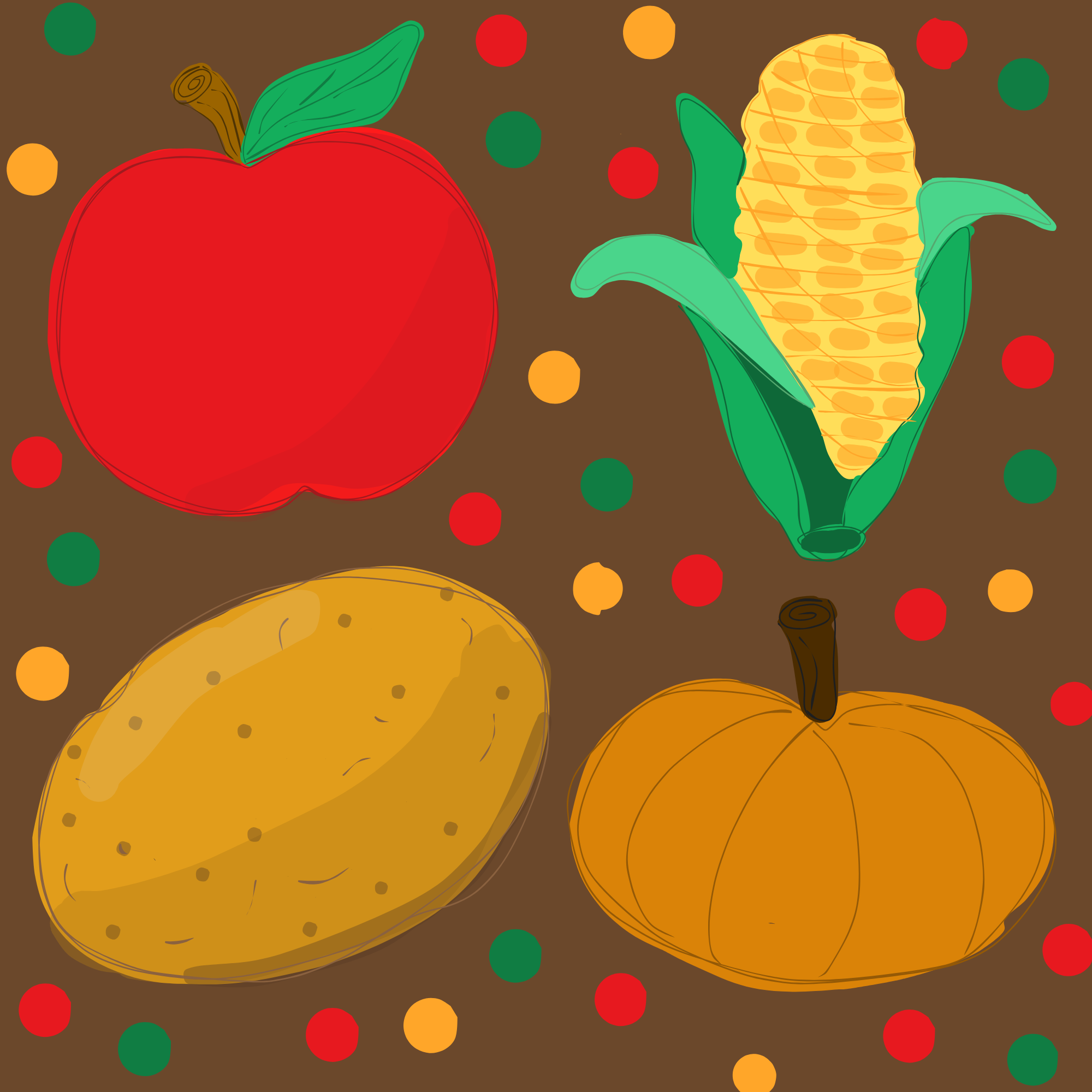
Graphic by Brianna Stockwell ’28
By Sam McKay ’29
Science & Environment Editor
What is seasonal eating? Seasonal eating is the practice of choosing to eat crops — preferably local — that are in season. Depending on where you live, this can be very difficult, particularly in New England where winters make growing any food challenging. It is also hard to practice seasonal eating while living on campus and relying on the College for meals. However, next time you go to the store, keep in mind the seasonality of different crops. If you don’t know, there are many helpful lists and charts online; in New England right now, apples, corn, potatoes and pumpkins are in peak season!
Seasonal eating goes hand and hand with buying locally, since local farms mainly grow in-season crops instead of out-of-season crops that take a lot more money and maintenance. As well as supporting your neighbors, buying from local farmers helps the environment, especially when we encourage in-season foods. Although the College can’t buy only from local businesses, we do get a large percentage of our food from New England farms. As of 2020, 20% of the College’s food purchases are sustainable. While this may not seem like a lot, it is a significant amount for an institution to put towards sustainable eating.
Who benefits from seasonal eating, you might ask? Everybody! Local farmers get more support, reliance on Big Agriculture decreases, and your stomach is happier! Eating fresh, locally grown produce is much better for you; it’s full of nutrients that most industrially grown crops don’t have enough of, and often has a much richer flavor. Even your wallet benefits because it’s typically more affordable to eat locally in season. Local crops are accessible at farmers markets and local grocery stores, and since the produce isn’t shipped as far — and doesn’t have to be stored — the cost is lower.
In South Hadley, we have very acidic soil, with a topsoil pH of 4.6 and very fast draining soil, which can cause untreated sewage to leak into groundwater very easily. High soil acidity is often caused by harvesting high-yielding crops and leaching. These issues can be mitigated by composting, using that compost and other organic matter as fertilizer, and implementing proper drainage structures.
While this can help mitigate the issue, preventing acidic soil is much easier: All you have to do is start with these suggestions and rotate your crops seasonally. Soil health is very important for happy crops, so it’s important to rotate crops in order to balance chemicals, pH levels, enhance drainage, and so much more.
Compost, let’s talk about it. Composting can be a closed loop of sustainability. Excess food scraps go in the compost which, after a while, is used as soil in a seasonal garden. The garden then produces healthier, happier crops and the cycle continues. Composting can fix a lot of soil issues and reduce waste. More things can be composted than you might first think, including coffee grounds, hair, non-glossy cardboard, leaves, grass clippings and more. Mount Holyoke College does a shockingly good job composting our massive amounts of food waste. All uneaten food goes to an anaerobic composting complex that turns our waste into power for a farm nearby. While this process is not flawless and some material still gets thrown out, it is a very important aspect of the College’s sustainability program.
Household gardens are a great way to eat seasonally and sustainably. Less than a quarter acre is needed to grow enough fruits, vegetables and even eggs to almost entirely sustain a family of four. Though most families don’t have the money, time or abilities to plant and upkeep a garden larger than a raised-bed garden, if those who can, do, we would be in a much better position. Families could share any excess with the community. Although Mount Holyoke has a garden, it is almost exclusively inedible.
If you’re feeling a bit helpless in the environmental struggles — and even if you aren’t — here’s what you can do: Buy from local farmers, go to farmers markets on the weekends, grow a garden at your house and educate yourself! Keeping ourselves educated keeps us responsible and staying responsible makes a greener future much more likely. We can’t fix problems if we don’t know about them. Learn what fruits and veggies are sustainably grown, native to where you live, and support your neighbors. Stay environmentally conscious, pookies.
Sophie Francis ’28 contributed fact-checking.
