
Graphic by Madeleine Diesl ’28
By Madeleine Diesl ’28
Copy Chief
If you’ve ever been to Mandelle or 1837 halls, you’ve likely crossed over the white pedestrian bridge known among students as “Spider Bridge.” Located atop the waterfall on the southern side of Lower Lake, Spider Bridge gets its name from the dozens of spotted orbweaver spiders — scientific name Neoscona crucifera — that make their webs on its wooden slats.
Though they may seem creepy, spotted orbweavers are harmless. In fact, in addition to being an essential native species, these spiders can actually be beneficial to humans by catching and eating harmful insects such as mosquitoes.
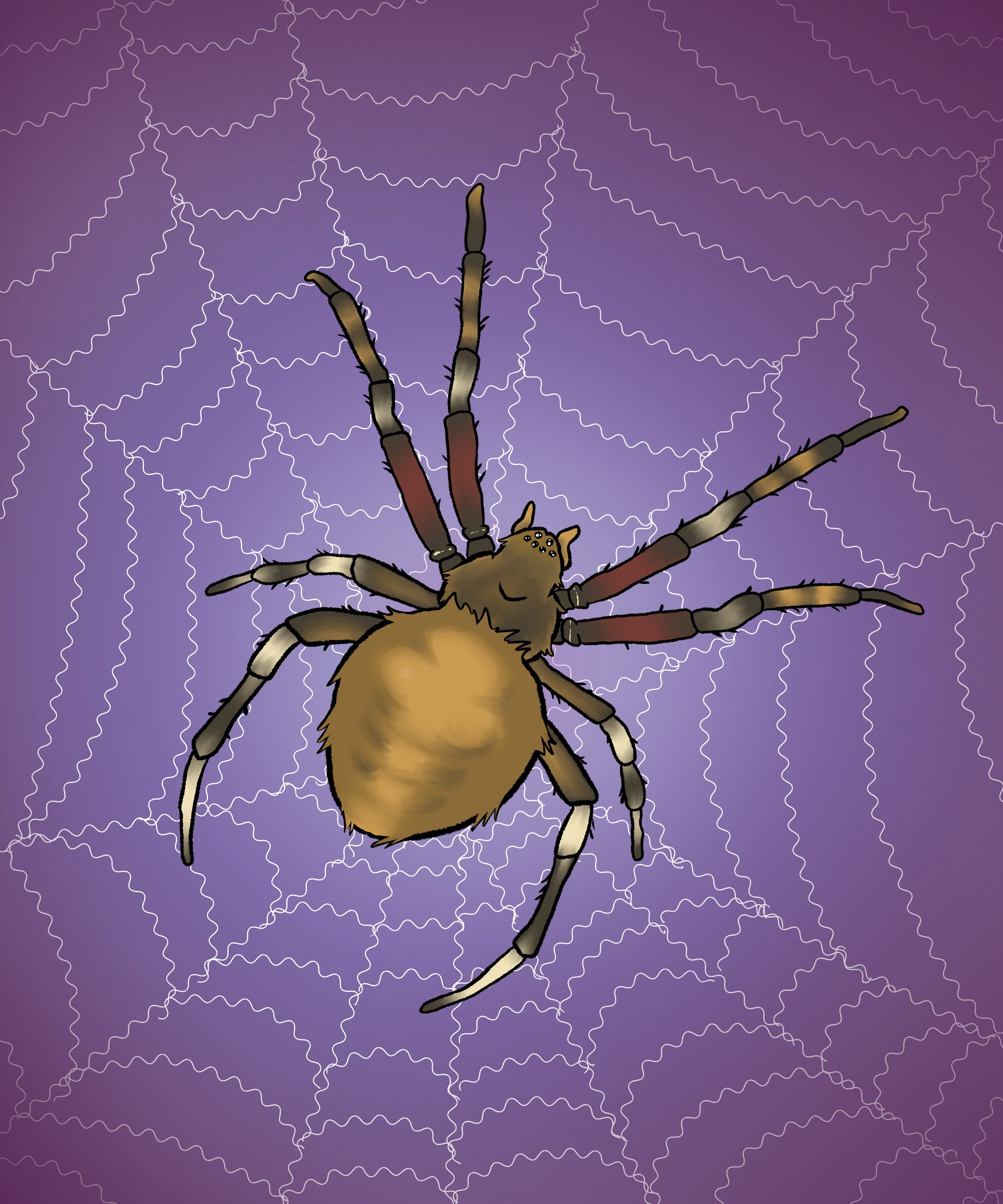
From far away, spotted orbweavers appear orangeish-brown and a little under an inch long. However, anyone brave enough to get a closer look at one of these spiders will notice that they have small brown hairs on their abdomen and legs. Two white spots can be found on the underside of their abdomen, and their legs are striped; these can be useful fieldmarks for someone unsure of what spider they’re looking at.
But why is Spider Bridge such prime real estate for spotted orbweavers? It’s likely a combination of a few things. Firstly, the streetlamps on the bridge attract many flying insects for the spiders to eat, and the stagnant lake below likely has the same effect. Also, spotted orbweavers are known to make their webs on trees or manmade structures with lots of corners, so a bridge is a perfect candidate.
Spotted orbweaver webs are characteristically circular and can span up to two feet across, often appearing similar to the stereotypical spider web depicted in media. One fun fact about spotted orbweaver webs is that the females, which are nocturnal, consume their webs for nutrients in the morning and rebuild them every night. This means that the webs on Spider Bridge at night might look different each time you cross. Plus, most of the spotted orbweavers you will see are female, as the males are smaller and do not build webs. In other words, each night on Spider Bridge is one big, spooky girl dinner in which the girls are spiders, the dinner is bugs and the whole thing gets devoured by morning.
Sophie Francis ’28 contributed fact-checking.
