
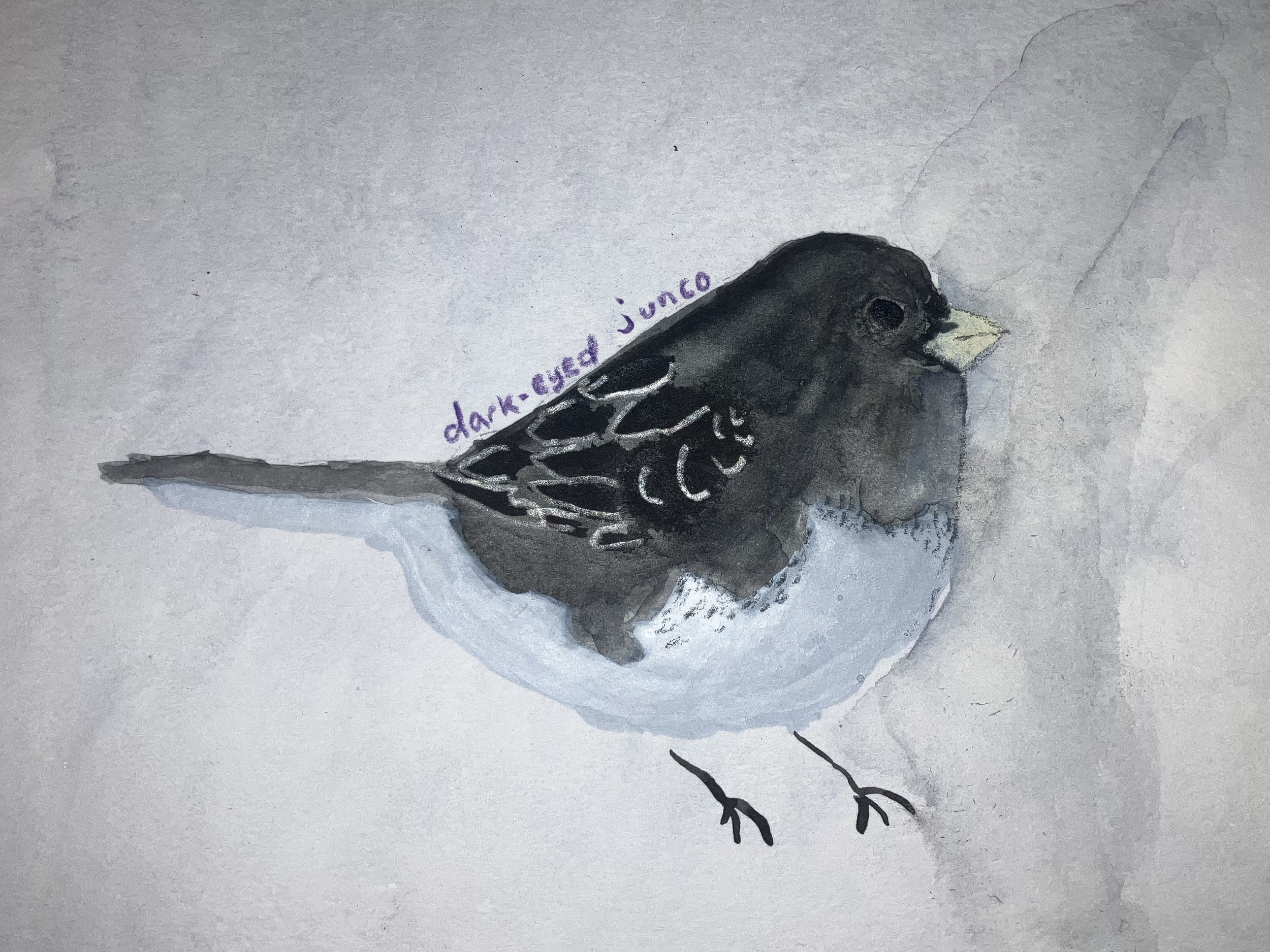
Graphic courtesy pf Gigi Spalding ‘28
By Sam Mckay ‘29
Science & Environment Editor
The dark-eyed junco is a small, round bird that is common across most of North America. There are five subspecies with varying patterns, but the one we see on the East Coast is called the “slate-colored junco,” which is gray on top with a white belly and under-tail. Juncos are classified as new-world sparrows, which you probably wouldn’t guess unless you saw their young, which are brown and streaky like a typical sparrow. Before the 1970s, each subspecies was considered its own species. Thousands of years ago the yellow-eyed junco started migrating north into the U.S. and Canada. In the northernmost parts of North America their eyes slowly turned from a yellow to dark gray, giving them their new title and separating them from their cousin, the yellow-eyed junco.
Juncos are sometimes called the snowbird because they are one of the few birds that come to the mid-latitudes for winter. During the winter, the farther south you go within their range, the more females you’ll see. The males tend to stay farther north, with young males staying even farther north than older males. This may be in part due to the fact that males arrive at breeding grounds before the females, a pattern that is exacerbated by climate change. In Massachusetts, we are north enough that we can technically see them year-round, but they are much more abundant in winter. Once you see dark-eyed juncos, it’s a good sign that winter will be coming soon.
Dark-eyed juncos live in wooded areas, hopping and scratching the ground to forage for seeds and insects. During mating season, pairs build nests on the ground for clutches of three to five eggs. Most of the nest-building work is done by the females, and they will often have one to three broods per year. Even though juncos are very skilled at hiding their nests, they still experience high predation because their nests are so low to the ground.
Dark-eyed junco populations have steadily declined since the early 1980s, though they are not considered threatened since they are still abundant. They have stopped migrating as far south as they used to due to climate change; warmer weather keeps them farther north.
Though we may start seeing them less and less with the warming climate, for now we get to see these little round birds all over on campus grounds. Next time you take a walk around the lakes, keep an eye out for dark gray and white birds hopping around in small groups. The easiest way to spot them is to catch the flash of white from their undertail as they flit to a tree or bush. We know nature has been proven to be very beneficial to mental health, which is especially important during winter in New England. Birdwatching is a good way to reduce stress, depression and anxiety; even a 30-minute walk each week can be effective. Listening to birds has been proven to be even more effective than just going for a walk or sitting outside. The theory is that focusing your senses on bird calls lowers heart rate and soothes your nervous system.
Madeleine Diesl ’28 contributed fact-checking.
