Alia Bloomgarden

BONDHU hosts Nov. 22 Bengali game night at Mount Holyoke

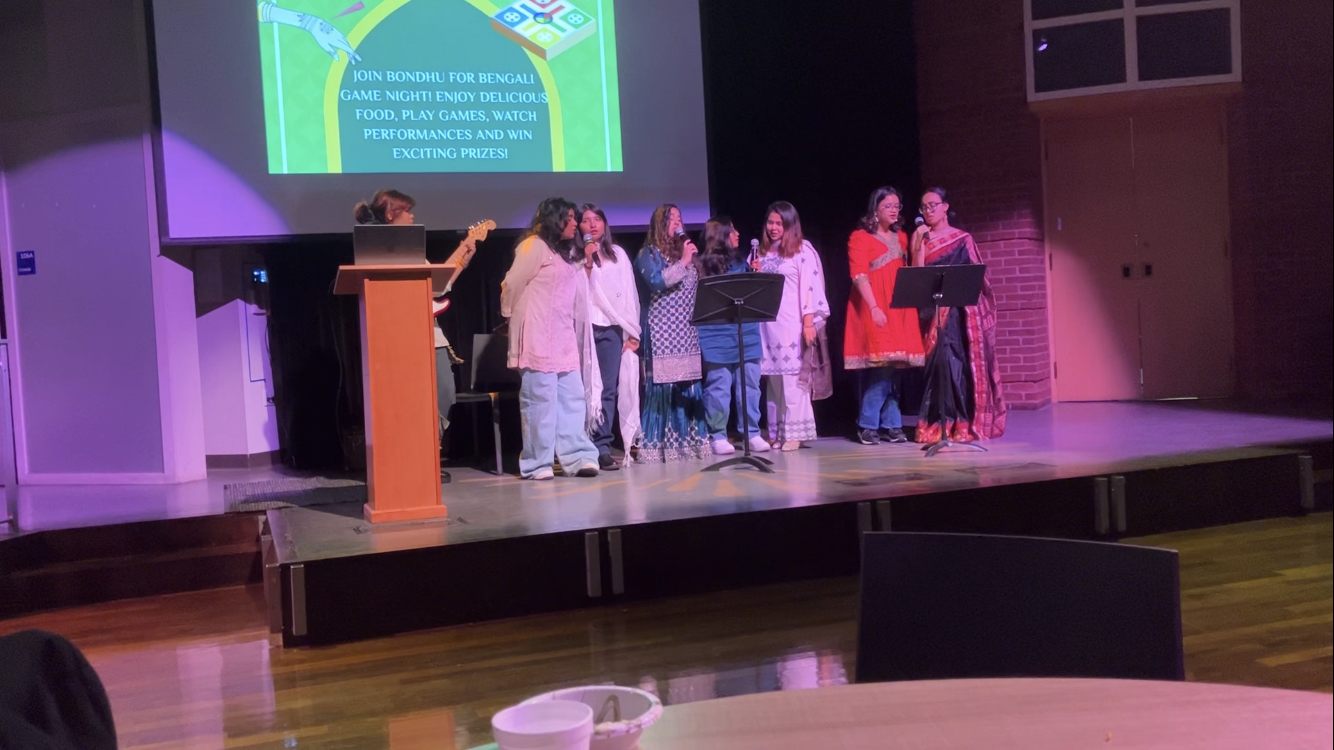
Photo by Alia Bloomgarden ’29

BONDHU hosted a Bengali game night on November 22, 2025; all students were welcome to join.

By Alia Bloomgarden ’29

Staff Writer

On Saturday, Nov. 22, BONDHU, Mount Holyoke College’s Bangladeshi student organization, hosted a Bengali game night. 

On this night, students gathered to play games, eat Indo-Chinese food, listen to Bengali music and watch three singing performances by Bangladeshi students. Shanum Sarkar ’29, a Bangladeshi student, explained in an interview with Mount Holyoke News, “Bengali game night…  is very close to my heart, and — I can speak for all my friends —  to their hearts, too … [board games are] such an important thing to have at every event.” 

Sarkar further reminisced, “I learned how to count because I knew how to play ludo, and I knew I had to beat my dumb brother at ludo, so I knew how to count before he did. The fierce competitiveness, the joys, the screaming at your cousins, the throwing over the entire board because you're losing … Game nights bring out this whole personality of Bengali people that you've never seen before.”

BONDHU ordered the Indo-Chinese food from Priya, an Indian cuisine restaurant. Sarkar stated that “Desi-Chinese [or Indo-Chinese] is a famous thing back at home … It's basically … like Chinese fried rice, dumplings [and] other things, but cooked in Desi spices.” She explained that this food is in-between everyday and fancy food. She added, “It also reminds you of home because of the spice and the fragrances.”

The Bangladeshi students performed three songs: a mashup of Rabindranath Tagore’s Mayabono Biharini and Yellow by Coldplay, Tomar Ghore by Hasan Raja, and Jodi Dekhar Iccha Hoy, a folk song about love. 

Sarkar explains that Mayabono Biharini is “heart-wrenching because it's an ode to an elusive yet alluring beloved whose beauty remains unattainable. And I think that nothing quite captures unrequited love like Rabindranath Thakur's work does, especially this song … this song is very popular… from the 90s to Gen Alpha [today].” 

Yellow is also a song about unconditional love and devotion. And we just felt like those two songs would go very well together because the beat matched really well,” Sarkar said. Tomar Ghore is about “the multiple facets of our personality.” 

This event showcased Bondhu’s “community and festive nature” that attracted Sarkar to Mount Holyoke in the first place. When Sarkar was asked about how she feels about the Bengali community on campus, she said she has found the Bengali community to be “more helpful than [she] thought [it] would be.” 

“Even before I came here, they were like older sisters … [from] answering these annoying little questions like it was no bother at all, to involving us very heavily in the events… despite most of us not being on the board, to organizing Nobin Boron,” which is a “welcome event for new students who come to the campus,” she explained.

 “I'm just very grateful for the Bangladeshis who've looked after us like we're their own, and I hope to one day be like them. And there are more little Bangladeshis on campus. I hope to learn more from them and be as supportive as them.” 

Karishma Ramkarran ’27 contributed fact checking. 

Mount Holyoke student celebrates Guru Nanak Gurpurab on Nov. 5

Photo courtesy of Aneet Brar ‘29

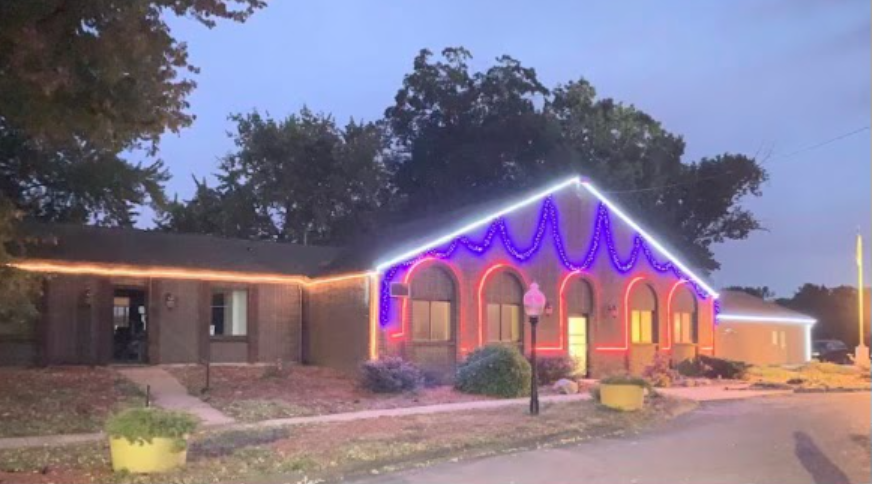
On November 5, Aneet Brar travelled to a gurdwara in Connecticut to celebrate Guru Nanak Gurpurab, a Sikh holiday celebrated around the around.

BY ALIA BLOOMGARDEN ‘29

STAFF WRITER

On Nov. 5, around 30 million people celebrated the Sikh holiday Guru Nanak Gurpurab.

Aneet Brar ’29 is a Sikh student at Mount Holyoke College. According to Brar, “Sikhism is an Indic ethno-religion that was founded about 600 years ago in the Punjab region of what is Northwestern India and Eastern Pakistan today. … Actually, Sikhism is kind of like the Anglicized word for the religion. It’s also called Sikhi.”

On Gurpurab, Brar explained that to celebrate she “[goes] to the gurudwara, which is the Sikh temple. Usually, there's a prayer, something akin to a sermon, and then also hymns are sung. We also have a free communal meal called langar. Actually, Guru Nanak Dev Ji, or Baba Nanak, he’s the person who started langar … so we all have a langer together.”

This Gurpurab, Brar went to a gurdwara in Connecticut. “It was really, really nice. In the community, there was really, really accepting, and I felt very happy to go there, especially after not going to Gurdwara in so long,” Brar said.

Moreover, she noticed that whenever she goes to the gurdwara, “People are very quick to help others. If there's someone who's sitting down eating and they need…something else, like…another dish or something, they won't [have to] get up because another person is going to be there to be like, hey, what do you need? I’ll go get it for you.”

She explained that one of the main ideas  in Sikhism is “ of one God, or rather this belief in the oneness of God. God is kind of understood as not really like this, this person in the sky who's controlling things or looking over you. It's more of just like this feeling and the oneness of the universe. God can be understood as a benevolent universe.”

This idea is called Ek Onkar. 

Brar said, along with Ek Onkar, the most important principles in Sikhi are Seva — service to their community — and “ the idea of being equal under God, that we're all creations of God or we're creations within the universe, and because of that, we're all equal.”

She continued by explaining that there are two smaller, but still important, principles: Kirat, living an honest life, and Vand Chakna, giving to the underprivileged.

Guru Nanak Dev Ji, the Guru celebrated on Gurpurab, is the first of ten Gurus.

“Guru means teachers, so our gurus are some kind of spiritual or religious teacher,” Brar said.

Additionally, the third Guru, Guru Amar Das, created the concept of pangat sangat, which means everybody, regardless of rank, caste, or anything else sits together and eats together as equals, according to Learn Religions, a website dedicated to providing education about different religions and spiritualities.  

“Sometimes people also light fireworks, or they'll also light divas,” which are clay oil lamps that are often also lit on Diwali, Brar added. 

When asked if Brar’s view of Sikhi changed from growing up to now at college, she said, “When I was a bit younger, I was quite areligious … but I realized that religion or faith or spirituality, whatever it is … It's just something about my identity.”

She reflected further on her Sikh identity, explaining, “I actually wrote my college essay about Sikhism, and after I wrote that essay, I became, I would say, a lot more appreciative of my identity and my family and my ancestors.”

In the Punjab region, there is a lot of religious syncretism, which Brar describes as meaning “we have a lot of different beliefs that are present in Punjab, such as Islam, Sikhism, Hinduism, Christianity. Because of this, a lot of people partake in other religions and other festivals and other holidays, and they follow specific principles or gods or whatever it may be in other religions.” 

At Mount Holyoke, Brar says while there are some people who “follow or celebrate certain Sikh holidays” to her knowledge, “it's not like they come from a Sikh family.” According to Brar, “generally being the only person that's from a Sikh family, it's been a little bit isolating at times.”

She grew up with a small South Asian community in Indiana, and they were usually Sikhs. 

Here it’s the reverse. “There's a lot of South Asians here, and there's a strong, very vibrant community here, but nobody here is Sikh. So because of that, sometimes I do feel a little bit alone. But I will say that the South Asian community here is still very, very accepting and very, very inclusive, which I really appreciate,” Brar said. 

Sophie Francis ’28 contributed fact-checking.

UN holds 80th session of the General Assembly high-level week

Graphic by Brianna Stockwell ’28

Alia Bloomgarden ’29

Staff Writer

On Sept. 22, the United Nations kicked off its most pivotal week of this year’s General Assembly. The high-level week lasted from Sept. 22-30 as part of the 80th session of the United Nations General Assembly held in New York.

According to the United Nations website, the week hinged on the general debate, the anniversary of the general assembly, the 30th anniversary of the Fourth World Conference on Women and the World Programme for Action for Youth, and the International Day for the Total Elimination of Nuclear Weapons. They focused on six specific topics: Palestine and the two-state solution, the climate, the global economy, noncommunicable diseases and mental health and well-being, AI governance, and Rohingya Muslims in Myanmar.

These topics were generally expected as they are major issues, Professor Christopher Mitchell, chair of the department of international relations, explained. He was surprised that Rohingya Muslims “made the agenda along with some things that sort of indisputably are major and controversial issues.” He added, “I’m glad to see they’re getting that attention,” as they “have not gotten nearly as much international attention as a lot of other crises in the world.”

On Sept. 23, President Donald Trump addressed the U.N., making a slew of controversial claims. During his speech, he claimed that all the U.N. does is “write a really strongly worded letter and then never follow up on this letter.” Mitchell explains that, while these remarks are “not tremendously significant, the Trump presidency obviously is.” These remarks and Trump's previous hostility to the U.N. are an “exaggeration and a continuation of the George W. Bush administration towards the United Nations, though with the caveat that the Bush administration consistently cast itself as broadly pro-United Nations, and opposed to the United Nations on the specific question of … the invasion of Iraq, whereas the Trump administration is more hostile to the notion of the United Nations as a whole.”

Despite Trump's hostility to the U.N., he told U.N. Secretary-General António Guterres that “our country is behind the United Nations 100%.” In addition to his criticisms of the U.N. in general, Trump criticized Europe’s handling of migrants. He warned European countries about the crisis of “uncontrolled migration,” claiming their “countries are being ruined. The U.N. is funding an assault on Western countries and their borders” and adding that London “want[s] to go to Sharia Law.”

Sir Sadiq Khan, the mayor of London, rejected this claim. He said that London is a “liberal, multi-cultural, progressive and successful city,” while claiming that Trump is “racist, … sexist … misogynistic and … Islamophobic.”

Mitchell explained that Trump’s remarks “link in with the idea that there is this common trend of right-wing populism across a lot of the democracies of the world. It’s an interesting aspect that all these countries … are both nationalistic and international in that there’s a nationalist international, … where the right-wing populists in Europe and the right-wing populists in the United States of America and the right-wing populists in Latin America all are looking to each other and aligning with each other and raising the same issues and concerns to a large degree.”

According to Mitchell, Trump is “signaling to his ideological allies in these countries.”

Trump re-emphasized his stance on climate change, referring to the carbon footprint as a “hoax,” and global warming as a “con job.” He insulted Europe for reducing its carbon footprint by 37%, which cost them “a lot of jobs, a lot of factories closed.”

Meanwhile, there’s been a “global [job] increase of 54% [with] much of it coming from China and countries that are thriving around China.” He also emphasized his executive orders to “hunt for oil.”

On the other hand, according to Reuters, China’s President, Xi Jinping, committed to reducing greenhouse gas emissions by 7-10% and increasing its wind and solar power capacity six times from its 2020 levels by 2035. Xi stated, “Green and low-carbon transformation is the trend of our times. Despite some countries going against the trend, the international community should stay on the right track, maintain unwavering confidence, unwavering action, and undiminished efforts,” clearly referring to Trump’s anti-environmentalist stance.

Mitchell explains that Trump's statements are yet another example of the continuation and exaggeration of the Bush presidency’s stances, which were hostile towards climate change. However, Bush was “less inclined to reject the science of climate change and more inclined to quibble as to questions of severity and necessity of action.” Essentially, Bush claimed that the climate crisis is “too expensive to do anything about and therefore we should not worry about it,” according to Mitchell.

On the other hand, Trump has taken a “much more aggressive … position” by denying that climate change exists entirely. Mitchell explains that America’s lack of action on climate change obviously makes it much harder for the rest of the world to deal with it, but this is not a new issue.

Mitchell states, “Obama talked a lot about climate change, but his actual record was pretty weak.”

This hypocrisy was something Trump pointed out in his speech, saying, “President Obama would get into Air Force One, a massive Boeing 747, and not a new one, an old one with old engines that spew everything into the atmosphere. He’d talk about the carbon footprint: ‘We must do something.’”

Mitchell believes that Europeans should stop “looking towards the U.S. for leadership that isn’t coming.” It may “spur them to act in a more dramatic fashion.”

On the other side of the issue, Mitchell explains that because the U.S. does not invest in renewable energy, they “[cede] space in what might well be the leading industry in the next half century.” This gives China the opportunity to become a dominant player, leaving “the U.S. in a worse position to reap the benefits of the green transition.” This may also lead Europeans to work with China.

On Sept. 21, Britain, Canada, Australia and Portugal recognized a Palestinian state, despite having traditionally allied with Israel, according to Reuters. This went against Trump’s stance and angered him and Netanyahu, who both said this rewards Hamas. Additionally, during Netanyahu’s speech at the General Assembly, many delegates walked out in protest.

Mitchell explains that the “practical effect is negligible … the real importance is symbolic,” indicating that Israel has lost a lot of support and trust on the world stage. He adds, “There’s always been a significant portion of the United Nations skeptical of Israel and Israel’s commitment to the peace process. That it’s reached states like Britain and France is a new level.” Additionally, this also “indicates a declining U.S. influence because, especially for the Anglosphere countries that have recognized Britain and Australia and Canada, one of the main factors has not just been their view of Israel, but that the United States urged them not to do it.”

At the end of Trump’s speech, he said, “Let us protect religious liberty, including for the most persecuted religion on the planet today. It’s called Christianity.” Mitchell explains that he thinks it’s “factually inaccurate” and “says more about the loss, the feeling of Christians that they’ve lost their primacy.”

When asked about his overall thoughts and what Mount Holyoke College students should take away from the General Assembly, Mitchell said that the importance of it is “almost entirely symbolic … This is about signaling to the rest of the world where you stand on certain issues.”

During the General Assembly, Trump has shown that the most interesting point of comparison is himself “versus George W. Bush, and the ways his positions can be seen as a continuity with those of the old Republican Party, the pre-Trump Republican Party, but also the very significant ways in which they’re not continuous but break from that position,” according to Mitchell.

Overall, Mitchell’s biggest takeaways are that “the U.S. has lost influence and Israel has lost influence that it had vis-à-vis where they both were a few years ago.”

Alayna Khan ’28 contributed fact-checking.

Vigil raises awareness about political turmoil in Nepal

Photo by Mira Crane ’27

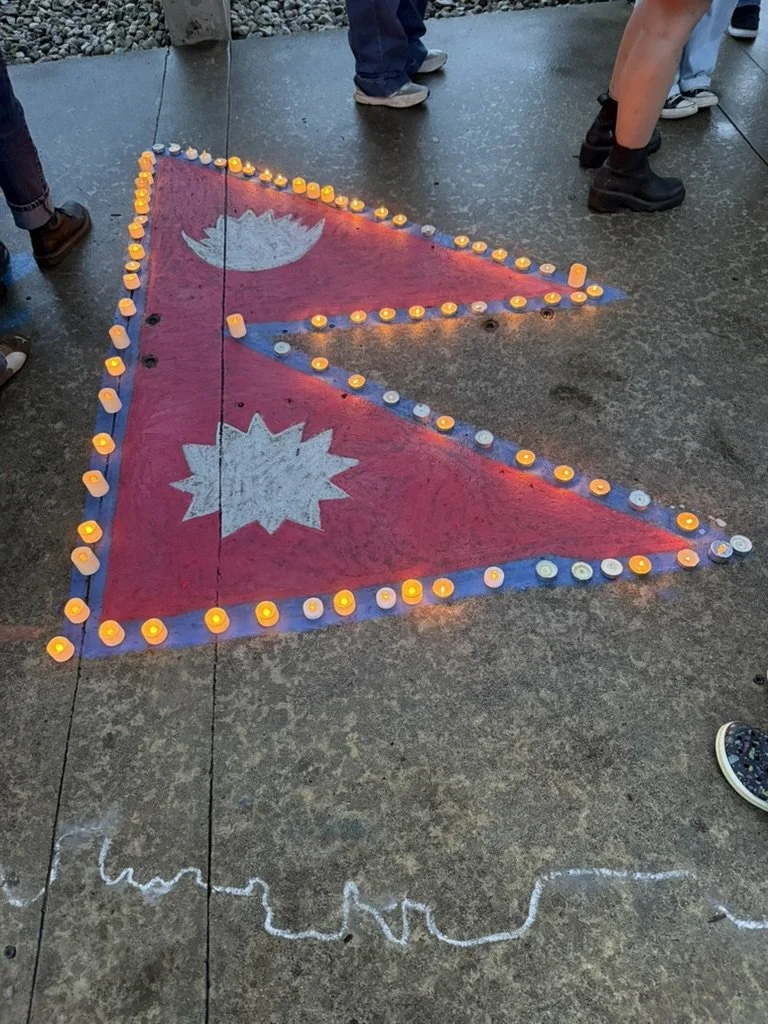
NEPSO hosted a vigil on September 13 to raise awareness about the ongoing situation in Nepal.

By Mira Crane ’27 & Alia Bloomgarden ’29

Global Editor | Staff Writer

During the first week of September, Nepali youth overthrew the government.

Violence erupted on Sept. 8 with student demonstrations protesting a government ban on multiple social media platforms, as well as allegations of government corruption, according to The New York Times.

Government security forces opened fire on the protesters, and the controversy led to the prime minister’s resignation. The following day, Sept. 9, parliament and other government buildings were set aflame by angry crowds.

An interim prime minister, Sushila Karki, was named that Friday. Karki is a former chief justice of Nepal’s Supreme Court and will be the first female prime minister Nepal has seen, the BBC reported. Karki’s appointment was supported by Gen Z leaders.

Prashuna Tamang’26, president of the Nepali Student Organization — abbreviated as NEPSO — explained many Nepali citizens' view of the government leading up to the regime change. She said, "Growing up, we would always only learn about how the government's corrupted.”

According to Tamang, the government was inefficient, with no transparency and a large income gap within the country. Although Nepal went through many prime ministers, alternating almost every year, the same few prime ministers and two political parties were always in power, Tamang stated.

Many small parties didn't have a say or chance of gaining power in the government. She said that this system felt like a joke and her friends would call it a "love triangle.”

A month before the regime change, there was a movement on TikTok to expose corrupt politicians and their families. But Tamang never realized the movement had gotten so huge.

She explained, “I went back home this summer and everything was okay. And this was literally a month ago.”

A few weeks later, her sister told her she was going to a protest. Tamang didn’t think much of it. It was supposed to be a peaceful protest, after all.

However, according to Reuters, on Sept. 8 nineteen students were killed and more than 100 injured as police fired tear gas and rubber bullets.

Tamang was shocked when she awoke to the news.

She explained, “I knew that people had anger in them. I get where the rage came from.”

While the students began the protests, Tamang said, “Other political parties took this as a means to, like, spread their own propaganda … they were the ones who started the violence and it was not the peaceful protestors. So I think the infiltration kind of really made the situation bad.”

Tamang and NEPSO wanted to honor those who fought and died battling corruption. So, on Sept. 13, NEPSO held an evening vigil open to the entire Mount Holyoke College community.

The event was held in the Gettell Amphitheater, which was adorned with a poster collage about the crisis and the Nepali flag. Members of NEPSO also drew a chalk version of the flag and a chalk map of Nepal; statements in English and Nepali were written in chalk on the stage.

The event opened with an introduction from Tamang, who thanked everyone for coming and explained that the event was about honoring the Gen Z student protestors in Nepal and the lives that have been lost.

She passed the mic on to another member of NEPSO, who spoke about the context behind the events that unfolded in Nepal during the week of Sept. 8. This member discussed protests where students lost their lives and the appointment of a new caretaker prime minister. According to her speech, there is now a fragile but genuine sense of hope, and what happens next will shape Nepal’s future.

After this speech, attendees went up to the stage to receive candles, which were then placed around the Nepali flag and other pieces of chalk art. Tamang gave a speech about how the event was in solidarity with Nepal, and was intended to honor those who lost their lives and educate the Mount Holyoke community about recent events in Nepal. She also mentioned that the political turmoil was personal for members of NEPSO, many of whom have family in Nepal. All those present observed a moment of silence, and the evening ended with Tamang playing Nepal’s national anthem.

She explained that NEPSO’s goal is to spread awareness of the situation in Nepal across campus. “We felt personally for our own selves that we needed to honor the lives lost. Because we are here in a foreign country, we're not able to do anything, but at least we can spread awareness about what's happening to a wider audience and also stand together,” she said. “Because, since the event that has occurred in Nepal till present, the Nepali students have been very strong knit, and we've been there for each other and we also want the campus community to know what's happening and also support us.”

When asked what she wanted people on campus to know about the situation in Nepal, Tamang said, “At least from the NEPSO community we want, we want the campus community to know that the situation, the Gen Z protest that was happening in Nepal was just not about social media. It was as a result of youth, just citizens getting fed up [with] the long standing corruption, the bureaucracy, the oppression that the youth were facing in Nepal.”

She wants the wider audience to understand why the protests started, and to know that lives were lost during them. Tamang believes the future is hopeful. She explained that although Interim Prime Minister Karki was chosen in chaos, she believes Karki was the best candidate. As chief justice, Karki stood up against corruption. Tamang also believes the chosen cabinet members are good candidates.

According to Tamang, while the future of Nepal has a bright potential, the situation is confusing. Although the prime minister has been overthrown, the political parties that had a strong hold on Nepal still exist and corruption is so strongly rooted in the current system.

As Tamang put it, “The war has just begun.”

Quill Nishi-Leonard ’27 contributed fact checking.