
Graphic by Betty Smart ’26
By Paige Comeau ’26
Managing Editor of Content
Over Fall Break, I was able to spend some time with my family and visit our local movie theater to watch “Wicked: For Good.” While I’m generally not a fan of musical theater, my family are, and I did enjoy both “Wicked” and “Wicked: For Good.” However, despite my best efforts to give myself a break as a politics major deep in my senior thesis, I could not watch the film through a neutral lens. Rather, I found myself analyzing it as a piece of political commentary, which I would argue “Wicked” largely is. There are many prevalent themes throughout both films that deserve analysis: The use of scapegoats in politics, the way censorship and propaganda work to uphold non-democratic governments, and how activism can veer into extremism when actors are without hope, just to list a few.
I found one theme in particular especially interesting, considering current discourse around the “Wicked” cast: The way appearance can be used for more sinister ends.
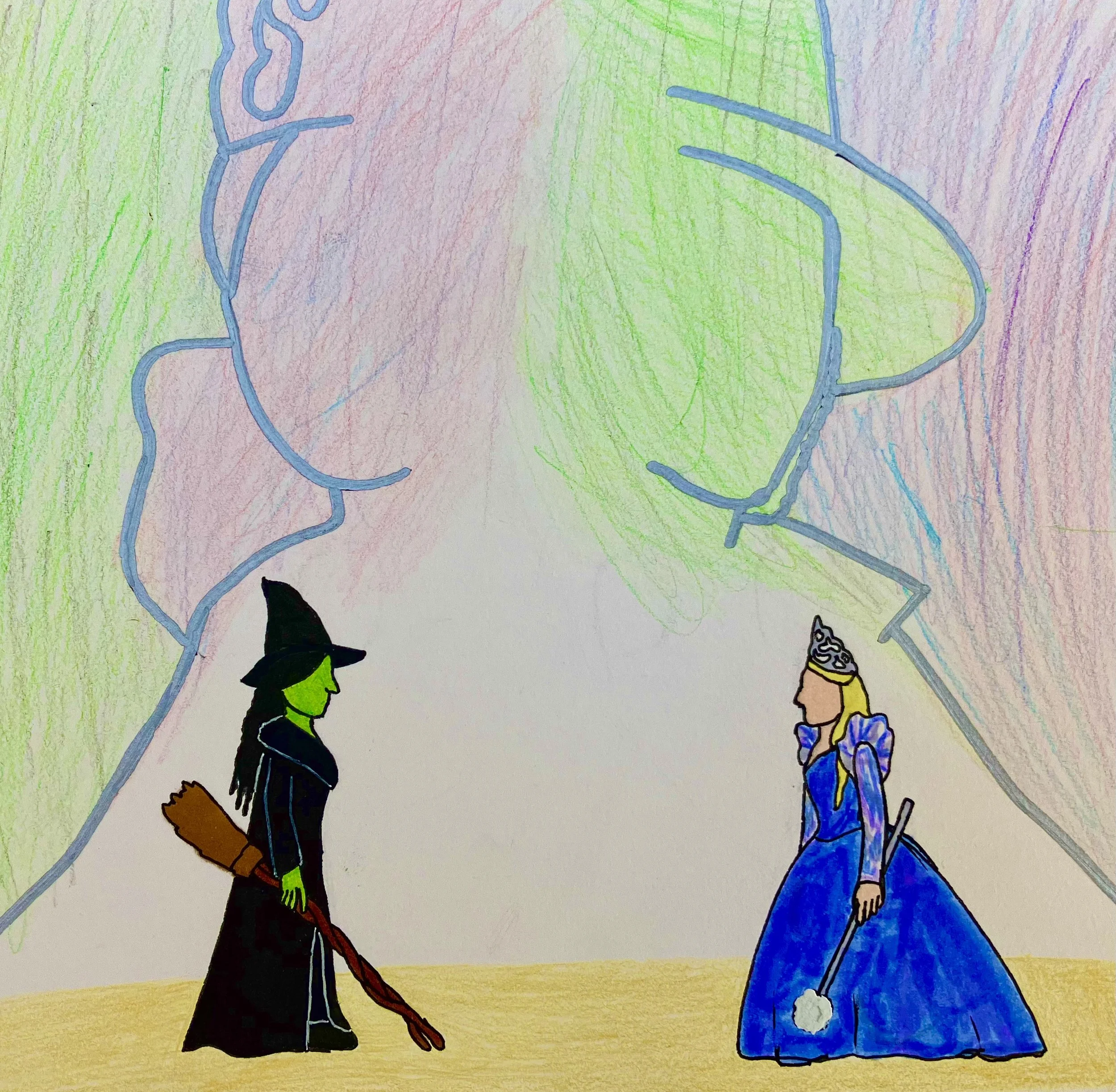
This is rather obvious throughout both movies: Glinda is blonde, white and conventionally beautiful, so she is seen as good; Elphaba is played by an actress of Nigerian descent and her skin tone is green, so she is seen as bad. It is a cliché trope that is easily traced back to the racial prejudices of the time the original “Wizard of Oz” was written. In the real world, however, life is imitating art just a little too well, as the “Wicked” cast continues to endure heavy discourse around their appearances and what ideals they are promoting.
Specifically, many of the female members of the cast, particularly Michelle Yeoh, Ariana Grande, and Cynthia Erivo are under intense scrutiny for their extreme weight loss over the last few years. Many photos of the cast before and after “Wicked” highlight the intense emaciation of the main actresses, all of whom sport protruding collarbones, gaunt faces, and a skin-and-bones appearance. Many fans are speculating on convoluted theories about the women, such as “on-set Ozempic swaps, eating disorder competitions among cast mates, or blind items alleging the actors tried to mimic Judy Garland’s harmful weight-loss methods from ‘The Wizard of Oz,’” none of which have any real evidence supporting them, according to Cosmopolitan Magazine.
While this focus on the “Wicked” cast in particular is the most prominent discussion on thinness right now, it is by far not the only one. In fact, it is part of a larger societal trend of celebrities and influencers prioritizing the pursuit of thinness over body positivity.
This has had noticeable effects on the content people consume, with more than 2.4 billion views on the TikTok hashtag #SkinnyTok and the amount of plus-sized models on runways diminishing from 2.8% in 2024 to 0.8% in 2025, according to Dazed magazine. This is particularly true in more conservative circles, where “trad wives” and “fascist fitness groups” are promoting extreme diets and weight loss as a part of their more political ideologies.
Largely, society is beginning to see an ideological shift around body size that bundles appearance with morality, politics, and religion, not unlike that seen in fascist, eugenicist regimes like Nazi Germany, or even Wicked’s Oz. Considering the current rise in both conservative extremism and extreme thinness, it is worth taking a look at the reasons why these two ideologies are interlocked or reinforcing, especially if we want a chance of combatting either.
Historically speaking, bodily appearance, and specifically thinness, has long been associated with oppressive, hierarchical regimes. In these societies, there is usually an idealized version of the human race or human body, one that is aligned with the people in power. Often, this version includes thin bodies, for several reasons: They are seen as the results of discipline and dominance over the body; they are seen as more likely to be able-bodied, and therefore more able to fight for or birth the dominant “ideal” race; and, perhaps most importantly, the thinness that is prized as ideal is the thinness of a white body, legitimizing the racial politics that have so often been the underlying force behind oppressive regimes.
University of California Professor of Sociology Sabrina Strings highlights this in an interview with the Daily Kos blog, stating, “by the 18th century, race science was built out, expanded to include additional physical characteristics. To the extent that people were linking indulgence in the oral appetite to an animalistic inability to control oneself, fatness became linked to the racial group [judged] to lack the capacity for self-government: Black people.”
Today, the conservative movement is reiterating such an ideology by tying thinness, and by extension whiteness, very heavily to morality. Like The New York Times opinion writer Jessica Gross says, “there’s a distinct idea that overeating or gluttony — which is one of the seven deadly sins — is immoral. And if your body size is not whatever society thinks is an appropriate body size, that is a sin.” This is especially true for white women, as “trad wife” influencers increasingly press the importance of a specific body type for the lifestyle they are promoting; that “feminine virtue lies in thinness, servility and domesticity.”
These ideals of feminine thinness promoted by conservative women also help legitimize a sexist agenda pushed by many conservative men. If women are physically smaller, if they literally take up less space, they are not fit to be the ones in power; they should sit by while the larger, more dominant men make the decisions. Meanwhile, people of color are shamed for being larger and told they are incapable of taking care of themselves or others, making it seem as though they should also stand aside and allow others to take power. It is this sort of hypocritical rhetoric that has fueled many long-standing, majorly oppressive hierarchies in the past.
So, conservatism promotes thinness, and utilizes an idea of ideal bodies to promote their political ideologies. But more than that, thinness and a focus on the body pull both men and women towards conservatism. For men, research has shown that the far right uses online fitness communities to recruit young men to their cause, starting with fitness tips before encouraging men to join closed chats where they push far-right ideology. While this is problematic in that this strategy utilizes people’s genuine worry about their health to entrap them into extremist groups, it is also problematic in the ways that it works.
By utilizing wellness as their topic of recruitment, these groups ensure their members associate positive changes in their life with far-right ideology, creating a sort of pavlovian effect for fascism. Also, in doing so, they create soldier-esque group members who are more than willing to commit acts of violence on behalf of their beliefs. For women, this emphasis on thinness often results in an extreme individualistic focus on the body and their habits, encouraging disordered eating and exercise which can have an array of negative effects on a person; these effects create vulnerabilities that extremists target as a part of recruitment. For instance, disordered eating combines extreme obsession with personal appearance and a lowered capacity for critical thought due to starvation, making it very easy for such people to be convinced of the eugenicist, gendered ideology that conservative radicals push.
In a community heavily made up of women like Mount Holyoke College, it is especially important that we recognize and combat such patterns; due to patriarchal norms, women are asked to place particular importance on their physical appearance, and are especially vulnerable to such messaging. Especially when public discourse makes it seems as though their favorite actresses, like Ariana Grande or Cynthia Erivo, promote a similar message.
This is not to say that either Ariana or Cynthia are allies of the far right’s agenda; in fact, I would actually venture to say the opposite. However, it is important to acknowledge the slippery slope that their images promote. And it is also important to take a lesson from the movies these two actresses are most famous for. Appearance is not the most important thing about a person, nor is it always what it seems. Instead, it is important to look beneath the surface and see what people really stand for, rather than what they want you to think, about them or yourself.
Maeve McCorry ’28 contributed fact checking.