Arts

Liberation in anxiety: ‘Teenage Sex and Death at Camp Miasma’

Graphic by Bei Jia Viggiano ’28 via Canva

By JJ Guo ’29 

Staff Writer

The tightness in my chest didn’t leave, though it was long after I stepped out of the movie theater. That familiar feeling of anxiety has been crawling behind me ever since I saw "Teenage Sex and Death at Camp Miasma." 

Written and directed by Jane Schoenbrun, "Teenage Sex and Death at Camp Miasma" follows Kris — played by Hannah Einbinder —  a young, queer filmmaker hired to reboot “Camp Miasma,” a fictional slasher franchise from the 1980s. Her research eventually leads her to Billy, who is portrayed by Gillian Anderson,  the original film’s final girl, who is living in the abandoned campsite where the film was shot. "Teenage Sex and Death at Camp Miasma" has been described as “a 2026 American satirical surrealist psychological romantic slasher film.” According to those elaborate labels, I should laugh, or scream. While I experienced both of those things, why was it that anxiety lingered the longest?  

Part of it is the style choice. The retro, low-grain look and exaggerated gore pays tribute to 80s slasher films; the soundtrack follows suit. Kris’s work and life mirrors the present, while the dreamy, surrealist landscape paints an ideal future. This amalgamation of past, present and future constructs a strange disorientation for the film’s audience. 

Scattered through the strangeness are the breadcrumbs we recognize, the unspeakable discomfort of sex, an infuriating Zoom meeting where no one can hear one another and a mindless snack shopping spree at a gas station. These ordinary details of modern life draw us so close that we cannot help but resonate.

This film presented the gap between the amalgamated zone and my own reality. This gap is eternally to be determined, beyond control and without categorization. Struggling to experience sexual pleasure without mentally placing herself inside the fictional world of Camp Miasma, Kris too flounders in this space of in-betweenness.  

The anxiety is given a figure and a name in this film: Little Death. Wearing a geometric metal helmet resembling an air vent and a raincoat, Little Death is the slasher who haunts the campsite. Their killing spree is the showpiece of the film, gleefully gory and set — unexpectedly — to the song “A Long December” by Counting Crows. Shifting between the perspective of Little Death, Kris and Billy, the nerve-wracking scene culminates with Little Death piercing the pair during intimacy with a spear. Then, the theater fell silent as my body buzzed with the aftermath of intense anxiety. 

At this moment, I remembered what Billy said to Kris. “If it gets too real, you can always turn it off.” 

In a Letterboxd interview, Schoenbrun explained this line to be about “exploring things that you know are going to be scary and tender; that you don’t have to be focused on the fact that you have a way to turn it off, but knowing that exists is the only way you’re going to be able to actually be present.” Chased by the slasher of anxiety, I had been holding my breath all my life. When chest tightness became habitual, the choice to exit was faded and forgotten. Yet watching Kris lying in the room, scared and safe all at once, I felt what it might be like to exhale into my own sexuality.  

The film keeps rolling. A moment later, Kris and Billy wake. Bathed in blood and tenderness, they go on a snack shopping-spree at the gas station.

Jillian Stammely ’28 contributed fact-checking.

Afrofuturist exhibitions showcase a celebration of the African American identity, past and present

Afrofuturist exhibitions showcase a celebration of the African American identity, past and present

Over the past several years, the art world has seen a significant increase in exhibits exploring the amalgamation of both past and present representations of the Black identity. According to a 2021 Axios article written by Russell Contreras, many of these include escapist art pieces that center around themes of science fiction and fantasy, also known as Afrofuturism. From banners to dresses made of paper and Swarovski crystals to multi-colored quilts, Lauren Halsey, Fabiola Jean-Louis and Bisa Butler have been steadily making an impact on the art scene through their work across various mediums. These three Black female artists all have a vision of African American identities through both past and contemporary lenses: a vision they aim to share with the world.

Artist Profile: Vivi Corre

Graphic by Vivi Corre

Graphic by Vivi Corre

By Anika Singh ’24

Staff Writer

 There is something immersive about Vivi Corre’s art. It is minimal yet enthralling — it entices the viewer to look, to relate. It draws them in. Gathering inspiration from current events, Corre sketched her latest piece, idly creating patterns influenced by her environment and ready to shape her newest work. 

Corre’s art journey wasn’t a straight line. “I used to not like art as a subject at all in high school,” she explained. “My own ideas and creativity were limited since the classes followed a technical flow and strived for a perfect depiction.” 

Corre did not find solace in this. “Art isn’t meant to be perfect, it’s supposed to be you!” she remarked.

It all started with a birthday gift. New iPad and pencil in hand, Corre explored the new features the device offered, her love for art growing by the minute. Corre remarked that it is incredible what a simple instrument can do, whether it's brightening up your favorite biology teacher's day as you give her your art as a baby shower gift (featuring the words “Future Stemminist”) or celebrating your college acceptance to Mount Holyoke by drawing Jorge enjoying M&Cs. These projects guided Corre to feeling a close affinity for art. 

“The Jorge artwork was definitely a turning point for me,” she said. “I had sent it out to [the Office of] Admission and they liked it so much that they reposted it on their Instagram, which led to people DMing me to ask if they could get it in a sticker format. That encouraged me to put my art out there,” she added. 

This resulted in the creation of a Redbubble account that now displays a handful of her creations. 

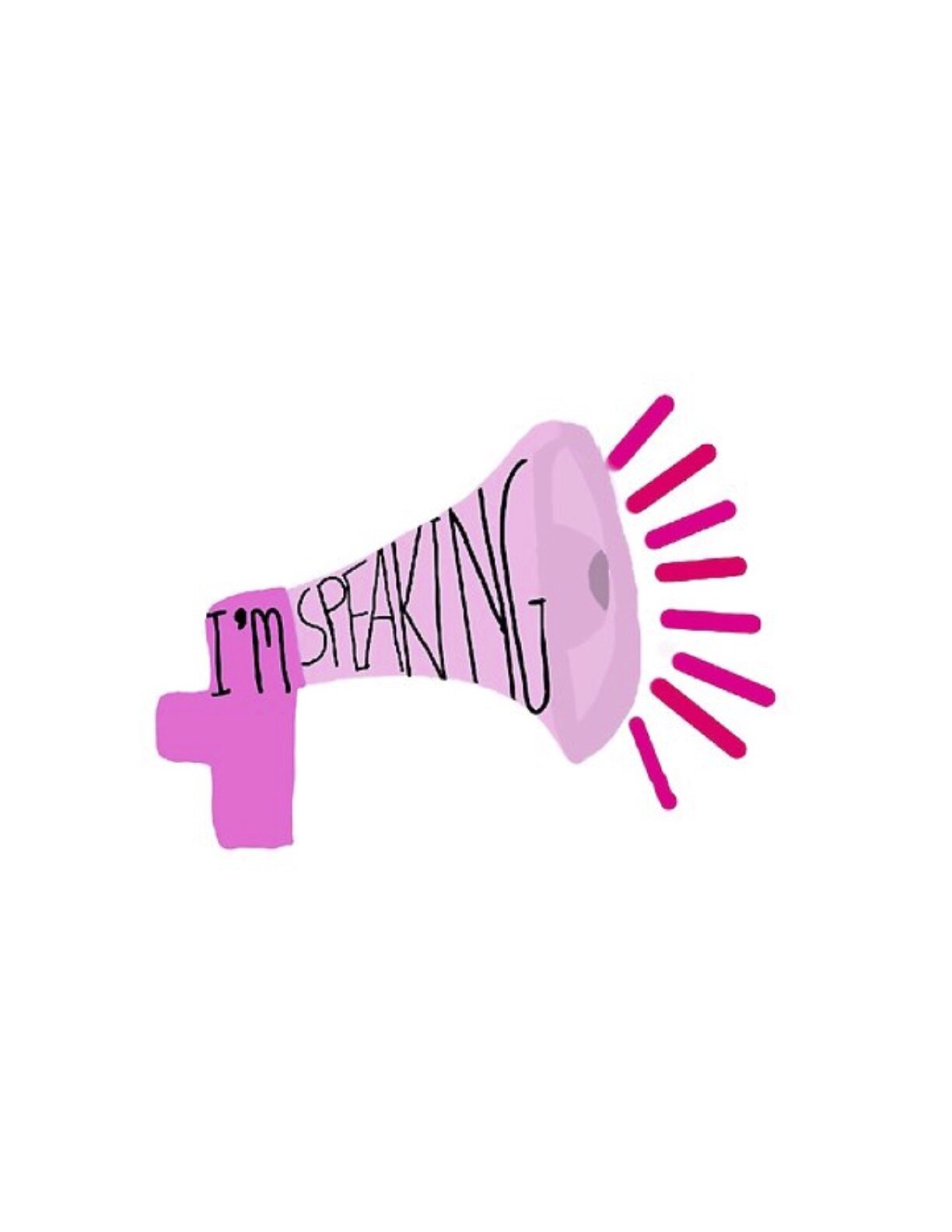
Art is everywhere, Corre believes. She described how her artistry comes to her, saying, “One of my favorite creations came to me as I sat in front of the television watching the 2020 vice presidential debate. Vice President-elect Kamala Harris shut down Vice President [Mike] Pence by her iconic ‘I’m speaking’ quote. That's where I got the idea to draw a loudspeaker with the quote.” 

Corre’s ideas are innovative and shine the brightest when her art is influenced by current events. A remarkable piece was her “AOC+Among Us” drawing, which came from the famous U.S. Representative Alexandria Ocasio-Cortez livestream during which she played the game Among Us to encourage the youth of America to vote in the 2020 presidential election. This piece is playful, displaying cutesy Among Us figurines while highlighting the political climate of America. Ocasio-Cortez seems to play a significant role in Corre’s art, as some of her quotes serve as catalysts for her creations. 

“I’m glad to see that my art can reach people,” Corre reflected. “I, unfortunately, don’t get to see who purchased my art, but at times my art is purchased from states or countries that I might not know people from, and I’m overjoyed to know that my art is now not only something I enjoy but other people do as well. Such a feeling can’t be replaced.”

To support Corre and her art, check out her Instagram art account, @vivicdesigns.

Banksy’s Ironic ‘Show Me the Monet’ Sells for $9 Million at Sotheby’s Auction

Banksy’s work. Image courtesy of Pixabay.

Banksy’s work. Image courtesy of Pixabay.

By Hiba Nawaid ’23

Staff Writer

“Show me the Monet,” Banksy’s reworking of Claude Monet’s impressionist painting “Bridge over a Pond of Water Lillies,” was auctioned for $9.8 million (£7.6 million) at Sotheby’s last week, becoming the artist’s second most expensive painting, according to CNN.

Known for his provocative street art, Banksy created a series of oil paintings for an exhibition in 2005 called “Crude Oils: A Gallery of Re-mixed Masterpieces, Vandalism and Vermin,” which featured “Show me the Monet.” These paintings were reinterpretations of famed works by Edward Hopper, Vincent van Gogh, Andy Warhol and more and were showcased by collectors Roland and Jane Cowan in West London. The couple purchased “Show me the Monet” after the show closed for £15,000, according to Banksy’s former agent Steve Lazarides.

After nine minutes of bidding on Oct. 21, a collector bought “Show me the Monet.” The painting features an orange traffic cone and two overturned metal shopping carts in the pond of water lilies under Monet’s originally painted Japanese-style bridge near Giverny, France. These additions, which strike the eye as interruptions in an otherwise peaceful scene, are a nod to the ever-increasing material consumption and environmental pollution levels of the modern world.

Following the auction, “Show me the Monet” became Banksy’s second most expensive piece of artwork. His most expensive piece, “Devolved Parliament,” sold last year at Sotheby’s in London for $12.2 million. “Devolved Parliament” depicts chimpanzees debating in the House of Commons in place of British politicians and was auctioned off during the Brexit negotiations.

In relation to Banksy’s street art, a medium which is often shunned by the art world and regarded as vandalism, there is irony in “Show me the Monet” fetching nearly $10 million. 

The artist’s graffiti-based works often critique controversial social and political issues; “Show me the Monet” itself is a commentary on the impact of excessive consumerism. “Monet” replaces “Money” in the title, pointing to the larger theme of art commodification. While street art is able to escape such commodification, this Banksy painting arguably has been objectified as a result of its lucrative auctioning to a private collector.

This irony can also be traced back to 2018, when another Banksy painting, titled “Girl With Balloon,” appeared to fall down from the frame in shreds minutes after being auctioned off for $1.4 million. The satirical stunt, which involved a secret installation of a paper shredder in the painting frame by Banksy himself, was arguably a criticism of the art world. However, according to Leon Benrimon, the director of modern and contemporary art at Heritage Auctions, the market worth of the painting doubled following the stunt. The painting was renamed to “Love Is in the Bin” and was claimed by the buyer in its tattered condition. 

Despite the paradoxical relationship between the themes of Banksy’s art and the art collectors who spend millions to own his work, the art world’s fixation with Banksy shows no sign of slowing down. What remains to be seen is how the artist continues to expand his practice and how he will respond to the sentiments of art buyers through his provocative pieces.


Northampton Arts Council Announces Distribution of COVID-19 Artist Relief Grant

Northampton Arts Council Announces Distribution of COVID-19 Artist Relief Grant

Last week, Northampton Arts Council announced that it will be distributing aid from its COVID-19 Artist Relief Grant to 120 local artists and cultural producers. An official press release stated that the council had raised $29,000 and redistributed $11,000 from its budget to the relief fund, which was initially announced in April.

Summer 2018: Vacation Vocations

Every summer, Mount Holyoke students go off into the real world for internships and experiences that will shape them for the rest of their lives. Some of our MoHos venture into more artistic endeavors. Arts & Entertainment talked to some of these students about their summers and the work they did in their respective fields.