
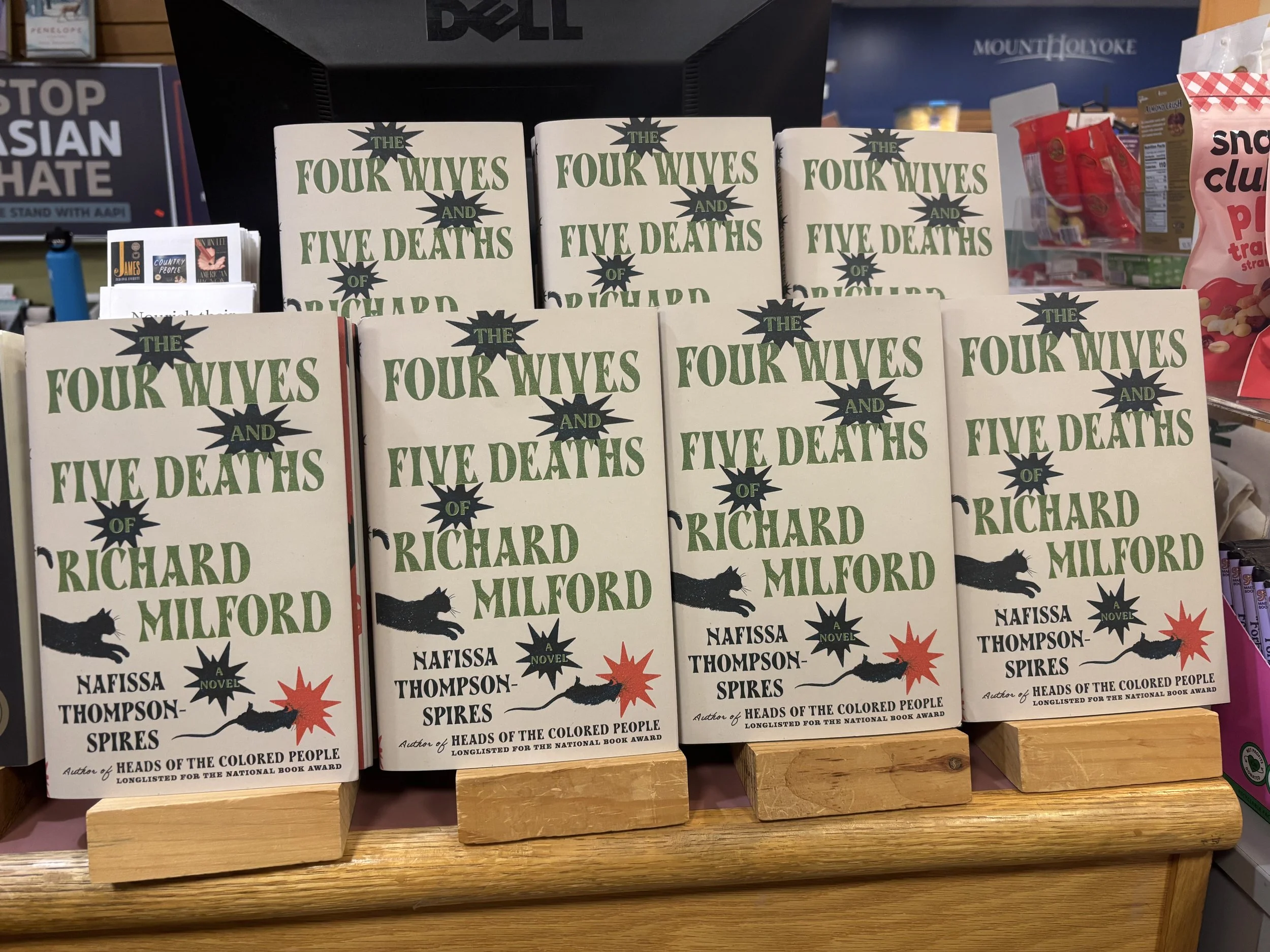
Photo by Krista Baldospino ’30
Nafissa Thompson-Spires spoke about her debut novel at Odyssey Bookshop on Tuesday, Oct. 27.
Krista Baldospino ’30
Staff Writer
On Tuesday, Oct. 27, Nafissa Thompson-Spires returned to South Hadley’s Odyssey Bookshop to celebrate her debut novel, “The Four Wives and Five Deaths of Richard Milford,” which is the store’s latest First Editions Club pick. Her story collection “Heads of the Colored People” was a previous 2018 pick. This time around, she spoke with Dr. Kijua Sanders-McMurtry, Mount Holyoke College’s vice president for equity and inclusion.
Set in 1920s Oklahoma in the fictionalized town of Newville, shortly after the 1921 Tulsa, Oklahoma race massacre, the novel follows the death of Richard Milford, a notorious womanizer and moonshiner. The main suspects are his four “wives,” Lally, Sophronia, Georgette and Vivianne, though Alberta, his cook, is also a suspect.
Thompson-Spires opened with a reading from the first chapter, voiced by the town of Newville. The town itself is one of the novel’s narrators, acting as a Greek chorus in every other chapter, and in this particular one it recalls Rich’s funeral. Upon hearing the effortless humor of Thompson-Spires’ writing style read aloud, Sanders-McMurtry admitted to having a “visceral reaction” to “the brilliance and also just the beauty of the words.”
Sanders-McMurtry began by asking about the novel’s setting: why Oklahoma? Thompson-Spires explained that she wanted to “historicize” all-Black towns in America. There were about 50 once, she said, and now only 13 remain; through the setting of Newville, Oklahoma, she wanted to pay tribute to them. In this journey, she conducted her research in the Oklahoma State Archives and watched films by Solomon Sir Jones — a Black documentarian who filmed Black communities in the 1920s — whose footage showed her “the everyday mundane life of people.” She shared advice for researchers in the age of AI: double and triple-check sources and treat oral history as seriously as printed records.
When asked if the womanizing Rich happens to have real-life inspiration, Thompson-Spires admitted that in the first draft, he was modeled on her great-grandfather, who her mother discovered had three wives and forty children. Everyone who remembered him, she said, added the same disclaimer: he was a terrible man who beat his wives with a horsewhip, “but oh, he was so handsome.” This discovery inspired her to ask, “What if the women in his life could get revenge on him?”
Yet, what started off as a revenge story soon became an exercise in empathy the more she learned about her great-grandfather’s life. As she learned about him, including a tragic accident that killed his brother and a lightning strike in his teens, the harder it was to see him purely as a villain. This depth carries over into the character of Rich, a traumatized man whom she describes as “a child in a grown man’s body.”
Lightning, which the author herself was struck by in 2022, runs through the novel like in her family’s life, where both her and her great-grandfather were victims of it. In the novel, Rich uses his lightning incident to excuse his behavior, blaming it on “barometric pressure.” Through this moment and the description of Rich’s many traumas, Thompson-Spires sought to poke fun at what has been called “the trauma plot,” by critic Parul Sehgal, the habit of explaining a character’s every flaw with one backstory.
Rich’s own philosophy, which he calls “stoic enterprising,” is his own version of Black nationalism where he believes that through having a large family he will make the Milfords the leaders of the town. Thompson-Spires described him as a “cult-like figure,” revealing she drew on communities like the Oneida Colony and the town of Lily Dale, New York, for inspiration.
As for the four titular wives, Thompson-Spires described their main connection as hunger. Lally, the only legal wife, is hungry for power and wealth; Georgette longs for another love; Vivianne craves the affection Rich starves her of; Sophronia is hungry for actual food. “Hunger became the way for me to get to know the characters,” Thompson-Spires stated.
For the writers in the room, Sanders-McMurtry asked about her writing process. Thompson-Spires admitted that moving from short stories to a novel was harder than expected. Admittedly, the title of her book arrived late for her; at first it was called “Kith and Kin,” but she felt it “wasn’t saying enough.”
A note from one of her two editors — which encouraged her to lean into “the whimsy” — was one of the most helpful tips she received. “Remember to return to a sense of playfulness,” she advises the audience, as her personal mantra for writing is: “Playfulness is what probably brought you into writing the story, and that’s what’s going to get you out of it.”
Peeking ahead, Thompson-Spires has more on the way. Her young adult debut titled “Akimbobo,” a satire about an Afrocentric summer camp in Alabama with a sinister plot against its campers, will be released in 2028.
Quill Nishi-Leonard ’27 contributed fact-checking.
