
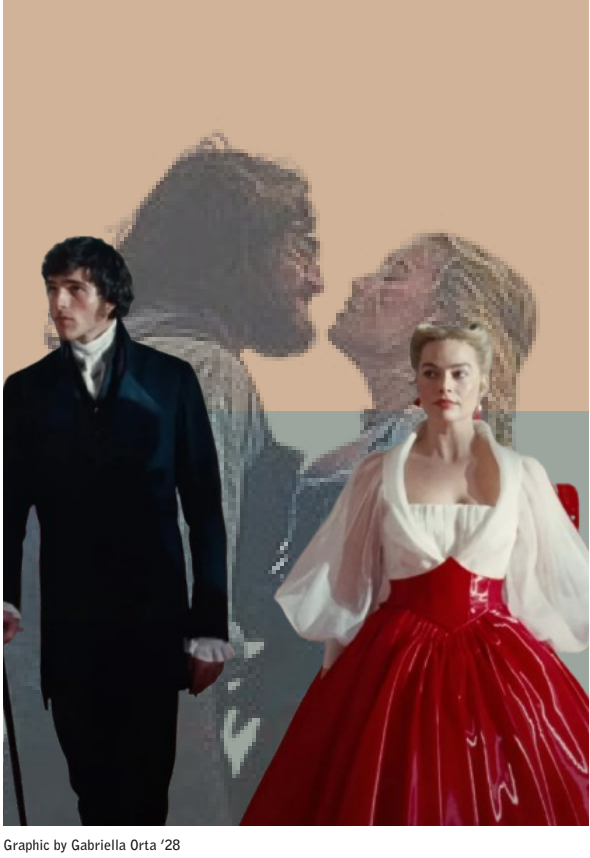
By Honora Quinn ’27 & Cat McKenna ’28
Staff Writers
What better way to spend Valentine’s day than a trip to the movies with some of your closest friends?
Despite writing an article for the Mount Holyoke News last fall regarding the online discourse and backlash the new adaptation of Emily Brontë’s 1847 novel, "Wuthering Heights,” was facing, we tried to go into Emerald Fennell’s adaptation with open minds. After all, the visuals we saw in the trailers were gorgeous — even if historically inaccurate — and Jacob Elordi had proved himself a competent period actor in Guillermo Del Toro’s now Academy Award-nominated “Frankenstein” just months prior.
However, just minutes into watching the “Saltburn” director’s follow-up venture, it became clear that the style on screen was not amounting to much substance. Notably, characters who were important to the plot of the novel were significantly changed or even not present in the film at all. One significant instance was the absence of Hindley, Catherine’s brother, who in the book is abusive and takes his aggression out on Heathcliff. In the film, Fennell combined the character of Hindley with Catherine’s father Mr. Earnshaw, who in the book is kind-hearted instead of a drunken, abusive, gambling addict before his early death, ultimately changing the dynamics and history of the Earnshaws and those that work for them at Wuthering Heights.
While those going into the film without the context of the novel may not notice these character changes, the lack of these plot points leaves a void in the audience’s understanding of the story. For example, eliminating Hindley’s relationship with Heathcliff, along with the whitewashing of Heathcliff’s character, which we addressed at length in our initial piece from the fall, erases the generational class, race and power struggle. In the novel, Heathcliff uses Hindley’s downfall to purchase the Wuthering Heights estate, symbolizing his victory over a generational hierarchy that once abused him.
The lack of Hindley and others is seemingly replaced by Catherine’s affair with Heathcliff while married to Edgar Linton. Whereas in the novel Heathcliff and Cathy never consummated their relationship, Fennell shifts the focus to a highly physical affair, deviating from the novel’s focus on the gothic tragedy elements and changing the story to what some viewers describe as just awkwardly filmed sex.
The changes to the plot, characters and setting have led to the film hardly feeling like the story envisioned by Brontë over a century and a half ago, and we’re not the only ones feeling that way. Other viewers have noted that while the film shares a title with the classic novel, its characters more closely resemble another notorious work of literature and film, “Gone With The Wind.” Online creator Jananie, who goes by the handle @thisstoryaintover on social media, pointed out how the plot of the 1939 film matched that of Fennell’s “Wuthering Heights” more accurately than it matches the novel it claims to be based on, even going so far as to wonder if Fennell had first wanted to remake the Civil War drama before switching gears to a slightly less controversial pillar of gothic media.
And this just made the viewing experience all the more disappointing for us. The costumes — designed by Jacqueline Durran, who has previously designed costumes for films like 2005’s “Pride and Prejudice” — despite not being accurate to the period, were gorgeous and interesting to see on screen. The landscapes, which felt endless yet claustrophobic at times, paired with the decadent color grading which has been missing from far too many new features, were absolutely beautiful. And yet every decision and change Fennell made to the heart of the story — to the central characters of Catherine and Heathcliff — felt like they were made to shock the viewer, rather than being made out of a genuine respect for the source material.
In the words of Claire Parker, co-host of the Good Noticings podcast, who also commented on the ongoing backlash facing the film, “If you’re going to use the clout from [Intellectual Property], you need to be held to the standard of IP.”
Angelina Godinez ’28 contributed to fact checking