
Photo by Bei Jia Viggiano ’28
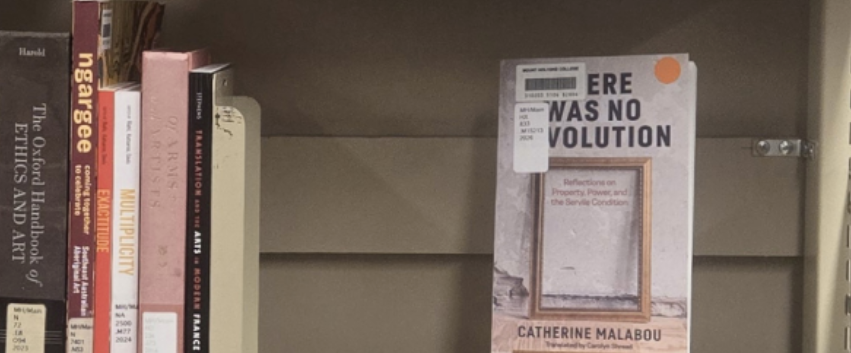
LITS has much “weird girl” literature to check out, as well as the lesser-known “normal girl” lit.
Sarah Berger ’27
Arts & Entertainment Editor
The term “Weird Girl Lit” has had a recent rise in popularity, roughly coinciding with the rise of #BookTok on social media and increased reliance on virality-based marketing of books. Some of the most popular books classified as “weird girl” include “Bunny” by Mona Awad, “My Year of Rest and Relaxation,” by Otessa Moshfegh, and “Boy Parts” by Eliza Clark. Going a bit further back, Sylvia Plath, Shirley Jackson and Charlotte Perkins Gilman are sometimes referred to as earlier iterations of the genre.
So, what exactly is a “weird girl” book in 2026? It seems like it’s an exercise in apathy and poor writing. Trust me, I’d know. Unfortunately, I fall victim to every blurb that describes a book as “original,” “jaw-dropping,” “exhilarating,” or any other combination of glowing adjectives. If I see a book on r/Weirdgirllit, there’s a high chance that I’ll try and get my hands on it.
Off the top of my head, I’ve read “Just Watch Me,” “Agnes Lives!,” “Open Wide,” “Fruit Fly,” “She’s a Lamb!,” “The Obsessed,” “A Real Animal,” “Offseason,” “The Vivisectors” “A Good Person,” “The Silent Period,” “Superfan,” “Lost Lambs,” and “Idlewild” in the past year. Last year, I read “Worry,” “Woo Woo,” “Blob,” “Beta Vulgaris,” and “Sky Daddy.”
I didn’t dislike all of them, and I enjoyed parts of almost all of them. However, I found the majority of them to be incredibly uniform. While each novel offers slight deviations on the theme, overall they’re all focused on white women in their mid to late twenties who don’t like their lives. Generally, this makes sense: Their lives suck and they don’t really have any interest in making them better.
Despite being classified in the story as “poor,” these women mostly have the money to do what they want, and they typically have parents or a boyfriend who will send them large sums of money if they ask. This is convenient because it means that they don’t have to work and can wallow in their sadness. Disaffection generally only makes for a good story when there’s something else going on, and there rarely is. Sure, some of these books feature beat-centric mysteries, humanized blobs, creeping fauna and women literally crawling inside other people. Unfortunately, these genuinely interesting ideas are almost always relegated to the background by the main character’s droll opinions.
Additionally, a lot of these books are simply not very good. It’s hard to see how they’ve been published in the first place, besides thirsty publishing houses looking to capitalize on the popularity of BookTok. “Lost Lambs,” written by Madeline Cash, was a highly anticipated “weird girl” book, yet turned out to be a mishmash of made up words and Islamaphobia. “Decomposition Book” by Sara Van Os, though highly recommended by most reviewers, was incomprehensible. It contains thoughtful lines like, “Instead I stare at her like Donald Trump stared at that solar eclipse: I blink twice, dry heave, turn ninety degrees to the left, and absolutely haul ass out of there.” It’s not just that the humor isn’t to my taste, it’s that this is a legitimately bad sentence; the sort of which abounds in these books.
And don’t even get me started on the endings. At the end of the vast majority of these books, the weird girl suffers. She dies, she is humiliated, she gives herself fully over to her “weirdness” and ruins her life; the weirdness isn’t usually something cool, like quitting her job to study a niche species of bug, it’s more like letting her obsessive and depressive tendencies isolate her. Even when the endings tell us that the character is happy or empowered, they never really show it.
Usually, she leaves a lot of blood and tears in her wake, and the audience doesn’t get a good idea of what’s going to happen next. The books end on a descriptive line that points vaguely toward the future, something like “I put down the bloody knife and looked up at the sky.” Of course, it’s difficult to do an ending when the story never really got started in the first place, and oftentimes these endings seem like the author realized the book had to end and rapidly accelerated the “plot.”
Sometimes, I’m left wondering how boring the people calling these books weird think that most people are. If it’s “weird” to hate your shitty job, your pointless life and your borderline abusive boyfriend, what do you think normal people are doing? Are they just meandering around, wallowing in their perfection, not working all that hard or thinking all that hard?
It’s been largely deemed weird to care, weird to have a girlfriend — and I don’t mean a woman that you kiss disaffectedly when your boyfriend ignores you — weird to be interested in peripheral things, weird to pursue your interests. There are a lot of ways to be truly weird, and I don’t think that most of these books understand that. Writing only about “girls” suspended in their adolescent apathy and depression does little service to generations of successful, emotional, passionate, smart, weird women everywhere.
McKenzie Phelan '28 contributed fact-checking.