Elizabeth Murray

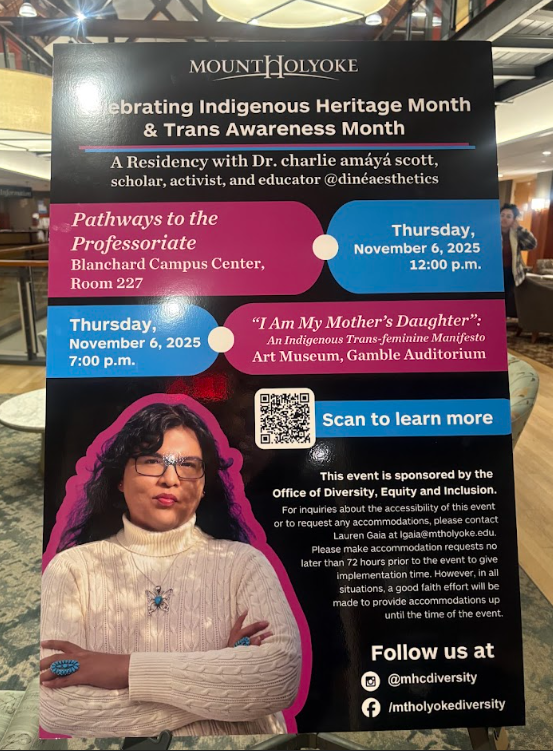
Dr. charlie amáyá scott gives her Indigenous transfeminine manifesto

Photo by Elizabeth Murray ‘28

dr. scott came to MHC to speak about her life.

BY ELIZABETH MURRAY ‘28

FEATURES EDITOR

To mark the start of Indigenous Heritage and Trans Awareness Month, Mount Holyoke College’s Office of Diversity, Equity and Inclusion, the Zowie Banteah Cultural Center and the Office of Community and Belonging welcomed Dr. charlie amáyá scott for a two-day residency on campus. scott gave a talk on Thursday, Nov. 6 about the Indigenous transfeminine experience, intergenerational wisdom, ancestors and community, which was held in Gamble Auditorium and featured a Q&A segment.

Emma Quirk ’26 opened the talk with the College’s Land Acknowledgment. This was followed by Kijua Sanders-McMurtry, vice president of equity and inclusion at the College, who highlighted Mount Holyoke’s Indigenous alums, such as Zowie Banteah and Ruth Muskrat, and their work to advance the rights and representation of Indigenous people on campus. Sanders-McMurtry also highlighted the work around inclusion of trans and gender-nonconforming students on campus. 

scott was then introduced by Ashley Mantanico ’27, who is an assistant at the Zowie Banteah Cultural Center. scott, who is a member of the Diné nation, also known as the Navajo, has a Ph.D. in education and has amassed a substantial following on social media, where she shares her culture and advocates for Black and Indigenous people of color as well as decolonization. 

scott began by introducing herself and her background. She was raised in the Diné nation and uses the English pronouns of she/her; the Diné language does not use pronouns. scott explained that her content addresses serious topics with humor and education. She also took a moment to recognize the genocides and wars occurring across the globe, and reminded the audience that they can make the world a better place.

The talk began with a poem of scott’s called “In My Dreams,” which was written in 2021, and features artwork done by her sister. scott then explained that she dreamed of a world where Two-Spirit and Indigenous LGBTQ+ people are “offered reciprocity rooted in radical kinship and unconditional love.” 

The second part of the talk focused on scott’s manifesto. She first began by giving a crash course on what a manifesto is. scott, a self-described “theory ho” finds healing in theory and its use as a tool for liberation. In Indigenous culture, stories are a tool to pass down memories and lessons from generation to generation. 

Her manifesto was broken down into several parts, with each title written in a drawing of several flowers joining at the stem. The first two parts of the manifesto highlight the sanctity of Indigenous womanhood and its traditions, with scott telling the story of her people’s survival of U.S. colonization and their intergenerational healing journey. The third part is a reclamation of sovereignty and power, followed by the importance of listening to others’ experiences with our hearts to understand them. 

The next part focuses on a relationship with one’s environment. scott highlights how, on her reservation, recycling is not an option, and they must find their own ways to use and reuse local materials and support local artists. 

The final part of scott’s manifesto ties back to intergenerational healing and decolonization. scott shares the story of how her mother came to accept her gender identity. She had originally come out as nonbinary, but later realized she felt more gender euphoria with she/her pronouns. 

scott never made this known to her mother, but one day her mother began referring to her with she/her pronouns. She shared an anecdote about when her mother first referred to her as her daughter, which occurred when her mother was in the process of adopting scott’s three younger siblings. Her mother told the social worker that she had two older daughters. This moment served as a marker of healing in their relationship.

The talk closed with a Q&A with Lily Rood ’27 and Ashley Mantanico ’27. This discussion drifted into different topics around what is currently happening across the U.S., processing the feelings of grief for what is lost and hoping for better in the future. The Q&A also touched on the work of education, and specifically how institutions of higher learning benefit off of the work, or “heartwork,” of activists and academics of color, while also having profited off of colonization and the Atlantic Slave Trade. scott noted the importance of rest and care, and making sure one’s well-being is not taken away by oppressive institutions.

Leah Dutcher ’28 contributed fact-checking. 

Discontent brewing amongst Frances Perk café staff

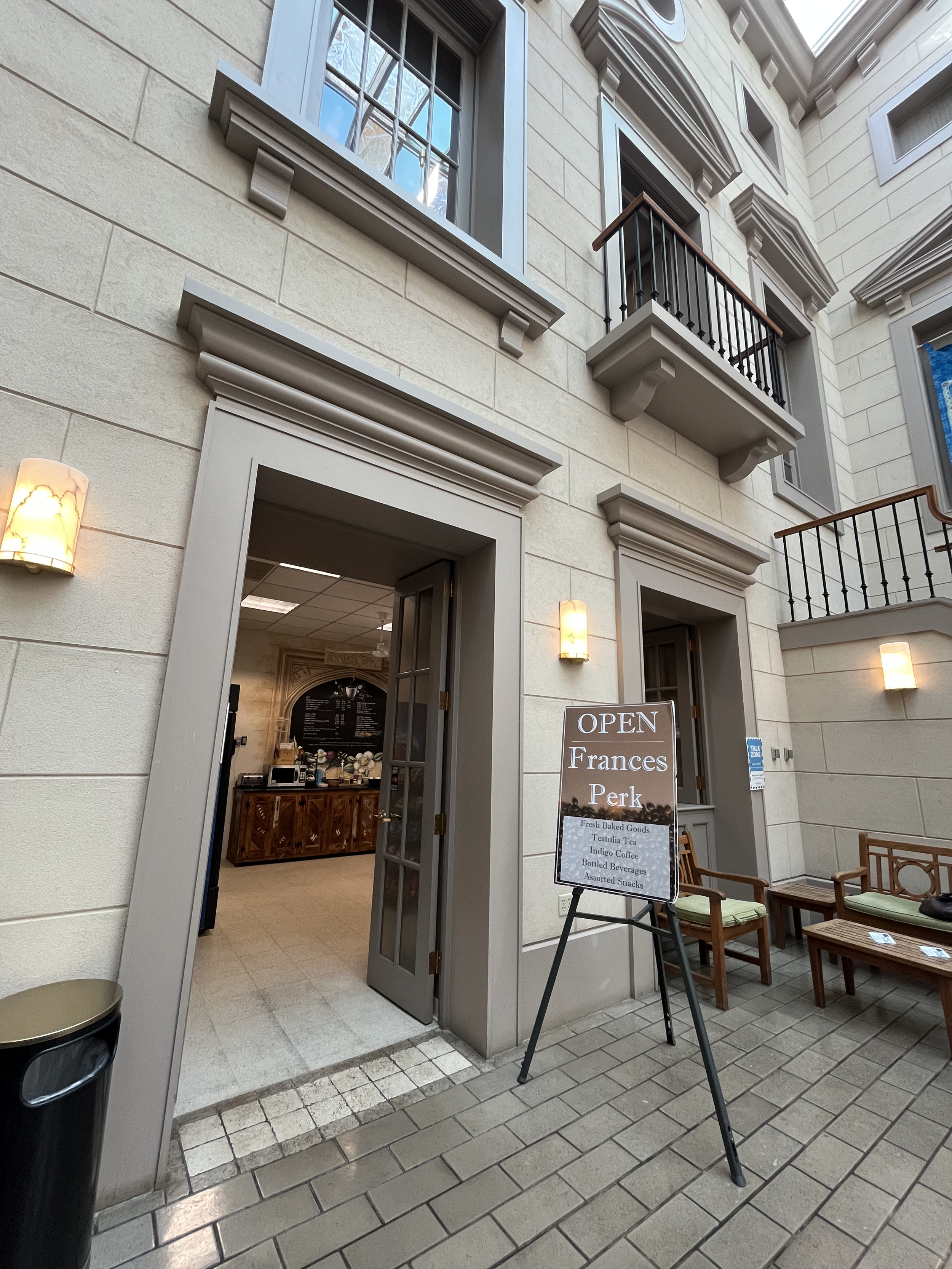
Photo by Sydney Wiser ’27

The Frances Perk, located inside the Williston Library’s Atrium, is a staple for many students; they serve snacks, coffee, teas, and a few baked goods.

Elizabeth Murray ’26

Features Editor

The Frances Perk café is a popular stop for students in between classes or on a study break. Located in the Williston Memorial Library Atrium, the Perk is managed by Mount Holyoke’s Dining Services and staffed almost entirely by students. The café is open most days of the semester and offers a mix of beverages and pastries.

Recently, baristas have grown more frustrated with their treatment by upper management. “Especially this semester, it kind of feels like we're on our own,” one Perk staff member who asked to remain anonymous said. Another anonymous student echoed this sentiment, stating, “It feels like [the administration] doesn't care about us at all.”

One concern is the onboarding of new baristas. The Perk hires staff once the café is open, which isn’t until students return for a new semester. Hired staff must have experience working as a barista, and they are normally trained in three training sessions before they can work on their own. Recently, new staff have had difficulty being able to schedule training sessions, leaving experienced staff to train during regular shifts, adding to their usual duties. This can be incredibly difficult during particularly busy shifts that overlap with rush times. One of the staff members we spoke to voiced their frustration, saying, “It was solely up to the students and it felt like management knew, but they were like, oh, it's not that big of a deal. You guys should figure it out on your own. That's how it felt.”

During a regular shift, there are ideally two or three baristas present to ensure that things run smoothly, but this hasn’t been standardized across shifts. Lately, there have been scheduling issues caused by an overall staffing shortage, meaning there is no one to fill in if someone calls out sick. This can leave staff members in a tight spot, having to manage the café by themselves. Other times shifts have to be left open because of conflicting class schedules. One of the employees Mount Holyoke News spoke to mentioned that management has scolded employees for not being able to fill empty shifts.

There has also been frustration around how management chooses to enforce certain policies over others. Baristas expressed frustration with management’s enforcement of the dress code policy in particular. “I've heard some people complain about misogynistic dress coding,” one barista said. Another employee said “managers cornering students and commenting on their bodies showing” was an issue. It isn’t clear to either staff member what is considered a dress code violation, and despite having contacted Dining Services they have received no answer.

The students continuously expressed how frustrated they were with upper management and felt that they made work for the employees harder. “They make it harder, not easier to open [and] close and they expect unreasonable hours … there's just a lack of communication.” one staff member said. Employees interviewed by MHN feel that upper management doesn’t understand the struggles students are having managing the Perk, and fail to include them in decision making. “We're the ones actually doing the work and I feel like maybe we have a better insight to how things work.” one staff member said.

“I think management needs to acknowledge that they've never run a coffee shop before. They run dining halls, which are very different things … it's a different beast entirely but the majority of students who work at the Perk… actually have worked at a coffee shop before,” another student said.

The Perk’s staff have reached out to Dining Services to voice their frustrations. “We have contacted management and collectivized. We sent them emails. They have not responded … We've been contacting them … since the beginning of the semester. They know the issues,” one student said.

When baristas were asked about potentially forming a union, one responded, “As far as I know, there won't be any unionizing. Our complaints are just easy, easy fixes, maybe in the future.” Another staff member said they were not comfortable with answering that question themselves.

Mount Holyoke News asked baristas what management can do to improve. One answered, “Management needs to do better with their hiring process and with the training process.” Another responded, “[I] think they need to start listening and engaging with us and acknowledging that we really care about the work we do, as well as … considering what is a priority for rules that need to be enforced and what is not, and also re-examining ways that they can make their staff feel like they’re cared for.”

Madeleine Diesl ’28 contributed fact-checking.

Mount Holyoke rings in another academic school year

Photo by Elizabeth Murray ’26
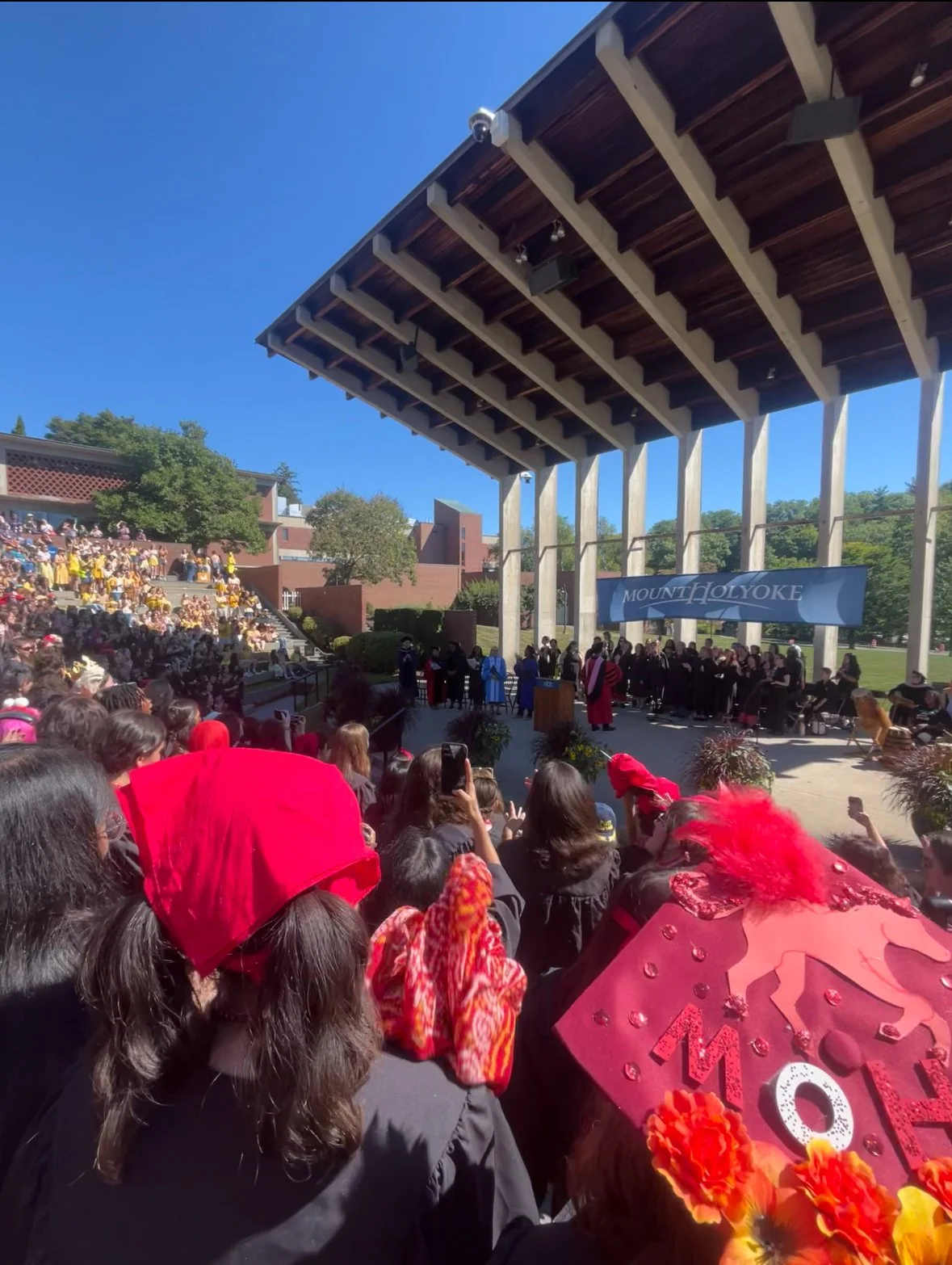
Students decked out in their class colors gathered in the Gettell Amphitheater to watch as this year’s Convocation began on a bright Tuesday morning.

Elizabeth Murray ‘26

Features Editor

It was a sunny day, and students enthusiastically filled the Gettell Amphitheater as the Five College West African Music Ensemble played. On Sept. 2, Mount Holyoke College held its annual Convocation to mark the beginning of a new academic year.

Convocation is a time-honored Mount Holyoke tradition, welcoming new and returning students. For first years, it's the wrap-up to orientation and their first campus-wide tradition. For seniors, it’s a great way to start their last year. “Everyone was cheering for all classes and faculty with catchy chants that made it hard not [to] join in! Not to mention some of the insanely creative outfits of some students that were a sight to see! I had such a great time and can’t wait for next year’s convocation!” Adrian Moncrief ’29 said in an email interview with Mount Holyoke News.

Although the Amphitheater’s ramp was blocked by construction, an accessible viewing was organized in the Gamble Auditorium. When asked about experiencing convocation indoors, Mia Gonzales Jackson ’26 said, “Folks in charge made sure we got water and beads, so we were well taken care of; [they] even made sure I made it back outside for the senior photo.”

Yet, despite many positive experiences, this year's Convocation was mired in controversy. Mount Holyoke College facilities workers, dining employees and housekeepers, who are members of the Service Employees International Union and the United Auto Workers Union, had gone six months without coming to an agreement on a contract. On Convocation, the workers protested the lengthy negotiations with a strike, during which the college hired outside staff for the post-Convocation barbecue. This was criticized as strike-breaking and prompted calls for a boycott in the days leading up to the ceremony. Many students chose to wear union pins and hold up signs expressing their support for the strike during the ceremony.

As the senior students and faculty came down the stairs, the usual convocation energy was high, and everyone took their seats. However, when Sally Durdan ’81, chair of the Board of Trustees, began her speech thanking the College’s staff for their hard work, the crowd immediately broke out into chants of “pay your workers” and “no Convocation,” interrupting the ceremony for several minutes.

Vic Klapa ’26, who had brought their own megaphone, led the chant and read a speech criticizing the college’s treatment of its staff. Eventually, President Holley came to the podium, at which point the Mount Holyoke Convocation Choir turned their chairs away from her. She stated her support for the College’s workers and her commitment to finding a solution. “We will never stay as a college that does not fairly engage with its workers. I promise,” she assured. President Holley also said that if the students did not wish to proceed with Convocation, she would respect that decision.

The crowd settled, and Convocation proceeded as normal. Durdan finished her speech and then ceded the podium to President Holley. In her speech, Holley announced that the theme for this year's Convocation was sustainability, “in every sense of the word.” Holley’s speech highlighted the College’s efforts to become environmentally sustainable through its geothermal project, as well as ensuring the Mount Holyoke community is sustainable through all the upheavals the world may throw at it. In her speech President Holley noted how in its 188-year history Mount Holyoke’s community has withstood natural disasters, wars, and pandemics, to name a few, and that it will continue on.

Next was a speech by Student Government Association (SGA) President Nathania Amadi ’26. Amadi spoke about making the Mount Holyoke College community stronger by continuously working to be inclusive and rejecting all forms of hate, prejudice, and bullying. She also highlighted SGA’s successes, such as providing free laundry in the dorms and free sanitary products in the bathrooms in Blanchard Hall. In a touching moment, Amadi called on all current and past members of the SGA to stand up and thanked them for their hard work and effort, highlighting that these wins were not a one-person job. She ended her speech by noting that growth is a continuous process, and encouraging our community to strive for it.

When asked about her feelings post-Convocation, Amadi said, “After the ceremony, I felt exhilarated, empowered, and excited to start the new year! Hearing the cheers from everyone whilst talking about change during my speech was reassuring that our great community will embrace and implement said change.”

After Amadi, Angelica Patterson, Curator of Education and Outreach for the Miller Worley Center for the Environment, spoke on the theme of sustainability and how it expands beyond environmental causes, encouraging personal growth and challenge. This was followed by the choir led by Colin Britt, lecturer in music and director of choral activities, singing “I. we have come,” a Persian song arranged by Abbie Betinis, based on the poems of Hâfez.

The final speaker was Olivia Aguilar, associate professor of environmental studies. Her speech tied back to this year’s common read, “Parable of the Sower” by Octavia Butler, comparing the novel’s plot to the issues facing our world today. In particular, she highlighted how the novel discusses climate change and how Mount Holyoke community members can learn to fight for a better future through our community.

The choir closed the ceremony with a rendition of the alma mater, and the seniors posed for their class photograph. In the end, a long-held school tradition marked by students making their voices heard probably made this year's Convocation the most Mount Holyoke of them all.

Leah Dutcher ’28 contributed fact-checking.