
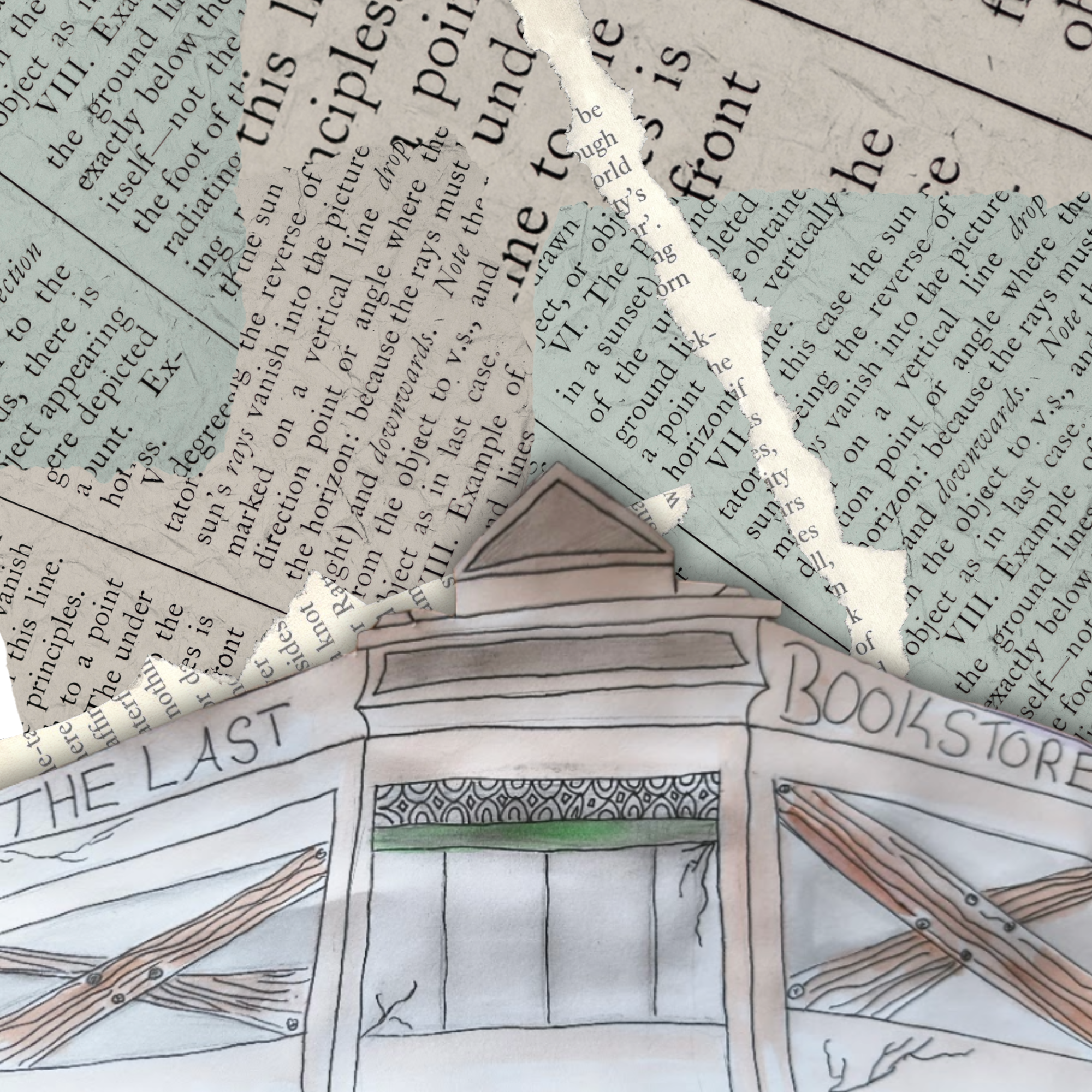
Graphic by Brianna Stockwell ’28
By Emily Finnila ’27
Contributing Writer
In her debut novel, “The Last Bookstore on Earth,” Smith College senior Lily Braun-Arnold imagines our modern world after an apocalyptic event. In this novel, the “Storm” has brought intense acid rain down all over America and left the nation in shambles, as seen in New Jersey, where the main character Liz Flannery lives. After tragedy strikes her family in the Storm, Liz chooses to live in her old workplace: A bookstore nestled in the abandoned suburbs. As she survives by bartering books with the few customers who still visit her bookstore and eating old stockpiled food, Liz learns of another impending acid rainstorm that her broken-down store is not prepared to handle.
Luckily for Liz, one night a stranger breaks into her bookstore looking for shelter, and she just so happens to be skilled at repairs. This is Maeve, the book's second main character, who agrees to help Liz fix up the bookstore in the hopes that its shelter will protect them both from the approaching storm. The book then follows their lives in this still recently-apocalyptic world, as they deal with their past trauma from the Storm, their current impending doom and their feelings for each other.
While the premise is exciting, this novel also has a few pitfalls. The book confronts the idea of the end of the world for a very specific and privileged group. Told from a first-person perspective, the reader hangs out with Liz for the entirety of the novel, and Liz doesn’t get out much. Having never left the bookstore for a year, Liz hasn’t seen how the rest of the world is fairing after this massive event. The story only explores Liz’s personal world ending: The world of an upper-middle class white family from the American suburbs. There is no mention of the wider world.
When Liz receives visitors at the bookstore, she writes down their stories of the Storm and their new lives, so we get a glimpse of how other parts of the U.S. were affected; mostly places in the East Coast and Northampton are mentioned! But the worldbuilding details stop there. This leaves readers with multiple questions, like did the Storm happen globally? How did this world’s population lose the ability to communicate online? What’s the state of the U.S. government? What happened to all the cars and infrastructure? None of these questions are really answered because the protagonist, Liz, doesn’t know the answers herself.
So, this book isn’t one to pick up if you’re looking for a rich new apocalyptic/dystopian world, like “The Hunger Games.” Instead, it would be one to read if you were interested in an introspective story about someone coming to terms with a changed world and life that will never be the same. Liz isn’t someone you would expect to have survived an apocalypse. She has zero survival instincts or skills and is entirely reliant on Maeve for everything. This makes her a very realistic protagonist in an apocalypse — albeit a frustrating one — that readers may find themselves in. This book often prompts you to question what the end of your life as you currently know it would look like. How would you deal with it, and how would you move on?
You may survive by becoming a hermit like Liz, or you may go out and explore this new world like Maeve. Either way, the end of the world may be closer than you think because — reminiscent of the movie “Don’t Look Up” — this book’s apocalypse comes when everyone is trying to pretend that everything is fine, much like the world today.
Despite my criticisms of “The Last Bookstore on Earth,” if I had discovered this book in my local library when I was younger, I would’ve devoured it. Reading about queer women taking on an apocalypse from a bookstore would’ve been right up my alley. And so, I’m immensely glad that this book will be discovered by other queer kids searching for these stories. This is the first of hopefully many books from Lily Braun-Arnold, and I’m excited to see what she writes next in the world of queer literature.
Abigail McKeon ’26 contributed fact checking.