MHC Board of Trustees to vote on retirement of PaGE

Graphic by Brianna Stockwell ’28

By Sydney Wiser ʼ27

Features Section Editor

Mount Holyoke’s Professional and Graduate Education — also known as PaGE — program has offered students in the education sector opportunities for higher education for 13 years, graduating 545 masters students as of May 2025 and serving 330 non-degree students in the past 5 years. The Board of Trustees will hold a vote to potentially retire the program in its entirety in October.

On Sept. 3, 2025, in an email from President Danielle Holley, reports from the College’s various 2024-25 working groups were shared with the Mount Holyoke community.

These working groups, composed of Mount Holyoke faculty members, were created as a part of President Holley’s MHC Forward Strategic Plan, and covered a range of topics from Career Readiness and Exploration to Supporting the Trans and Gender Nonconforming Community.

The Graduate and Professional Programs Working Group — abbreviated as GPPWG — began its first phase in between October and December 2024, and was part of the “Resource Stewardship” pillar of the MHC Forward Strategic Plan, according to the College. GPPWG, along with a consulting group, Hanover Research, was tasked with assessing “both current and potential future Mount Holyoke College programs against the dual benchmarks of reputational enhancement and revenue generation.”

In their May 2025 report, GPPWG found that the PaGE programs “represent an annual drain on College resources,” and that there were few reputational benefits to keeping them operating in their current capacity.

When looking at the net income of the PaGE program over the last four years, GPPWG projected a loss of $157,000 for the 2025 fiscal year. GPPWG also projected flat to declining numbers of enrollees for the 2025 fiscal year, following the trend of the last four years.

GPPWG also noted that while PaGE programs have seen a recent uptick of professional development contracts, which is in part how PaGE programs bring in revenue, “the current federal funding and regulation landscape makes the future of such programs (and revenue from them) uncertain at best.”

Based on their findings, GPPWG recommended the retirement of the program, with an emphasis on supporting PaGE staff, and further investigation into whether the College could adopt other academic programs in place of PaGE that would more effectively bolster the reputation and revenue of Mount Holyoke.

“This recommendation would allow the College to further focus on and support our undergraduate program, including our undergraduate teacher licensure program,” the College said in a statement to the Mount Holyoke News.

The College added that in anticipation of the Board’s decision, Mount Holyoke had paused applications for Spring 2026 enrollment and ensured current enrollees in the PaGE program would be able to finish by summer 2027 at the latest.

For current and former PaGE program students, the news came as a shock.

Alison Beattie, a 2017 alum of the graduate program, described the decision to close the program as “gut-wrenching.”

“To cancel a program where you help garner a workforce that is so deeply important I will never understand. It seems that MHC doesn’t care about investing in young learners in MA unless they are prepared to pay undergraduate tuition,” Beattie said.

Beattie also served on the alum panel when the program was set to be reviewed by the Massachusetts Department of Elementary and Secondary Education and noted that the program had received accolades like the department’s “Approval with Distinction.”

The day before the GPPWG’s report went public, current graduate student Evelyn Bushway ’24 received an email from Provost and Dean of Faculty Lisa Sullivan and Interim Executive Director of Professional and Graduate Education Programs Corinne Miller. “I just remember reading and being super confused and having a hard time understanding it,” Bushway said.

In the email, Bushway was informed of GPPWG’s recommendation to end the PaGE programs. Sullivan and Miller explained that the recommendation was supposed to “allow MHC to focus institutional resources on its mission and strengths as the leading gender-diverse women’s college for undergraduate education.” Sullivan and Miller also stressed that currently enrolled students who did not deviate from their plan of study would be able to complete their degree and encouraged Bushway to fill out a feedback form about the recommendation.

According to Bushway, she has not received any other information from the College’s senior leadership team.

PaGE alum Jazebel Bermudez, who received a master of arts in teaching in English as a Second Language from Mount Holyoke, heard about GPPWG’s report when she was considering returning to the College. Bermudez wants to become the director of a language program and was looking forward to using PaGE’s Teacher Leadership program to help her reach that next step. When she discovered the program might be shut down, Bermudez was shaken.

“My support system that I depended on is gone,” Bermudez said.

Bermudez began studying at Mount Holyoke in 2018 through a program called Urban Teacher Pathways, which helped Holyoke public school educators earn a master of arts in teaching, an initial general education license and at least one other license, including English-language learners.

As a first generation graduate of high school, college and graduate school, Mount Holyoke College gave Bermudez opportunities she did not think were possible. “If it wasn't for Mount Holyoke, I don't think I would be in the position I am today,” Bermudez said.

Bermudez emphasized how the diversity in her classes and her close relationships with professors supported her as she tackled being an educator, new mother and graduate student.

Having studied at the College for her undergraduate degree, Bushway knew the aspects of the College she would appreciate for graduate school. She emphasized the academic rigor she had grown familiar with at the undergraduate level, the support system Mount Holyoke provided through resources like the SAW center, and the opportunity to connect with groups of students with teaching experiences both domestic and international.

The College also had something that few other institutions Bushway knew of, had — a master of arts of teaching in mathematics. This program allows students to concentrate their teaching studies in mathematics while also studying for their masters in education. As someone who had always enjoyed middle school math, Bushway knew that this was the program for her.

“Having a master's that helped me dive deeper into mathematics and [see] how we can facilitate student discussions of math and help [students] have a deeper understanding of math was super important to me,” Bushway explained.

Before graduating from Mount Holyoke in 2024, Bushway already had a teaching job and a commitment to Mount Holyoke’s graduate school lined up.

After the recommendation to terminate the PaGE program was made public, alums and current students rallied together in protest. Across all 11 graduate classes of the master of arts in mathematics program, 46 alums sent a letter attached with written testimonies about the impact of the program to the College’s senior officials.

“Because of the nature of our work as educators, the work of every graduate multiplies exponentially through every student we teach, teacher we develop, and organization we lead. It is not an exaggeration to claim millions of students and educators have been positively impacted by this group of co-signers and the scores of other alumni of the program,” part of the letter reads. 40 alums of the program also replied to the email thread signaling their support.

Bushway put together a similar email for her graduating class cohort.

A decision will be made in October when the Board of Trustees votes on the recommendation from GPPWG. Regardless of the outcome, the College said, “Mount Holyoke emphasizes that PaGE graduates will continue to be a valued part of the MHC alum community. Their contributions to education and public service reflect the College’s enduring mission of lives of purposeful leadership, and the College will always be incredibly proud of their accomplishments and academic journeys.”

Karishma Ramkarran ’27 contributed fact checking.

Answering your questions about the College’s budget: Part one

Graphic by Betty Smart ’26

By Betty Smart ’26

Graphics Editor

The recent strike of Mount Holyoke College’s workers made me very curious about exactly how the College’s budget works. While the College’s annual financial statements are available for public viewing on the MHC website, for most students their only real exposure to the budget comes from experiencing increases in tuition. I sat down with the College’s Vice President for Finance and Administration and Treasurer, Carl Ries, to break down the budget.

Something important to know off the bat is that there are actually two budgets. One is the operating budget that directly deals with the ins and outs of the college, including but not limited to wages, benefits, supplies, and maintenance. The other is the capital budget, which is used for bigger infrastructure projects.

Where does the college get its money?

Ries explained to me that the College’s operating budget encapsulates “everything… from food to utilities to paying our employees … Our annual budget is … somewhere in the $165 to $180 million range, depending on how you interpret it. That is what it takes every year to run the college. We don't borrow money to run the college, we have to balance the budget.”

“Tuition, housing, and food is the majority of our revenue; so, let's just call it $100 million out of $165 or $170 million. The other $65 million, we have to find sources for that every year. The next biggest support is our endowment,” Ries said.

Mount Holyoke College’s endowment is a collection of individual funds that regularly invest in the markets, with each fund having their own restrictions on what they can be spent on.

“The endowment is basically protected forever … we really can’t touch that money because it’s permanently restricted, the majority of it. There’s some unrestricted, but this is how endowments work. The vast majority are protected … in perpetuity. So you can only take the earnings every year,” Ries continued. “Every year, the endowment does well in the markets… They'll spin off a little bit of money every year. And that money… we're allowed to spend. So we call it basically 5%... of the endowment value we can use every year to support the college… it’s about $50 million a year.”

“So you have 100 million in tuition, housing and food. You've got $50 million in endowment support, leaving [you] somewhere between another $15 and $20 million that we've got to find every year. So fundraising is about $10 million for what we call the annual fund. And again, this is money that just gets used to support the operating budget,” he explained.

“So that leaves like another … five to 10 [million] left.” Ries went on to describe other forms of revenue that make up this last amount, which included people paying to eat in the dining commons, the hotel, and summer conferences. All of these are categorized as auxiliary income, Ries finished.

What does the college spend its money on?

According to Ries, “Personnel, staffing, faculty, wages and benefits. So everything for … faculty, student labor, workers in the dining commons, facilities and maintenance.”

“Next… when we think about categories of expenses, you can start to think about things like utilities … gas, electricity, water, those kinds of things tend to be pretty pricey when it comes to the budget,” Ries said. “And then the other big piece is really the cost of all of our systems. So Workday, Colleague, all of the IT support and function services, that's a huge and increasing amount of our budget annually.”

He continued, “There are other things…just to shed light on sort of why we raise tuition. Utilities is part of it, but in the dining hall, those ingredients… are increasing exponentially right now. We saw a 20% increase recently in getting local meat, which [when] you think about like how much meat we actually use, can be significant… If an orange goes up 20%, [it’s] maybe not a big deal. But if all my groceries go up 20%, that makes a big difference. So, we do have to kind of constantly be aware of how that impacts our food and housing costs.”

Another operating expense is depreciation of the various buildings and projects on campus that are paid off a little at a time.

Does the end of the strike mean any big changes are coming?

Ries explained, “We generally expect expenses to go up between, you know, 2% and 4% a year based on inflation and increased wages. That's going to be the case even with the union deal… I think it's a great outcome for our employees. They're seeing significant wage increases in the first year, and then those wage increases slow in the second and third years of the contract. But I'd say that the outcome of the union deal is very much in line with what we expected from a budget impact, so there's not a huge impact.”

How will the college keep giving financial aid if tuition goes up again?

“First of all, Mount Holyoke is committed to making sure that we meet a student's financial need. So Student Financial Services works with every student based on their expected family contribution within the parameters of what they can afford and offers a package … Even when tuition increases happen, the amount that the student pays might increase, but it won't increase 100% of what tuition goes up because some portion of their whole education, if they have financial aid, is being covered by the college,” Ries said.

He gave an example: “Tuition went up 10% three years ago … And students who were basically getting a full ride, they didn't see any change … because they had 100% need. Students who had like a 50% need, they might have seen a small increase because part of their tuition was already being paid for by the College and part was being paid for by the family. So they didn't see an entire increase of 10%. They maybe saw 5% for some of those students. We try not to raise tuition as much as is possible, but we do need to raise for inflation.”

“...Over time, the College has offered significant financial aid to the point where a majority of our students are getting some financial aid… So part of what we have to do is…balance as much as we can trying to get a slightly higher average tuition per student because we have students that have more ability to pay full tuition on average. And so we try to balance the financial aid to provide as much access as possible, but knowing that we still rely on some full and fuller pay students,” he concluded.

Karishma Ramkarran ’27 contributed fact checking.
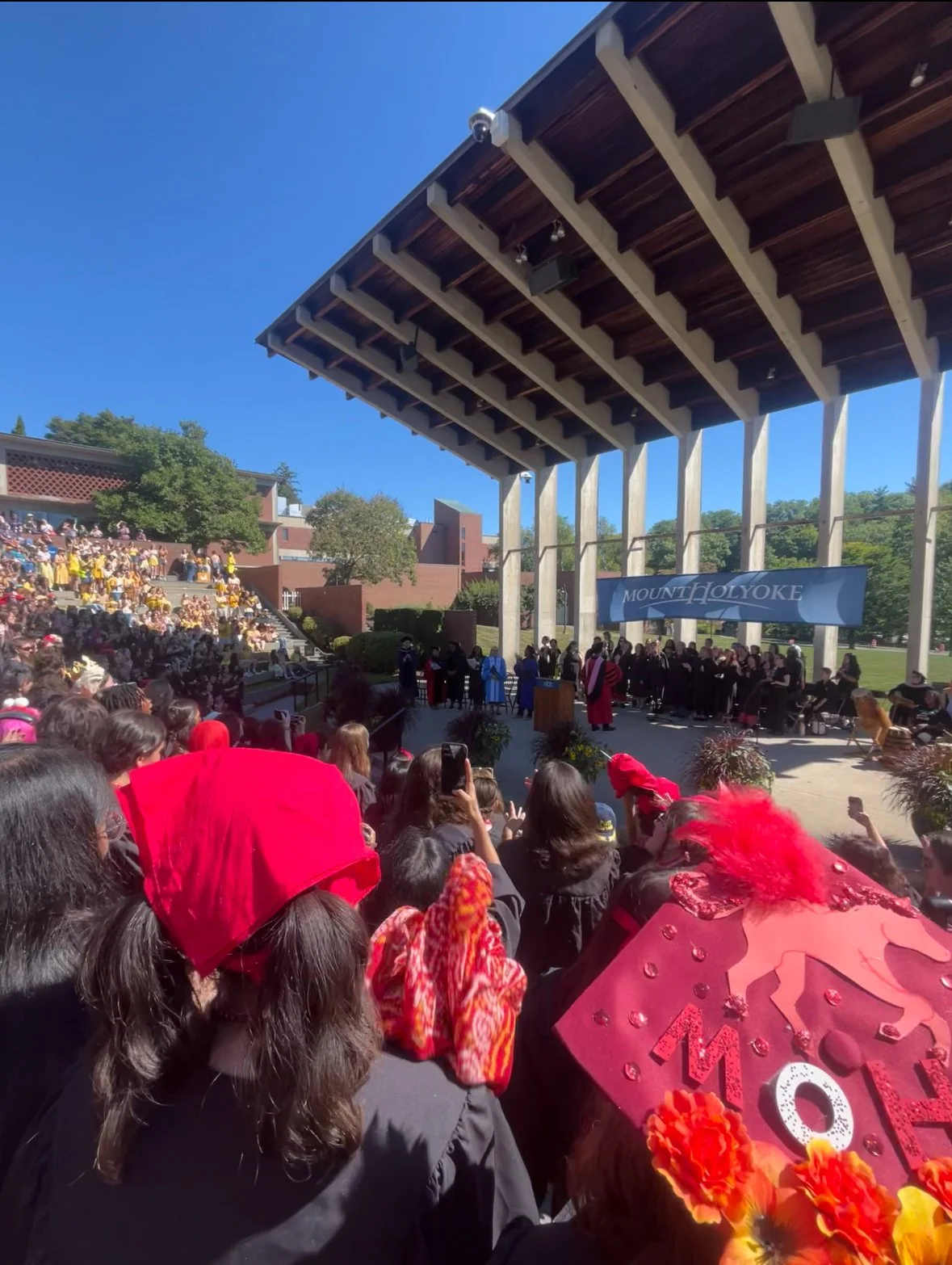
Mount Holyoke rings in another academic school year

Photo by Elizabeth Murray ’26
Students decked out in their class colors gathered in the Gettell Amphitheater to watch as this year’s Convocation began on a bright Tuesday morning.

Elizabeth Murray ‘26

Features Editor

It was a sunny day, and students enthusiastically filled the Gettell Amphitheater as the Five College West African Music Ensemble played. On Sept. 2, Mount Holyoke College held its annual Convocation to mark the beginning of a new academic year.

Convocation is a time-honored Mount Holyoke tradition, welcoming new and returning students. For first years, it's the wrap-up to orientation and their first campus-wide tradition. For seniors, it’s a great way to start their last year. “Everyone was cheering for all classes and faculty with catchy chants that made it hard not [to] join in! Not to mention some of the insanely creative outfits of some students that were a sight to see! I had such a great time and can’t wait for next year’s convocation!” Adrian Moncrief ’29 said in an email interview with Mount Holyoke News.

Although the Amphitheater’s ramp was blocked by construction, an accessible viewing was organized in the Gamble Auditorium. When asked about experiencing convocation indoors, Mia Gonzales Jackson ’26 said, “Folks in charge made sure we got water and beads, so we were well taken care of; [they] even made sure I made it back outside for the senior photo.”

Yet, despite many positive experiences, this year's Convocation was mired in controversy. Mount Holyoke College facilities workers, dining employees and housekeepers, who are members of the Service Employees International Union and the United Auto Workers Union, had gone six months without coming to an agreement on a contract. On Convocation, the workers protested the lengthy negotiations with a strike, during which the college hired outside staff for the post-Convocation barbecue. This was criticized as strike-breaking and prompted calls for a boycott in the days leading up to the ceremony. Many students chose to wear union pins and hold up signs expressing their support for the strike during the ceremony.

As the senior students and faculty came down the stairs, the usual convocation energy was high, and everyone took their seats. However, when Sally Durdan ’81, chair of the Board of Trustees, began her speech thanking the College’s staff for their hard work, the crowd immediately broke out into chants of “pay your workers” and “no Convocation,” interrupting the ceremony for several minutes.

Vic Klapa ’26, who had brought their own megaphone, led the chant and read a speech criticizing the college’s treatment of its staff. Eventually, President Holley came to the podium, at which point the Mount Holyoke Convocation Choir turned their chairs away from her. She stated her support for the College’s workers and her commitment to finding a solution. “We will never stay as a college that does not fairly engage with its workers. I promise,” she assured. President Holley also said that if the students did not wish to proceed with Convocation, she would respect that decision.

The crowd settled, and Convocation proceeded as normal. Durdan finished her speech and then ceded the podium to President Holley. In her speech, Holley announced that the theme for this year's Convocation was sustainability, “in every sense of the word.” Holley’s speech highlighted the College’s efforts to become environmentally sustainable through its geothermal project, as well as ensuring the Mount Holyoke community is sustainable through all the upheavals the world may throw at it. In her speech President Holley noted how in its 188-year history Mount Holyoke’s community has withstood natural disasters, wars, and pandemics, to name a few, and that it will continue on.

Next was a speech by Student Government Association (SGA) President Nathania Amadi ’26. Amadi spoke about making the Mount Holyoke College community stronger by continuously working to be inclusive and rejecting all forms of hate, prejudice, and bullying. She also highlighted SGA’s successes, such as providing free laundry in the dorms and free sanitary products in the bathrooms in Blanchard Hall. In a touching moment, Amadi called on all current and past members of the SGA to stand up and thanked them for their hard work and effort, highlighting that these wins were not a one-person job. She ended her speech by noting that growth is a continuous process, and encouraging our community to strive for it.

When asked about her feelings post-Convocation, Amadi said, “After the ceremony, I felt exhilarated, empowered, and excited to start the new year! Hearing the cheers from everyone whilst talking about change during my speech was reassuring that our great community will embrace and implement said change.”

After Amadi, Angelica Patterson, Curator of Education and Outreach for the Miller Worley Center for the Environment, spoke on the theme of sustainability and how it expands beyond environmental causes, encouraging personal growth and challenge. This was followed by the choir led by Colin Britt, lecturer in music and director of choral activities, singing “I. we have come,” a Persian song arranged by Abbie Betinis, based on the poems of Hâfez.

The final speaker was Olivia Aguilar, associate professor of environmental studies. Her speech tied back to this year’s common read, “Parable of the Sower” by Octavia Butler, comparing the novel’s plot to the issues facing our world today. In particular, she highlighted how the novel discusses climate change and how Mount Holyoke community members can learn to fight for a better future through our community.

The choir closed the ceremony with a rendition of the alma mater, and the seniors posed for their class photograph. In the end, a long-held school tradition marked by students making their voices heard probably made this year's Convocation the most Mount Holyoke of them all.

Leah Dutcher ’28 contributed fact-checking.

Mount Holyoke students reflect on housing lottery challenges

Photo by Sydney Wiser ’27

Creighton Hall, one of 18 residential halls on Mount Holyoke College’s campus, is home to several Living-Learning Communities and includes many amenities such as air conditioning and a full kitchen.

By Jo Elliott ’28

Staff Writer

Mount Holyoke has a diverse range of housing options, with 18 residential halls and ten non-residence hall apartments for students to be housed in. While each dorm has its own pros and cons, it’s the housing selection lottery that most students have recently had difficulty adjusting to. This year’s housing lottery took place from late March into mid-April.

Kairi Harness ’28, who participated in the housing lottery for the first time this year, described confusion and frustration when it came to the process. “With the whole lottery system, I didn't understand the rules, I didn't know what was happening,” Harness said.

Others, it seems, feel the same way. Another first year, Fajar Amjad ’28, said, “I had very, very limited options that did restrict my choices … I didn't feel like I had a choice at the end of the day.” By the time they could select a room, Amjad noted, they were left with only two dorm options: 1837 Hall and Prospect Hall.

According to Harness, housing selection makes much more sense for incoming students.“The housing process when applying to a new college is easy, so easy. It was so simple, you just filled out the form, you were done,” Harness said.

Rosemary Osafo-Kwaako ’26, a resident advisor for the first-year exclusive MacGregor Hall, added to the discussion about first-year housing, stating that the promotional videos the College posts to YouTube and TikTok about the residence halls are helpful for incoming students. “I do think they're trying well with the YouTube videos and the TikToks,” Osafo-Kwaako said. The purpose of these videos is to prepare the incoming first years for what’s in store, as many of them do not have the opportunity to interact with the dorms before arriving on campus.

Nevertheless, current Mount Holyoke students have experienced issues with finding on-campus housing. “There is a general shortage of rooms that we feel like exists,” Amjad said.

Although most students interviewed did not claim their issues were part of a housing shortage, Amjad noted that, “I do think there are more people present than there are rooms, and I also think that people who require or need more options aren't getting enough, especially people who need accommodations.”

Harness tended to agree with the assessment that student housing issues may be caused by a shortage, stating that, “It feels like you're fitting three people into a space. It feels like the …. newer triple rooms are just what used to be double rooms. They're just shoving a new bed in there to make room.”

Other students agree that there is a housing problem, but do not believe it is due to a shortage. Anha Chaudhry ’28, for instance, said in an email to Mount Holyoke News, “I don't think there is a housing crisis in the sense that there's not enough housing for all of us, but I do feel like there's a bit of an issue with accommodations and students needing singles … I get that there needs to be some sort of strict policy to ensure that not every student is getting their way to a single when others may need it more, but it's really exhausting when I have several evident disabilities and concerns and am still sent into a loop of doubt.”

Moreover, Chaundhry noted, “I think there needs to be a more straightforward method to attain accommodations instead of both facilities not taking responsibility for the first step. There should be a streamline[d] pattern for a student to fill out a form, meet one office, get confirmation from the other, come to a conclusion and get the accommodations they need, be it a single, central campus housing, lower floor rooms, or having ACs and larger appliances.”

Adeyla Hoenck ’28 contributed fact-checking.

SCOTUS amidst the Trump administration: An interview with Danielle Holley

Graphic by Brianna Stockwell ’28

By Liliana Stinson ’27

Contributing Writer

Even before Donald Trump's inauguration as president on Jan. 20, 2025, the Supreme Court of the United States has functioned as a significant political actor. With a few notable exceptions, the nine justices have decided most cases along liberal and conservative ideological lines, and the conservative majority has not shied away from dismantling decades-long precedents in order to pursue a partisan agenda. 

How might the political role of the Supreme Court change in the context of Trump’s second term? To answer this question, Mount Holyoke News sat down with Mount Holyoke College President and legal scholar Danielle Holley, who offered insight into the current landscape of the Supreme Court. 


The first case the Supreme Court has ruled on relating to Trump’s second term executive orders is Department of State v. AIDS Vaccine Advocacy Coalition. This case occurred in response to Executive Order 14169, “REEVALUATING AND REALIGNING UNITED STATES FOREIGN AID,” which ordered a 90-day pause on all foreign aid programs. On Feb. 10 and 11, recipients of foreign aid and non-profit organizations issued two lawsuits challenging this order, one of which resulted in this case. 

On March 5, the Supreme Court issued a 5-4 decision empowering a district judge to move forward with his order that the State Department and U.S. Agency for International Development must issue payments for work already performed by the AIDS Vaccine Advocacy Coalition and other organizations and corporations. The payments would total nearly $2 billion. Since these organizations and corporations historically receive federal foreign-assistance funding and had completed work before Trump released the executive order, they required these earnings by law.

This decision is notable: By making the executive branch follow the contracts and federal appropriations guidelines set out by Congress, the Supreme Court is upholding a fundamental separation of powers outlined by the Constitution. However, the majority is extremely slim and has only issued an unsigned, one-paragraph opinion, as opposed to the eight-page slashing dissent authored by Justice Samuel Alito and joined by justices Clarence Thomas, Neil Gorsuch and Brett Kavanaugh. 

Additionally, in this dissent, Alito indicates that the dissenting justices would have preferred for the Court to officially review the case on its merits, rather than just deciding to approve or deny the government’s request to vacate the judge’s order. 

This is significant, Holley said, as a further review of this case could have implications on the powers of federal judges. “Every district court judge, like we saw with the district court judge in this opinion, has the ability to issue what's called a nationwide injunction,” Holley explained. A nationwide injunction allows judges to block federal policy or orders nationwide. This power has recently become controversial because judges have used it against the Trump administration. “In the previous administration, it was operating in benefit of conservatives. In this administration, it's operating in benefit of liberals,” Holley said. 

“I think what the Supreme Court is struggling with is, if you do not like nationwide injunctions, that can't be a partisan view … If you don't like it for USAID, you [can’t] like it for mifepristone,” Holley continued, noting the injunction District Judge Kacsmaryk issued in 2023 suspending FDA approval of mifepristone, a drug crucial to medical abortion. 

Indeed, this case touches on the increasing politicization of the judiciary, not only because of conservative outrage against the power of liberal judges to issue nationwide injunctions, but also because of the tendency of those on the far-right to punish any judge — or justice — who rules against Trump. 

For example, Justice Amy Coney Barrett joined the majority decision and allowed the injunction against Trump to go through. After the decision was released, Barrett faced an online barrage from far-right personalities. These attacks included accusing her of being a “DEI hire,” which Holley said indicates the prejudice behind the movement against diversity, equity and inclusion. As Holley described, “When you hear someone say someone is a DEI hire, they're attempting to attack that person on the basis of their race or gender … Amy Coney Barrett is the subject of sexist attacks because she failed to adhere to the party line.” 

The attacks on the judiciary have threatened other justices as well.  In a March 18 post on Truth Social — the far-right social media platform modeled after the website formerly known as Twitter — Trump called for the impeachment of U.S. District Judge James Boasberg, who ordered the Trump administration to cease deportation flights under the Alien Enemies Act. This is a largely unprecedented attack on the judiciary, which is intended to operate entirely independently from political influences in order to protect the rule of law. 


Indeed, only 15 federal judges have ever been impeached, all related to high crimes and misdemeanors in which the judges broke the law or abused their position. The fact that the president has called for judicial impeachment due to a political disagreement is a shocking breach of civil norms, and even evoked a rare rebuke from Chief Justice John Roberts. 

“For more than two centuries, it has been established that impeachment is not an appropriate response to disagreement concerning a judicial decision,” Roberts said in a statement issued mere hours after Trump’s social media post. “The normal appellate review process exists for that purpose.”

Though it is extremely unlikely that Congress would actually remove federal judges from office, a representative has introduced articles of impeachment against Judge Boasberg in the House. 

In response to the growing politicization of the judiciary, Holley said, “We have to fight on every front. So number one, I would encourage people to raise their voices at every opportunity, right, [when] they feel that their First Amendment free speech is being shut down, to petition their government, write to their Congressperson, write to their senator, write to the White House.” 

“The second thing is,” Holley continued, “we have to fight in the courts … because, honestly, much of what the current administration is doing is extralegal, is outside of the rule of law … Everyone in our society must be responsible for following the rule of law. And if they aren't, then we aren’t in a democracy.”

Lastly, Holley advocated for the College’s community to gain a thorough understanding of the norms and limits of government power. “We have to gain more knowledge about what our government [is] authorized to do, because this is a time where we have to push back against government authority. Most of the time we think of the government as our protector. In this case, the government is our oppressor,” Holley said. “One of the features of living in what is supposed to be a democratic institution, is to have no fear in saying our government is wrong, our government is not following the rule of law, our government should be challenged and sanctioned based on what they do, and that's one of the most critical things we can do as people who support democracy at this time.” 

Madeleine Diesl ’28 contributed fact-checking.

Loksi’ Shaali’ opera premieres on the East Coast at MHC

By Jo Elliot ’28

By Jo Elliott ’28


“Loksi’ Shaali’,” the first-ever opera to be sung entirely in a Native American language, premiered on the East Coast in Mount Holyoke’s own Abbey Memorial Chapel on Friday, Feb. 28. The two-act opera is performed in Chickasaw and was created by Chickasaw composer Jerod Impichchaachaaha’ Tate, a revolutionary figure for bringing Native American voices to opera. 

The performance featured Mount Holyoke’s Symphony Orchestra, Glee Club and Chamber Singers and was conducted by Director of Orchestral Studies Tianhui Ng. The opera featured several distinguished singers, including Cristina Maria Castro, Charles Calotta, Kirsten C. Kunkle, Nicole Van Every, Mark Billy and Grant Youngblood. 

The opera takes place approximately a thousand years ago on the ancestral land of the Chickasaw tribe. It opens with a young Chickasaw girl, Loksi' — meaning “Turtle” — who regains confidence in herself after gaining wisdom from her grandmother and Old Turtle. According to a press release on the Mount Holyoke College website, “the young girl learns she must leave home to find her purpose. She sets out on a long woodland journey, returning a cultural hero, enriched by the divine gift of the turtle shell shakers and knowledge of the Chickasaw people’s new homelands.”

The production of the opera started in 2021. Tianhui Ng and the Mount Holyoke Symphony Orchestra received a Mellon Foundation Five College Native American Indigenous Studies Grant, in order to develop the world’s first opera sung entirely in a Native American language. The grant allowed for libretto, piano-vocal and orchestra workshops to occur. In addition, Tate had a semester-long residency with the students to allow for “critical conversations surrounding the performance practice of Native American work.” 

Zoya Agboatwalla ’28 stated, “We have been preparing for the opera almost all semester, even having extra classes to make sure that it was sung in the way that the director and the composer intended. Our preparation extended beyond just learning the music. We studied the story and meaning behind the opera, which deepened our understanding and made the performance more powerful.”

Agboatwalla also mentioned that the main challenge they faced around producing the opera “stemmed from the length of the opera itself. Throughout rehearsals, sections were frequently cut or reintroduced, meaning no two performers had identical scores. This required us to rely heavily on our ears and one another rather than just reading and following a fixed score.”

According to Ainsley Morrison ’25, President of the Mount Holyoke Symphony Orchestra and co-principal violist, “This was not our first time working directly with a composer. The music department and the orchestra frequently commission pieces from composers. However, this was the first time we have had an in-person interface with a composer since the pandemic.” 

“The Mount Holyoke Symphony Orchestra works with the choral forces at least once a year at the Family and Friends performance, and working together is not unusual,” Morrison said. “The scale of this particular performance was unusual, as we were working not only with our fellow student ensembles, but with renowned Native American opera singers from all over the country, and with many local professional singers and instrumentalists.”

The Mount Holyoke Symphony Orchestra has plans to continue collaborating with the Chamber Singers and Glee Club. “The Mount Holyoke Symphony will be performing on April 18 with Han Chen, a professional pianist,” Morrison said. “The orchestra will have our usual collaboration with Glee Club, Chorale, and Chamber Singers at the Family and Friends Concert in the fall.”


Madeline Diesl ’28 contributed fact-checking.

Larry Spotted Crow Mann speaks at Indigenous Heritage Month events

Larry Spotted Crow Mann speaks at Indigenous Heritage Month events

Indigenous Heritage Month was celebrated through the sponsorship of several offices and programs at Mount Holyoke College last month, with several events featuring guest speaker Larry Spotted Crow Mann. The first event, “The Living Presence of Nipmuc People,” was held virtually on Nov. 14 from 7-8:30 p.m., inviting all community members to view online. A second event, an interfaith lunch, was held in person on Nov. 21 from 12-1:30 p.m. 

Mount Holyoke celebrates Diwali: A night of culture and community

Mount Holyoke celebrates Diwali: A night of culture and community

The South Asian community at Mount Holyoke College illuminated Chapin Auditorium with the vibrant celebration of Diwali, the Festival of Lights, on Saturday, Nov. 23. Organized by AWAZ, the South Asian Association on campus, and co-sponsored by the Weissman Center for Leadership and the Office of Diversity, Equity and Inclusion, the event brought together students, faculty and visitors for an unforgettable evening of cultural immersion. 

VariAsians 2024: A delightful night of Pan-Asian culture celebration

 VariAsians 2024: A delightful night of Pan-Asian culture celebration

VariAsians, the annual celebration of Pan-Asian culture and heritage in the Five College Consortium, took place on Nov. 15 in Chapin Auditorium with unprecedented hype and high spirits. Even though ticket sales for VariAsians began almost a week before the show, tickets sold out in several minutes each day when the registration opened. 

Monsters Ball 2024 substitutes traditional partying for many students

Monsters Ball 2024 substitutes traditional partying for many students

With Halloween having passed by on campus, the Mount Holyoke community has reflected on how they spent their spooky weekend. While many students attended student-run parties both on and off campus, Mount Holyoke News interviewed students who preferred alternative festivities, including the beloved Monsters Ball. 

The Gender Euphoria Closet opens its doors

The Gender Euphoria Closet opens its doors

After seeing the popularity of past binder drives, August Owens ’26 knew there was a need on campus for affordable gender-affirming products. Because of this, he got involved with what is now the Gender Euphoria Closet project towards the end of his first year at Mount Holyoke College.

Prentis Hemphill ’04 returns to campus for conversation about healing, living, love and change-making

Prentis Hemphill ’04 returns to campus for conversation about healing, living, love and change-making

Prentis Hemphill ’04 recently returned to Mount Holyoke College to discuss their book and host a QTPOC Somatic Healing Workshop. On Oct. 16, students, faculty and staff gathered in Gamble Auditorium for an event called “What It Takes to Heal with Prentis Hemphill ’04 and Kai Cheng Thom.”

Letter to the Editor: Why it is important to have a safe space for a-specs at MHC

Letter to the Editor: Why it is important to have a safe space for a-specs at MHC

Asexuality is a sexual orientation that describes someone who experiences little to no sexual attraction to others or has a low or absent interest in sexual activity. Asexual people are often referred to as “ace” for short. Asexuality is a spectrum with sub-identities, often called micro-labels. Since asexuality is a spectrum, some people choose to use these micro-labels as another way to express themselves and as an additional way to find community in the broader asexual community. 

STEMPOC runs mixer event with “100 years of Clapp” theme

STEMPOC runs mixer event with “100 years of Clapp” theme

The annual STEMPOC mixer, run by the student organization STEMPOC, took place on Friday, Oct. 18, with their theme “100 years of Clapp.” The event celebrated alums within the science, technology, engineering and math fields, appreciating their academic involvement and achievements in the field of STEM. 

MHC Democrats host vice presidential debate watch party in Gamble Auditorium

MHC Democrats host vice presidential debate watch party in Gamble Auditorium

The vice presidential debate watch party, just like last month’s presidential debate watch party, was hosted by the Mount Holyoke College Democrats in collaboration with the Division of Student Life. All community members were invited to the viewing of the debate in Gamble Auditorium. The event was held on Oct. 1 and ran from 9-10:30 p.m. The MHC Democrats provided refreshments for the duration of the viewing. 

What does the 2024 Supreme Court term have in store for us? An interview with President Holley

 What does the 2024 Supreme Court term have in store for us? An interview with President Holley

The Supreme Court of the United States is more political than ever. In just its most recent term, the Court has — led by a 6-to-3 conservative majority — overturned a major precedent for administrative agencies, granted broad immunity to the office of the president and drawn criticisms for the alleged corruption taking place among its Justices.

Latine/x Heritage Month begins with dancing, conversation and community

Latine/x Heritage Month begins with dancing, conversation and community

Community members gathered in the Blanchard Hall Great Room for an evening of dancing and conversation to celebrate the beginning of Latine/x Heritage Month on Sept. 16. Latine/x Heritage Month, also referred to as National Hispanic Heritage Month, begins on Sept. 15 and ends on Oct. 15.

Students celebrate the new academic year at Nightfest: Celebration Edition

Students celebrate the new academic year at Nightfest: Celebration Edition

Students enjoyed a silent disco, light-up games, Batch ice cream and more at Nightfest: Celebration Edition. Hosted on Sept. 7 by the Office of Student Involvement, students could participate in a dance party in Chapin Auditorium or a silent disco on the Abbey/Buck Green. Besides the music, there was a photo booth for taking pictures with friends and bags of kettle corn to snack on. Outside, there were LED ping pong tables and mini golf, as well as two food trucks, where students could choose between five flavors of Batch ice cream and three styles of grilled cheese sandwiches.