
Photo by Madeleine Diesl ’28
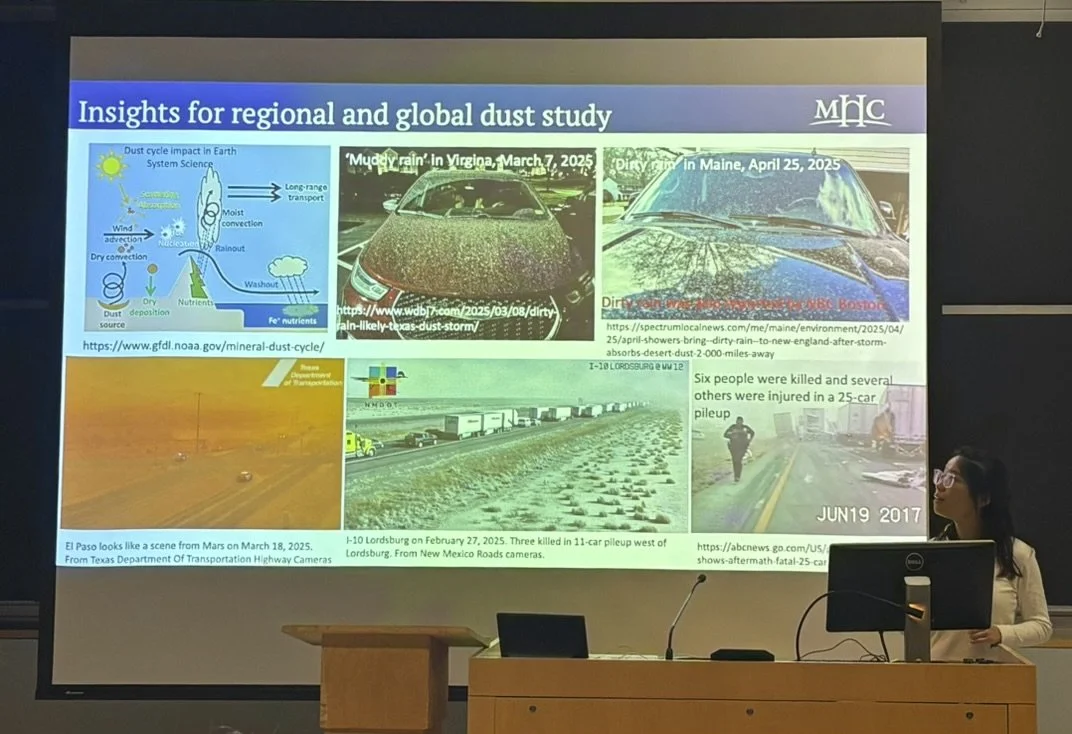
Dr. Pei Zhang discusses the human impacts of dust storms in southern New Mexico and beyond.
By Madeleine Diesl ’28
Copy Chief
At 6 p.m. on Tuesday, Sept. 22, the Five College Consortium held its 46th annual Geology Faculty Symposium at Smith College. Every year, geoscience faculty from the Five Colleges — in addition to Williams College — meet up to “showcase the spectrum of original research and discovery underway in the area and provide opportunities for cross-fertilization of ideas among earth scientists,” according to the Five College Consortium website. Students and faculty from all six colleges attended to listen to the presentations and mingle with fellow geoscientists.
Much support was expressed for Hampshire College in light of its impending closure. In fact, the first presentation of each Five College Geology Faculty Symposium is titled the “John Reid Memorial Lecture” after the late Hampshire College geologist. Reid, who passed away in 2003, was a prominent professor of geology at Hampshire and a valued member of the Five College community. This year, the John Reid Memorial Lecture was given by Smith College Professor of Geosciences Amy Rhodes in honor of her recently retired colleague, Robert M. Newton. Newton, who was in attendance, stood and gave a short speech about the importance of the Five College community during such tough times. Rhodes then commenced with her lecture, titled “From walkways to the pond: Tracing road salt through Smith’s campus.”
The second of the five lectures was given by Alice Bradley of Williams College. Williams College, though not included in the Five College Consortium, participates in the symposium due to its proximity. Bradley’s talk was called “Detecting stability: Using ICESat-2 to find grounded ridges in coastal sea ice.”
Next, Mount Holyoke’s very own Assistant Professor of Geology and Geography, Pei Zhang, gave her lecture on dust storms: “When and how does a dry lake emit dust? Observations from southern New Mexico.” Zhang, who was newly hired as a tenure-track professor this year, is teaching “GEOG-224: Atmosphere and Weather” this semester, though her research is mainly focused on sediment transport and sand dune geomorphology.
The penultimate lecture was given by Assistant Professor Victor Guevara of Amherst College about the orogeny of the Himalayas. The talk was titled, “Rapid heating during crustal exhumation of the Nanga Parbat Massif.”
Finally, the last lecture of the night was given by University of Massachusetts Amherst Professor Julie Brigham-Grette, who worked with Indigenous communities in Alaska to better understand how climate change is affecting the local villages. Her talk was titled, “Age matters: Surficial mapping on the outer Yukon-Kuskokwim delta to assess coastal erosion vulnerability and permafrost thaw.”
Mount Holyoke College students had many positive things to say about the event. Yan Hernandez ’28 shared, “I think it’s beautiful that, after almost 40 years, colleagues and friends still gather to talk about how wonderful John Reid Jr. was. … You can tell how much they admired him as a professor and friend.” He also mentioned that the symposium always teaches them “something new about geochemistry.”
Hernandez finished on a positive note: “I think it’s wonderful that the [Five Colleges] are more than just a consortium.”
Quill Nishi-Leonard ’27 contributed fact-checking.
