
Gianna Akter ’29
Staff writer
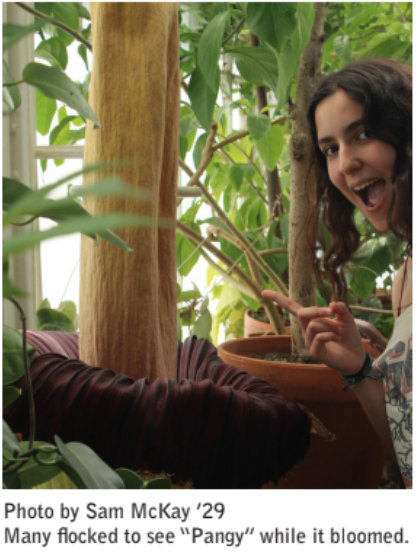
Early morning, April 14, 2026, Mount Holyoke College’s beloved corpse flower — Amorphophallus titanum, nicknamed “Pangy” — had its triennial blooming. The endangered specimen drew quite a crowd, with students, faculty and community members alike coming to see and smell the rare spectacle in person at the Talcott Greenhouse, where the plant is on display.
“I think that people are drawn to [Pangy] because it is so unique in its appearance and scent,” Jessie Blum, the greenhouse supervisor responsible for the living collection, shared in an interview with Mount Holyoke News. “[It has a] very short flowering period.”
According to Blum, Pangy was added to the living collection in 2020 when it was a “corm,” or an underground, food storage organ which is similar to a bulb. Pangy was given to Mount Holyoke College by Dartmouth College's Life Sciences Greenhouse, and has grown to be almost six feet tall in the six years it has spent here. Once a corpse flower reaches maturity, it can start to flower. This is Pangy’s second flowering, with its first occurring in 2023.
“I think they need time and patience, as they don't tend to follow a strict timeline on flowering or putting up a leaf or going dormant," Blum elaborated, highlighting optimal care and environment for the corpse flower. “I think in ideal conditions, which are warm temps and high humidity, these plants can flower every 3-5 years. That said, this is only my second flower ever so we'll see!”
While Pangy has become the staple nickname for the corpse flower, Blum highlights that the name was coined by Mount Holyoke in honor of “Pangy Day,” an annual celebration for the last day of Spring classes, and was not given by Dartmouth College.
“The first time this plant flowered for us, back in 2023, we didn't know whether it was a leaf bud or a flower bud until Pangy Day,” Blum explained. “Thus, we thought it was fitting to name the plant Pangy.”
Pangy’s flowering is especially exciting with the knowledge that there are fewer than 162 individual corpse plants in the wild, according to the nature journal Biodiversity and Conservation. The endangerment comes from several factors, varying from habitat loss and deforestation to inbreeding.
“They are native to Sumatra, Indonesia,” Blum said. “A lot of [botanic gardens] have multiple plants, and also share pollen with each other to create a little more genetic diversity within the cultivated plants.”
There are conservation initiatives among several botanic gardens, such as the Chicago Botanic Garden Initiative, to cultivate, study and promote genetic diversity in these plants through managing pollination and sharing specimens with other institutions, much like how Pangy came into the care of the Talcott Greenhouse.
“I love that we have such a diverse collection of plants here and that there are so many fascinating stories that they can tell us!” Blum explained, emphasizing the diverse vegetation and conservation at the greenhouse. “I really enjoy watching Pangy grow prior to the inflorescence opening up and also seeing everyone's reactions when they come to view it.”
Hopefully, we will see Pangy have its third successful blossoming soon to learn more about this fascinating plant.
Madeleine Diesl ’28 contributed fact-checking.