
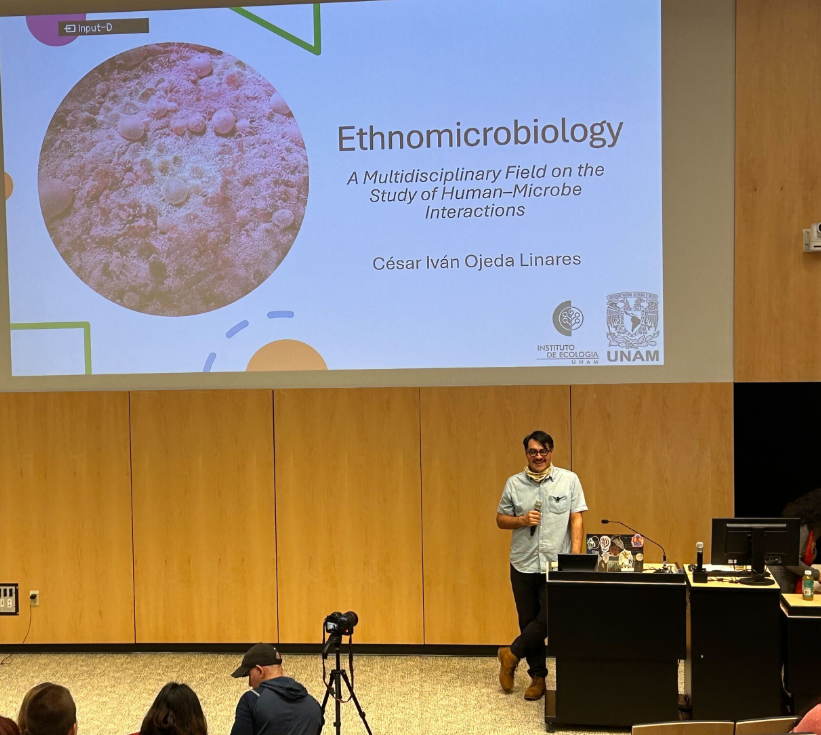
Photo by Angelina Godinez ‘28
Dr. Ojeda Linares traveled to Mount Holyoke College to deliver a guest lecture on ethnomicrobiology in Gamble Auditorium.
BY ANGELINA GODINEZ ‘28
MANAGING EDITOR OF SOCIAL MEDIA
On Nov. 11, Mount Holyoke College’s Department of Critical Race and Political Economy hosted ethnographic microbiologist Dr. César Iván Ojeda Linares to deliver a unique lecture on ethnomicrobiology and cultural preservation of traditional and indigenous fermentation practices. Ojeda Linares is a recent Ph.D. graduate from the National Autonomous University of Mexico who promotes traditional fermentation techniques throughout Mexico through a mix of ethnography and microbiology.
The lecture began with Visiting Professor of Critical Race and Political Economy, Pilar Egüez Guevara, introducing Ojeda Linares and discussing how this lecture connects to her course, Latinx Foodways, where students are encouraged to think of cultural food production and consumption. Through Ojeda Linares’ ethnographic work and effort to preserve cultural practices from big pharmaceutical companies, students get to learn the cultural consequences of micropiracy and the capitalization of traditional fermented drinks such as kombucha and colonche.
Fermentation is a natural process which uses microorganisms to produce a variety of foods and beverages. Microorganisms are organisms often composed of just one cell, typically too small to be seen under a microscope; these seemingly invisible organisms shape the planet's atmosphere and are a companion to all human evolution. They exist everywhere — in water, soil, air, on our skins, in the food we eat — and can either have a positive or negative effect on the human body. Ethnomicrobiology aims to understand and reflect on the historical and dynamic human knowledge systems about microorganisms. Like most scientific research, research on microbes — and therefore fermentation — often remains completely disconnected from traditional ecological practices in Indigenous traditions.
Ojeda Linares sought to correct this lack of traditional scientific knowledge, starting with learning about the fermentation process of colonche, a fermented drink made from the prickly pears found on cacti. Colonche has historical origins in Zacatecas and Guanajuato, Mexico and is well known for its vibrant color and similarities to tapeche and pulque. In Ojeda Linares’ study, he discovered the importance of using traditional clay pots during the fermentation process in order to best maintain microbial communities, further emphasizing the importance of traditional fermentation practices as opposed to modern techniques involving stainless steel and fabricated starter cultures.
To underline the significance and importance of traditional fermentation practices, Ojeda Linares shared results from an experiment where selected participants consumed a liter of colonche a month and experienced changes such as increased sleep, libido and overall health. When the same participants were offered a pill form of healthy microbes found in colonche, the results were not as significant. Ojeda Linares hopes to continue to bring information about microbes to young children and aid them in seeing their cultural practices in a positive light, motivating future generations to study ethnomicrobiology.
Eden Copeland ’27 contributed fact checking.