
Science

Sustainable eating: Seasonal produce and composting

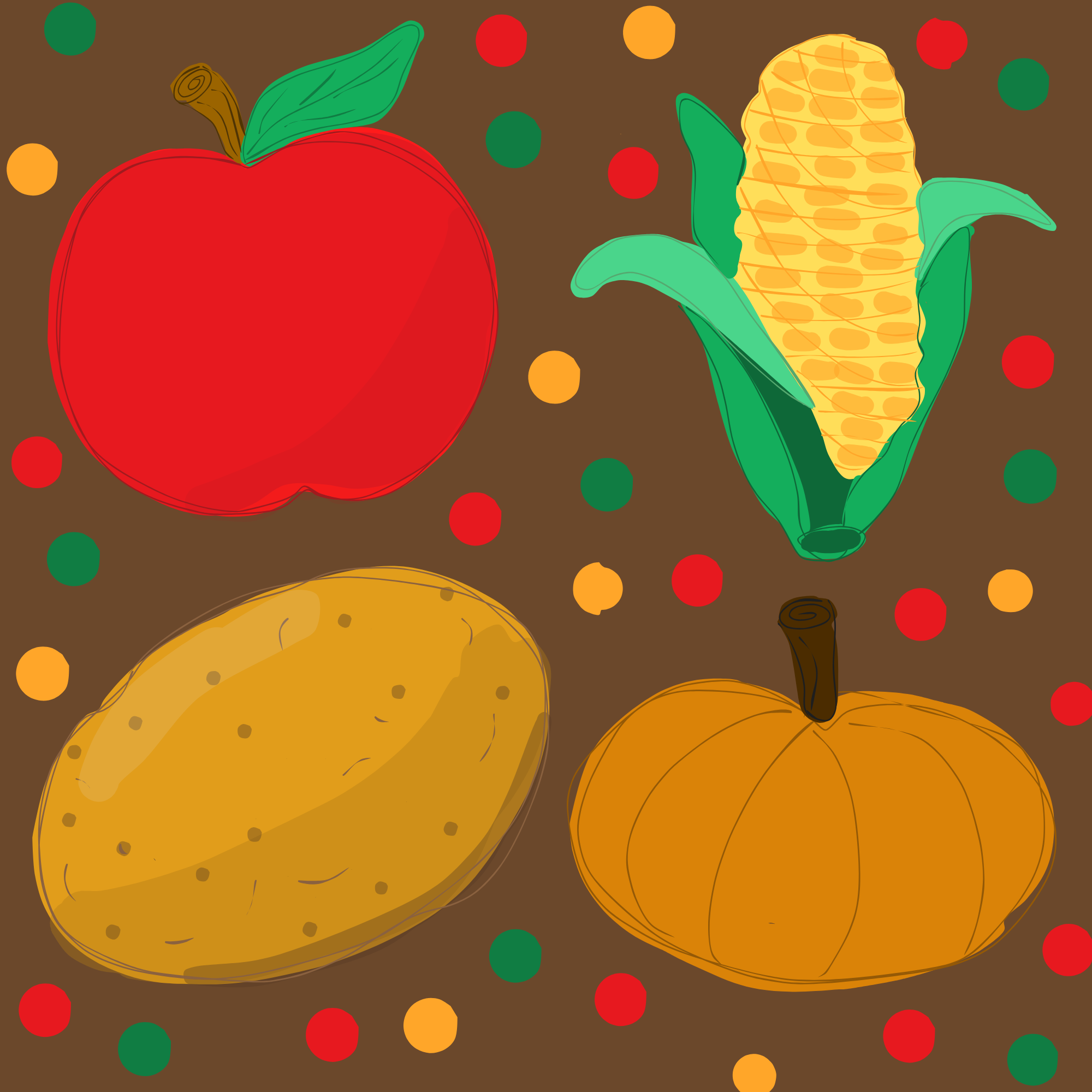
Graphic by Brianna Stockwell ’28

By Sam McKay ’29

Science & Environment Editor

What is seasonal eating? Seasonal eating is the practice of choosing to eat crops — preferably local — that are in season. Depending on where you live, this can be very difficult, particularly in New England where winters make growing any food challenging. It is also hard to practice seasonal eating while living on campus and relying on the College for meals. However, next time you go to the store, keep in mind the seasonality of different crops. If you don’t know, there are many helpful lists and charts online; in New England right now, apples, corn, potatoes and pumpkins are in peak season! 

Seasonal eating goes hand and hand with buying locally, since local farms mainly grow in-season crops instead of out-of-season crops that take  a lot more money and maintenance. As well as supporting your neighbors, buying from local farmers helps the environment, especially when we encourage in-season foods. Although the College can’t buy only from local businesses, we do get a large percentage of our food from New England farms. As of 2020, 20% of the College’s food purchases are sustainable. While this may not seem like a lot, it is a significant amount for an institution to put towards sustainable eating.

Who benefits from seasonal eating, you might ask? Everybody! Local farmers get more support, reliance on Big Agriculture decreases, and your stomach is happier! Eating fresh, locally grown produce is much better for you; it’s full of nutrients that most industrially grown crops don’t have enough of, and often has a much richer flavor. Even your wallet benefits because it’s typically more affordable to eat locally in season. Local crops are accessible at farmers markets and local grocery stores, and since the produce isn’t shipped as far — and doesn’t have to be stored — the cost is lower. 

 In South Hadley, we have very acidic soil, with a topsoil pH of 4.6 and very fast draining soil, which  can cause untreated sewage to leak into groundwater very easily. High soil acidity is often caused by harvesting high-yielding crops and leaching. These issues can be mitigated by composting, using that compost and other organic matter as fertilizer, and implementing proper drainage structures. 

While this can help mitigate the issue, preventing acidic soil is much easier: All you have to do is start with these suggestions and rotate your crops seasonally. Soil health is very important for happy crops, so it’s important to rotate crops in order to balance chemicals, pH levels, enhance drainage, and so much more.

Compost, let’s talk about it. Composting can be a closed loop of sustainability. Excess food scraps go in the compost which, after a while, is used as soil in a seasonal garden. The garden then produces healthier, happier crops and the cycle continues. Composting can fix a lot of soil issues and reduce waste. More things can be composted than you might first think, including coffee grounds, hair, non-glossy cardboard, leaves, grass clippings and more. Mount Holyoke College does a shockingly good job composting our massive amounts of food waste. All uneaten food goes to an anaerobic composting complex that turns our waste into power for a farm nearby. While this process is not flawless and some material still gets thrown out, it is a very important aspect of the College’s sustainability program. 

Household gardens are a great way to eat seasonally and sustainably. Less than a quarter acre is needed to grow enough fruits, vegetables and even eggs to almost entirely sustain a family of four. Though most families don’t have the money, time or abilities to plant and upkeep a garden larger than a raised-bed garden, if those who can, do, we would be in a much better position. Families could share any excess with the community. Although Mount Holyoke has a garden, it is almost exclusively inedible. 

If you’re feeling a bit helpless in the environmental struggles — and even if you aren’t — here’s what you can do: Buy from local farmers, go to farmers markets on the weekends, grow a garden at your house and educate yourself! Keeping ourselves educated keeps us responsible and staying responsible makes a greener future much more likely. We can’t fix problems if we don’t know about them. Learn what fruits and veggies are sustainably grown, native to where you live, and support your neighbors. Stay environmentally conscious, pookies.

Sophie Francis ’28 contributed fact-checking.

The Creature Feature, featuring: Spooky spotted orbweavers!

Graphic by Madeleine Diesl ’28

By Madeleine Diesl ’28

Copy Chief

If you’ve ever been to Mandelle or 1837 halls, you’ve likely crossed over the white pedestrian bridge known among students as “Spider Bridge.” Located atop the waterfall on the southern side of Lower Lake, Spider Bridge gets its name from the dozens of spotted orbweaver spiders — scientific name Neoscona crucifera —  that make their webs on its wooden slats. 

Though they may seem creepy, spotted orbweavers are harmless. In fact, in addition to being an essential native species, these spiders can actually be beneficial to humans by catching and eating harmful insects such as mosquitoes. 

From far away, spotted orbweavers appear orangeish-brown and a little under an inch long. However, anyone brave enough to get a closer look at one of these spiders will notice that they have small brown hairs on their abdomen and legs. Two white spots can be found on the underside of their abdomen, and their legs are striped; these can be useful fieldmarks for someone unsure of what spider they’re looking at.

But why is Spider Bridge such prime real estate for spotted orbweavers? It’s likely a combination of a few things. Firstly, the streetlamps on the bridge attract many flying insects for the spiders to eat, and the stagnant lake below likely has the same effect. Also, spotted orbweavers are known to make their webs on trees or manmade structures with lots of corners, so a bridge is a perfect candidate. 

Spotted orbweaver webs are characteristically circular and can span up to two feet across, often appearing similar to the stereotypical spider web depicted in media. One fun fact about spotted orbweaver webs is that the females, which are nocturnal, consume their webs for nutrients in the morning and rebuild them every night. This means that the webs on Spider Bridge at night might look different each time you cross. Plus, most of the spotted orbweavers you will see are female, as the males are smaller and do not build webs. In other words, each night on Spider Bridge is one big, spooky girl dinner in which the girls are spiders, the dinner is bugs and the whole thing gets devoured by morning.

Sophie Francis ’28 contributed fact-checking.

Exploring student reliance on generative AI at MHC

Graphic by Brianna Stockwell ’28

By Gianna Akter ’29

S&E Writer

Schools across the globe have seen an increase in the use of generative AI with the rise of models such as Claude and ChatGPT. From professors themselves to the student body, many have become reliant on these AI tools to assist with grading or “brainstorming” ideas. The rise of generative AI has brought with it questions: If, when and how should AI be utilized in higher education?

At Mount Holyoke College, many students have voiced opposition to the introduction of AI, such as through a student flyer posted on campus.  However, many professors have chosen to allow AI usage through the implementation of tools such as Gemini, which Mount Holyoke has enabled in student accounts. The College's official policy for the “ethical use of AI” acknowledges concerns over its implementation in education — though allows its usage so long as it supports human values, avoids bias, discrimination and plagiarism while also perpetuating fairness, equity and integrity. This also means each professor can mitigate its use in accordance with their individual policies, sometimes prohibiting it from classes altogether.

Amid debate about whether AI should be used or allowed in academic settings, it may be helpful to consider what drives students to use AI for their assignments. Academic stress has been shown to lead to increased dependency on generative AI tools in higher education, according to Li Zhang and Yunxue Deng in “Stressed minds, smart tools: How academic expectation stress fuels generative AI dependency in Chinese higher education.” 

This may be related to a phenomenon called “cognitive offloading,” where people use external tools to reduce the mental effort required for a task or assignment or to free up room to concentrate on other tasks, according to an article by the American Psychological Association.  The temptation to offload using AI when academics get overwhelming can be ever-present, whether that be from a hefty work schedule, rigorous coursework, or something else entirely.

Mount Holyoke student Erin Mihok ’29 observed how high school students in the summer program she worked at thought about AI, saying, “I noticed that a few of [the highschoolers] were disappointed that we had a 'no AI' policy. Something I’ve heard echoed by many students … is the reluctance to spend time on tasks or assignments when AI could just do it for them.”

While many have argued that AI has become an encouragement for students to cheat, according to Artificial Intelligence Governance Professional Matthew Wemyss, researchers have found that AI actually has not affected the cheating rates among students; it has just become another method. Thus, many of the reasons why students choose to cheat using AI are the same reasons students choose to cheat using other methods. 

A 2021 meta-analysis by researchers Megan Krou, Carlton Fong, and Meagan Hoff found that students who were more extrinsically motivated, meaning they acted in pursuit of good grades or other external rewards, demonstrated higher levels of academic dishonesty. 

Meanwhile, students who were more intrinsically motivated, meaning they acted in pursuit of self-satisfaction or based on their individual interests, demonstrated lower levels of academic dishonesty. These findings could suggest that academic dishonesty, including the unauthorized use of AI, could be decreased in the classroom by fostering an academic environment where students are encouraged to prioritize intrinsic motivations like content mastery and personal growth, rather than grades in an environment where each student gets a learning experience that is individualized and personal. 

As discussion continues over whether AI should have a place in higher education, and, if not, what should be done to limit AI usage, it’s important to acknowledge where students that utilize generative AI may be coming from. For students that may be struggling with stress, overwhelm or pressure to succeed academically, Mount Holyoke offers various support systems on campus, such as wellness initiative groups, office hours, peer study groups and campus tutors.

Quill Nishi-Leonard ’27 contributed fact-checking.

Captured greenhouse gas emissions can be repurposed into everyday objects

Captured greenhouse gas emissions can be repurposed into everyday objects

Plastic is often considered environmentalists’ number-one enemy because it necessitates large quantities of fossil fuels in its production and its reputation for polluting the Earth’s natural resources. However, technological developments in recent years have created a possibility for plastic to act as a force against the onset of climate change. Scientists have found that CO2 emissions captured from the atmosphere can be used as a base material for plastics and other goods.