
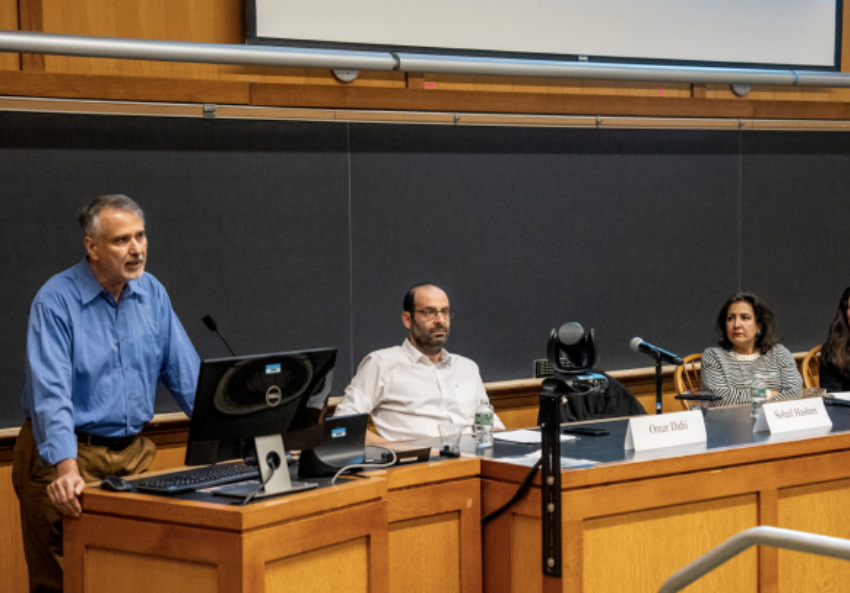
Photo by Zeyu Zhao ’27
MHC hosted a panel on the U.S.-Iran War on Sept. 29; it featured several panelists from MHC.
By Karishma Ramkarran ’27
Managing Editor of Content
On Sept. 29, the McCulloch Center For Global Initiatives, along with the departments of Asian Studies, International Relations and Politics, cosponsored the panel “US-Iran War and the Changing Security Order in the Middle East” in Hooker Auditorium. At around 5 p.m., Director of the McCulloch Center for Global Initiatives and Professor of Politics Kavita Khory ’84 began the event with a land acknowledgement and set the topics for discussion.
The purpose of the talk, according to Khory, was to situate the US-Iran War in a broader historical context and analyze the regional ramifications from various perspectives. Although there was a focus on current tensions between the U.S. and Iran, the panelists pieced together a “big picture” of the conflict both temporally and spatially, with each professor approaching the subject theme from a different disciplinary perspective.
As Khory introduced the panel of four professors — three of whom teach at the College — special gratitude was given to Omar Dahi, a visiting professor of international relations. Dahi, who was formerly a professor of economics at Hampshire College, both proposed and helped organize the event. Although it is his first semester teaching at Mount Holyoke, Dahi is a familiar speaker on campus. Along with his fellow co-panelist Sohail Hashmi, Dahi was a panelist for an academic talk that took place on Oct. 24, 2023 called “Middle East Crisis: Implications for Israel, Palestine and U.S. Policy in the Region.” He currently focuses on economic development and international trade, along with interdisciplinary studies of security measures in the Global South.
Dahi was joined by Professor of International Relations Sohail Hashmi, a scholar of politics in the Middle East and pioneer in the interdisciplinary field of ethics and international relations, and Sidita Kushi, assistant professor of politics. Kushi teaches World Politics and American Foreign Policy at Mount Holyoke, and her research focus is on the domination of force in U.S. foreign policy, the ethics of humanitarian intervention and regional biases in military intervention. She has published two works related to this field of research: “Dying by the Sword: The Militarization of U.S. Foreign Policy” and “From Kosovo to Darfur: The Regional Biases within Humanitarian Military Interventionism.”
Niki Akhavan, associate professor and chair of the Department of Media and Communication Studies at the Catholic University of America, offered a cultural and sociological perspective to the panel. Akhavan provided insight regarding the communication structures that exist in Iran, and in particular, how state-produced media has changed in articulating certain policies. She is the author of “Electronic Iran: The Politics of an Online Evolution,” and has worked in English-Persian translation.
After the panelists had been introduced, Kushi engaged the audience with a vivid narrative of U.S. foreign policy. By providing a timeline of relevant military interventions, from “Operation Midnight Hammer” to “Operation Epic Fury,” Kushi aimed to characterize and explain the nature of this current iteration of war against Iran. This “big picture” narrative, according to Kushi, allows one to recognize the patterns, but also the divergences in U.S. policy towards Iran. One of the common threads that she drew attention to was the American dependence on “kinetic diplomacy,” or diplomacy dictated by military force. These patterns in U.S. foreign policy, though hinged on military continuities, demonstrate certain aberrations in rhetorical narratives, argued Kushi.
An explanation for the phenomenon of the militarization of American foreign policy was proposed: There is a “dramatic absence in diplomatic resources” and the U.S. is “investing in force, not diplomacy,” Kushi stated. The crux of her argument lay in the lack of diplomats in U.S. embassies and the replacement of career diplomats with political appointees in the government. This lack of diplomacy between nations affects civilians in relation to internal democratic structures, especially as a majority of Americans are against the war in Iran. Kushi noted that there is an apparent divergence between the executive and legislative branches and the general public.
With a new iteration of the U.S. war against Iran, Akhavan emphasized that our thinking of Iran needs to fundamentally change. Similarly to Kushi, Akhavan drew similarities and differences between “Operation Absolute Resolve,” which saw the capturing of Venezuelan President Nicolás Maduro by American forces, and the current campaign against Iran. A common theme of the talk emphasized that Iran was not a mere “paper tiger,” but capable of inflicting losses on the American military.
Drawing on her expertise, Akhavan also aimed to explain how Iran’s communications to the public has changed in this second iteration of war with the U.S. The digital sphere has suddenly become an important place to spread new narratives and expand the limits of conversation, particularly through funny and relevant media production. With pro-state embassies employing young people to produce content that has the capacity to resonate with new generations, Akhavan argued the feelings of the Iranian people towards the U.S. have changed unfavourably.
As gas prices in the United States have increased by almost 50 percent since the start of the war against Iran, Hashmi’s emphasis on the world’s dependence on oil from the Persian Gulf provided another perspective on the futility of the conflict.
“War is God's way of teaching Americans geography,” Hashmi said, eliciting some laughter from the crowd, before delving into the hard numbers that described how many ships passed through the Strait of Hormuz both before and after the U.S.-Iran war.
He encouraged the crowd to look for themselves how many ships were able to pass through the Strait of Hormuz in the last 24 hours, compared to a normal day in 2025 using a website called “Strait Up Maritime.” Although various solutions around the Strait of Hormuz were discussed, Hashmi argued that most of these alternatives were ineffective. The only solution, according to Hashmi, is to “end this war.”
To round off the panel, and to de-center the impact on Americans, Dahi outlined the effects of the war on the peoples in the region more broadly. With a particular focus on the countries of Lebanon and Syria, Dahi spoke to the geopolitical changes that have occurred as a result of the United States’ “greenlight” of Israel’s endeavor to “destroy regional resistance” such as that of the Axis of Resistance, an informal, anti-U.S. and Israeli coalition led by Iran. The polities that comprise this resistance include Hezbollah and the Houthis, who have been targets of Israel’s campaigns in that region.
Dahi discussed how the degradation of the Axis of Resistance has led to the rise in pro-Western political groups in both Lebanon and Syria. These groups are less willing to put up a defense to Western encroachment; in the example of Syria, Israeli attacks have majorly destroyed Soviet-developed air defense systems without retaliation from the new Syrian government. The Interim President Ahmad al-Sharaa still seeks de-escalation with Israel, despite their occupation of an U.N. buffer zone in southern Syria.
The alliance between the U.S. and Israel in unsettling various sovereign countries in the Middle East has shown the effects of their “kinetic diplomacy” on local populations, including constant exposure to forms of violence that render people refugees or under the line of poverty. It has also diverted attention from Israel’s ongoing campaign to annex the West Bank, and its genocidal war against Palestinians. Therefore, Dahi echoed Hashmi’s sentiment: “End the war.”
Madeleine Diesl ’28 contributed fact-checking.