
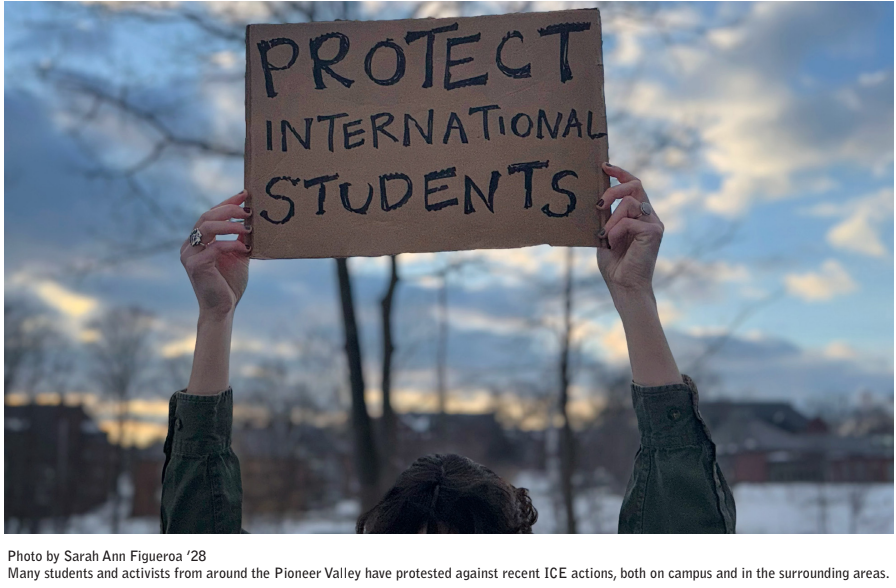
By Sarah Ann Figueroa ’28
Staff Writer
During the senate meeting on Tuesday, Feb. 26, student body president Nathania Amadi ’26 announced the college’s new protocols for what individuals should do in the event that United States Immigration and Customs Enforcement — also known as ICE — agents come onto campus.
With ICE agents seen in nearby towns like Northampton and Amherst, and the increasing violence exhibited in their methods, students have been waiting for answers from the college on what they should do if ICE were to reach Mount Holyoke campus. 20% of the student body is international, meaning many students could be at risk for the abductions being carried out by ICE across the country.
The College’s only protocol previously was to direct ICE agents to the President’s office in Mary Lyon Hall. However, many have noted how this would most likely be ineffective. As Amadi put it, “They are operating completely off the books.” Now, three weeks into the spring semester, and over a year since the start of President DonaldTrump’s inauguration, the College has put together improved protocols for what to do in this increasingly likely scenario.
Beginning like any other senate meeting, Coco Athas ’26 opened with an ice breaker where senators shared their weirdest childhood obsessions. The conversation bounced from early 1900s ocean liners to snacking on the graphite in mechanical pencils; something that is surprisingly nontoxic. After the lighthearted opening, followed by a few quick announcements, Amadi took the floor to discuss the pressing topic on everyone’s minds.
Before beginning with the new protocols, Amadi prefaced with a general statement for the community. “It’s a hard time, and I think what makes this harder is … it’s the federal government,” she began. “I wish it was something small or something we could combat as a tiny institution … I don’t want to say there’s not much we can do, but from September, October to now, we’ve seen how drastically their operations have changed … These people are not following the law … It’s hard to strategize and plan about something we are not even sure [of] … So now we have to restrategize and focus more on safety and community education and community engagements.”
In total, there are three separate protocols for different ICE-related scenarios.
If you spot ICE on Campus
The first is what to do if ICE is spotted on campus or a campus-adjacent space, such as to the Village Commons, College Street, or another location directly outside of where the College’s academic campus ends. If an individual sees ICE on or near campus, they are asked to immediately enter into a OneCard-locked building.
Students are encouraged to stray away from entering residential halls that are home to Living-Learning Communities for marginalized groups; students can see a complete list of which buildings LLCs are located in on the Residence webpage.. Students are also reminded to carry their OneCard at all times, as well as to be wary of who they are letting into buildings. Granting ICE access to any private building on campus could prove detrimental to the safety of many in our community. Amadi noted for everyone to “be more aware of the power our OneCard has.” This is especially important to remember in the wake of Feb. 26, when ICE agents entered a dorm in Columbia University under false pretenses, according to CNN.
Once ensuring their own security, students must call Public Safety and make a report of their sighting. The number for Public Safety is 413-538-2304. Amadi stressed that everyone should memorize this number and add it to their phone contacts, as it will be key to having a rapid response in this dangerous scenario.
When reporting an ICE sighting to Public Safety, it is important to give them as much detail as possible. A campus-wide alert will be sent out in the event that ICE is on or near campus, similar to weather-related ones. Being as detailed as possible in reporting will protect the community and enable public safety to respond faster. To remember which information is most crucial, SGA is in the process of developing an acronym: LITES. Though not finalized, here is what it means;
The “L” stands for both Location and License Plate. Tell Public Safety exactly where you saw ICE, and what the license plate of their vehicle was, if you saw it. They will be able to track the plate number to confirm that the plate number isn’t registered to a civilian vehicle, as ICE rents their vans from the car rental company Enterprise. The “I” stands for Information. Tell public safety as much information as you can discern from what you saw. How many agents were there, what were they wearing, what were they doing, etc. The “T” stands for Time. Let public safety know when you saw ICE exactly. The “E” stands for Exit-Strategy. Do you have a way of safely removing yourself from the presence of ICE, if you have not done so already? Finally, the “S” stands for Safety. Are you and others around you safe, or in danger?
An important thing to note about how ICE agents present themselves is that they sometimes wear clear markings that say “ICE,” but they also often wear unlabeled, nondescript clothing. ICE agents are allowed to wear civilian attire, and do not typically wear a uniform like a police officer would. Their faces may be entirely covered, typically with masks, bandanas, sunglasses, and hats. Though they are dressing for anonymity — an aspect that makes them all the more dangerous — one can identify them by the heavy military gear that they wear over their regular clothes, such as bulletproof vests and utility belts with armed weapons. And because they almost always travel in groups, the visual of multiple masked and armed men will be a likely giveaway to their presence, regardless of if they are labeled as ICE.
If a student is actively being abducted on campus
The second protocol is what to do if a student is actively being abducted on campus. Individuals are instructed to follow all of the same instructions as mentioned above. If civil rights are clearly being violated, record as much evidence and report it in detail to public safety. Most importantly, do not attempt to interact with the agents. Doing so may only escalate the situation, putting yourself and others in harm’s way. In this event, Public Safety will be sent out as soon as they are notified. They will intervene with the agents, and do everything in their power to protect the student being targeted, in accordance with the law. Massachusetts has a “Duty to Intervene” law, meaning our Public Safety team is not just allowed, but legally obligated to step in against ICE violence. According to section 15 of this law, “An officer present and observing another officer using physical force, including deadly force, beyond that which is necessary or objectively reasonable based on the totality of the circumstances, shall intervene to prevent the use of unreasonable force unless intervening would result in imminent harm to the officer or another identifiable individual.”
Also in regards to the role of Public Safety in these scenarios, they will in no way, shape or form be assisting ICE. Amadi emphasized, “The only way they would be able to do that is if they have a federal warrant and that's very rare, very hard to come by.”
If you are abducted off campus
The final protocol addressed is what a student should do if they are abducted off campus. Should such a horrific scenario occur, students are advised to call Public Safety if they can and notify them of what happened. Public Safety will update your professors, deans, advisors, and emergency contacts of your whereabouts. Additionally, while the College can’t help students financially with litigation, the College’s immigration team will provide legal support with their attorneys. Here, having Public Safety’s phone number memorized may prove to be vital. This may also be a good reminder to be sure emergency contacts are up to date on my.mountholyoke.
In discussing what the college can do for students abducted by ICE, Amadi noted the unique position of President Danielle Holley. As a civil rights attorney, she has expressed her willingness to use her legal connections to get a student in this situation the help they need.
The talk of these new protocols wrapped up with a Q&A. Before the regular Senate meeting continued, Athas gave an analogy to put these intense circumstances into perspective. “This is all kind of like our first aid kit, right?” Athas said. “We never want to use it, but we want to have one. I hike a lot and I have those thermal blankets if you get stranded. I've never needed to use one, but if you ever do need to use one, it's good to have your back pocket.”
Shortly after that Senate, the College started hanging posters on the bulletin boards in residential halls advertising the LUCE Immigration Justice Network of Massachusetts. LUCE, which stands for Liberation, Union, Community and Esperanza, hosts a daily hotline for ICE reporting, operating from 6AM to 8PM. The hotline can be reached at the number 617-370-5023. Students are encouraged to report any ICE sightings to LUCE, as they will distribute confirmed reports to keep our communities informed and safe against this ongoing state violence.
The final remarks from Amadi on Feb. 17 made full acknowledgement of the weight of these circumstances, saying that, “These are strange times … very dystopian times.” However, the note that senators were left with exemplifies the E in LUCE: Esperanza, which in Spanish, means Hope. “Making sure you're safe, making sure your friends are safe, making sure your community members are safe. How do you do that? By education, by sharing all this information, by talking about it with your friends, by making sure people are aware of this.”
Cat McKenna ’28 contributed fact-checking.