
By Danny Alajawi ’28
Staff Writer
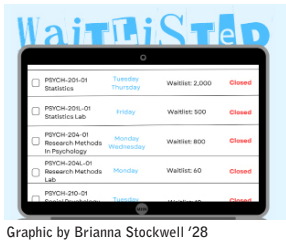
The class registration process is stressful for everyone, but it’s definitely more stressful for some majors than others. Psychology classes are some of the hardest classes to get into at Mount Holyoke College, as it’s the most popular major here. Undoubtedly, the College should offer more psychology classes to make this process easier on students.
Psychology majors, particularly second semester first years and sophomores, struggle to get into the classes they want and or need for their major. Many students end up on waitlists, and have to plead their case to get into classes. It’s not fair that psychology students have to go through so much stress to try to get into the classes they need. It shouldn’t be normalized to have to beg professors to let you into classes. It’s a lot more than dignity that’s at stake, as the ability to get into required classes impacts a student’s ability to do a lot of things like study abroad, early graduation, double majoring. The impact of this is profoundly felt by Springies. Though these things are still possible with the psychology major, the stress and weight of these things on student’s minds becomes overwhelming, and is clearly a fault within the College’s system.
So, things are even more stressful when people are trying to explore 200 levels in psychology. Students may not realize they want to major in psychology until later on, which can make it really stressful to complete requirements when classes are so hard to get into. Even if someone is in a situation where they know exactly what they want to do, they aren’t able to knock requirements out of the way very quickly.
In writing this piece, I wanted to get the perspective of the psychology department, to see if they saw the same problems. So, I interviewed the Co-Chair of the Psychology department and a Mount Holyoke College alum, Professor K.C. Haydon ’00.
Haydon and I discussed issues surrounding people getting into classes and the way the system is set up. She talked to me about how she has worked closely with the registrar and knows they have a massive job at their hand. Haydon also spoke about the fact that we are dealing with a “limited resource environment,” as any college is, which makes it really difficult to fix these kinds of issues.
I’m a firm believer that the College should open more classes, and in talking about that with Haydon, it was clear that the department has considered that option. However, there are limitations. Haydon shared, “If we had more faculty, we would offer more courses, and we would have more seats. But that's not a viable solution for the College. We can't just keep adding faculty unlimited in an unlimited way, because each faculty member costs the College a certain amount of money. You know, if we add a faculty member to one department, the College can only afford so many at a time, and so that means another department isn't getting that. So those are very difficult decisions to make in terms of the allocation of faculty positions across departments.”
It was clear to see that the department nonetheless works really hard to meet the needs of the students. Haydon discussed the survey program: “The survey was a pilot program that we developed with the registrar and the provost office. The survey is for any student who is waitlisted in our 200 level area courses … If you show up on our waitlist, you get a ping from us. Our department coordinator, Janet [Crosby], sends out a QR code and a survey link to say, ‘Hey, you're waitlisted on this course. Fill out the survey.’ That gets populated to a Google form, and every registration period in spring and fall, the co-chairs and our department coordinator. So …[we] sit down and look through those by hand, person by person.”
As they do that, they consider each student’s circumstance to determine who they should move into classes based on need. The program is incredible because it demonstrates the care faculty has towards their students and the dedication they have to get people into the classes they need. Part of the problem, however, is that even though it’s very helpful in the long run, it doesn’t seem to reduce the stress of the students.
Another issue I have noticed this brings up is increased class sizes. Haydon explained that classes are expanded based on the needs of the students and gave an example: “Our course is capped at 28 but look, we have these nine people who really need this class this semester. We request from the registrar to expand that course to 38 and then we've moved those people with the highest need for the class into those nine seats.”
That’s not only understandable, but is helpful for so many students. However, it does change the dynamic of the class. When asking about the professor's perspective of this, if it was fair to the professor to have to take on more students, Haydon explained that “fair” is a tricky word. She shared that handling different class sizes is a skill that is developed by professors over time. But she also stated that “the more students we have in classes, the more recommendation letters we're asked to write, the more office hours we need to have, you know, and so it becomes kind of like, how do we deliver the same quality of experience on a larger scale? That's really challenging.”
I believe the larger class sizes have an impact on the students too. Haydon said for psych majors “the first chance [they] might get for a small class is the 300 levels,” which I find to be concerning. Mount Holyoke College is a small college and a big part of that attraction is small class size with 9:1 student to facility ratio. Of course, I would take a bigger psychology class over no psychology class any day, but should I have to? I don’t think so. More classes should be offered so more people can take them within smaller class sizes.
There's a financial aspect to consider too. The classes and the class sizes are reasons people chose to go to Mount Holyoke College College. They’re one of the things students are paying for, so I think it’s only fair that they get it.
When classes are desperately needed, new sections should be added and new instructors should be hired to take that on. People should be able to easily take the classes they need.
But it’s not just the very essential classes that are a problem. I talked to Haydon in detail about what people want to take. It’s clear at this point that people love to take 200-level psychology classes. Some need it, but some people want to explore or take something fun! The way I see it, psychology is a really expansive field of study. It makes sense that people would want to explore its different areas, and they should be encouraged to do so.
One of the ethical considerations we discussed was the idea of “super majors,” which are people who take more classes than required within the major. As a psychology student struggling to get into classes, I understand how that can be frustrating. I understand that frustration from the department, too, because one of the ways they’ve tried to navigate the problem is by minimizing requirements for the major, yet some people are still taking a lot of classes they don't need.
At the same time, I do think other, non-psychology students have a right to explore their interests to the extent they want. They struggled with this process earlier and if the system isn’t working, why should they have to stop themselves from taking a class that they're interested in now that they have the chance to register for it?
This expands to the people outside the major too. Some seniors in different majors chose to explore a psychology class or two because they find it interesting. As upsetting as it is to watch them take seats in a class they don’t need, while having friends in the psychology major be turned away, it’s not those seniors’ faults. Students have every right to explore their interests without feeling like they’re taking away opportunities from other people.
With that said, I want to make it clear that I don’t think it’s the psychology department’s fault. In speaking with Haydon, I gained a lot of understanding about the way the system works. I never blamed them for the issue, but now more than ever I see the way that the department truly cares. To me, that’s part of why this is such an issue. Not only is psychology incredibly fascinating, but the professors in the department are truly wonderful and are involved in incredibly fascinating research. I have been very lucky to have gotten to know some of the facilities in the psychology department and I have nothing but great things to say. So, of course people would want to take their classes.
The issue at hand is that the College needs to give more funding to the psychology department. I believe the department should be expanded to allow students to fulfill the major with less anxiety as well as to give students the opportunity to explore their interests. The funding the psychology department gets should reflect the need and interest of the students.
Cat McKenna ’28 contributed fact checking