
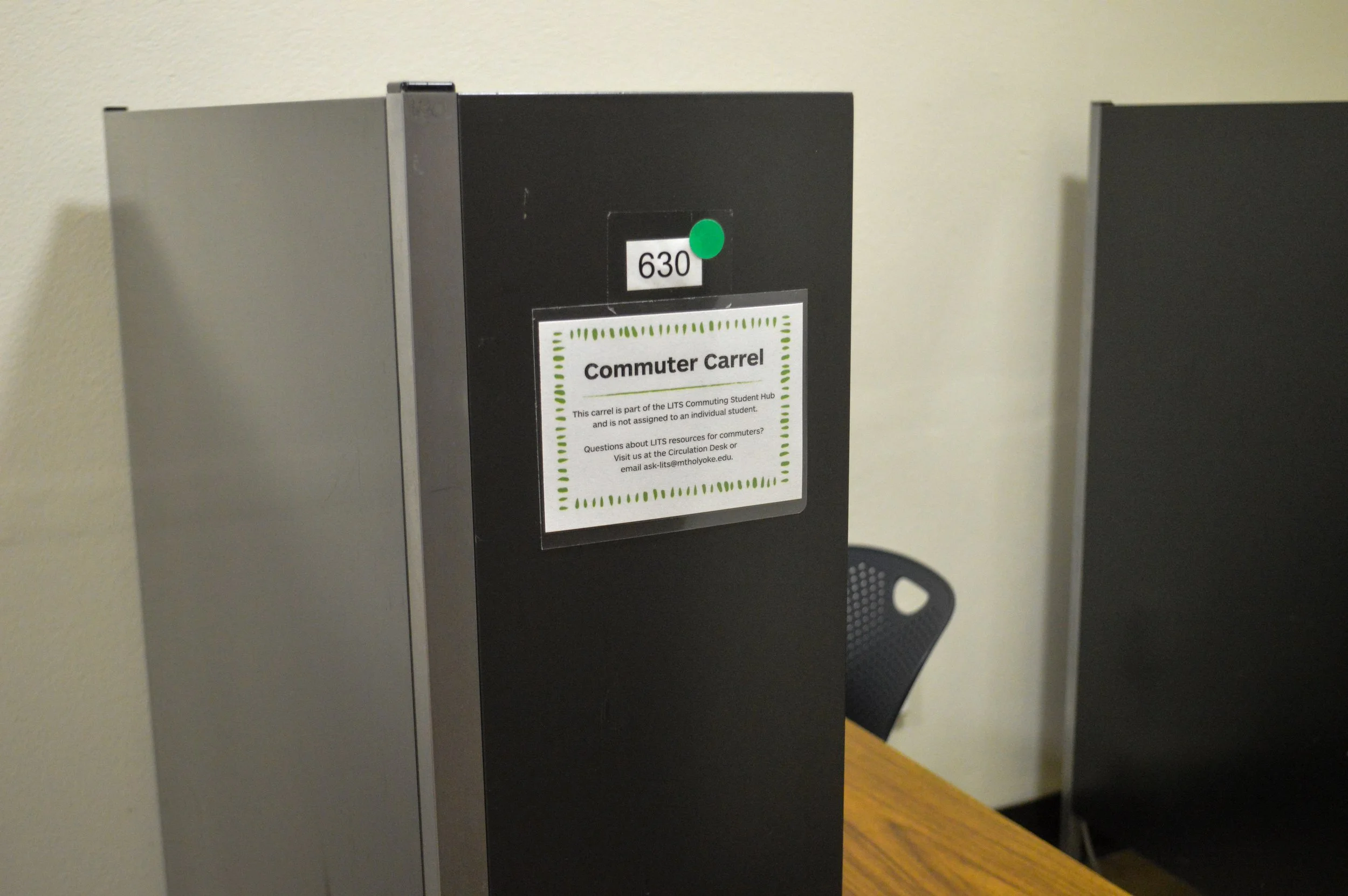
Photo by Marri Shaeffer ’29
Many commuters feel the library carrels and kitchenette aren’t good replacements for the lounge.
BY ALLYSON O’DELL ’28
STAFF WRITER
Mount Holyoke College talks a lot about belonging. At the beginning of each academic year, students hear familiar messages: “Welcome back,” “welcome home” and “you belong here.” But for commuter students, belonging is also a practical question. Where do you go when you have three hours between classes? Where do you eat lunch when you do not have a residence hall room to return to? Where do you leave your belongings or find a quiet place to rest? These questions shape whether campus feels like a community students can participate in throughout the day or simply a place they come to attend class.
Last year, the commuter lounge in Blanchard helped answer these questions. It was not extravagant, but it was functional. With a small kitchen, refrigerator, computers, a couch and lockers, it offered commuters a designated space to eat, work, store belongings and decompress between classes. Most importantly, it provided a home base for students who do not live on campus. Residential students have spaces built into their college experience. They can return to their rooms or residence hall common areas between classes. Commuters do not have that same option. The lounge helped bridge that difference.
Now that the space is gone, the alternatives do not offer the same benefits. The replacement kitchenette is located on the sixth floor of the library, in a quiet area near the restrooms. It does not provide a comparable place to sit down for a meal, gather with other commuters or collaborate on work. Resources that once existed together have been scattered across campus, making everyday needs more difficult to manage.
Communication has also been a concern. Information about obtaining and using locks for commuter lockers was not clearly communicated, and lockers were not yet available as the fall semester was already underway. Even parking can become another source of uncertainty when students are unsure which lots they can use. These practical details matter when commuter students are trying to get to class on time and participate fully in campus life.
The problem is not necessarily that commuters have nowhere to go, as we can usually find somewhere to sit. The problem is that finding a place is not the same as having a place to belong. I have experienced a similar sense of displacement as a Francis Perkins Scholar. The Frances Perkins House became available for use on Sept. 28, but its delayed reopening meant commuter FPs lacked access to that designated space during the first month of the semester. Communication about the reopening was also lacking.
Recognition matters, too. At this year’s convocation, Francis Perkins Scholars and transfer students were not acknowledged in the same distinct way they had been in previous years. Last year, FPs’ recognition felt validating. This year, that distinction was absent. These changes may seem small individually, but together they can influence whether students feel seen and valued by their institution. I do not believe every change or inconvenience means the College does not value its students. But I do believe cultivating a feeling of belonging among all students requires more than just good intentions. It is also shaped by institutional decisions: Which spaces are provided, how accessible they are, how clearly resources are communicated, and whether different student communities are recognized.
Commuters do not need special treatment. We need thoughtful treatment. We need a convenient, welcoming space to sit, eat, work, and rest between classes. We need accessible storage for our belongings, clear information about parking, and reliable communication about campus resources. We also need safe, adequately cleared parking during winter weather. Mount Holyoke should consider what belonging looks like for students whose college experience does not follow the traditional residential model. A commuter can spend eight hours on campus and still feel like a visitor. That should concern a college that places such importance on community.
A meaningful response would include restoring or establishing a genuinely usable commuter gathering space, ensuring lockers are available and accessible, communicating resource changes clearly, and considering how campus traditions can recognize the students who make up its community. Belonging should not depend on a student’s ability to live on campus or navigate a scattered collection of resources. If Mount Holyoke wants commuter students to feel that they are part of campus life, that commitment must extend beyond the classroom.
Because sometimes telling someone they belong is not enough. Sometimes you have to give them a seat at the table.
Zoe Brisbois ’30 contributed fact-checking.
