
By Quinlan Cooke ’29
Staff Writer
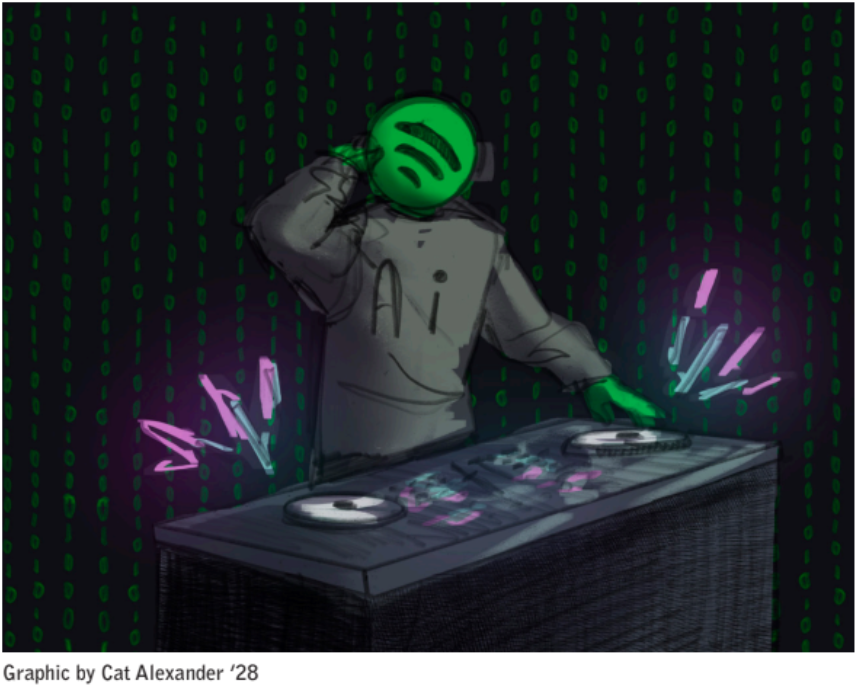
Spotify’s AI DJ was released in early 2023, but lately it has been causing some strife when it comes to easy listening. The AI tool was developed by OpenAI using their own technology. Users, like myself, report that Spotify’s dedication to customization and personalization does not come through with their DJ; instead songs you skip are repeatedly suggested and overplayed.
Spotify’s DJ is designed to talk about the music it is going to play for you, then play 5 songs. This pattern repeats itself until you decide to turn it off, or to switch things up by hitting the designated button to stop the set of songs you are currently listening to. You can also request any prompt from the DJ, and it will do its best to comply. I once asked my DJ to play Garbage (the band), and it took it as playing music that it (or someone else) thought was “bad” or “garbage”.
Sometimes, the AI DJ says nonsensical sentences, or pronounces artist’s names entirely wrong. My DJ, for some inexplicable reason, cannot pronounce Tyler, The Creator. It also cannot handle when artists have obscure or plural names: It almost never pronounces Arctic Monkeys correctly, or Cyndi Lauper.
The main issue I find with the OpenAI DJ is that the songs which are consistently recommended are ones that I often skip, or even ask the DJ not to play. One in particular is “Rules” by Doja Cat. The DJ suggests this song so often that it winds up being in my “On Repeat” playlist that Spotify also creates.
Spotify has rolled out another AI feature, this one to do with playlists. This “prompted playlist” feature allows premium Spotify users on the mobile to type a prompt, and Spotify will generate a playlist that best fits the parameters. It is unclear which AI system Spotify has teamed up with for this feature.
Prior to this, Spotify’s closest feature to this was “Spotify Generated” playlists that users could not edit or request. These playlists followed very niche queues. These playlists are custom for each user, so the music in each playlist is skewed for each listener. This might sound thoughtful and ideal, however there are big issues with this method. If you look up a playlist and are wanting new music, you are unlikely to find it.
These playlists constantly recommend music you already like, or artists you are familiar with. There are also playlists with different titles/themes that end up being almost identical because it leans so heavily on the user’s pre-existing music taste and listening history.
If you are looking for new music that you have yet to hear and discover, I recommend finding playlists that other users have created. If you want to hear what Spotify recommends for something new, listen to one of their public playlists that do not say “made for you,” so there will be no bias towards the user listening.
It is important to note and acknowledge the widespread use of AI in something so personal as making a playlist. There is no shame in taking advantage of one of these Spotify features, but I feel it lacks personality. Many people take pride in their playlists and underground song discoveries; but this is in danger if the same songs are recommended over and over again by playlists and AI DJs run by AI. Individual music taste could slowly be overtaken by readily available playlists and recommendations if people are unaware that AI has a part in their streaming.
If you find yourself frustrated with AI infiltrating your music taste and want new music, ask other friends for recommendations and listen to a playlist on their profiles. If you want something niche, there are endless possibilities with searching other people’s playlists. Spotify users are very creative, with playlists ranging from being based on fictional characters to the most classical music you can imagine. Don’t feel that you need to depend on pre-made recommendations, there is endless music to discover; and isn’t that part of the fun?
Madeleine Diesl ’28 contributed fact-checking.