
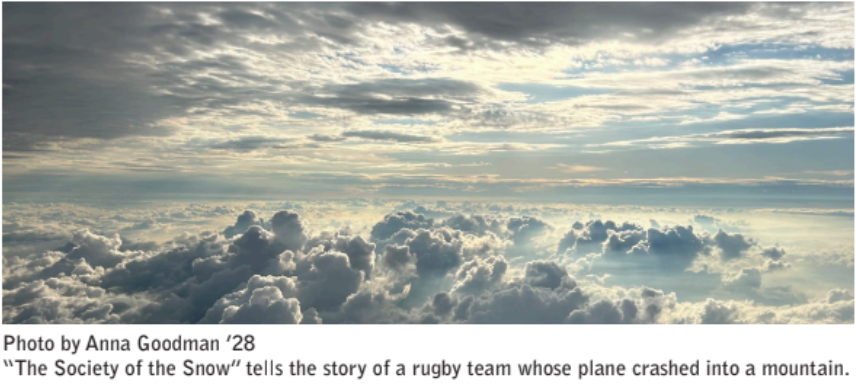
By Anna Goodman ’28
Staff Writer
Content Warnings: this article discusses death, grief, plane crashes, extreme cold, hypothermia, extreme starvation and weight loss, and (briefly, undetailed) cannibalism.
Spoilers for La Sociedad de la Nieve (The Society Of The Snow)
Nothing grows in the Vallé de las Lacrimas (Valley Of Tears). It earns its name. 12,000 feet above the ground, surrounded on all sides by the stoic, near-vertical cliff faces of the biggest mountain range in the world, there is nothing for a dozen miles but blinding snow and blinding sun. It is always dead silent.
And then a plane falls from the sky.
“On October 13, 1972, an Uruguayan plane crashed in the Andes. Some say it was a tragedy. Some say it was a miracle.” Thus begins “La Sociedad de la Nieve,” or “The Society of the Snow,” a spellbindingly unflinching, often brutal, incredibly moving production that tells a story perhaps too unbelievable to seem real. Thus begins the question: ¿Qué es un milagro? What is a miracle?
The forty-five people on board Uruguayan Air Force Flight 571 were headed to a rugby match in Chile the next day when their plane struck the mountain. A dozen or so were part of an amateur rugby team in Uruguay; the rest were their friends, their family, and a small crew. 27 left the wreckage alive.
I know what you’re thinking, but wait. Because this isn’t the story you think it’s going to be.
The first time I watch “The Society of the Snow,” I’m eighteen and in the midst of a depressive episode, in one of those agonizingly liminal moments when you can’t decide whether to sleep or to keep your eyes open, only to stare up like the ceiling is going to give you the secrets to the universe. I don’t remember why I end up watching this movie, but I do.
“Me llamo Numa Turcatti. Tengo veinte cuatro años,” our narrator says. “[My name is Numa Turcatti. I am twenty-four years old].” Numa is not a member of the rugby team, but three of his friends are, and they convince him to come along. He doesn’t know most of the team well; he’s our point of view character for a reason — a quiet, compassionate observer that often shrinks from the spotlight in favor of louder personalities, like players Roberto Canessa or Nando Parrado.
Our main cast begins their story as a bunch of college-aged rugby players in the early 1970s, who talk about women like they’re foreign creatures for conquest, and only touch each other to slap shoulders affectionately in the locker room or in millisecond-long hugs for photos. When their plane begins experiencing turbulence, several ask each other mockingly: “Are you scared?” and “Are you going to cry?”
But then they crash.
Then society is gone, and they scream for their mothers. They ask to be held: the first night Numa begs his friend: “Hold me. Hold me tighter, Pancho”. They keep each other as warm as they can in a place where nightly temperatures can be under -30 degrees Fahrenheit. And when the elements rip them away from life, they kiss each other goodbye.
They lay the injured on the side of the fuselage with the strongest sun and treat head wounds with snow wrapped in torn fabric. They string a hammock made of broken seatbelts to carry a man with broken legs and lace their hands together on his chest to ease the fluid in his lungs. They create a makeshift water purifier that magnifies the sunlight to melt ice into water, fix a broken radio with parts from a lighter, and fashion snow-blindness glasses out of the tinted cockpit windows.
And they compose bad, sappy poetry to pass the time in the fuselage. They mimic bird songs to make each other laugh. They have a snowball fight in the middle of nowhere. They smoke 130 packs of cigarettes, because it’s 1972.
In short, they live in a place where, as Numa says, living is an anomaly. But it does not come without a cost.
This movie is brutal; there is no use pretending otherwise. You are witnessing the characters become skeletons, with cracked, frostbitten lips and ever-growing sores on their arms. I don’t know if it happens at the same scene for everyone, but I clearly remember the moment when I thought to myself: These people are dying.
You have already read the content warnings. “Cannibalism.” Yes.
When, on the eleventh day, the crash survivors make the fateful decision that will define this story in the eyes of many, the film treats it with the gravity and respect it deserves. They recognize that there is no way to survive in a place that is only snow if they do not eat the bodies. Unlike many stories in this vein, the crash survivors kill no one, only scavenging from the already dead with as much care and dignity as they can; even still, they do not do this lightly. They agonize. They pray. They weep.
“If we do this, will God forgive us?” one asks. To which another answers: “God has nothing to do with this.”
And perhaps “the” God doesn’t. But “a” god does.
“I think everyone has their own god,” my sister told me once. It was late July, but it was freezing; we were sharing a pair of earbuds, listening to Noah Kahan and rubbing our hands together inside her pocket, trying to make a starmap on top of a 14,000 foot mountain where the air is so thin that you’re out of breath just standing still. She told me of people with vengeful Old Testament gods, people with forgiving, nurturing ones, then confessed she didn’t know what hers was like yet. I told her then that I like to think God is in people. Looking back, I think that standing there with her was the closest I’ve been to understanding what “god” is.
“I have more faith than I’ve ever had, but my faith isn’t in your God, Numa,” Arturo Nogueira says, even when his legs are broken and his heart is slowing. “I believe in the god that Roberto keeps inside his head when he comes to heal my wounds. In the god that Nando keeps in his legs, that lets him continue walking no matter what. I believe in Daniel’s hands … Fito’s strength. And in our dead friends … that’s the god I believe in.”
Sometimes faith alone is not enough. Sometimes–
“Me llamo Numa Turcatti,” our narrator says once again, two hours in, once we’ve grown to love him and his quiet dedication and his settled compassion. Then, “I died on December 11th, 1972. In my sleep.” And you think, no. No, wait. Because after a point, you think you care for these people too much for them to die. That they are too young. That this could not happen.
But you are wrong. That is not how death works.
“I’m twenty-five years old, Pancho,” Numa says as he starts to fade. “I have my entire life left ahead of me. I want to see my siblings again. My mom, my dad. I want to dance.”
“Numa, you don’t dance.”
“I know. But I want to now. I want to do it all. I want to laugh. I want to cry.”
“Then cry,” Pancho tells him. “Cry. Please.” So he does.
It is only at the moment that Numa dies, still in Pancho’s arms, that we realize the entire film is a tribute to him. It is only at that moment that I realize I’m crying too. I haven’t cried in months, and now I can’t stop, because I have never before been confronted by how deeply I want to live. But, god do I want to live.
And sometimes, it’s hard. Sometimes someone I care about dies and sometimes I’ll twist my ankle and sometimes I’ll throw up my hands and ask, what’s the point?
On those bad days — though slowly, painstakingly, there are less — I think of mapping the stars with my sister on top of a mountain I could never have climbed alone. Of movie nights and microwave popcorn with my friends. My dad and his viola and his plaid shirts and his hugs. My mom and her forever changing hair color and her love for discovering recipes. And I remember that there are people who would give anything to live, to do it all over again, laughter and tears and everything in between.
That there are people out there somewhere who wanted to dance but never got the chance to.
That la vida es un milagro — life is a miracle.
In Gwendolyn Brooks’ poem, “To The Young Who Want To Die,” she writes: “Sit down. Inhale. Exhale. The gun will wait. The lake will wait … will wait, will wait. Will wait a week: will wait through April … You need not die today. Stay here - through pout or pain or peskyness. Stay here.”
The day after Numa Turcatti died, Roberto Canessa and Nando Parrado began a nine day, thirty-eight mile hike through knee-deep snow, three of those days up the cliffs surrounding their valley. On the tenth, they reached Chile, reached help, and promptly collapsed.
Speaking to the Guardian, Nando said: “I said: ‘Come on, Roberto, I cannot do it alone. [Either way] I’m going to die looking into your eyes.’ Roberto was very weak. He gave everything that he had. Everybody gave everything that they had. He was the best associate, the best companion, the best friend I could have had in this expedition.”
Including Roberto and Nando, sixteen people survived, against all the odds, seventy-two days in the Vallé de las Lacrimas, where nothing lives and nothing grows. This gave the saga its name: “El Milagro de los Andes.”
Every year, three days before Christmas, the 12 remaining survivors of the Milagro de los Andes — and their families — meet to mark the day they were rescued. “This is a story of life,” Nando said in the same Guardian article. “We celebrate the memory of our friends who didn’t come back.”
And together, the survivors, the families, and a team of passionate, dedicated actors, cinematographers, and directors created “The Society of the Snow.”
We are living in a world where hope is hard to come by, I know. I’m not here to tell you that it isn’t terrifying to stare the unknown in the face. And we cannot save the world. But we can save each other. We can be there for the people we care about.
“Keep taking care of each other,” Numa, still and forever our narrator, ends the movie saying. “And tell everyone what we did on the mountain.”
¿Qué es un milagro? On October 13th, 1972, a Uruguayan plane crashed in the Andes. Some say it was a tragedy. Others, a miracle. Perhaps it was both.
I would like to dedicate this article to the 45 passengers and crew of Uruguayan Air Force Flight 571:
Eugenia Parrado. Graziela de Mariani. Dante LaGuarara. Esther Horta de Nicola.
Francisco Nicola. Julio Ferradás. Julio Martínez Lamas. Felipe Maquirriain.
Francisco “Panchito” Abal. Fernando Vásquez. Carlos Valeta. Susana Parrado.
Gastón Costemalle. Ramón Martínez. Ovidio Ramírez. Alexis Hounie. Guido Magri.
Daniel Shaw. Liliana Methol. Marcelo Pérez. Carlos Roque. Juan Carlos Menéndez.
Enrique Platero. Diego Storm. Gustavo “Coco” Nicolich. Daniel Maspons. Arturo Nogueira. Rafael “Vasco” Echavarren. Numa Turcatti. Javier Methol. Jose Luis “Coche” Inciarte.
Daniel Fernandez. Álvaro Mangino. Roy Harley. Roberto “Bobby” François. Gustavo Zerbino. Eduardo Strauch. Ramón “Moncho” Sabella. Pedro Algorta. Adolfo “Fito” Strauch.
Antonio “Tintin” Vizintin. Carlitos Miguel Paez. Alfredo “Pancho” Delgado. Roberto Canessa.
Fernando “Nando” Parrado.
Madeleine Diesl ’28 contributed fact-checking.