
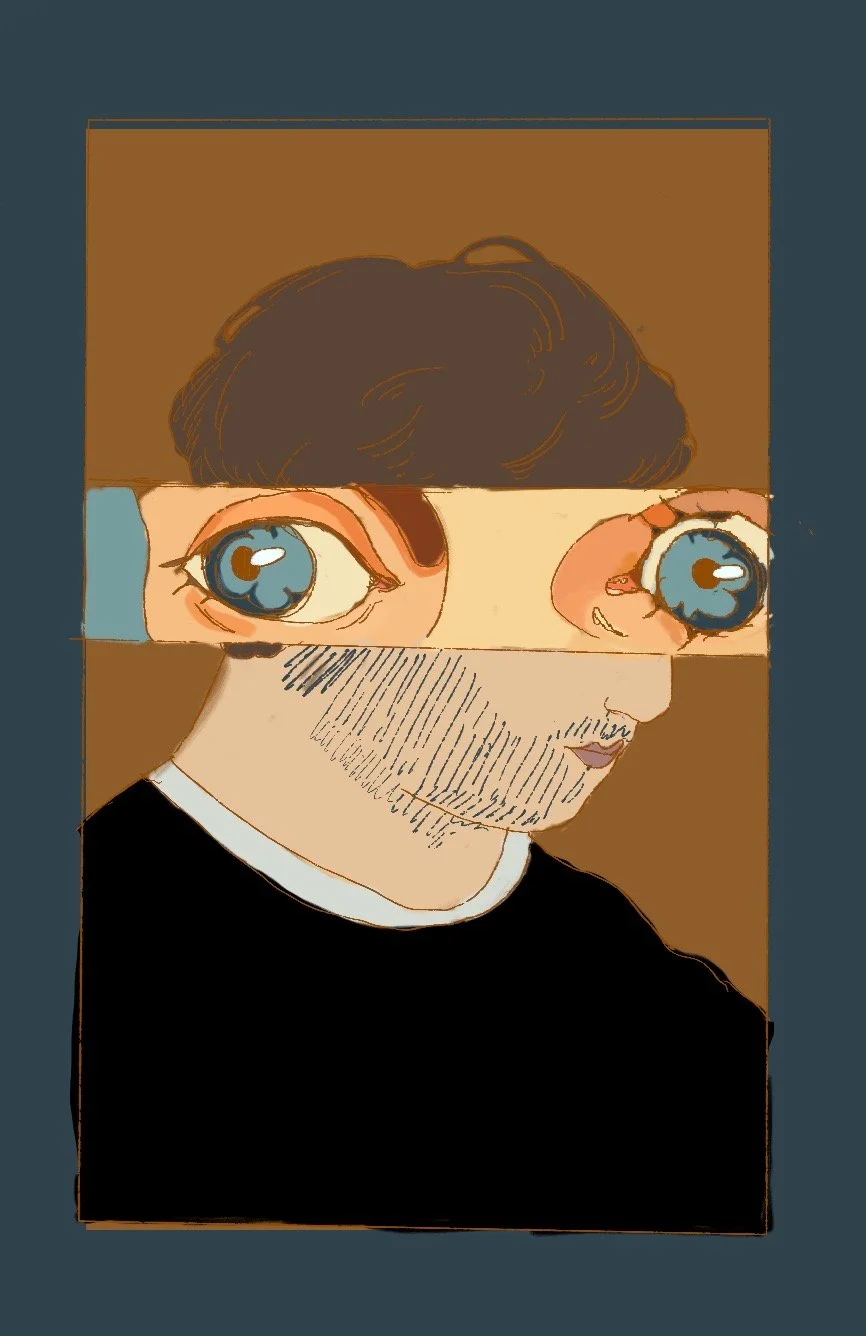
Graphic by Isabelle Peterson '28
By Ezra Reiser ‘29
Staff Writer
Nathan Fielder and Lance Oppenheim have been making waves with the release of their new documentary, “You Can See Everything.” Announced via a secret screening at Telluride Film Festival, nobody knew prior to its release that Fielder and Oppenheim were filming . It's now on track to be the one of the highest grossing documentaries ever made, and could quite possibly make history as the first documentary to ever be nominated for the Best Picture category at the Oscars this year.
As a documentary, I found it absolutely groundbreaking. Despite its runtime of nearly three hours, I was completely engrossed the entire time. I did find it to be a bit slow at the beginning, as it focused on the day to day life of Elizabeth Holmes, known for founding Theranos and the fraud trial in relation to that company, pre-prison. Once Holmes was imprisoned and the focus of the film shifted with Amanda Seyfried’s presence, who won her first Emmy for portraying Holmes in “The Dropout” in 2022, I was hooked.
This is a film that wants you to actively question everything you are being told. Although you might come prepared to question Holmes, a notorious scammer and liar, you are less likely to expect to question what Fielder and Oppenheim are telling you. In the final two hours, this uncertainty becomes the central conflict of the movie. Fielder is no longer a reliable documentarian for Holmes’s story, as he has fallen under her spell. Seyfried expresses this doubt in the very last conversation she and Fielder have in the film. Fielder's delivery of “it’s complicated” when asked if he is trying to protect Holmes is quintessential to understanding the documentary. The film shifts its attention from understanding Holmes to exploring the nature of truth.
Fielder’s methodology here is very similar to his other work. As a self-proclaimed Fielderhead, it did not come as a surprise to me. In many ways, “You Can See Everything” is simply the next development of Fielder’s previous work. It particularly emulates his second television show, “The Rehearsal,” where he uses decoys to simulate situations for people to experience. It comes as little surprise, then, that he employs Seyfried to reenact interactions with Holmes that he could not record. This allows Fielder to make sense of those interactions and what they might mean for his interpretation. Of course, this is where the truth gets murky, as we can never know what exactly occurred in those meetings, especially since Fielder is the one writing the scripts for these reenactments. The sinking feeling I got as a viewer having this realization alongside Seyfried is incomparable to any other documentary. It is with this conversation that Seyfried becomes the grounding force of the documentary, forcing you to reconsider everything you have just watched.
“You Can See Everything” is a groundbreaking documentary, and as you watch it, you get the sense that you are watching pure magic be performed. I cannot recommend it enough.
Whitney White ’28 contributed fact-checking.
