
Chiara Bian ’29
Staff writer
Did you know that Esther Howland, class of 1847, is also known as the “mother of the American valentine”?
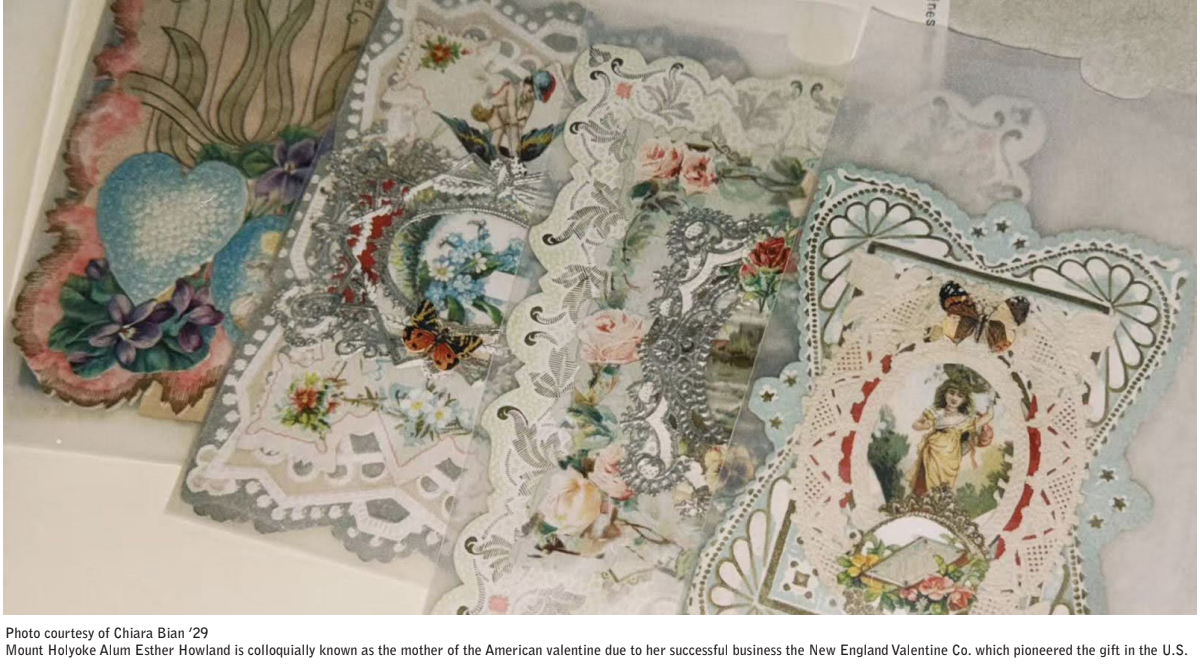
Born in Massachusetts, Esther Howland was the woman who helped make Valentine’s Day cards popular across the United States. Soon after graduating from Mount Holyoke College, she received a Valentine card from her father’s business partner. At that time, most Valentine cards were imported from Europe and decorated with lace, delicate cutouts and fine details. The card amazed Howland and sparked an idea. Inspired, she decided to create even more beautiful cards in America.
She asked her father to order special materials from England which she used to make more than a dozen sample cards by hand. Through her brother, a traveling salesman, she began selling them. At first, she did not expect much. But the response was shocking: She soon received $5,000 in orders, an incredible amount for a young woman in the mid-19th century.
Encouraged by this success, Howland decided to build a real business. She turned a room on the third floor of her home into her first workshop. Each worker focused on one step of the process and together, they worked like a simple assembly line. One by one, elegant cards were created, as tempting as small, decorated cakes. Howland also hired women who could work from home, giving them rare chances to earn their own income. In this lively and supportive environment, women earned fair pay while sending love and joy to households across the country. At its peak, her company, The New England Valentine Company, made up to $100,000 a year; they were a powerful business led by women.
On Valentine’s Day, I visited Mount Holyoke College Archives and Special Collections to see our collection of historic Valentine cards. I had to be extremely careful when handling these cards because the lace edges and embossed patterns have yellowed over time, and the paper is fragile. The exhibit followed the timeline from the earliest cards to later designs. Along the way, I saw how styles slowly changed: Early cards often showed angels and romantic couples, while later ones focused more on mothers and children.
Some designs were also surprisingly creative. There were frame cards that could stand up and hold photographs, vase-shaped cards that opened like fans, andeven hanging cards that unfolded like a long strip of pictures. Each design felt playful, clever, and full of imagination.
One of the most interesting discoveries was a group of cards inspired by William Shakespeare. His works contain some of the earliest literary mentions of Valentine’s Day. One famous verse appears in Hamlet, written around 1600. In Act IV, Scene V, Ophelia sings:
“To-morrow is Saint Valentine’s day,
All in the morning betime,
And I a maid at your window,
To be your Valentine.”
This refers to a popularly held belief at the time, that the first woman a man saw on Valentine’s Day would become his true love. It is fascinating to see how this idea traveled from literature into popular culture and finally onto greeting cards.
But not all Valentine cards were sweet. As we kept turning the pages, we discovered something very different: Victorian “Vinegar Valentines.” These cards were sharp, sarcastic, and sometimes even cruel. They carried jokes and insults about politics, gender, race, and social behavior. People sent them to annoying salesmen, rude neighbors, or even strangers on the street. Love was not always the goal.
By the end of the visit, my eyes were tired, but my heart was light. I felt excited, curious, and strangely happy, like a small bird singing on one’s shoulder in February. These cards carry far more than lace and paper. They hold stories of love, humor, creativity, and bold imagination. I strongly recommend visiting the Archives to experience them in person. You might walk in for history, but you will leave with wonder.
Madeleine Diesl ’28 contributed fact-checking.