
Angelina Godinez ’28
Managing Editor of Social Media
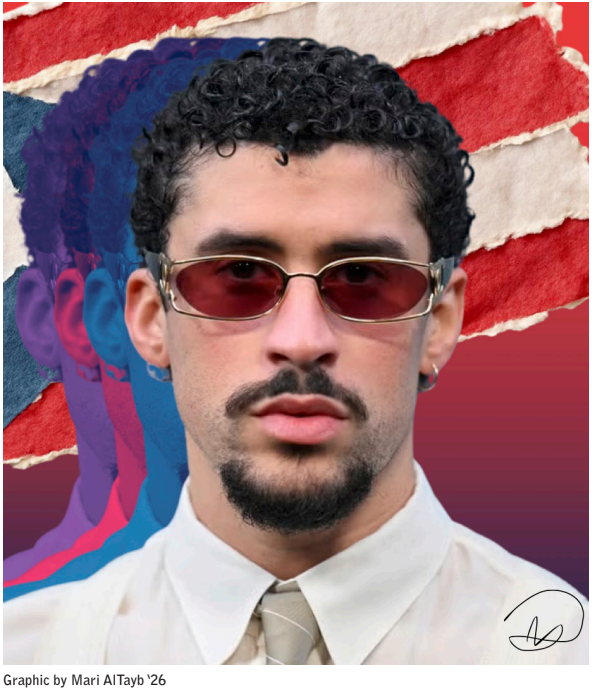
Sunday, Feb. 8 marked a historical halftime performance by Benito Antonio Martínez Ocasio, better known as Bad Bunny. Leading up to his performance, the politicized Puerto Rican singer faced backlash for his spot in the halftime show, with many people horrified at a mostly Spanish-speaking performance, a fear that is no doubt due to the current political climate, a climate where racial profiling is normalized and often utilized to justify deportation at worst, and un-Americanism at best. As such, right now, it is important to understand the complex history between Puerto Rico and the Colonial United States. Something that is not only important for allowing Americans to resist anti-immigrant rhetoric, but also to best understand Bad Bunny’s historic halftime show.
Formerly a colonial territory under the Spanish empire, Puerto Rico became an unincorporated colonial territory of the United States following the Spanish-American War and the creation of the Treaty of Paris. Amidst racial profiling toward the greater Latine population in the United States, Puerto Ricans are lumped in with a racially motivated idea of immigrants, which ignores the complex relationship between Puerto Rico and the United States. When Trump campaigned for his return to office, a campaign rally in New York City’s Madison Square Garden sparked debate as Tony Hinchcliffe referred to Puerto Rico as a "floating island of garbage." The GOP attempted to disconnect themselves from Hinchcliffe’s comment to protect their ballots, but this comment was not as isolated as it was made to appear. Prior to Hinchcliffe’s comment, a similar “joke” was made by Trump, where he referred to the U.S. as a "garbage can for the world,” a metaphor for the quantity of immigrants residing in the U.S., despite President John F. Kennedy once formally labelling the country as the “Nation of Immigrants.” This depiction of the U.S. as a garbage disposal of crime and terror caused by immigrants is a narrative that is not new or isolated. Rather, it is heavily related to the racism of the past, and our history of colonialism, including that which the people of Puerto Rico have and continue to face. These are themes Bad Bunny continuously combats through his lyrics, performances and bold political statements.
The Super Bowl halftime performance opened with a man wearing a pava, a traditional hat used by agricultural workers in Puerto Rico’s countryside and also famously tokened as the logo of Puerto Rico’s 1938 Popular Democratic Party founded by Luis Muñoz Marín. Aside from highlighting the cultural relevance of the sugar cane labor done by Puerto Ricans, the performance also serves as a clear political reminder of Marín, Puerto Rico's first democratically elected governor following the U.S.’s colonial “ownership” of the island, and his fight for equality and economic growth alongside the U.S. Despite formally fighting for independence from the U.S. as a colonial territory after the Spanish American War, Marín strategically shifted his focus and prioritized the development of Puerto Rico as a commonwealth, paving the way for Puerto Rico to create its own constitution and authorize autonomy from the racial limitations of the U.S. Constitution. This is significant to the start of the performance as it mirrors Bunny's prior reminders that Puerto Ricans are American, despite constantly being marked as “racial others.” Still, the performance celebrated the unique culture of Puerto Rico with the opening statement of, “Qué rico es ser latino.”
This statement is followed by a clip panning over the supposed sugar cane field, representing the sheer number of Latine laborers that not only go unnoticed but are targeted in Trump's campaign despite their historical economic contribution to the U.S. As Bunny begins to perform his popular hit song “Tití Me Preguntó” we are met with a beautiful representation of not only Latine laborers but Afro-Latine people, a reminder of many Puerto Ricans’ mixed Afro-Caribbean culture.
Throughout his performance as he navigated his way through the sugar cane fields, Bunny used the stage of America's favorite pastime to highlight common Latine narratives and careers that too often go unseen by non-Latines or wrongfully stigmatized as “illegal” behavior. Within the first five minutes of his performance we see a coconut fruit vendor, elderly Latino men playing a game of dominos, nail techs, construction workers, piraguas, taco stands, professional boxers, jewelry vendors and much more. Although it can easily go unnoticed by non-Latines, this beautiful homage to Latine culture and family dynamics validates the Latine experience both on and off the island in a political climate that criminalizes the celebration of Latin American culture.
In addition to emphasizing the various economic and social contributions of Latinos in America, Bunny's house-like stage featured various celebrities such as Pedro Pascal, Cardi B, Karol G, Jessica Alba and Young Miko. Their cameos further highlight the diversity of Latine culture with direct representation of Chilean, Dominican, Colombian, Mexican, and Puerto Rican peoples.
As Bad Bunny continued performing popular songs such as “Yo Perreo Sola,” “VOY A LLeVARTE PA PR,” Daddy Yankee's “Gasolina” and “EoO” he formally introduced himself as Benito Antonio Martínez Ocasio, saying “Es porque nunca, nunca dejé de creer en mí. Tú también debería, tú también deberías de creer en ti. Vales más de lo que piensa, créeme.” This translates to, “It's because I never, never stopped believing in myself. You should too, you should believe in yourself. You're worth more than you think, believe me.”
These motivational comments segue into the marriage between two performers, and Lady Gaga performing an alternate version of “Die with a Smile”; in this performance, the union between the couple is celebrated in addition to unique Latine marriage traditions and musical influence. Although there were mixed reviews on Gaga’s performance and cameo in the superbowl halftime show due to her political relations with Israel and others arguing a Latina artist like Cardi B or Karol G should have been the musical cameo, it is important to remember the performance serves as a celebration of various diverse cultures, and focusing solely on Gaga’s appearance waters down the significance of an otherwise all spanish performance.
Aside from Gaga’s minute-long performance, Bunny held to his promises and performed solely in Spanish. This is influential as Latine artists in the music industry are commonly pressured to assimilate to American culture and perform in English or better cultivate themselves to appeal to an American crowd, as seen with Shakira’s past Super Bowl halftime performance. Not only is Bad Bunny persistent with his Spanish lyrics and motivating non-Spanish speakers to learn the second most spoken language in the United States, but with ICE detentions and deportations rising, he refused to perform within the United States as a safety precaution for his large Latine fanbase.
This refusal to assimilate is what sparked conservative backlash as Trump shared a post on his conservative leaning social media platform, Truth Social, saying "absolutely terrible, one of the worst, EVER!” followed by “nobody understands a word this guy is saying.” and that it was “an affront to the Greatness of America.” These comments were mirrored with thousands of conservative-leaning Americans as they chose to tune in to Turning Point USA, “All-American” Halftime show which only drew 6.1 million viewers as opposed to Bunny’s all-American performance — Puerto Rico is part of the US — viewership of 128.2 million. Gaga’s cameo was topped off by Puerto Rican singer, Ricky Martín, commonly understood as a key incorporator of Latin American music in the United States with hits such as “Livin’ la Vida Loca” and “La Copa de la Vida.”
Following these notable cameos and homages to not only young Benito but also broadwr Latine culture in the United States, Bad Bunny ended his performance by saying his only line in English: “God Bless America.” This comment was followed by a celebration of various nations that makes up the Americas such as Chile, Argentina, Uruguay, Paraguay, Bolivia, Peru, Ecuador, Brazil, Colombia, Venezuela, Guyana, Panama, Costa Rica, Nicaragua, Honduras, El Salvador, Guatemala, Mexico, Cuba, Dominican Republic, Jamaica, Haiti, Las Antilles, the U.S., Canada and last but not least, Puerto Rico.
This Super Bowl started and ended as a reminder of what truly makes the “Americas,” an important thing to note in this day and age. Despite this term commonly being used to describe a person born and raised in the United States, it also extends to South America and commonwealth territories such as Puerto Rico, making their citizens just as American as those who boycotted the 2026 halftime performance.
Madeleine Diesl ’28 contributed fact-checking.