
Mount Holyoke Art Museum

Mount Holyoke College Art Museum reopens after long hiatus

Graphic by Brianna Stockwell ’28

By Aspen Pearson ’28

Arts and Entertainment Staff Writer 

After more than three years of renovations and a full shutdown that started in the spring of last year, the Mount Holyoke College Art Museum has reopened its galleries with a new presentation of its collection. The renovated spaces feature a chronological approach to displaying artwork, along with changes to the layout and flow of the museum.

The renovation, which began in July 2023, was intended to improve accessibility, create more space for visitors and classes and allow the museum to display a broader range of its collection. The project was a part of various preparations for the museum's celebration of its 150th anniversary, which will take place in November. Additionally, the event will put on display  an archival project mapping 150 years of the museum, completed by archives interns at the College.

Although some of these  renovations were in progress and presented to the public before the museum closed in the spring of 2026, much of the work was completed during the months it was closed.

Some of the newer galleries include special exhibits including “Faith Ringgold’s America” and “Art Histories: The Past as Provocation.” There are also permanent exhibitions, such as “Art from 700 to 1700.”

The reopened galleries demonstrate the museum's commitment to sharing the  provenance of objects, as well as acknowledging the faults and complexities of cultural objects that exist within the collection. Curators paid special attention to the diversification of the art on display and included  broader cultural conversations within their gallery spaces. This process was facilitated by moving away from separating art by region. The art is now organized by  historical era, rather than by the place it was created.

One label reads, “We think it is critical to confront and teach about complicated objects, rather than presenting a sanitized version of history. Importantly, research is ongoing.” Staff also included pamphlets and signs that discuss provenance and how the objects got to the museum, which can be found on various walls around the museum.

Walking through the museum, there was a noticeable change in the flow of the galleries. Besides the new chronological system of organization, there was more room for classes to sit and discuss artwork. There were at least two classes present when I visited, discussing different parts of the museum in depth, with staff rolling in other artworks for them to discuss.

My favorite exhibit was the drawers in the “Art Before 700 CE” gallery, which allows visitors to interact with the collection in a different way. Staff included objects like coins and fabric samples that add a different dimension of complexity to the gallery pieces.

The changes to the gallery are best experienced in person. The museum is open Tuesday-Friday, 11 a.m.-5 p.m., and Saturday-Sunday, 1-5 p.m., for visitors who want to explore the newly renovated galleries and see how the collection has been reimagined.

Whitney White ’28 contributed fact-checking.
Indigenous artists in residence present ‘Ancestral Memories’

By Lucy Oster ’23

Staff Writer

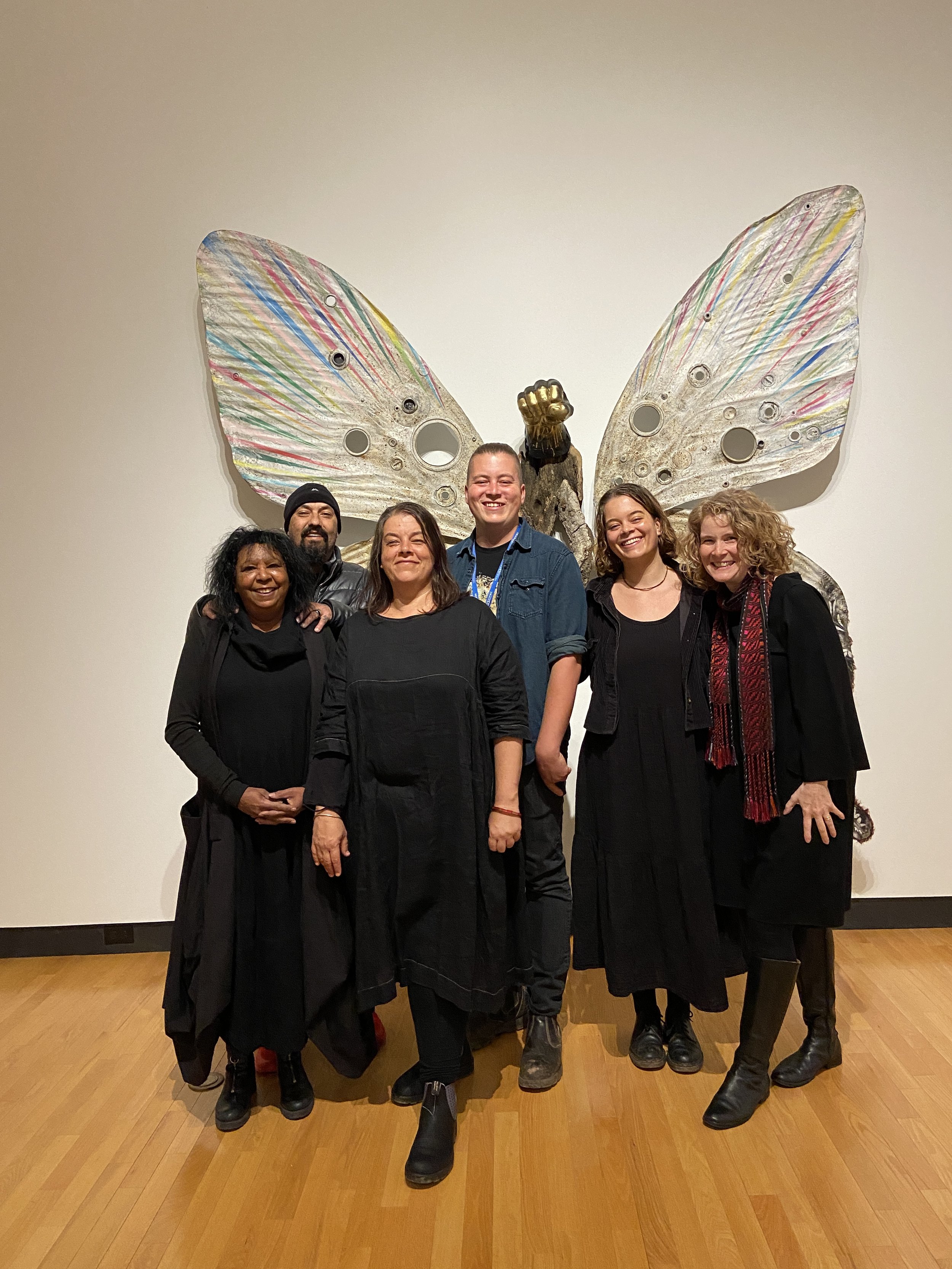
A group of people pose and smile in front of a piece of artwork in the shape of wings.

Photo courtesy of Ellen Alvord ‘89

At “Ancestral Memories: Artists in Conversation,” a team of Indigenous Australian artists stand in front of a sculpture by Hector Dionico Mendoza

The Mount Holyoke College Art Museum, in collaboration with the University of Melbourne and a team of Indigenous Australian artists, hosted an event on Thursday, April 7, called “Ancestral Memories: Artists in Conversation.” 

The artists, Maree Clarke (Mutti Mutti/Wamba Wamba/Yorta Yorta/Boonwurrung), Nicholas Hovington (Palawa), Kerri Clarke (Boonwurrung/Wemba Wemba), Mitch Mahoney (Boonwurrung/Wemba Wemba/Barkindji) and Molly Mahoney (Boonwurrung/Wemba Wemba/Barkindji), are currently in residence at Mount Holyoke as a part of Assistant Professor of Anthropology Sabra Thorner’s “Special Topics in Anthropology: Decolonizing Museums” seminar. The class has been focusing on centering Indigenous knowledge practices and art making over a more colonial lens. 

Associate Curator of Visual and Material Culture and Native American Graves Protection and Repatriation Act Coordinator Aaron Miller and Thorner opened the Ancestral Memories event. Thorner gave an updated version of the usual Mount Holyoke College land acknowledgment, urging audience members to understand the history of the Nonotuck land that the College is situated on. 

“I encourage all of you to learn about and to amplify the contemporary work of the Indigenous nations whose land you’re on, and also endeavor to support Indigenous sovereignty in all the ways that you can,” she said.

Thorner also connected her land acknowledgment to the artists. “Your engagement with and your witnessing of the work of these artists is part of that process, so I extend my gratitude to you for coming here today,” she said. 

“My own use of my own land acknowledgment is going rogue, right? I used my own because I feel like it’s more meaningful and more impactful and more accurate and more thoughtful than the one that is being presented to us to offer up as the official body of the College,” Thorner later shared.

After Thorner’s statement, Maree Clarke, one of the visiting artists, took over. Maree Clarke gave a presentation about her work as an artist reviving cultural practices in Southeastern Australia. She described herself as an “independent multidisciplinary artist and curator with more than 30 years working with First Nations people.” She spoke about Aboriginal art practices and how they are connected to country, culture and place, and shared stories about taking the teeth out of kangaroo roadkill to make necklaces. 

“[Maree Clarke] described the PowerPoint she presented as her life’s work. … It was going through everything she had done artistically and it was really cool to see how it had changed over the years, but also how she had gotten more influence from her family,” ​​Domenica Guaman ’22, an anthropology and Spanish major who attended the event, said. Guaman is also a student in Thorner’s seminar. 

Ellen Alvord ’89, the associate director for engagement and Weatherbie curator of academic programs, shared a similar sentiment to Guaman. 

“Understanding the scope of what [Maree Clarke has] done in her lifetime, to bring those practices back in her research, and in her connection with her family, and bringing in new generations to take up that practice — I thought that was really inspiring,” she said. 

Much of Maree Clarke’s presentation heavily involved her family, who were also present at the Ancestral Memories event. They sat at a table next to where Maree Clarke presented, acting as a panel for the question and answer session that followed Maree Clarke’s presentation. 

Erin Foley ’24, an anthropology and political science major who attended the event, said, “It was … really cool to see a multigenerational family working together collectively as artists.” Foley asked a question during the question and answer session about how their community has changed over the years, to which Kerri Clarke mentioned feeling “secure” in passing on cultural practices to the younger members of the family, Mitch and Molly Mahoney. 

The final product of Thorner’s “Special Topics in Anthropology: Decolonizing Museums” seminar is a collaboratively-made possum skin cloak as a form of Indigenous knowledge transmission. The visiting artists are at Mount Holyoke, guiding and teaching the students in that class how to make the cloak. The cloak is not yet complete, but the MHCAM is looking to acquire it once it is. 

“We are planning on putting the work into a show for the fall that focuses on some broad themes and conversations around indigeneity,” Miller said.

“The cloak and the conversation about the project on campus and the work that [Maree Clarke] and her family are doing: that’s going to be one conversation in a broader exhibition. Thinking about place, thinking about how objects end up in museums and then go home again. This is about reclaiming traditional ways and sharing those with communities,” Miller added.

Community was a common theme at the event. “I think that for me, [the event] really became about not only having the artists speak to and reach a broader audience in this bigger context of decolonizing museums,” Thorner said. “It also became about a kind of mission for me, to be like, ‘this has been so hard. I am going to stand up and thank everyone.’ And part of that is about forging community. This is hard, we’re in a hard moment, but it can be done. And it is so necessary to be in community and in solidarity with each other.”

Alvord concluded, “There’s just so much meaning, and so to think about having Mount Holyoke students be a part of that process, and have something involved in storytelling that’s meaningful in this moment, to that group, is really exciting.”

‘The Art of Remembering’: Exploring nostalgia during COVID-19

The Mount Holyoke College Art Museum has not let the COVID-19 pandemic stop it from engaging with students. “Sightlines Tours,” which are live and interactive student-led thematic tours of the 3D museum, are available until May 1.

‘Through Their Eyes’: Celebrating Blackness at MHC

‘Through Their Eyes’: Celebrating Blackness at MHC

A Black woman in an intricately patterned quilted gown examines herself using a hand-held mirror. The other hand rests delicately on her temple. Her face is frozen in a state of self-analysis.

This photograph, titled “I Looked and Looked and Failed to See What so Terrified You,” is just one image from artist and photographer Carrie Mae Weems’ series “The Louisiana Project.” Weems’ piece was the concluding image in the student-led guided art tour “Through Their Eyes: Blackness Across Media,” which took place last Friday, Feb. 5.