
Photo by Karishma Ramkarran ‘27
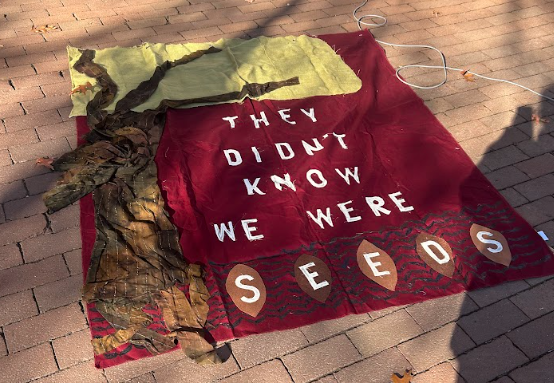
Students for Justice in Palestine in South Hadley rallied outside the Williston Memorial Library on November 19, 2025, gathering in the morning.
BY QUILL NISHI-LEONARD ‘27
EDITOR-IN-CHIEF
On Nov. 19, Students for Justice in Palestine in South Hadley —1837 SJP — held a rally outside of the Williston Memorial Library. The event coincided with the National SJP’s Day of Action protesting Israel's ceasefire violations in Gaza, which have killed at least 242 Palestinians, according to the Palestinian Ministry of Health. The event was also held in protest of a series of U.S. military strikes on boats off the coast of Venezuela and in the Caribbean, which experts at the U.N. have described as “extrajudicial executions” in a press release.
The rally began at 9:30 a.m. and lasted about an hour. During the rally, representatives of 1837 SJP read off a list of demands, calling for Mount Holyoke College administration to formally condemn Israel’s genocide in Gaza, disclose all of the College’s investments, renegotiate its contract with Duo, and encourage UMass Amherst to sever its relationship with Raytheon, a U.S. defense contractor.
Duo is the two-factor authentication system that all Mount Holyoke students must use in order to access many College-related websites and resources. Organizers voiced concerns about Duo’s parent company, Cisco, which “supplies critical networking hardware, servers, and telecommunications equipment that form the backbone of Israel's military infrastructure,” according to the Business & Human Rights Resource Centre.
Rally organizers also echoed U.N. criticism of the U.S.’ attacks on Venezuelan boats, with one stating, “We believe that Venezuela has a right to exist free of imperial violence.”
The “grief and anguish [caused by violence] will be felt by generations to come,” organizers said.
Although the U.N. Security Council has just approved a resolution set forth by the United States to create “an international force to restore order in Gaza, protect civilians and open the way for large-scale aid and rebuilding,” many have expressed confusion about what its uncertain specifics may mean for people in Gaza.
The Guardian’s Senior International Correspondent Julian Borger has described the resolution as “one of the oddest in United Nations history.” It sets forth the creation of a “board of peace” to be chaired by U.S. President Donald Trump, alongside a conditional offer of potential Palestinian statehood “if the Palestinian Authority reformed itself satisfactorily,” Borger wrote.
Representatives of 1837 SJP stated that this move was “the tried and tested blueprint used by the U.S. in many … countries”. In reference to the U.S.’ 2003 military campaign to overthrow Saddam Hussein and subsequent plan to rebuild Iraq, which has since been described as a “failure” by many experts, including Anthony Cordesman of the Center for Strategic & International Studies.
At its peak the rally attracted around 40 attendees, who stood in a semi-circle around the entrance to the library chanting, “Not another nickel, not another dime, no more money for Israel’s crimes,” and “From the Caribbean to Palestine, occupation is a crime,” as students walked to and from their classes.
“The imperialist violence [in Venezuela and Gaza] are inextricably linked by the U.S.’ war machine,” a representative of 1837 SJP explained during the rally.
Before 1837 SJP’s rally concluded, organizers handed out informational zines and led attendees in singing “Down by the Riverside” and “Solidarity Forever.”
One organizer summarized the impact of international conflict and violence on everyday people: “While we are able to peacefully take classes at Mount Holyoke, students in Palestine have to put classes on pause indefinitely.”
Karishma Ramkarran ’27 assisted with coverage.
Angelina Godinez ’28 contributed fact-checking.
