
Photo by Elizabeth Murray ‘28
dr. scott came to MHC to speak about her life.
BY ELIZABETH MURRAY ‘28
FEATURES EDITOR
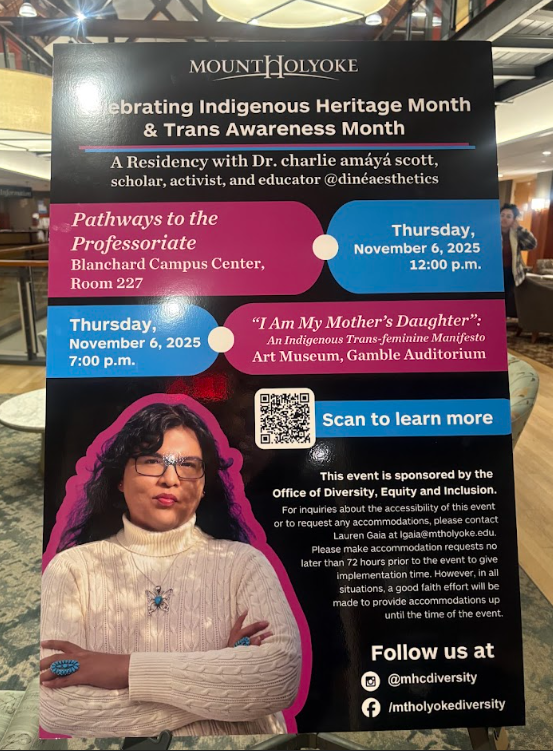
To mark the start of Indigenous Heritage and Trans Awareness Month, Mount Holyoke College’s Office of Diversity, Equity and Inclusion, the Zowie Banteah Cultural Center and the Office of Community and Belonging welcomed Dr. charlie amáyá scott for a two-day residency on campus. scott gave a talk on Thursday, Nov. 6 about the Indigenous transfeminine experience, intergenerational wisdom, ancestors and community, which was held in Gamble Auditorium and featured a Q&A segment.
Emma Quirk ’26 opened the talk with the College’s Land Acknowledgment. This was followed by Kijua Sanders-McMurtry, vice president of equity and inclusion at the College, who highlighted Mount Holyoke’s Indigenous alums, such as Zowie Banteah and Ruth Muskrat, and their work to advance the rights and representation of Indigenous people on campus. Sanders-McMurtry also highlighted the work around inclusion of trans and gender-nonconforming students on campus.
scott was then introduced by Ashley Mantanico ’27, who is an assistant at the Zowie Banteah Cultural Center. scott, who is a member of the Diné nation, also known as the Navajo, has a Ph.D. in education and has amassed a substantial following on social media, where she shares her culture and advocates for Black and Indigenous people of color as well as decolonization.
scott began by introducing herself and her background. She was raised in the Diné nation and uses the English pronouns of she/her; the Diné language does not use pronouns. scott explained that her content addresses serious topics with humor and education. She also took a moment to recognize the genocides and wars occurring across the globe, and reminded the audience that they can make the world a better place.
The talk began with a poem of scott’s called “In My Dreams,” which was written in 2021, and features artwork done by her sister. scott then explained that she dreamed of a world where Two-Spirit and Indigenous LGBTQ+ people are “offered reciprocity rooted in radical kinship and unconditional love.”
The second part of the talk focused on scott’s manifesto. She first began by giving a crash course on what a manifesto is. scott, a self-described “theory ho” finds healing in theory and its use as a tool for liberation. In Indigenous culture, stories are a tool to pass down memories and lessons from generation to generation.
Her manifesto was broken down into several parts, with each title written in a drawing of several flowers joining at the stem. The first two parts of the manifesto highlight the sanctity of Indigenous womanhood and its traditions, with scott telling the story of her people’s survival of U.S. colonization and their intergenerational healing journey. The third part is a reclamation of sovereignty and power, followed by the importance of listening to others’ experiences with our hearts to understand them.
The next part focuses on a relationship with one’s environment. scott highlights how, on her reservation, recycling is not an option, and they must find their own ways to use and reuse local materials and support local artists.
The final part of scott’s manifesto ties back to intergenerational healing and decolonization. scott shares the story of how her mother came to accept her gender identity. She had originally come out as nonbinary, but later realized she felt more gender euphoria with she/her pronouns.
scott never made this known to her mother, but one day her mother began referring to her with she/her pronouns. She shared an anecdote about when her mother first referred to her as her daughter, which occurred when her mother was in the process of adopting scott’s three younger siblings. Her mother told the social worker that she had two older daughters. This moment served as a marker of healing in their relationship.
The talk closed with a Q&A with Lily Rood ’27 and Ashley Mantanico ’27. This discussion drifted into different topics around what is currently happening across the U.S., processing the feelings of grief for what is lost and hoping for better in the future. The Q&A also touched on the work of education, and specifically how institutions of higher learning benefit off of the work, or “heartwork,” of activists and academics of color, while also having profited off of colonization and the Atlantic Slave Trade. scott noted the importance of rest and care, and making sure one’s well-being is not taken away by oppressive institutions.
Leah Dutcher ’28 contributed fact-checking.
