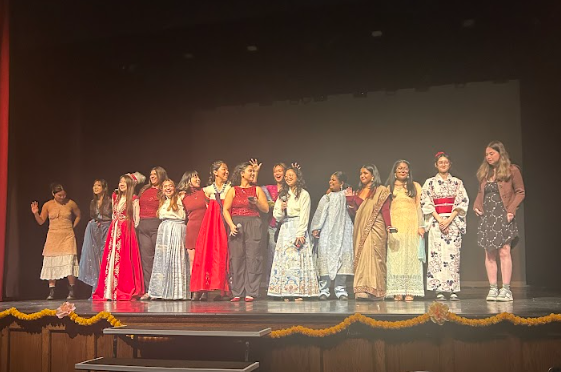
Photo by Karishma Ramkarran ‘27
VariAsians is an annual celebration of Asian culture and creativity hosted at Mount Holyoke College; it began in the 1970s as a potluck by the ASA.
BY KARISHMA RAMKARRAN ‘27
COPY CHIEF
On Nov. 14, students and members of the Mount Holyoke College community gathered in Chapin Auditorium for the College’s 51st celebration of VariAsians, an annual cultural showcase of Asian culture, talent and heritage. The event was hosted by the Asian Student Association — abbreviated as ASA — a Pan-Asian organization dedicated to increasing awareness and appreciation of those of Asian descent on campus and in the wider community.
The theme for this year’s VariAsians was “In Bloom,” a choice that was not only visually stunning but teeming with complex Pan-Asian references. When introducing the theme, the ASA board members pointed to inspiration from the 2025 Nepalese Gen Z protests, numerous flower festivals throughout Asia and the Hindu holiday Diwali. Each table donned hand-painted flowers as centerpieces, through which ASA aimed to demonstrate the uniqueness of Asian culture and both demographic and environmental diversity.
In an interview with Mount Holyoke News, ASA Senior Co-Chair Maggie Doig ’26 described the process of planning one of the College’s largest cultural events of the year: “The obstacles faced were ensuring we represented as many cultures as possible and correctly. We made sure to get the information out to as many student organizations and students as possible to represent different cultures through performances while expanding the restaurants we catered from to include more, within our budget restraints.”
Indeed, this year’s VariAsians included an impressive amount of variety in terms of both catering and performances. Students at Mount Holyoke were able to register for free tickets for both dinner and the show; food was provided by Kiao Wan Thai, Priya’s, India House and Ichiban Chinese and Japanese Restaurant, and entertainment by Five College performers such as Raunak Bhangra, Lion Dance and Rainbow Jelly.
Although VariAsians brought vibrant energy to both the stage and the audience, the event harmoniously balanced both an appreciation of Asian culture and an awareness of issues facing the Pan-Asian community today. Throughout the showcase, the audience was reminded of the intersection between heritage and activism: “ASA would not be here today without the activism and petitioning done by those who came before us to establish our organization in 1973. We would like to recognize and remember that this event is one of many that created space for unity and allows us to celebrate our cultures,” Yurim Oh ’26 said.
As a preface to the elaborate performances, the ASA board members spoke of VariAsians of the past. The event, one member noted, originally began as a potluck in 1977. It was not until 1999 that VariAsians bloomed into the massively successful cultural showcase held each fall semester.
VariAsians has come far from its origins, with 14 performances necessitating extensive organization and collaboration. The event was planned in three months, with most preliminary planning of the theme “In Bloom” taking place during last year’s VariAsians 2024: All Around Asia.
“The most rewarding aspect of planning was seeing everything come together as we envisioned after countless hours of planning and collaboration. Hearing the board, audience and performers enjoying the event was what made everything worth it,” Doig said.
The event kicked off in a darkened Chapin, with the only light centered on the stage’s runway. Cheers and applause filled the room as numerous students from the College walked the runway in their cultural clothing, ranging from Myanmar’s Burmese longyi from the Konbaung dynasty to Pakistan’s kurta originating from nomadic tunics in ancient Central and South Asia.
Immanuelle Niez ’28 orchestrated the cultural fashion show. “Each ensemble represents the story of a unique cultural heritage, offering a window into the craftsmanship and prosperity of the past and present civilizations,” she said in an interview with Mount Holyoke News.
The diversity of Asia was not only demonstrated through beautiful cultural wear, but also through the variety of performances that took place.
For Doig, the Pan-Asian focus of VariAsians inspired her in 2021 when she saw a virtual recording of it as a prospective student. “I wanted to be part of an event that brought together students from different backgrounds to create a space of community and celebration of our differences and similarities,” Doig said.
Siyan Zhang ’28 commenced the live performances with a self-choreographed classical Chinese dance that was inspired by the novel “The Dream of the Red Chamber.” Zhang was perfectly emblematic of the theme, “In Bloom,” as she exercised almost effortless command over the stage. Although the performance was classical in nature, it promised a night filled with vibrant energy in Chapin.
Amherst’s K:NETICS, DJB Dance Crew, Smith K-Pop Dance Crew and Mount Holyoke’s very own Rainbow Jelly Dance Crew brought a wide range of high-energy and high-production performances inspired by the K-Pop genre. With excellent synchronization and intense passion, each dance demonstrated how group performance could be both an incredible source of community and of individuality. Rainbow Jelly Dance Crew performed KATSEYE’s “Gnarly,” which was a particular crowd favorite.
The sound of ankle bells behind the curtains was followed by energetic performances by Raunuk Bhangra and Jhumka, which represented South Asian dance culture. The performers utilized various props, from suitcases to poles, to aid in their celebration. Bursts of energy in the performance elicited ecstatic crowd reactions.
“Bhangra isn’t just a dance,” one ASA board member said, “but an explosion of energy, laughter and love.”
Puja Chakraborty ’27, Ishita Panigrahi ’27 and Lam Dinh ’29 performed an amalgamated combination of “Mora Saiyaan” and “Burn” from the American musical “Hamilton.” On the stage with just their instruments and their cultural clothing, the trio demonstrated with ease the convergence and divergence of Asian identity. In fact, most performances of the night represented how Asian students at the College personally interpret and interact with their heritage.
Asian American Students In Action — also known as AASIA — took center stage to share poems from Palestinian writers. AASIA board members read out loud Refaat Alareer’s poem “If I Must Die,” and Mosab Abu Toha’s “What is Home?” Alareer was killed by an airstrike on Dec. 6, 2023 during Israel’s still-ongoing genocide against the Palestinian people.
“If you’re enjoying the culture tonight, sit with the fact that culture is never apolitical … The joy you see on stage exists because our communities and our ancestors have lived through and continue to live with and resist those colonial legacies, occupation, displacement and genocides,” one AASIA board member said.
The student organization left the audience with a moment of reflection: “Tonight, consider what it means to stand in solidarity with all of those ongoing struggles, because none of us are free until all of us are free.”
Leah Dutcher ’28 contributed fact-checking.